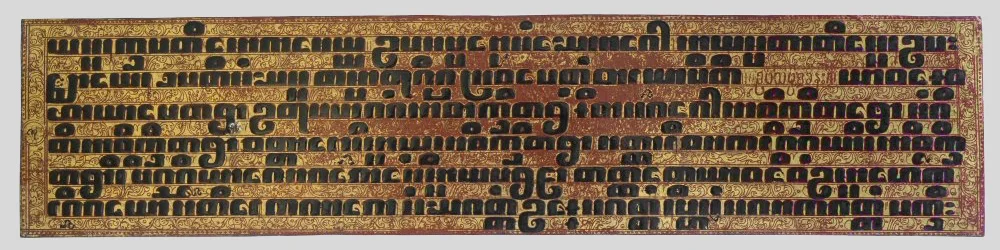
The Dhammapada, 'verses of the teaching', is a collection of 423 short verses in Pali, in 26 chapters, kept in the Theravada canon and taken as the Buddha's own words. It opens with the mind: what we become follows how the mind moves. From there it gathers the teaching in plain images: hatred calmed by non-hatred, the heedful who do not die, the lotus in the rubbish heap, the house-builder seen, the island no flood can cover. It ends with the 'brahmin', the one who is fully freed. Rendered from the Pali, in its own Theravada sense first.
Mind goes before all ;
mind is their chief, they are made by mind.
If you speak or act
with a spoiled mind,
suffering follows you
as the wheel follows the ox's foot.
Mind goes before all states: the book's first and governing claim.
'All things are not-self':
when one sees this with wisdom,
one turns away from suffering.
This is the path to purity.
All things are not-self: seen with wisdom, this is the path to purity.
What most readings miss
The Dhammapada is often read as a book of moral rules, or as a call to leave the world in disgust. Its own lines go further. Ethics here is a way of seeing: others feel as I feel (129-130); harm returns to its doer (125). The aim is not a better self but the end of the claim to one: 'he himself is not his own' (62), 'all things are not-self' (279), no sense of 'mine' towards mind and body (367). Freedom is found in this life (89), and the freed still move among people like the lotus (58-59). This is close to Advaita on the falling of the I-claim. It parts at one point: the Dhammapada does not name what remains as a Self, and 279 is often read as ruling that out; Advaita holds that awareness is not one more thing seen.