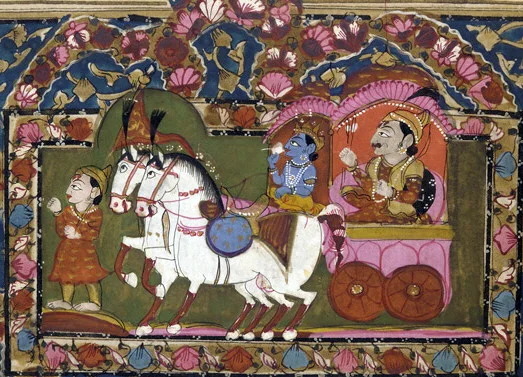
Seven hundred verses from the Mahabharata. On the field of Kurukshetra the warrior Arjuna, facing his own teachers and kin, sinks into grief, and Krishna, his charioteer, teaches him. The teaching moves from the Self that is not born and does not die (chapter 2), through action done without claiming its fruit (3-6), and the Lord as the order of all things (7-12), to the field and its knower (13-18). Its answer to Arjuna is to act from knowledge: the work done fully, the I-claim let go. Rendered from the received Sanskrit text, read with Shankara.
It is never born, and it never dies.
It did not come to be,
and it will not cease to be.
Unborn, lasting, ever the same, ancient,
it is not killed when the body is killed.
The ground of the whole teaching: the Self is not born and does not die.
Your right is to the action alone,
never to its fruits.
Do not let the fruit be your motive,
and do not hold on to not acting.
The practice in one verse: the action is yours, never its fruit.
What most readings miss
The Gita is often read as a call to duty, or as three paths, of action, devotion and knowledge, for different temperaments. Shankara reads it otherwise, and the text bears him out. Freedom comes by knowledge: 'Nothing here makes pure like knowledge' (4.38). Action and devotion clear the mind for that knowledge (3.4, 5.6); they do not replace it. Yet Arjuna, his confusion gone, says 'I will do as you say' (18.73) and fights. What changes is not the action but the one who seemed to act: 'the qualities move among the qualities' (3.28); one with no sense of 'I am doing' 'does not kill, and is not bound' (18.17). In the site's reading this is the whole practice: full attention to the work, the I-claim offered, the result taken as the order's. The test is pressure, not quiet (2.55-72).