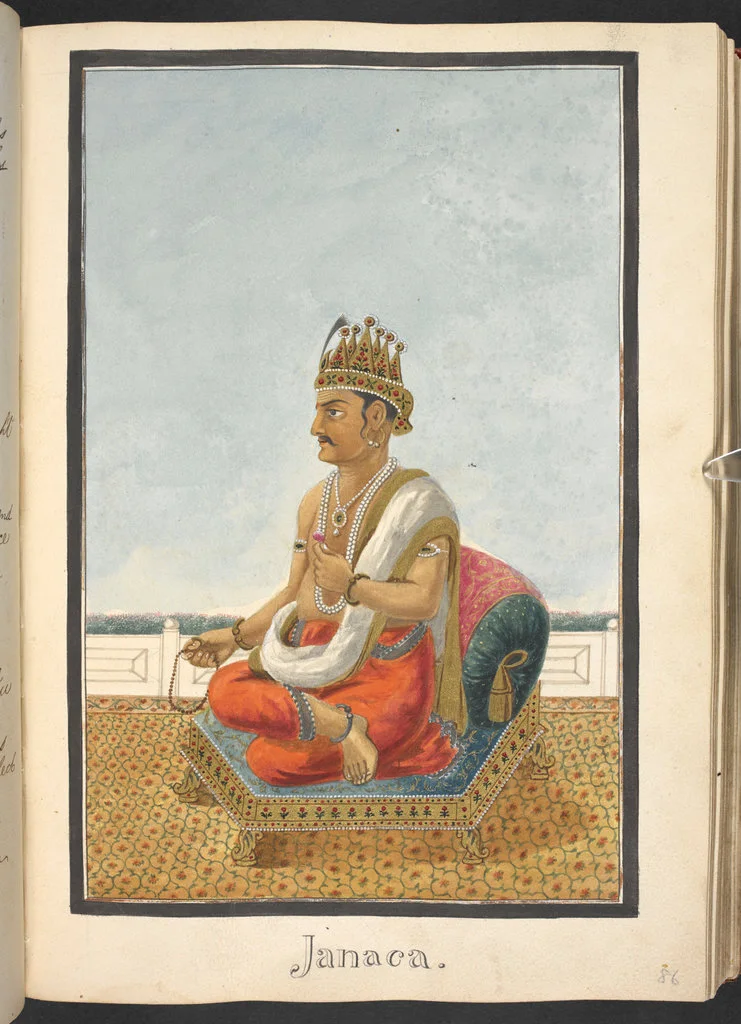
A dialogue in 298 verses between the sage Ashtavakra and Janaka, king of Videha; author and date unknown. It gives Advaita Vedanta in its most direct form, with almost no ritual, myth or argument. Janaka asks how freedom is reached; Ashtavakra answers that he is free already: the one witness, awareness itself, never bound. Janaka wakes to this at once, is tested, and then teacher and pupil take turns describing the one who lives in the world untouched. Rendered here in plain words, in the text's own Advaita sense.
When there is no 'I', there is freedom;
when there is 'I', there is bondage.
Knowing this, lightly,
grab nothing, drop nothing.
Where the I-claim is, there is bondage; where it is not, freedom.
What most readings miss
The Ashtavakra Gita is easily read as saying that the world is nothing and practice is pointless, so that one need only declare 'I am free'. Both readings miss its care. It calls the world a snake seen in a rope, but also waves of the Self's own ocean (2.4, 7.2) and clay going back to clay (2.10): what it denies is a world apart from awareness, not the world's appearing. The knower has no quarrel with it (17.7). Practice is not dismissed either: samadhi binds when done to become what one already is (1.15), yet the restless mind needs it (18.75), and those who only repeat that they are the whole are mocked (18.43). What frees is recognition: 'when there is no I, there is freedom' (8.4). The free one still says 'I' without the claim (18.95).