Nrisimhatapaniya Upanishad
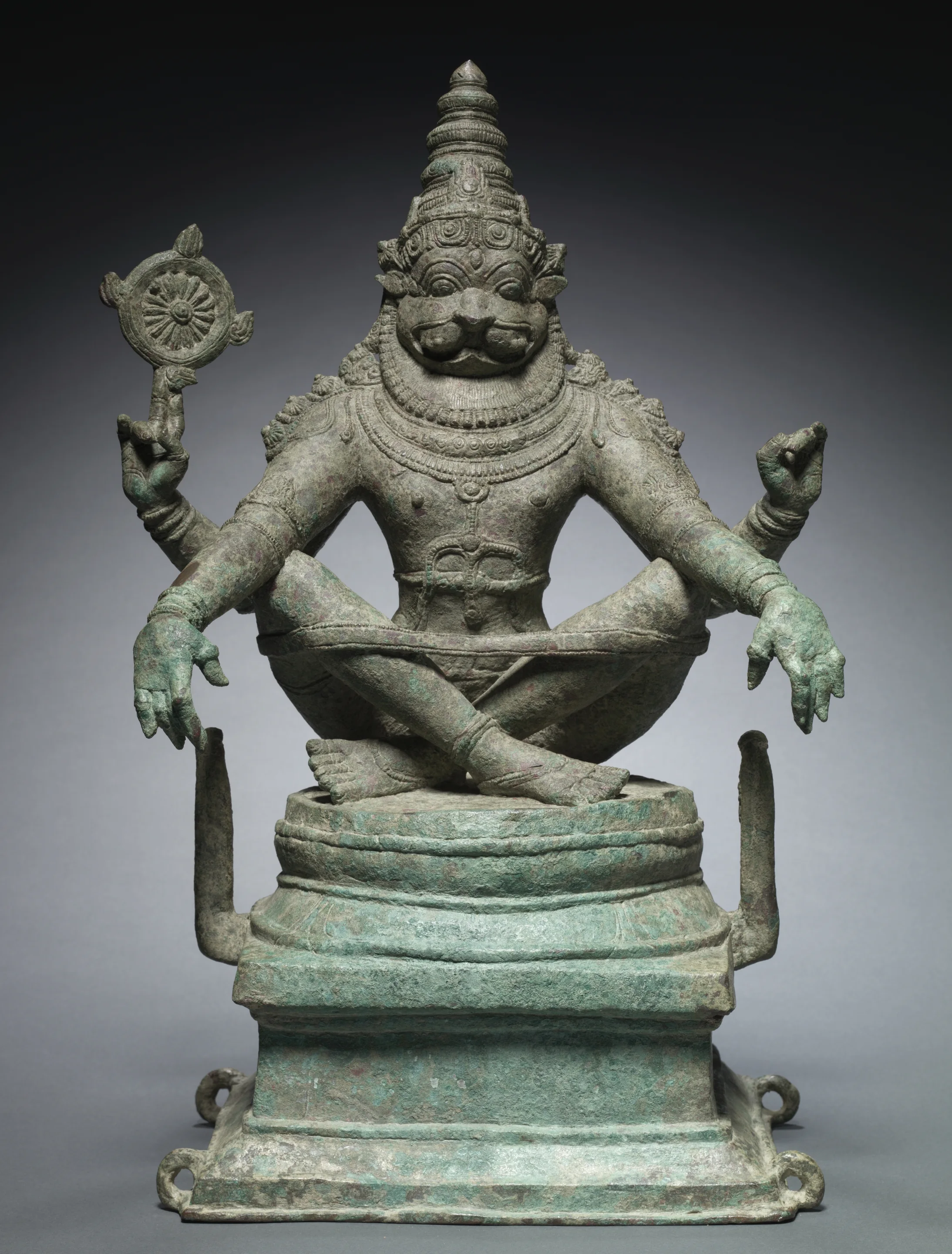
In the words of Pranav Ashar
How we renderThe heart of the Nrisimhatapaniya
In brief
Prajapati sees the man-lion's mantra and makes the world by it. Its eleven words are each the Self, down to 'I bow' and 'I'. The second part works out the Mandukya: waking, dream and deep sleep are sleep and dream, only appearance; the fourth is the witness of every state, 'the swallower of the Lord': 'there is no division here at all'. Duality is never established; by maya alone the Self seems other. The gods, taught, find they cannot see or say the Self, and are it: 'I am he; he is I.'
- The man-lion is the Self
- Om and the four quarters
- Waking too is sleep and dream
- The fourth swallows the Lord
- No division here at all
- As if other, by maya alone
Contents
आपो वा इदमासन्सलिलमेव स प्रजापतिरेकः पुष्करपर्णे समभवत्तस्यान्तर्मनसि कामः समवर्ततेदं सृजेयमिति तस्माद्यत्पुरुषो मनसाऽभिगच्छति तद्वाचा वदति तत्कर्मणा करोति तदेषाभ्युक्ता--कामस्तदग्रे समवर्तताधि मनसो रेतः प्रथमं यदासीत्। सतो बन्धुमसति निरविन्दन्हृदि प्रतीष्य कवयो मनीषेत्युपैनं तदुपनमति यत्कामो भवति स तपोऽतप्यत स तपस्तप्त्वा स एतं मन्त्रराजं नारसिंहमानुष्टुभमपश्यत्तेन वै सर्वमिदमसृजत यदिदं किञ्च तस्मात्सर्वमिदमानुष्टुभमित्याचक्षते यदिदं किञ्चानुष्टुभो वा इमानि भूतानि जायन्तेऽनुष्टुभा जातानि जीवन्त्यनुष्टुभं प्रयन्त्यभिसंविशन्ति तस्यैषा भवत्यनुष्टुप्प्रथमा भवत्यनुष्टुबुत्तमा भवति वाग्वा अनुष्टुब्वाचैव प्रयन्ति वाचैवोद्यन्ति परमा वा एषा छन्दसां यदनुष्टुबिति ॥
āpo vā idamāsansalilameva sa prajāpatirekaḥ puṣkaraparṇe samabhavattasyāntarmanasi kāmaḥ samavartatedaṃ sṛjeyamiti tasmādyatpuruṣo manasā'bhigacchati tadvācā vadati tatkarmaṇā karoti tadeṣābhyuktā--kāmastadagre samavartatādhi manaso retaḥ prathamaṃ yadāsīt| sato bandhumasati niravindanhṛdi pratīṣya kavayo manīṣetyupainaṃ tadupanamati yatkāmo bhavati sa tapo'tapyata sa tapastaptvā sa etaṃ mantrarājaṃ nārasiṃhamānuṣṭubhamapaśyattena vai sarvamidamasṛjata yadidaṃ kiñca tasmātsarvamidamānuṣṭubhamityācakṣate yadidaṃ kiñcānuṣṭubho vā imāni bhūtāni jāyante'nuṣṭubhā jātāni jīvantyanuṣṭubhaṃ prayantyabhisaṃviśanti tasyaiṣā bhavatyanuṣṭupprathamā bhavatyanuṣṭubuttamā bhavati vāgvā anuṣṭubvācaiva prayanti vācaivodyanti paramā vā eṣā chandasāṃ yadanuṣṭubiti ||
In the beginning all this was waters, only the flood. Prajapati alone came to be, on a lotus leaf. Within his mind desire arose: 'Let me bring this forth.' So what a person reaches for in the mind, he says in speech, and does in action. A verse says this: 'Desire arose in the beginning, the first seed of the mind. Searching in the heart with wisdom, the seers found the bond of being in non-being.' Whatever one desires comes to the one who knows this. He practised austerity. Having practised austerity, he saw this king of mantras, the man-lion's, in the anushtubh metre, and by it he made all this, whatever there is. So they call all this, whatever there is, 'of the anushtubh'. From the anushtubh these beings are born; by the anushtubh, born, they live; into the anushtubh they go and enter. Of it this is said: the anushtubh is first, the anushtubh is last. Speech is the anushtubh: by speech they go forth, by speech they rise. The anushtubh is the highest of the metres.
Note //
The opening of the first section, the same as Brihajjabala 1.a (Taittiriya Aranyaka 1.23, with Rig Veda 10.129.4). The anushtubh is the metre of four quarters of eight syllables; the 'king of mantras' of Nrisimha is in it. 'Born from it, living by it, returning into it' is the Taittiriya's definition of Brahman (3.1), said here of the mantra. Editions: 'āpo vā idam āsan' (Deccan College, Anandashrama) over 'apo vā idam āsīt' (Adyar); 'anuṣṭub uttamā' for 'anuṣṭab uttamā' (Deccan College).
ससागरां सपर्वतां सप्तद्वीपां वसुन्धरां तत्साम्नः प्रथमं पादं जानीयाद्यक्षगन्धर्वाप्सरोगणसेवितमन्तरिक्षं तत्साम्नो द्वितीयं पादं जानीयाद्वसुरुद्रादित्यैः सर्वैर्देवैः सेवितं दिवं तत्साम्नस्तृतीयं पादं जानीयाद्ब्रह्मस्वरूपं निरञ्जनं परमव्योम्निकं तत्साम्नश्चतुर्थं पादं जानीयाद्यो जानीते सोऽमृतत्वं च गच्छति। ऋग्यजुःसामाथर्वाणश्चत्वारो वेदाः साङ्गाः सशाखाश्चत्वारः पादा भवन्ति। किं ध्यानं किं दैवतं कान्यङ्गानि कानि दैवतानि किं छन्दः क ऋषिरिति ॥
sasāgarāṃ saparvatāṃ saptadvīpāṃ vasundharāṃ tatsāmnaḥ prathamaṃ pādaṃ jānīyādyakṣagandharvāpsarogaṇasevitamantarikṣaṃ tatsāmno dvitīyaṃ pādaṃ jānīyādvasurudrādityaiḥ sarvairdevaiḥ sevitaṃ divaṃ tatsāmnastṛtīyaṃ pādaṃ jānīyādbrahmasvarūpaṃ nirañjanaṃ paramavyomnikaṃ tatsāmnaścaturthaṃ pādaṃ jānīyādyo jānīte so'mṛtatvaṃ ca gacchati| ṛgyajuḥsāmātharvāṇaścatvāro vedāḥ sāṅgāḥ saśākhāścatvāraḥ pādā bhavanti| kiṃ dhyānaṃ kiṃ daivataṃ kānyaṅgāni kāni daivatāni kiṃ chandaḥ ka ṛṣiriti ||
The earth with its oceans and mountains and seven continents: one should know it as the first foot of that saman. The middle air, served by yakshas, gandharvas and hosts of apsaras: the second foot of that saman. Heaven, served by the Vasus, Rudras, Adityas and all the gods: the third foot of that saman. Brahman's own form, stainless, in the highest space: the fourth foot of that saman. Whoever knows this goes to deathlessness. The four Vedas, Rig, Yajus, Sama and Atharva, with their limbs and branches, are the four feet. What is its meditation? What its deity? What are its limbs, what their deities? What is its metre, who its seer?
Note //
The mantra is called a 'saman', a chant, with four feet, like the four quarters of the Self in the Mandukya: earth, middle air, heaven, and Brahman itself as the fourth. The questions at the end are those asked of every mantra. Editions agree; 'tat sāmnaḥ' for 'tat sānnaḥ' (Deccan College); 'caturthaṃ pādaṃ' (Adyar) for 'caturthe'.
स होवाच प्रजापतिः स यो ह वै तत्सावित्रस्याष्टाक्षरं पदं श्रियाऽभिषिक्तं तत्साम्नोऽङ्गं वेद, श्रिया हैवाभिषिच्यते सर्वे वेदाः प्रणवादिकास्तं प्रणवं तत्साम्नोऽङ्गं वेद, स त्रींल्लोकाञ्जयति चतुर्विंशत्यक्षरा महालक्ष्मीर्यजुस्तत्साम्नोऽङ्गं वेद, स आयुर्यशःकीर्तिज्ञानैश्वर्यवान्भवति, तस्मादिदं साङ्गं साम जानीयाद्यो जानीते सोऽमृतत्वं च गच्छति, सावित्रीं प्रणवं यजुर्लक्ष्मीं स्त्रीशूद्राय नेच्छन्ति, द्वात्रिंशदक्षरं साम जानीयाद्यो जानीते सोऽमृतत्वं च गच्छति, सावित्रीं लक्ष्मीं यजुः प्रणवं यदि जानीयात्स्त्रीशूद्रः स मृतोऽधो गच्छति तस्मात्सर्वदा नाचष्टे यद्याचष्टे स आचार्यस्तेनैव मृतोऽधो गच्छति ॥
sa hovāca prajāpatiḥ sa yo ha vai tatsāvitrasyāṣṭākṣaraṃ padaṃ śriyā'bhiṣiktaṃ tatsāmno'ṅgaṃ veda, śriyā haivābhiṣicyate sarve vedāḥ praṇavādikāstaṃ praṇavaṃ tatsāmno'ṅgaṃ veda, sa trīṃllokāñjayati caturviṃśatyakṣarā mahālakṣmīryajustatsāmno'ṅgaṃ veda, sa āyuryaśaḥkīrtijñānaiśvaryavānbhavati, tasmādidaṃ sāṅgaṃ sāma jānīyādyo jānīte so'mṛtatvaṃ ca gacchati, sāvitrīṃ praṇavaṃ yajurlakṣmīṃ strīśūdrāya necchanti, dvātriṃśadakṣaraṃ sāma jānīyādyo jānīte so'mṛtatvaṃ ca gacchati, sāvitrīṃ lakṣmīṃ yajuḥ praṇavaṃ yadi jānīyātstrīśūdraḥ sa mṛto'dho gacchati tasmātsarvadā nācaṣṭe yadyācaṣṭe sa ācāryastenaiva mṛto'dho gacchati ||
Prajapati said: Whoever knows the eight-syllabled word of Savitri, anointed with fortune, as a limb of that saman, is anointed with fortune. All the Vedas begin with Om: whoever knows Om as a limb of that saman wins the three worlds. The twenty-four-syllabled Mahalakshmi formula of the Yajurveda: whoever knows it as a limb of that saman has long life, fame, renown, knowledge and lordship. So one should know this saman with its limbs: whoever knows it goes to deathlessness. The Savitri, Om, the Yajus formula of Lakshmi: these they do not wish for women and shudras. One should know the thirty-two-syllabled saman: whoever knows it goes to deathlessness. If a woman or a shudra should know the Savitri, Lakshmi, the Yajus or Om, at death he goes down. So one never tells it; if one tells it, the teacher, by that very act, goes down at death.
Note //
The limbs of the mantra are given in section 4: Om, the Savitri ('ghṛṇiḥ sūrya ādityaḥ'), the Mahalakshmi formula and the Nrisimha Gayatri. The exclusion of women and shudras, and the threat against the teacher who tells them, reflect the rules of Vedic learning of the text's time; they are rendered as the text has them. Editions: 'aṣṭākṣaraṃ', 'praṇavādikās taṃ', 'aṅgaṃ' for the slips 'aṣṭakṣaraṃ', 'praṇavādikāsataṃ', 'amnaṃ' (Deccan College).
स होवाच प्रजापतिरग्निर्वै वेदा इदं सर्वं विश्वानि भूतानि प्राणा वा इन्द्रियाणि पशवोऽन्नममृतं सम्राट्स्वराड्विराट्तत्साम्नः प्रथमं पादं जानीयादृग्यजुःसामाथर्वरूपः सूर्योऽन्तरादित्ये हिरण्मयः पुरुषस्तत्साम्नो द्वितीयं पादं जानीयाद्य ओषधीनां प्रभवति तारापतिः सोमस्तत्साम्नस्तृतीयं पादं जानीयात्स ब्रह्मा स शिवः स हरिः स इन्द्रः सोऽग्निः सोऽक्षरः परमः स्वराट् तत्साम्नश्चतुर्थं पादं जानीयाद्यो जानीते सोऽमृतत्वं च गच्छति।ॐ उग्रं प्रथमस्याद्यं ज्वलं द्वितीयस्याद्यं नृसिं तृतीयस्याद्यं मृत्युं चतुर्थस्याद्यं साम जानीयाद्यो जानीते सोऽमृतत्वं च गच्छति, तस्मादिदं साम यत्र कुत्रचिन्नाचष्टे यदि दातुमपेक्षते पुत्राय शुश्रूषवे दास्यत्यन्यस्मै शिष्याय चेति ॥
sa hovāca prajāpatiragnirvai vedā idaṃ sarvaṃ viśvāni bhūtāni prāṇā vā indriyāṇi paśavo'nnamamṛtaṃ samrāṭsvarāḍvirāṭtatsāmnaḥ prathamaṃ pādaṃ jānīyādṛgyajuḥsāmātharvarūpaḥ sūryo'ntarāditye hiraṇmayaḥ puruṣastatsāmno dvitīyaṃ pādaṃ jānīyādya oṣadhīnāṃ prabhavati tārāpatiḥ somastatsāmnastṛtīyaṃ pādaṃ jānīyātsa brahmā sa śivaḥ sa hariḥ sa indraḥ so'gniḥ so'kṣaraḥ paramaḥ svarāṭ tatsāmnaścaturthaṃ pādaṃ jānīyādyo jānīte so'mṛtatvaṃ ca gacchati|oṃ ugraṃ prathamasyādyaṃ jvalaṃ dvitīyasyādyaṃ nṛsiṃ tṛtīyasyādyaṃ mṛtyuṃ caturthasyādyaṃ sāma jānīyādyo jānīte so'mṛtatvaṃ ca gacchati, tasmādidaṃ sāma yatra kutracinnācaṣṭe yadi dātumapekṣate putrāya śuśrūṣave dāsyatyanyasmai śiṣyāya ceti ||
Prajapati said: Fire, the Vedas, all this, all beings, the breaths, the senses, cattle, food, the deathless, the emperor, the self-ruler, the far-shining: know this as the first foot of that saman. The sun, whose form is the Rig, Yajus, Sama and Atharva, the golden Person within the sun: the second foot. Soma, lord of the stars, from whom the plants spring: the third foot. He is Brahma, he is Shiva, he is Hari, he is Indra, he is fire, he is the imperishable, the highest, self-ruling: the fourth foot of that saman. Whoever knows this goes to deathlessness. Om: 'ugram' is the beginning of the first, 'jvalam' of the second, 'nṛsiṃ' of the third, 'mṛtyum' of the fourth. One should know the saman: whoever knows it goes to deathlessness. So one never tells this saman anywhere; if one wishes to give it, one gives it to a son who serves, or to another disciple.
Note //
A second set of four feet: fire, sun, moon, and the one who is all the gods, 'the imperishable, the highest'. The first syllables of the four quarters of the mantra are then given: ugraṃ (vīraṃ mahāviṣṇum), jvalantaṃ (sarvatomukham), nṛsiṃhaṃ (bhīṣaṇaṃ bhadram), mṛtyumṛtyuṃ (namāmy aham). The mantra is not written out whole anywhere in the text: it is to be put together from these sections and learnt from a teacher. Editions: 'sa brahmā sa śivaḥ' (Adyar) for 'sa brahmā śivaḥ' (Deccan College).
क्षीरोदार्णवशायिनं नृकेसरिं योगिध्येयं परमं पदं साम जानीयाद्यो जानीते सोऽमृतत्वं च गच्छति, वीरं प्रथमस्यार्धान्त्यं तंसं द्वितीयस्यार्धान्त्यं हम्भी तृतीयस्यार्धान्त्यं मृत्युं चतुर्थस्यार्धान्त्यं साम जानीयाद्यो जानीते सोऽमृतत्वं च गच्छति, तस्मादिदं साम येन केनचिदाचार्यमुखेन यो जानीते स तेनैव शरीरेण संसारान्मुच्यते मोचयति मुमुक्षुर्भवति जपात्तेनैव शरीरेण देवतादर्शनं करोति, तस्मादिदमेव मुख्यं द्वारं कलौ नान्येषां भवति, तस्मादिदं साङ्गं साम जानीयाद्यो जानीते स मुमुक्षुर्भवति ॥
kṣīrodārṇavaśāyinaṃ nṛkesariṃ yogidhyeyaṃ paramaṃ padaṃ sāma jānīyādyo jānīte so'mṛtatvaṃ ca gacchati, vīraṃ prathamasyārdhāntyaṃ taṃsaṃ dvitīyasyārdhāntyaṃ hambhī tṛtīyasyārdhāntyaṃ mṛtyuṃ caturthasyārdhāntyaṃ sāma jānīyādyo jānīte so'mṛtatvaṃ ca gacchati, tasmādidaṃ sāma yena kenacidācāryamukhena yo jānīte sa tenaiva śarīreṇa saṃsārānmucyate mocayati mumukṣurbhavati japāttenaiva śarīreṇa devatādarśanaṃ karoti, tasmādidameva mukhyaṃ dvāraṃ kalau nānyeṣāṃ bhavati, tasmādidaṃ sāṅgaṃ sāma jānīyādyo jānīte sa mumukṣurbhavati ||
The one lying on the ocean of milk, the man-lion, the highest state on which yogis meditate: one should know the saman; whoever knows it goes to deathlessness. 'vīraṃ' is the end of the first half of the first, 'taṃ sa' of the second, 'haṃ bhī' of the third, 'mṛtyuṃ' of the fourth. One should know the saman: whoever knows it goes to deathlessness. So whoever knows this saman from the mouth of any teacher is freed from the round of birth in that very body, frees others, becomes a seeker of freedom, and by repeating it sees the deity in that very body. So this alone is the main door in the age of Kali, not the others. So one should know this saman with its limbs: whoever knows it becomes a seeker of freedom.
Note //
The syllables at the end of the first half of each quarter: vīraṃ, (jvalan)taṃ sa(rvatomukham), (nṛsiṃ)haṃ bhī(ṣaṇam), mṛtyu(mṛtyum). 'In that very body': freedom while living. Editions agree; 'tasmād' for 'tasād' (Deccan College).
ॐ ऋतं सत्यं परं ब्रह्म पुरुषं नृकेसरिविग्रहम्। कृष्णपिङ्गलमूर्ध्वरेतं विरूपाक्षं शङ्करं नीललोहितमुमापतिं पशुपतिं पिनाकिनं ह्यमितद्युतिमीशानः सर्वविद्यानामीश्वरः सर्वभूतानां ब्रह्माधिपतिर्ब्रह्मणोऽधिपतिर्यो यजुर्वेदवाच्यस्तं साम जानीयाद्यो जानीते सोऽमृतत्वं च गच्छति। महा प्रथमान्तार्धस्याद्यम्। र्वतो द्वितीयान्तार्धस्याद्यं, षणं तृतीयान्तार्धस्याद्यं, नमा चतुर्थान्तार्धस्याद्यं साम जानीयाद्यो जानीते सोऽमृतत्वं च गच्छति। तस्मादिदं सच्चिदानन्दमयं परं ब्रह्म तमेवं विद्वानमृत इह भवति। तस्मादिदं साङ्गं साम जानीयाद्यो जानीते सोऽमृतत्वं च गच्छति ॥
oṃ ṛtaṃ satyaṃ paraṃ brahma puruṣaṃ nṛkesarivigraham| kṛṣṇapiṅgalamūrdhvaretaṃ virūpākṣaṃ śaṅkaraṃ nīlalohitamumāpatiṃ paśupatiṃ pinākinaṃ hyamitadyutimīśānaḥ sarvavidyānāmīśvaraḥ sarvabhūtānāṃ brahmādhipatirbrahmaṇo'dhipatiryo yajurvedavācyastaṃ sāma jānīyādyo jānīte so'mṛtatvaṃ ca gacchati| mahā prathamāntārdhasyādyam| rvato dvitīyāntārdhasyādyaṃ, ṣaṇaṃ tṛtīyāntārdhasyādyaṃ, namā caturthāntārdhasyādyaṃ sāma jānīyādyo jānīte so'mṛtatvaṃ ca gacchati| tasmādidaṃ saccidānandamayaṃ paraṃ brahma tamevaṃ vidvānamṛta iha bhavati| tasmādidaṃ sāṅgaṃ sāma jānīyādyo jānīte so'mṛtatvaṃ ca gacchati ||
Om. The right, the real, the highest Brahman, the Person in the form of the man-lion, dark and tawny, his seed drawn upward, with unequal eyes, Shankara, blue-throated and red, Uma's lord, lord of creatures, bearing the bow, of boundless brightness: the ruler of all knowledge, the lord of all beings, the overlord of Brahma, of prayer, the one spoken of in the Yajurveda: one should know him as the saman; whoever knows it goes to deathlessness. 'mahā' is the beginning of the last half of the first, 'rvato' of the second, 'ṣaṇaṃ' of the third, 'namā' of the fourth. One should know the saman: whoever knows it goes to deathlessness. So this is the highest Brahman, made of being, and bliss. Knowing it so, one becomes deathless here. So one should know this saman with its limbs: whoever knows it goes to deathlessness.
Note //
The opening verse is from the Mahanarayana Upanishad (12.1 in the Taittiriya numbering), where it describes the Person who is Shiva; here the same words are given to the man-lion. The syllables at the start of the second half of each quarter: mahā(viṣṇum), (sa)rvato(mukham), (bhī)ṣaṇaṃ (bhadram), namā(my aham). 'Knowing it so, one becomes deathless here' is from the Purusha Sukta as given in the Taittiriya Aranyaka (3.12.7); compare Shvetashvatara 3.8 ('knowing him alone one passes beyond death'). Editions: 'amṛta iha bhavati' (Adyar, as in the verse quoted) for 'amṛtatvam iha' (Deccan College); 'paśupatiṃ' and 'brahmādhipatir brahmaṇo 'dhipatir' for the slips 'paśupātiṃ' and 'bahmādhipatir brahmaṇoyaṇo 'dhipatir' (Deccan College).
विश्वसृज एतेन वै विश्वमिदमसृजन्त यद्विश्वमसृजन्त तस्माद्विश्वसृजो विश्वमेनाननु प्रजायते ब्रह्मणः सायुज्यं सलोकतां यन्ति तस्मादिदं साङ्गं साम जानीयाद्यो जानीते सोऽमृतत्वं च गच्छति। विष्णुं प्रथमस्यान्त्यं मुखं द्वितीयस्यान्त्यं भद्रं तृतीयस्यान्त्यं म्यहं चतुर्थस्यान्त्यं साम जानीयाद्यो जानीते सोऽमृतत्वं च गच्छति। योऽसौ सोऽवेदयदिदं किं चात्मनि ब्रह्मण्यानुष्टभं जानीयाद्यो जानीते सोऽमृतत्वं च गच्छति। स्त्रीपुंसोर्वा य इहैव स्थातुमपेक्षते स सर्वैश्वर्यं ददाति यत्र कुत्रापि म्रियते देहान्ते देवः परं ब्रह्म तारकं व्याचष्टे, येनासावमृती भूत्वा सोऽमृतत्वं च गच्छति। तस्मादिदं साममध्यगं जपति तस्मादिदं सामाङ्गं प्रजापतिस्तस्मादिदं सामाङ्गं प्रजापतिर्य एवं वेदेति महोपनिषत्। य एतां महोपनिषदं वेद स कृतपुरश्चरणोऽपि महाविष्णुर्भवति। महाविष्णुर्भवतीति ॥
viśvasṛja etena vai viśvamidamasṛjanta yadviśvamasṛjanta tasmādviśvasṛjo viśvamenānanu prajāyate brahmaṇaḥ sāyujyaṃ salokatāṃ yanti tasmādidaṃ sāṅgaṃ sāma jānīyādyo jānīte so'mṛtatvaṃ ca gacchati| viṣṇuṃ prathamasyāntyaṃ mukhaṃ dvitīyasyāntyaṃ bhadraṃ tṛtīyasyāntyaṃ myahaṃ caturthasyāntyaṃ sāma jānīyādyo jānīte so'mṛtatvaṃ ca gacchati| yo'sau so'vedayadidaṃ kiṃ cātmani brahmaṇyānuṣṭabhaṃ jānīyādyo jānīte so'mṛtatvaṃ ca gacchati| strīpuṃsorvā ya ihaiva sthātumapekṣate sa sarvaiśvaryaṃ dadāti yatra kutrāpi mriyate dehānte devaḥ paraṃ brahma tārakaṃ vyācaṣṭe, yenāsāvamṛtī bhūtvā so'mṛtatvaṃ ca gacchati| tasmādidaṃ sāmamadhyagaṃ japati tasmādidaṃ sāmāṅgaṃ prajāpatistasmādidaṃ sāmāṅgaṃ prajāpatirya evaṃ vedeti mahopaniṣat| ya etāṃ mahopaniṣadaṃ veda sa kṛtapuraścaraṇo'pi mahāviṣṇurbhavati| mahāviṣṇurbhavatīti ||
By this the makers of the universe made the universe. Because they made the universe, they are the makers of the universe, and the universe is born after them. They reach union with Brahman, and his world. So one should know this saman with its limbs: whoever knows it goes to deathlessness. 'viṣṇuṃ' is the end of the first, 'mukhaṃ' of the second, 'bhadraṃ' of the third, 'myaham' of the fourth. One should know the saman: whoever knows it goes to deathlessness. That one made known all this within the Self, in Brahman, the anushtubh: one should know it; whoever knows it goes to deathlessness. Whoever, man or woman, wishes to stay here, to him he gives every kind of lordship. Wherever one dies, at the body's end, the god explains the highest Brahman, the one that carries across, by which one becomes deathless and goes to deathlessness. So one repeats this saman, at the centre; so Prajapati is the limb of the saman; so Prajapati is the limb of the saman: the one who knows this, knows. This is the great Upanishad. Whoever knows this great Upanishad, even without the preliminary rites, becomes the great Vishnu, becomes the great Vishnu.
Note //
The end of the first section. The last syllables of each quarter: (mahā)viṣṇum, (sarvato)mukham, bhadram, (namā)my aham. 'The god explains, at death, the Brahman that carries across' (tāraka) is the teaching of the Jabala Upanishad, that Shiva whispers the saving word into the ear of the dying at Kashi. The sentences 'yo 'sau so 'vedayad idaṃ kiṃ cātmani brahmaṇy ānuṣṭubhaṃ' and 'strīpuṃsor vā ...' are obscure in every edition; the rendering is tentative. Pending review. Editions agree in substance.
देवा ह वै मृत्योः पाप्मभ्यः संसाराच्चाबिभयुस्ते प्रजापतिमुपाधावंस्तेभ्य एतं मन्त्रराजं नारसिंहमानुष्टुभं प्रायच्छत्तेन वै सर्वे मृत्युमजयन्सर्वे पाप्मानमतरन्संसाराच्चातरंस्तस्माद्यो मृत्योः पाप्मभ्यः संसाराच्च बिभीयात्स एवं मन्त्रराजं नारसिंहमानुष्टुभं प्रतिगृह्णीयात्स मृत्युं जयति स पाप्मानं तरति स संसारं तरति तस्य ह वै प्रणवस्य या पूर्वा मात्रा पृथिव्यकारः स ऋग्भिरृग्वेदो ब्रह्मा वसवो गायत्री गार्हपत्यः स साम्नः प्रथमः पादो भवति, द्वितीयाऽन्तरिक्षं स उकारः स यजुर्भिर्यजुर्वेदो विष्णू रुद्रास्त्रिष्टुब्दक्षिणाग्निः स साम्नो द्वितीयः पादो भवति, तृतीया द्यौः स मकारः स सामभिः सामवेदो रुद्रा आदित्या जगत्याहवनीयः स साम्नस्तृतीयः पादो भवति, याऽवसानेऽस्य चतुर्थ्यर्धमात्रा सा सोमलोक ओङ्कारः सोऽथर्वणैर्मन्त्रैरथर्ववेदः संवर्तकोऽग्निर्मरुतो विराडेक ऋषिर्भास्वती सा साम्नश्चतुर्थः पादो भवति ॥
devā ha vai mṛtyoḥ pāpmabhyaḥ saṃsārāccābibhayuste prajāpatimupādhāvaṃstebhya etaṃ mantrarājaṃ nārasiṃhamānuṣṭubhaṃ prāyacchattena vai sarve mṛtyumajayansarve pāpmānamataransaṃsārāccātaraṃstasmādyo mṛtyoḥ pāpmabhyaḥ saṃsārācca bibhīyātsa evaṃ mantrarājaṃ nārasiṃhamānuṣṭubhaṃ pratigṛhṇīyātsa mṛtyuṃ jayati sa pāpmānaṃ tarati sa saṃsāraṃ tarati tasya ha vai praṇavasya yā pūrvā mātrā pṛthivyakāraḥ sa ṛgbhirṛgvedo brahmā vasavo gāyatrī gārhapatyaḥ sa sāmnaḥ prathamaḥ pādo bhavati, dvitīyā'ntarikṣaṃ sa ukāraḥ sa yajurbhiryajurvedo viṣṇū rudrāstriṣṭubdakṣiṇāgniḥ sa sāmno dvitīyaḥ pādo bhavati, tṛtīyā dyauḥ sa makāraḥ sa sāmabhiḥ sāmavedo rudrā ādityā jagatyāhavanīyaḥ sa sāmnastṛtīyaḥ pādo bhavati, yā'vasāne'sya caturthyardhamātrā sā somaloka oṅkāraḥ so'tharvaṇairmantrairatharvavedaḥ saṃvartako'gnirmaruto virāḍeka ṛṣirbhāsvatī sā sāmnaścaturthaḥ pādo bhavati ||
The gods were afraid of death, of wrongs, and of the round of birth. They ran to Prajapati, and he gave them this king of mantras, the man-lion's, in the anushtubh. By it they all conquered death, crossed over wrongs, and crossed over the round of birth. So whoever fears death, wrongs and the round of birth should take up this king of mantras, the man-lion's, in the anushtubh. He conquers death, crosses over wrong, crosses over the round of birth. Of that Om, the first measure is earth, the letter A: with the Rig verses it is the Rig Veda, Brahma, the Vasus, the gayatri metre, the householder's fire: it is the first foot of the saman. The second is the middle air, the letter U: with the Yajus formulas, the Yajurveda, Vishnu, the Rudras, the trishtubh, the southern fire: the second foot of the saman. The third is heaven, the letter M: with the Sama chants, the Samaveda, Rudra, the Adityas, the jagati, the offering fire: the third foot of the saman. The fourth, the half-measure at its end, is the world of soma, Om: with the Atharvan mantras, the Atharvaveda, the fire of dissolution, the Maruts, the far-shining, the one seer, the bright one: it is the fourth foot of the saman.
Note //
Section 2 begins. The four feet of the mantra are the four measures of Om, A, U, M and the half-measure, as the four quarters of the Self in the Mandukya (8-12). The Uttara-tapaniya (3.1) repeats this passage. Editions: 'pṛthivy akāraḥ' (Adyar, Anandashrama) for 'pṛthivyākāraḥ', 'the form of earth' (Deccan College); 'triṣṭub' for 'triṣṭab'.
अष्टाक्षरः प्रथमः पादो भवत्यष्टाक्षरास्त्रयः पादा भवन्ति, एवं द्वात्रिंशदक्षराणि सम्पद्यन्ते द्वात्रिंशदक्षरा वा अनुष्टुब्भवति, अनुष्टुभा सर्वमिदं सृष्टमनुष्टुभा सर्वमुपसंहृतं तस्य हि पञ्चाङ्गानि भवन्ति, चत्वारः पादाश्चत्वार्यङ्गानि भवन्ति, सप्रणवं सर्वं पञ्चमं भवति। ॐ हृदयाय नमः। ॐ शिरसे स्वाहा । ॐ शिखायै वषट्। ॐ कवचाय हुम्। ॐ अस्त्राय फडिति प्रथमं प्रथमेन युज्यते द्वितीयं द्वितीयेन तृतीयं तृतीयेन चतुर्थं चतुर्थेन पञ्चमं पञ्चमेन व्यतिषक्ता वा इमे लोकास्तस्माद्व्यतिषक्तान्यङ्गानि भवन्त्योमित्येतदक्षरमिदं सर्वं तस्मात्प्रत्यक्षरमुभयत ओङ्कारो भवतीत्यक्षराणां न्यासमुपदिशन्ति ब्रह्मवादिनः ॥
aṣṭākṣaraḥ prathamaḥ pādo bhavatyaṣṭākṣarāstrayaḥ pādā bhavanti, evaṃ dvātriṃśadakṣarāṇi sampadyante dvātriṃśadakṣarā vā anuṣṭubbhavati, anuṣṭubhā sarvamidaṃ sṛṣṭamanuṣṭubhā sarvamupasaṃhṛtaṃ tasya hi pañcāṅgāni bhavanti, catvāraḥ pādāścatvāryaṅgāni bhavanti, sapraṇavaṃ sarvaṃ pañcamaṃ bhavati| oṃ hṛdayāya namaḥ| oṃ śirase svāhā | oṃ śikhāyai vaṣaṭ| oṃ kavacāya hum| oṃ astrāya phaḍiti prathamaṃ prathamena yujyate dvitīyaṃ dvitīyena tṛtīyaṃ tṛtīyena caturthaṃ caturthena pañcamaṃ pañcamena vyatiṣaktā vā ime lokāstasmādvyatiṣaktānyaṅgāni bhavantyomityetadakṣaramidaṃ sarvaṃ tasmātpratyakṣaramubhayata oṅkāro bhavatītyakṣarāṇāṃ nyāsamupadiśanti brahmavādinaḥ ||
The first foot has eight syllables; the three feet have eight syllables each: so they come to thirty-two syllables. The anushtubh has thirty-two syllables. By the anushtubh all this was made; by the anushtubh all this is withdrawn. It has five limbs: the four feet are four limbs, and the whole, with Om, is the fifth. 'Om, to the heart, homage. Om, to the head, svaha. Om, to the topknot, vashat. Om, to the armour, hum. Om, to the weapon, phat.' The first is joined with the first, the second with the second, the third with the third, the fourth with the fourth, the fifth with the fifth. These worlds are interwoven; so the limbs are interwoven. Om: this syllable is all this; so Om stands on both sides of each syllable: so the knowers of Brahman teach the placing of the syllables.
Note //
The placing (nyāsa) of the mantra on the body: each of its parts is set on a part of the body with its formula, and Om is said before and after each syllable. 'Om: this syllable is all this' is the opening of the Mandukya. Editions: 'aṣṭākṣarās trayaḥ' (Adyar), 'anuṣṭub bhavati', 'vaṣaṭ' and 'hum' (Adyar) for slips in the Deccan College copy.
तस्य ह वा उग्रं प्रथमं स्थानं जानीयाद्यो जानीते सोऽमृतत्वं च गच्छति, वीरं द्वितीयं स्थानं महाविष्णुं तृतीयं ज्वलन्तं चतुर्थं सर्वतोमुखं पञ्चमं नृसिंहं षष्ठं भीषणं सप्तमं भद्रमष्टमं मृत्युमृत्युं नवमं नमामि दशममहमित्येकादशं स्थानं जानीयाद्यो जानीते सोऽमृतत्वं च गच्छति। एकादशपदा वा अनुष्टुब्भवत्यनुष्टुभा सर्वमिदं सृष्टमनुष्टुभा सर्वमुपसंहृतं तस्मात्सर्वमिदमानुष्टुभं जानीयाद्यो जानीते सोऽमृतत्वं च गच्छति ॥
tasya ha vā ugraṃ prathamaṃ sthānaṃ jānīyādyo jānīte so'mṛtatvaṃ ca gacchati, vīraṃ dvitīyaṃ sthānaṃ mahāviṣṇuṃ tṛtīyaṃ jvalantaṃ caturthaṃ sarvatomukhaṃ pañcamaṃ nṛsiṃhaṃ ṣaṣṭhaṃ bhīṣaṇaṃ saptamaṃ bhadramaṣṭamaṃ mṛtyumṛtyuṃ navamaṃ namāmi daśamamahamityekādaśaṃ sthānaṃ jānīyādyo jānīte so'mṛtatvaṃ ca gacchati| ekādaśapadā vā anuṣṭubbhavatyanuṣṭubhā sarvamidaṃ sṛṣṭamanuṣṭubhā sarvamupasaṃhṛtaṃ tasmātsarvamidamānuṣṭubhaṃ jānīyādyo jānīte so'mṛtatvaṃ ca gacchati ||
One should know 'fierce' (ugram) as its first place: whoever knows it goes to deathlessness. 'Hero' (vīram) is the second place, 'great Vishnu' the third, 'blazing' the fourth, 'facing every way' the fifth, 'man-lion' the sixth, 'terrible' the seventh, 'auspicious' the eighth, 'death of death' the ninth, 'I bow' the tenth, 'I' the eleventh place. Whoever knows them goes to deathlessness. The anushtubh has eleven words. By the anushtubh all this was made; by the anushtubh all this is withdrawn. So one should know all this as the anushtubh: whoever knows it goes to deathlessness.
Note //
The eleven words of the mantra, in order; the next passage explains each. Editions: 'aham ity ekādaśaṃ' (Adyar) for 'aham ilekādaśaṃ' (Deccan College); 'ṣaṣṭhaṃ' for 'ṣaṣṭaṃ'.
देवा ह वै प्रजापतिमब्रुवन्नथ कस्मादुच्यत उग्रमिति, स होवाच प्रजापतिर्यस्मात्स्वमहिम्ना सर्वांल्लोकान्सर्वान्देवान्सर्वानात्मनः सर्वाणि भूतान्युद्गृह्णात्यजस्रं सृजति विसृजति विवासयत्युद्ग्राह्यत उद्ग्रह्यते। स्तुहि श्रुतं गर्तसदं युवानं मृगं न भीममुपहन्तुमुग्रम्। मृडा जरित्रे सिंह स्तवानो अन्यं ते अस्मन्निवपन्तु सेनाः । तस्मादुच्यत उग्रमिति। अथ कस्मादुच्यते वीरमिति यस्मात्स्वमहिम्ना सर्वांल्लोकान्सर्वान्देवान्सर्वानात्मनः सर्वाणि भूतानि विरमति विरामयत्यजस्रं सृजति विसृजति वासयति। यतो वीरः कर्मण्यः सुदक्षो युक्तग्रावा जायते देवकामः। तस्मादुच्यते वीरमिति ॥
devā ha vai prajāpatimabruvannatha kasmāducyata ugramiti, sa hovāca prajāpatiryasmātsvamahimnā sarvāṃllokānsarvāndevānsarvānātmanaḥ sarvāṇi bhūtānyudgṛhṇātyajasraṃ sṛjati visṛjati vivāsayatyudgrāhyata udgrahyate| stuhi śrutaṃ gartasadaṃ yuvānaṃ mṛgaṃ na bhīmamupahantumugram| mṛḍā jaritre siṃha stavāno anyaṃ te asmannivapantu senāḥ | tasmāducyata ugramiti| atha kasmāducyate vīramiti yasmātsvamahimnā sarvāṃllokānsarvāndevānsarvānātmanaḥ sarvāṇi bhūtāni viramati virāmayatyajasraṃ sṛjati visṛjati vāsayati| yato vīraḥ karmaṇyaḥ sudakṣo yuktagrāvā jāyate devakāmaḥ| tasmāducyate vīramiti ||
The gods said to Prajapati: Why is he called 'fierce'? Prajapati said: Because by his own greatness he lifts up all the worlds, all the gods, all selves, all beings, and without pause sends them forth, lets them go, makes them dwell; he lifts and is lifted. 'Praise the famous one, seated in the chariot, young, terrible as a wild beast, fierce to strike; lion, being praised, be gracious to the singer; let your armies strike down another than us.' So he is called 'fierce'. Why is he called 'hero'? Because by his own greatness he brings all the worlds, all the gods, all selves, all beings, to rest, lets them rest, and without pause sends them forth, lets them go, makes them dwell. 'From him the hero is born, active, skilful, pressing the soma, longing for the gods.' So he is called 'hero'.
Note //
Each word is explained by its root ('ugra' from 'ud-grah', lift up; 'vīra' from 'vi-ram', bring to rest) and by a Vedic verse. The first verse is Rig Veda 2.33.11, to Rudra, with 'lion' for 'Rudra'; the second Rig Veda 3.4.9 (Taittiriya Samhita). Editions: 'ajasraṃ' (Adyar) for 'ajakhaṃ' (Deccan College); 'udgrāhyata' for 'ugrāhyata'.
अथ कस्मादुच्यते महाविष्णुमिति। यः सर्वांल्लोकान्व्याप्नोति व्यापयति स्नेहो यथा पललपिण्डमोतप्रोतमनुप्राप्तं व्यतिषक्तो व्याप्यते व्यापयते। यस्मान्न जातः परोऽन्योऽस्ति य आविवेश भुवनानि विश्वा। प्रजापतिः प्रजया संविदानस्त्रीणि ज्योतींषि सचते स षोडशीति। तस्मादुच्यते महाविष्णुमिति। अथ कस्मादुच्यते ज्वलन्तमिति यस्मात्स्वमहिम्ना सर्वाँल्लोकान्सर्वान्देवान्सर्वानात्मनः सर्वाणि भूतानि स्वतेजसा ज्वलति ज्वालयति ज्वाल्यते ज्वालयते। सविता प्रसविता दीप्तो दीपयन्दीप्यमानः। ज्वलञ्ज्वलिता तपन्वितपन्सन्तपन्रोचनो रोचमानः शोभनः शोभमानः कल्याणः। तस्मादुच्यते ज्वलन्तमिति। अथ कस्मादुच्यते सर्वतोमुखमिति। यस्मादनिन्द्रियोऽपि सर्वतः पश्यति सर्वतः शृणोति सर्वतो गच्छति सर्वत आदत्ते स सर्वगः सर्वतस्तिष्ठति । एकः पुरस्ताद्य इदं बभूव यतो बभूव भुवनस्य गोपाः । यमप्येति भुवनं साम्पराये नमामि तमहं सर्वतोमुखम् । तस्मादुच्यते सर्वतोमुखमिति ॥
atha kasmāducyate mahāviṣṇumiti| yaḥ sarvāṃllokānvyāpnoti vyāpayati sneho yathā palalapiṇḍamotaprotamanuprāptaṃ vyatiṣakto vyāpyate vyāpayate| yasmānna jātaḥ paro'nyo'sti ya āviveśa bhuvanāni viśvā| prajāpatiḥ prajayā saṃvidānastrīṇi jyotīṃṣi sacate sa ṣoḍaśīti| tasmāducyate mahāviṣṇumiti| atha kasmāducyate jvalantamiti yasmātsvamahimnā sarvām̐llokānsarvāndevānsarvānātmanaḥ sarvāṇi bhūtāni svatejasā jvalati jvālayati jvālyate jvālayate| savitā prasavitā dīpto dīpayandīpyamānaḥ| jvalañjvalitā tapanvitapansantapanrocano rocamānaḥ śobhanaḥ śobhamānaḥ kalyāṇaḥ| tasmāducyate jvalantamiti| atha kasmāducyate sarvatomukhamiti| yasmādanindriyo'pi sarvataḥ paśyati sarvataḥ śṛṇoti sarvato gacchati sarvata ādatte sa sarvagaḥ sarvatastiṣṭhati | ekaḥ purastādya idaṃ babhūva yato babhūva bhuvanasya gopāḥ | yamapyeti bhuvanaṃ sāmparāye namāmi tamahaṃ sarvatomukham | tasmāducyate sarvatomukhamiti ||
Why is he called 'great Vishnu'? Because he pervades all the worlds and makes them pervaded, as oil pervades a ball of sesame paste, woven through it, reaching into it, interwoven; he pervades and makes pervade. 'He than whom no other was born higher, who entered all the worlds; Prajapati, at one with his creatures, joins the three lights: he of the sixteen parts.' So he is called 'great Vishnu'. Why is he called 'blazing'? Because by his own greatness he blazes, by his own brightness, through all the worlds, all the gods, all selves, all beings; he makes them blaze, is blazed, makes blaze. 'Savitri, the impeller, shining, making shine, being shone upon; blazing, set blazing, burning, burning through, burning all round, bright, brightening, lovely, being made lovely, auspicious.' So he is called 'blazing'. Why is he called 'facing every way'? Because, though without senses, he sees on every side, hears on every side, goes on every side, takes on every side; going everywhere, he stands on every side. 'One, he was before, who became all this, from whom the guardian of the world came to be; into whom the world goes at the end: I bow to him, facing every way.' So he is called 'facing every way'.
Note //
'As oil pervades sesame' is Shvetashvatara 1.15-16. 'He than whom no other was born higher, who entered all the worlds' is Vajasaneyi Samhita 8.36 and 32.5. 'Though without senses he sees on every side' echoes Shvetashvatara 3.19, 'without hands or feet he moves and grasps; without eyes he sees, without ears he hears': the Self sees without being a seer among things. Editions: 'jvalañ jvalitā' (Adyar) for 'jvalañ jālitā' (Deccan College); 'sarvāṃl lokān' for 'sarvāṃ lokān'.
अथ कस्मादुच्यते नृसिंहमिति। यस्मात्सर्वेषां भूतानां ना वीर्यतमः श्रेष्ठतमश्च सिंहो वीर्यतमः श्रेष्ठतमश्च तस्मान्नृसिंह आसीत्परमेश्वरो जगद्धितं वा एतद्रूपमक्षरं भवति। प्र तद्विष्णुः स्तवते वीर्याय मृगो न भीमः कुचरो गिरिष्ठाः। यस्योरुषु त्रिषु विक्रमणेष्वधि क्षियन्ति भुवनानि विश्वा। तस्मादुच्यते नृसिंहमिति। अथ कस्मादुच्यते भीषणमिति। यस्माद्यस्य रूपं दृष्ट्वा सर्वे लोकाः सर्वे देवाः सर्वाणि भूतानि भीत्या पलायन्ते स्वयं यतः कुतश्चिन्न बिभेति। भीषाऽस्माद्वातः पवते भीषोदेति सूर्यः। भीषाऽस्मादग्निश्चेन्द्रश्च मृत्युर्धावति पञ्चमः। तस्मादुच्यते भीषणमिति। अथ कस्मादुच्यते भद्रमिति। यस्मात्स्वयं भद्रो भूत्वा सर्वदा भद्रं ददाति रोचनो रोचमानः शोभनः शोभमानः कल्याणः। भद्रं कर्णेभिः शृणुयाम देवा भद्रं पश्येमाक्षभिर्यजत्राः। स्थिरैरङ्गैस्तुष्टुवांसस्तनूभिर्व्यशेम देवहितं यदायुः। तस्मादुच्यते भद्रमिति ॥
atha kasmāducyate nṛsiṃhamiti| yasmātsarveṣāṃ bhūtānāṃ nā vīryatamaḥ śreṣṭhatamaśca siṃho vīryatamaḥ śreṣṭhatamaśca tasmānnṛsiṃha āsītparameśvaro jagaddhitaṃ vā etadrūpamakṣaraṃ bhavati| pra tadviṣṇuḥ stavate vīryāya mṛgo na bhīmaḥ kucaro giriṣṭhāḥ| yasyoruṣu triṣu vikramaṇeṣvadhi kṣiyanti bhuvanāni viśvā| tasmāducyate nṛsiṃhamiti| atha kasmāducyate bhīṣaṇamiti| yasmādyasya rūpaṃ dṛṣṭvā sarve lokāḥ sarve devāḥ sarvāṇi bhūtāni bhītyā palāyante svayaṃ yataḥ kutaścinna bibheti| bhīṣā'smādvātaḥ pavate bhīṣodeti sūryaḥ| bhīṣā'smādagniścendraśca mṛtyurdhāvati pañcamaḥ| tasmāducyate bhīṣaṇamiti| atha kasmāducyate bhadramiti| yasmātsvayaṃ bhadro bhūtvā sarvadā bhadraṃ dadāti rocano rocamānaḥ śobhanaḥ śobhamānaḥ kalyāṇaḥ| bhadraṃ karṇebhiḥ śṛṇuyāma devā bhadraṃ paśyemākṣabhiryajatrāḥ| sthirairaṅgaistuṣṭuvāṃsastanūbhirvyaśema devahitaṃ yadāyuḥ| tasmāducyate bhadramiti ||
Why is he called 'man-lion'? Because of all beings man is the most powerful and best, and the lion is the most powerful and best, so the highest Lord was the man-lion; this form, the imperishable, is for the good of the world. 'Vishnu is praised for his might, like a terrible wild beast, roaming, dwelling on the mountain, in whose three wide strides all the worlds dwell.' So he is called 'man-lion'. Why is he called 'terrible'? Because, seeing his form, all worlds, all gods and all beings run away in fear, while he himself fears nothing from anywhere. 'From fear of him the wind blows; from fear of him the sun rises; from fear of him fire and Indra, and death, the fifth, run.' So he is called 'terrible'. Why is he called 'auspicious'? Because, being auspicious himself, he always gives what is auspicious: bright, brightening, lovely, being made lovely, auspicious. 'Gods, may our ears hear what is good; holy ones, may our eyes see what is good; with steady limbs and bodies, praising you, may we live out the span the gods have given.' So he is called 'auspicious'.
Note //
The second verse is Rig Veda 1.154.2, on Vishnu's three strides. 'From fear of him the wind blows' is Taittiriya 2.8 and Katha 2.3.3: the one who is feared by all and fears nothing, because there is no second for him to fear (Brihadaranyaka 1.4.2). 'Auspicious' (bhadra) is explained by the peace invocation that begins with the same word. Editions: 'pra tad viṣṇuḥ', 'mṛgo na bhīmaḥ' and 'giriṣṭhāḥ' as in the Rig Veda, for slips in the Deccan College copy.
अथ कस्मादुच्यते मृत्युमृत्युमिति। यस्मात्स्वमहिम्ना स्वभक्तानां स्मृत एव मृत्युमपमृत्युं च मारयति। य आत्मदा बलदा यस्य विश्व उपासते प्रशिषं यस्य देवाः। यस्य च्छायामृतं यो मृत्युमृत्युः कस्मै देवाय हविषा विधेम। तस्मादुच्यते मृत्युमृत्युमिति। अथ कस्मादुच्यते नमामीति। यस्माद्यं सर्वे देवा नमन्ति मुमुक्षवो ब्रह्मवादिनश्च। प्र नूनं ब्रह्मणस्पतिर्मन्त्रं वदत्युक्थम्। यस्मिन्निन्द्रो वरुणो मित्रो अर्यमा देवा ओकांसि चक्रिरे।तस्मादुच्यते नमामीति। अथ कस्मादुच्यतेऽहमिति। अहमस्मि प्रथमजा ऋता३स्य। पूर्वं देवेभ्यो अमृतस्य ना३भायि। यो मा ददाति स इदेव मा३वाः। अहमन्नमन्नमदन्तमा३द्मि। अहं विश्वं भुवनमभ्यभवा३म्। सुवर्न ज्योतीः। य एवं वेदेत्युपनिषत् ॥
atha kasmāducyate mṛtyumṛtyumiti| yasmātsvamahimnā svabhaktānāṃ smṛta eva mṛtyumapamṛtyuṃ ca mārayati| ya ātmadā baladā yasya viśva upāsate praśiṣaṃ yasya devāḥ| yasya cchāyāmṛtaṃ yo mṛtyumṛtyuḥ kasmai devāya haviṣā vidhema| tasmāducyate mṛtyumṛtyumiti| atha kasmāducyate namāmīti| yasmādyaṃ sarve devā namanti mumukṣavo brahmavādinaśca| pra nūnaṃ brahmaṇaspatirmantraṃ vadatyuktham| yasminnindro varuṇo mitro aryamā devā okāṃsi cakrire|tasmāducyate namāmīti| atha kasmāducyate'hamiti| ahamasmi prathamajā ṛtā3sya| pūrvaṃ devebhyo amṛtasya nā3bhāyi| yo mā dadāti sa ideva mā3vāḥ| ahamannamannamadantamā3dmi| ahaṃ viśvaṃ bhuvanamabhyabhavā3m| suvarna jyotīḥ| ya evaṃ vedetyupaniṣat ||
Why is he called 'death of death'? Because by his own greatness, merely remembered, he kills death and untimely death for his devotees. 'He who gives the Self, who gives strength, whose command all, even the gods, obey; whose shadow is deathlessness, who is the death of death: to what god shall we offer?' So he is called 'death of death'. Why is he called 'I bow'? Because all the gods bow to him, and those who seek freedom, and the knowers of Brahman. 'Surely Brahmanaspati speaks the mantra, the praise, in which Indra, Varuna, Mitra and Aryaman, the gods, have made their home.' So he is called 'I bow'. Why is he called 'I'? 'I am the first-born of the real, before the gods, the navel of the deathless. Whoever gives me, he indeed has helped me. I am food; I eat the eater of food. I have overcome the whole world. Light like the sun.' The one who knows this, knows. This is the Upanishad.
Note //
The end of the second section. The first verse is Rig Veda 10.121.2, with 'the death of death' for the Rig Veda's 'whose shadow is death'. The second is Rig Veda 1.40.5. The last is the song of the knower at the end of the Taittiriya (3.10.6), with its drawn-out vowels ('ṛtā3sya'): the word 'I' in the mantra is the one who has known Brahman and sings 'I am food, I am the eater of food'. The one who says 'I bow' is, in the end, the 'I' bowed to. Editions: 'kasmād' and 'brahmaṇaspatir' for slips in the Deccan College copy; 'nā3bhāyi' and 'ā3dmi' (Adyar, as in the Taittiriya) for 'nā3bhāvi' and 'ā3dbhi' (Deccan College).
देवा ह वै प्रजापतिमब्रुवन्नानुष्टुभस्य मन्त्रराजस्य नारसिंहस्य शक्तिं बीजं च नो ब्रूहि भगव इति । स होवाच प्रजापतिर्माया वा एषा नारसिंही सर्वमिदं सृजति सर्वमिदं रक्षति सर्वमिदं संहरति । तस्मान्मायामेतां शक्तिं विद्याद्य एतां मायां शक्तिं वेद स पाप्मानं तरति सोऽमृतत्वं च गच्छति महतीं श्रियमश्नुते मीमांसन्ते ब्रह्मवादिनो ह्रस्वा वा दीर्घा वा प्लुता वेति । यदि ह्रस्वा भवति सर्वं पाप्मानं दहत्यमृतत्वं च गच्छति यदि दीर्घा भवति महतीं श्रियमाप्नुयादमृतत्वं च गच्छति यदि प्लुता भवति ज्ञानवान्भवत्यमृतत्वं च गच्छति । तदेतदृषिणोक्तं निदर्शनम् । सईं पाहि य ऋजीषी तरुत्रः श्रियं लक्ष्मीमौपलामम्बिकां गां षष्ठीं च यामिन्द्रसेनेत्युत आहुस्तां विद्यां ब्रह्मयोनिं सरूपां तामिहायुषे शरणं प्रपद्ये । सर्वेषां वा एतद्भूतानामाकाशः परायणं सर्वाणि ह वा इमानि भूतान्याकाशादेव जायन्ते । आकाशादेव जातानि जीवन्त्याकाशं प्रयन्त्यभिसंविशन्ति । तस्मादाकाशं बीजं विद्यात्तदेतदृषिणोक्तं निदर्शनम् । हंसः शुचिषद्वसुरन्तरिक्षसद्धोता वेदिषदतिथिर्दुरोणसत् । नृषद्वरसदृतसद्व्योमसदब्जा गोजा ऋतजा अद्रिजा ऋतं बृहत्॥ य एवं वेदेत्युपनिषत् ॥
devā ha vai prajāpatimabruvannānuṣṭubhasya mantrarājasya nārasiṃhasya śaktiṃ bījaṃ ca no brūhi bhagava iti | sa hovāca prajāpatirmāyā vā eṣā nārasiṃhī sarvamidaṃ sṛjati sarvamidaṃ rakṣati sarvamidaṃ saṃharati | tasmānmāyāmetāṃ śaktiṃ vidyādya etāṃ māyāṃ śaktiṃ veda sa pāpmānaṃ tarati so'mṛtatvaṃ ca gacchati mahatīṃ śriyamaśnute mīmāṃsante brahmavādino hrasvā vā dīrghā vā plutā veti | yadi hrasvā bhavati sarvaṃ pāpmānaṃ dahatyamṛtatvaṃ ca gacchati yadi dīrghā bhavati mahatīṃ śriyamāpnuyādamṛtatvaṃ ca gacchati yadi plutā bhavati jñānavānbhavatyamṛtatvaṃ ca gacchati | tadetadṛṣiṇoktaṃ nidarśanam | saīṃ pāhi ya ṛjīṣī tarutraḥ śriyaṃ lakṣmīmaupalāmambikāṃ gāṃ ṣaṣṭhīṃ ca yāmindrasenetyuta āhustāṃ vidyāṃ brahmayoniṃ sarūpāṃ tāmihāyuṣe śaraṇaṃ prapadye | sarveṣāṃ vā etadbhūtānāmākāśaḥ parāyaṇaṃ sarvāṇi ha vā imāni bhūtānyākāśādeva jāyante | ākāśādeva jātāni jīvantyākāśaṃ prayantyabhisaṃviśanti | tasmādākāśaṃ bījaṃ vidyāttadetadṛṣiṇoktaṃ nidarśanam | haṃsaḥ śuciṣadvasurantarikṣasaddhotā vediṣadatithirduroṇasat | nṛṣadvarasadṛtasadvyomasadabjā gojā ṛtajā adrijā ṛtaṃ bṛhat|| ya evaṃ vedetyupaniṣat ||
The gods said to Prajapati: 'Lord, tell us the power and the seed of the man-lion's king of mantras, in the anushtubh.' Prajapati said: This maya is the man-lion's: it makes all this, keeps all this, withdraws all this. So one should know this maya as the power. Whoever knows this maya as the power crosses over wrong, goes to deathlessness, and gains great fortune. The knowers of Brahman ask whether it should be short, long or drawn out. If short, it burns up every wrong, and one goes to deathlessness. If long, one gains great fortune, and goes to deathlessness. If drawn out, one becomes a knower, and goes to deathlessness. A seer has given this example: 'Protect us, you who are full of soma, our rescuer; she whom they call Shri, Lakshmi, Aupala, Ambika, the cow, Shashthi, and Indrasena: that teaching, the womb of Brahman, of one form with it, I take refuge in her here, for life.' Space is the final resting place of all these beings. All these beings are born from space; born from space they live; into space they go and enter. So one should know space as the seed. A seer has given this example: 'The swan dwelling in the bright, the good one in the middle air, the priest at the altar, the guest in the house, dwelling in men, in the best, in the true, in the sky, born of the waters, of the rays, of the truth, of the rock: the truth, the great.' The one who knows this, knows. This is the Upanishad.
Note //
Section 3. The 'power' (śakti) and 'seed' (bīja) are terms of mantra lore; the power here is maya, and the seed-syllable of the mantra ('kṣrauṃ' in the tradition) is identified with space. 'Short, long or drawn out' refers to the vowel of the seed-syllable. 'Space is the final resting place of all beings' is Chandogya 1.9.1; the swan verse is Rig Veda 4.40.5 (Katha 2.2.2), on the one Self in all. The first quoted verse is obscure and its rendering tentative (compare Tripuratapini 5.21). Editions: 'aśnute' and 'hrasvā' for slips in the Deccan College copy; 'mahopaniṣat' (Adyar) for 'upaniṣat' at the end.
देवा ह वै प्रजापतिमब्रुवन्नानुष्टुभस्य मन्त्रराजस्य नारसिंहस्याङ्गमन्त्रान्नो ब्रूहि भगव इति । स होवाच प्रजापतिः प्रणवं सावित्रीं यजुर्लक्ष्मीं नृसिंहगायत्रीमित्यङ्गानि जानीयाद्यो जानीते सोऽमृतत्वं च गच्छति । ओमित्येतदक्षरमिदं सर्वं तस्योपव्याख्यानं भूतं भवद्भविष्यदिति सर्वमोङ्कार एव यच्चान्यत्त्रिकालातीतं तदप्योङ्कार एव सर्वं ह्येतद्ब्रह्मायमात्मा ब्रह्म सोऽयमात्मा चतुष्पाज्जागरितस्थानो बहिःप्रज्ञः सप्ताङ्ग एकोनविंशतिमुखः स्थूलभुग्वैश्वानरः प्रथमः पादः स्वप्नस्थानेऽन्तःप्रज्ञः सप्ताङ्ग एकोनविंशतिमुखः प्रविविक्तभुक्तैजसो द्वितीयः पादो यत्र सुप्तो न कञ्चन कामं कामयते न कञ्चन स्वप्नं पश्यति तत्सुषुप्तं सुषुप्तस्थान एकीभूतः प्रज्ञानघन एवानन्दमयो ह्यानन्दभुक्चेतोमुखः प्राज्ञस्तृतीयः पाद एष सर्वेश्वर एष सर्वज्ञ एषोऽन्तर्याम्येष योनिः सर्वस्य प्रभवाप्ययौ हि भूतानां न बहिःप्रज्ञं नान्तःप्रज्ञं नोभयतःप्रज्ञं न प्रज्ञं नाप्रज्ञं न प्रज्ञानघनमदृष्टमव्यवहार्यमग्राह्यमलक्षणमलिङ्गमचिन्त्यमव्यपदेश्यमेकात्मप्रत्ययसारं प्रपञ्चोपशमं शिवमद्वैतं चतुर्थं मन्यन्ते स आत्मा स विज्ञेयः ॥
devā ha vai prajāpatimabruvannānuṣṭubhasya mantrarājasya nārasiṃhasyāṅgamantrānno brūhi bhagava iti | sa hovāca prajāpatiḥ praṇavaṃ sāvitrīṃ yajurlakṣmīṃ nṛsiṃhagāyatrīmityaṅgāni jānīyādyo jānīte so'mṛtatvaṃ ca gacchati | omityetadakṣaramidaṃ sarvaṃ tasyopavyākhyānaṃ bhūtaṃ bhavadbhaviṣyaditi sarvamoṅkāra eva yaccānyattrikālātītaṃ tadapyoṅkāra eva sarvaṃ hyetadbrahmāyamātmā brahma so'yamātmā catuṣpājjāgaritasthāno bahiḥprajñaḥ saptāṅga ekonaviṃśatimukhaḥ sthūlabhugvaiśvānaraḥ prathamaḥ pādaḥ svapnasthāne'ntaḥprajñaḥ saptāṅga ekonaviṃśatimukhaḥ praviviktabhuktaijaso dvitīyaḥ pādo yatra supto na kañcana kāmaṃ kāmayate na kañcana svapnaṃ paśyati tatsuṣuptaṃ suṣuptasthāna ekībhūtaḥ prajñānaghana evānandamayo hyānandabhukcetomukhaḥ prājñastṛtīyaḥ pāda eṣa sarveśvara eṣa sarvajña eṣo'ntaryāmyeṣa yoniḥ sarvasya prabhavāpyayau hi bhūtānāṃ na bahiḥprajñaṃ nāntaḥprajñaṃ nobhayataḥprajñaṃ na prajñaṃ nāprajñaṃ na prajñānaghanamadṛṣṭamavyavahāryamagrāhyamalakṣaṇamaliṅgamacintyamavyapadeśyamekātmapratyayasāraṃ prapañcopaśamaṃ śivamadvaitaṃ caturthaṃ manyante sa ātmā sa vijñeyaḥ ||
The gods said to Prajapati: 'Lord, tell us the limb-mantras of the man-lion's king of mantras, in the anushtubh.' Prajapati said: One should know as its limbs Om, the Savitri, the Yajus formula of Lakshmi and the Nrisimha Gayatri: whoever knows them goes to deathlessness. Om: this syllable is all this. Here is its explanation. What has been, what is and what will be: all of it is Om. And whatever else is beyond the three times, that too is Om. All this is Brahman. This Self is Brahman. This Self has four quarters. The first quarter is Vaishvanara, whose place is waking, knowing outward, with seven limbs and nineteen mouths, enjoying the gross. The second quarter is Taijasa, whose place is dream, knowing inward, with seven limbs and nineteen mouths, enjoying the subtle. Where one asleep desires nothing and sees no dream: that is deep sleep. The third quarter is Prajna, whose place is deep sleep, become one, a mass of knowing, made of bliss, enjoying bliss, whose mouth is . This is the lord of all, the knower of all, the inner controller, the womb of all, the arising and the passing of beings. Not knowing inward, not knowing outward, not knowing both ways, not a mass of knowing, not knowing, not unknowing; unseen, beyond dealings, beyond grasp, without marks, beyond thought, beyond naming, whose essence is the knowing of the one Self, the stilling of the world, the auspicious, without a second: this they think of as the fourth. That is the Self; that is to be known.
Note //
Section 4 begins. Om, the first limb of the mantra, is explained in the words of the Mandukya Upanishad (1-7), almost word for word; the Uttara-tapaniya takes this up in its first section. 'Whose mouth is the light' renders cetomukhaḥ. Editions: 'prajñānaghanam' and 'yac cānyat trikālātītam' (Adyar, as in the Mandukya) for slips in the Deccan College copy.
अथ सावित्री गायत्री या यजुषा प्रोक्ता तया सर्वमिदं व्याप्तं घृणिरिति द्वे अक्षरे सूर्य इति त्रीण्यादित्य इति त्रीण्येतद्वै सावित्रस्याष्टाक्षरं पदं श्रियाभिषिक्तं य एवं वेद श्रिया हैवाभिषिच्यते । तदेतदृचाऽभ्युक्तम् । ऋचो अक्षरे परमे व्योमन्यस्मिन्देवा अधि विश्वे निषेदुः । यस्तन्न वेद किमृचा करिष्यति य इत्तद्विदुस्त इमे समासत इति । न ह वा एतस्यर्चा न यजुषा न साम्नाऽर्थोऽस्ति यः सावित्रीं वेदेति । ॐ भूर्लक्ष्मीर्भुवर्लक्ष्मीः सुवःकालकर्णी । तन्नो महालक्ष्मीः प्रचोदयादित्येषा वै महालक्ष्मीर्यजुर्गायत्री चतुर्विंशत्यक्षरा भवति गायत्री वा इदं सर्वं यदिदं किञ्च तस्माद्य एतां महालक्ष्मीं याजुषीं वेद महतीं श्रियमश्नुते । ॐ नृसिंहाय विद्महे वज्रनखाय धीमहि । तन्नः सिंहः प्रचोदयादित्येषा वै नृसिंहगायत्री वेदानां देवानां निदानं भवति य एवं वेद स निदानवान्भवति ॥
atha sāvitrī gāyatrī yā yajuṣā proktā tayā sarvamidaṃ vyāptaṃ ghṛṇiriti dve akṣare sūrya iti trīṇyāditya iti trīṇyetadvai sāvitrasyāṣṭākṣaraṃ padaṃ śriyābhiṣiktaṃ ya evaṃ veda śriyā haivābhiṣicyate | tadetadṛcā'bhyuktam | ṛco akṣare parame vyomanyasmindevā adhi viśve niṣeduḥ | yastanna veda kimṛcā kariṣyati ya ittadvidusta ime samāsata iti | na ha vā etasyarcā na yajuṣā na sāmnā'rtho'sti yaḥ sāvitrīṃ vedeti | oṃ bhūrlakṣmīrbhuvarlakṣmīḥ suvaḥkālakarṇī | tanno mahālakṣmīḥ pracodayādityeṣā vai mahālakṣmīryajurgāyatrī caturviṃśatyakṣarā bhavati gāyatrī vā idaṃ sarvaṃ yadidaṃ kiñca tasmādya etāṃ mahālakṣmīṃ yājuṣīṃ veda mahatīṃ śriyamaśnute | oṃ nṛsiṃhāya vidmahe vajranakhāya dhīmahi | tannaḥ siṃhaḥ pracodayādityeṣā vai nṛsiṃhagāyatrī vedānāṃ devānāṃ nidānaṃ bhavati ya evaṃ veda sa nidānavānbhavati ||
Now the Savitri, the Gayatri told in the Yajus, by which all this is pervaded: 'ghṛṇiḥ', two syllables; 'sūrya', three; 'āditya', three. This is the eight-syllabled word of Savitri, anointed with fortune; whoever knows this is anointed with fortune. A verse of the Rig Veda says this: 'The verses rest in the imperishable, the highest space, in which all the gods are seated. One who does not know that, what will he do with the verse? Those who know it sit here together.' The one who knows the Savitri has no need of Rig, Yajus or Sama. 'Om. Earth is Lakshmi, air is Lakshmi, heaven is Kalakarni: may that Mahalakshmi move us.' This is the Mahalakshmi, the Yajus Gayatri, of twenty-four syllables. The Gayatri is all this, whatever there is; so whoever knows this Mahalakshmi of the Yajus gains great fortune. 'Om. Let us know the man-lion, let us meditate on the one with diamond claws; may that lion move us.' This is the Nrisimha Gayatri, the source of the Vedas and the gods. Whoever knows this has the source.
Note //
The other three limbs: the Savitri 'ghṛṇiḥ sūrya ādityaḥ' (Taittiriya Aranyaka 10.15), the Mahalakshmi formula and the Nrisimha Gayatri. The Rig Veda verse is 1.164.39, quoted also in Brihajjabala 6.12. Editions agree.
देवा ह वै प्रजापतिमब्रुवन्नथ कैर्मन्त्रैर्देवः स्तुतः प्रीतो भवति स्वमात्मानं दर्शयति तन्नो ब्रूहि भगव इति । स होवाच प्रजापतिः । ॐ उं ॐ यो वै नृसिंहो देवो भगवान्यश्च ब्रह्मा तस्मै वै नमो नमः १ । ॐ ग्रं ॐ यो वै नृसिंहो देवो भगवान्यश्च विष्णुस्तस्मै वै नमो नमः २ । ॐ वीं ॐ यो वै नृसिंहो देवो भगवान्यश्च महेश्वरस्तस्मै वै नमो नमः ३ । ॐ रं ॐ यो वै नृसिंहो देवो भगवान्यश्च पुरुषस्तस्मै वै नमो नमः ४ । ॐ मं ॐ यो वै नृसिंहो देवो भगवान्यश्चेश्वरस्तस्मै वै नमो नमः ५ । ॐ हां ॐ यो वै नृसिंहो देवो भगवान्या सरस्वती तस्यै वै नमो नमः ६ । ॐ विं ॐ यो वै नृसिंहो देवो भगवान्या श्रीस्तस्यै वै नमो नमः ७ । ॐ ष्णुं ॐ यो वै नृसिंहो देवो भगवान्या गौरी तस्मै वै नमो नमः ८ । ॐ ज्वं ॐ यो वै नृसिंहो देवो भगवान्या प्रकृतिस्तस्मै वै नमो नमः ९ । ॐ लं ॐ यो वै नृसिंहो देवो भगवान्या विद्या तस्मै वै नमो नमः १० । ॐ तं ॐ यो वै नृसिंहो देवो भगवान्यश्चोङ्कारस्तस्मै वै नमो नमः ११ । ॐ सं ॐ यो वै नृसिंहो देवो भगवान्याश्चतस्रोऽर्धमात्रास्तस्मै वै नमो नमः १२ । ॐ वं ॐ यो वै नृसिंहो देवो भगवान्ये च वेदाः साङ्गाः सशाखास्तस्मै वै नमो नमः १३ । ॐ तों ॐ यो वै नृसिंहो देवो भगवान्ये पञ्चाग्नयस्तस्मै वै नमो नमः १४ । ॐ मुं ॐ यो वै नृसिंहो देवो भगवान्याः सप्त व्याहृतयस्तस्मै वै नमो नमः १५ । ॐ खं ॐ यो वै नृसिंहो देवो भगवान्ये चाष्टौ लोकपालास्तस्मै वै नमो नमः १६ । ॐ नृं ॐ यो वै नृसिंहो देवो भगवान्ये चाष्टौ वसवस्तस्मै वै नमो नमः १७ । ॐ सिं ॐ यो वै नृसिंहो देवो भगवान्ये च रुद्रास्तस्मै वै नमो नमः १८ । ॐ हं ॐ यो वै नृसिंहो देवो भगवान्ये चादित्यास्तस्मै वै नमो नमः १९ । ह्रीं भिं ॐ यो वै नृसिंहो देवो भगवान्ये चाष्टौ ग्रहास्तस्मै वै नमो नमः २० । ॐ षं ॐ यो वै नृसिंहो देवो भगवान्यानि पञ्च महाभूतानि तस्मै वै नमो नमः २१ । ॐ णं ॐ यो वै नृसिंहो देवो भगवान्यश्च कालस्तस्मै वै नमो नमः २२ । ॐ भं ॐ यो वै नृसिंहो देवो भगवान्यश्च मनुस्तस्मै वै नमो नमः २३ । ॐ द्रं ॐ यो वै नृसिंहो देवो भगवान्यश्च मृत्युस्तस्मै वै नमो नमः २४ । ॐ मृं ॐ यो वै नृसिंहो देवो भगवान्यश्च यमस्तस्मै वै नमो नमः २५ । ॐ त्युं ॐ यो वै नृसिंहो देवो भगवान्यश्चान्तकस्तस्मै वै नमो नमः २६ । ॐ मृं ॐ यो वै नृसिंहो देवो भगवान्यश्च प्राणस्तस्मै वै नमो नमः २७ । ॐ त्युं ॐ यो वै नृसिंहो देवो भगवान्यश्च सूर्यस्तस्मै वै नमो नमः २८ । ॐ नं ॐ यो वै नृसिंहो देवो भगवान्यश्च सोमस्तस्मै वै नमो नमः २९ । ॐ मां ॐ यो वै नृसिंहो देवो भगवान्यश्च विराट्पुरुषस्तस्मै वै नमो नमः ३० । ॐ म्यं ॐ यो वै नृसिंहो देवो भगवान्यश्च जीवस्तस्मै वै नमो नमः ३१ । ॐ हं ॐ यो वै नृसिंहो देवो भगवान्यश्च सर्वं तस्मै वै नमो नमः॥ इति तान्प्रजापतिरब्रवीदेतैर्द्वात्रिंशन्मन्त्रैर्नित्यं देवं स्तुवते ततो देवः प्रीतो भवति स्वात्मानं दर्शयति । तस्माद्य एतैर्मन्त्रैर्नित्यं देवं स्तौति स देवं पश्यति स सर्वं पश्यति सोऽमृतत्वं च गच्छति य एवं वेदेति महोपनिषत् ॥
devā ha vai prajāpatimabruvannatha kairmantrairdevaḥ stutaḥ prīto bhavati svamātmānaṃ darśayati tanno brūhi bhagava iti | sa hovāca prajāpatiḥ | oṃ uṃ oṃ yo vai nṛsiṃho devo bhagavānyaśca brahmā tasmai vai namo namaḥ 1 | oṃ graṃ oṃ yo vai nṛsiṃho devo bhagavānyaśca viṣṇustasmai vai namo namaḥ 2 | oṃ vīṃ oṃ yo vai nṛsiṃho devo bhagavānyaśca maheśvarastasmai vai namo namaḥ 3 | oṃ raṃ oṃ yo vai nṛsiṃho devo bhagavānyaśca puruṣastasmai vai namo namaḥ 4 | oṃ maṃ oṃ yo vai nṛsiṃho devo bhagavānyaśceśvarastasmai vai namo namaḥ 5 | oṃ hāṃ oṃ yo vai nṛsiṃho devo bhagavānyā sarasvatī tasyai vai namo namaḥ 6 | oṃ viṃ oṃ yo vai nṛsiṃho devo bhagavānyā śrīstasyai vai namo namaḥ 7 | oṃ ṣṇuṃ oṃ yo vai nṛsiṃho devo bhagavānyā gaurī tasmai vai namo namaḥ 8 | oṃ jvaṃ oṃ yo vai nṛsiṃho devo bhagavānyā prakṛtistasmai vai namo namaḥ 9 | oṃ laṃ oṃ yo vai nṛsiṃho devo bhagavānyā vidyā tasmai vai namo namaḥ 10 | oṃ taṃ oṃ yo vai nṛsiṃho devo bhagavānyaścoṅkārastasmai vai namo namaḥ 11 | oṃ saṃ oṃ yo vai nṛsiṃho devo bhagavānyāścatasro'rdhamātrāstasmai vai namo namaḥ 12 | oṃ vaṃ oṃ yo vai nṛsiṃho devo bhagavānye ca vedāḥ sāṅgāḥ saśākhāstasmai vai namo namaḥ 13 | oṃ toṃ oṃ yo vai nṛsiṃho devo bhagavānye pañcāgnayastasmai vai namo namaḥ 14 | oṃ muṃ oṃ yo vai nṛsiṃho devo bhagavānyāḥ sapta vyāhṛtayastasmai vai namo namaḥ 15 | oṃ khaṃ oṃ yo vai nṛsiṃho devo bhagavānye cāṣṭau lokapālāstasmai vai namo namaḥ 16 | oṃ nṛṃ oṃ yo vai nṛsiṃho devo bhagavānye cāṣṭau vasavastasmai vai namo namaḥ 17 | oṃ siṃ oṃ yo vai nṛsiṃho devo bhagavānye ca rudrāstasmai vai namo namaḥ 18 | oṃ haṃ oṃ yo vai nṛsiṃho devo bhagavānye cādityāstasmai vai namo namaḥ 19 | hrīṃ bhiṃ oṃ yo vai nṛsiṃho devo bhagavānye cāṣṭau grahāstasmai vai namo namaḥ 20 | oṃ ṣaṃ oṃ yo vai nṛsiṃho devo bhagavānyāni pañca mahābhūtāni tasmai vai namo namaḥ 21 | oṃ ṇaṃ oṃ yo vai nṛsiṃho devo bhagavānyaśca kālastasmai vai namo namaḥ 22 | oṃ bhaṃ oṃ yo vai nṛsiṃho devo bhagavānyaśca manustasmai vai namo namaḥ 23 | oṃ draṃ oṃ yo vai nṛsiṃho devo bhagavānyaśca mṛtyustasmai vai namo namaḥ 24 | oṃ mṛṃ oṃ yo vai nṛsiṃho devo bhagavānyaśca yamastasmai vai namo namaḥ 25 | oṃ tyuṃ oṃ yo vai nṛsiṃho devo bhagavānyaścāntakastasmai vai namo namaḥ 26 | oṃ mṛṃ oṃ yo vai nṛsiṃho devo bhagavānyaśca prāṇastasmai vai namo namaḥ 27 | oṃ tyuṃ oṃ yo vai nṛsiṃho devo bhagavānyaśca sūryastasmai vai namo namaḥ 28 | oṃ naṃ oṃ yo vai nṛsiṃho devo bhagavānyaśca somastasmai vai namo namaḥ 29 | oṃ māṃ oṃ yo vai nṛsiṃho devo bhagavānyaśca virāṭpuruṣastasmai vai namo namaḥ 30 | oṃ myaṃ oṃ yo vai nṛsiṃho devo bhagavānyaśca jīvastasmai vai namo namaḥ 31 | oṃ haṃ oṃ yo vai nṛsiṃho devo bhagavānyaśca sarvaṃ tasmai vai namo namaḥ|| iti tānprajāpatirabravīdetairdvātriṃśanmantrairnityaṃ devaṃ stuvate tato devaḥ prīto bhavati svātmānaṃ darśayati | tasmādya etairmantrairnityaṃ devaṃ stauti sa devaṃ paśyati sa sarvaṃ paśyati so'mṛtatvaṃ ca gacchati ya evaṃ vedeti mahopaniṣat ||
The gods said to Prajapati: 'Lord, tell us with which mantras the god, praised, is pleased and shows his own Self.' Prajapati said: 'Om uṃ Om. The god, the Lord Nrisimha, who is Brahma: to him, homage, homage. Om graṃ Om. The god Nrisimha, who is Vishnu: to him, homage, homage.' And so on, with a syllable of the mantra each time: who is Maheshvara; who is the Person; who is Ishvara; who is Sarasvati; who is Shri; who is Gauri; who is Prakriti, nature; who is Vidya, knowledge; who is Om; who is the four half-measures; who is the Vedas, with their limbs and branches; who is the five fires; who is the seven great words; who is the eight guardians of the world; who is the eight Vasus; who is the Rudras; who is the Adityas; who is the eight planets; who is the five great elements; who is time; who is Manu; who is death; who is Yama; who is the ender; who is breath; who is the sun; who is the moon; who is the cosmic Person; who is the living self; 'Om haṃ Om. The god, the Lord Nrisimha, who is all: to him, homage, homage.' Prajapati said to them: Praise the god always with these thirty-two mantras. Then the god is pleased and shows his own Self. So whoever praises the god always with these mantras sees the god, sees all, and goes to deathlessness. The one who knows this: this is the great Upanishad.
Note //
The end of section 4. Thirty-two praises, one for each syllable of the mantra, abridged in the rendering after the first two: each says 'Om, the syllable, Om; the god, the Lord Nrisimha, who is ...: to him, homage, homage'. The list runs from the gods through nature, the Vedas and the elements to 'the living self' and 'all'. What the praise brings is that the god 'shows his own Self' (svātmānaṃ darśayati). Editions: 'kair mantrair' and 'ॐ uṃ ॐ' (Adyar) for slips in the Deccan College copy; the copies vary between 'tasyai' and 'tasmai' with the feminine names.
देवा ह वै प्रजापतिमब्रुवन्महाचक्रं नाम चक्रं नो ब्रूहि भगव इति सार्वकामिकं मोक्षद्वारं यद्योगिन उपदिशन्ति स होवाच प्रजापतिः षडरं वा एतत्सुदर्शनं महाचक्रं तस्मात्षडरं भवति षट्पत्रं चक्रं भवति षड् वा ऋतव ऋतुभिः सम्मितं भवति मध्ये नाभिर्भवति नाभ्यां वा एतेऽराः प्रतिष्ठिताः । मायया वा एतत्सर्वं वेष्टितं भवति नात्मानं माया स्पृशति तस्मान्मायया बहिर्वेष्टितं भवति । अथाष्टारमष्टपत्रं चक्रं भवत्यष्टाक्षरा वै गायत्री गायत्र्या सम्मितं भवति बहिर्मायया वेष्टितं भवति क्षेत्रं क्षेत्रं वा मायैषा सम्पद्यते । अथ द्वादशारं द्वादशपत्रं चक्रं भवति द्वादशाक्षरा वै जगती जगत्या सम्मितं भवति बहिर्मायया वेष्टितं भवति । अथ षोडशारं षोडशपत्रं चक्रं भवति षोडशकलो वै पुरुषः पुरुष एवेदं सर्वं पुरुषेण सम्मितं भवति मायया बहिर्वेष्टितं भवति । अथ द्वात्रिंशदरं द्वात्रिंशत्पत्रं चक्रं भवति द्वात्रिंशदक्षरा वा अनुष्टुबनुष्टुभा सम्मितं भवति बहिर्मायया वेष्टितं भवत्यरैर्वा एतत्सुबद्धं भवति वेदा वा एतेऽराः पत्रैर्वा एतत्सर्वतः परिक्रामति छन्दांसि वै पत्राणि ॥
devā ha vai prajāpatimabruvanmahācakraṃ nāma cakraṃ no brūhi bhagava iti sārvakāmikaṃ mokṣadvāraṃ yadyogina upadiśanti sa hovāca prajāpatiḥ ṣaḍaraṃ vā etatsudarśanaṃ mahācakraṃ tasmātṣaḍaraṃ bhavati ṣaṭpatraṃ cakraṃ bhavati ṣaḍ vā ṛtava ṛtubhiḥ sammitaṃ bhavati madhye nābhirbhavati nābhyāṃ vā ete'rāḥ pratiṣṭhitāḥ | māyayā vā etatsarvaṃ veṣṭitaṃ bhavati nātmānaṃ māyā spṛśati tasmānmāyayā bahirveṣṭitaṃ bhavati | athāṣṭāramaṣṭapatraṃ cakraṃ bhavatyaṣṭākṣarā vai gāyatrī gāyatryā sammitaṃ bhavati bahirmāyayā veṣṭitaṃ bhavati kṣetraṃ kṣetraṃ vā māyaiṣā sampadyate | atha dvādaśāraṃ dvādaśapatraṃ cakraṃ bhavati dvādaśākṣarā vai jagatī jagatyā sammitaṃ bhavati bahirmāyayā veṣṭitaṃ bhavati | atha ṣoḍaśāraṃ ṣoḍaśapatraṃ cakraṃ bhavati ṣoḍaśakalo vai puruṣaḥ puruṣa evedaṃ sarvaṃ puruṣeṇa sammitaṃ bhavati māyayā bahirveṣṭitaṃ bhavati | atha dvātriṃśadaraṃ dvātriṃśatpatraṃ cakraṃ bhavati dvātriṃśadakṣarā vā anuṣṭubanuṣṭubhā sammitaṃ bhavati bahirmāyayā veṣṭitaṃ bhavatyarairvā etatsubaddhaṃ bhavati vedā vā ete'rāḥ patrairvā etatsarvataḥ parikrāmati chandāṃsi vai patrāṇi ||
The gods said to Prajapati: 'Lord, tell us the wheel called the great wheel, which grants every wish, the door to freedom, which yogis teach.' Prajapati said: This great wheel, Sudarshana, has six spokes; so it is six-spoked, a wheel of six petals. There are six seasons: it is measured by the seasons. In the middle is the navel; in the navel these spokes are fixed. All this is wrapped by maya; maya does not touch the Self; so it is wrapped by maya on the outside. Then there is a wheel of eight spokes and eight petals: the gayatri has eight syllables, it is measured by the gayatri, wrapped outside by maya: this maya becomes field upon field. Then a wheel of twelve spokes and twelve petals: the jagati has twelve syllables, it is measured by the jagati, wrapped outside by maya. Then a wheel of sixteen spokes and sixteen petals: the Person has sixteen parts, the Person is all this, it is measured by the Person, wrapped outside by maya. Then a wheel of thirty-two spokes and thirty-two petals: the anushtubh has thirty-two syllables, it is measured by the anushtubh, wrapped outside by maya. It is well bound by the spokes: the spokes are the Vedas. By the petals it goes round on every side: the petals are the metres.
Note //
Section 5. Sudarshana, 'beautiful to see', is Vishnu's discus. Each ring is 'wrapped outside by maya', and the reason is given once: 'maya does not touch the Self' (nātmānaṃ māyā spṛśati). The Self is at the centre, untouched; maya is only at the edge, as appearance around it. 'The Person has sixteen parts' is Prashna 6. Editions agree.
तदेवं चक्रं सुदर्शनं महाचक्रं तस्य मध्ये नाभ्यां तारकं भवति यदक्षरं नारसिंहमेकाक्षरं तद्भवति षट्सु पत्रेषु षडक्षरं सुदर्शनं भवत्यष्टसु पत्रेष्वष्टाक्षरं नारायणं भवति द्वादशसु पत्रेषु द्वादशाक्षरं वासुदेवं भवति । षोडशसु पत्रेषु मातृकाद्याः सबिन्दुकाः षोडश कला भवन्ति । द्वात्रिंशत्सु पत्रेषु द्वात्रिंशदक्षरं मन्त्रराजं नारसिंहमानुष्टुभं भवति । तद्वा एतत्सुदर्शनं महाचक्रं सार्वकामिकं मोक्षद्वारमृङ्मयं यजुर्मयं साममयं ब्रह्ममयममृतमयं भवति । तस्य पुरस्ताद्वसव आसते रुद्रा दक्षिणत आदित्याः पश्चाद्विश्वे देवा उत्तरतो ब्रह्मविष्णुमहेश्वरा नाभ्यां सूर्याचन्द्रमसौ पार्श्वयोः । तदेतदृचाऽभ्युक्तम् । ऋचो अक्षरे परमे व्योमन्यस्मिन्देवा अधि विश्वे निषेदुः । यस्तं न वेद किमृचा करिष्यति य इत्तद्विदुस्त इमे समासत इति । तदेतन्महाचक्रं बालो वा युवा वा वेद स महान्भवति स गुरुर्भवति स सर्वेषां मन्त्राणामुपदेष्टा भवत्यनुष्टुभा होमं कुर्यादनुष्टुभार्चनं तदेतद्रक्षोघ्नं मृत्युतारकं गुरुतो लब्धं कण्ठे बाहौ शिखायां वा बध्नीत सप्तद्वीपवती भूमिर्दक्षिणार्थं नावकल्पते तस्माच्छ्रद्धया यां काञ्चिद्दद्यात्सा दक्षिणा भवति ॥
tadevaṃ cakraṃ sudarśanaṃ mahācakraṃ tasya madhye nābhyāṃ tārakaṃ bhavati yadakṣaraṃ nārasiṃhamekākṣaraṃ tadbhavati ṣaṭsu patreṣu ṣaḍakṣaraṃ sudarśanaṃ bhavatyaṣṭasu patreṣvaṣṭākṣaraṃ nārāyaṇaṃ bhavati dvādaśasu patreṣu dvādaśākṣaraṃ vāsudevaṃ bhavati | ṣoḍaśasu patreṣu mātṛkādyāḥ sabindukāḥ ṣoḍaśa kalā bhavanti | dvātriṃśatsu patreṣu dvātriṃśadakṣaraṃ mantrarājaṃ nārasiṃhamānuṣṭubhaṃ bhavati | tadvā etatsudarśanaṃ mahācakraṃ sārvakāmikaṃ mokṣadvāramṛṅmayaṃ yajurmayaṃ sāmamayaṃ brahmamayamamṛtamayaṃ bhavati | tasya purastādvasava āsate rudrā dakṣiṇata ādityāḥ paścādviśve devā uttarato brahmaviṣṇumaheśvarā nābhyāṃ sūryācandramasau pārśvayoḥ | tadetadṛcā'bhyuktam | ṛco akṣare parame vyomanyasmindevā adhi viśve niṣeduḥ | yastaṃ na veda kimṛcā kariṣyati ya ittadvidusta ime samāsata iti | tadetanmahācakraṃ bālo vā yuvā vā veda sa mahānbhavati sa gururbhavati sa sarveṣāṃ mantrāṇāmupadeṣṭā bhavatyanuṣṭubhā homaṃ kuryādanuṣṭubhārcanaṃ tadetadrakṣoghnaṃ mṛtyutārakaṃ guruto labdhaṃ kaṇṭhe bāhau śikhāyāṃ vā badhnīta saptadvīpavatī bhūmirdakṣiṇārthaṃ nāvakalpate tasmācchraddhayā yāṃ kāñciddadyātsā dakṣiṇā bhavati ||
So this is the wheel, Sudarshana, the great wheel. At its navel, in the middle, is what carries across: the man-lion's one syllable. On the six petals is the six-syllabled Sudarshana mantra; on the eight, the eight-syllabled Narayana mantra; on the twelve, the twelve-syllabled Vasudeva mantra; on the sixteen, the sixteen vowels of the alphabet, with the dot; on the thirty-two, the thirty-two-syllabled king of mantras, the man-lion's, in the anushtubh. This Sudarshana, the great wheel, grants every wish, is the door to freedom, made of Rig, Yajus and Sama, made of Brahman, made of the deathless. Before it sit the Vasus, to the south the Rudras, behind the Adityas, to the north the All-gods, at the navel Brahma, Vishnu and Maheshvara, at the sides the sun and moon. A verse of the Rig Veda says this: 'The verses rest in the imperishable, the highest space, in which all the gods are seated. One who does not know that, what will he do with the verse? Those who know it sit here together.' Whoever knows this great wheel, child or youth, becomes great; he becomes a teacher, the one who teaches all mantras. One should make the offering with the anushtubh, and worship with the anushtubh. This wheel destroys demons, carries one across death. Received from the teacher, it should be tied at the throat, on the arm or in the topknot. The earth with its seven continents is not enough as the fee for it; so whatever one gives in faith is the fee.
Note //
The same closing words are used of the Brihajjabala (6.12): the passage is shared. 'What carries across' (tāraka) at the navel is the one syllable, the seed of the mantra. Editions: 'mantrāṇām', 'badhnīta' and 'śraddhayā' for slips in the Deccan College copy.
देवा ह वै प्रजापतिमब्रुवन्नानुष्टुभस्य मन्त्रराजस्य फलं नो ब्रूहि भगव इति स होवाच प्रजापतिर्य एतं मन्त्रराजं नारसिंहमानुष्टुभं नित्यमधीते सोऽग्निपूतो भवति स वायुपूतो भवति स आदित्यपूतो भवति स सोमपूतो भवति स सत्यपूतो भवति स ब्रह्मपूतो भवति स विष्णुपूतो भवति स रुद्रपूतो भवति स वेदपूतो भवति स सर्वपूतो भवति स सर्वपूतो भवति ॥ य एतं मन्त्रराजं नारसिंहमानुष्टुभं नित्यमधीते स मृत्युं तरति स पाप्मानं तरति स ब्रह्महत्यां तरति स भ्रूणहत्यां तरति स वीरहत्यां तरति स सर्वं तरति स सर्वं तरति ॥ य एतं मन्त्रराजं नारसिंहमानुष्टुभं नित्यमधीते सोऽग्निं स्तम्भयति स वायुं स्तम्भयति स आदित्यं स्तम्भयति स सोमं स्तम्भयति स उदकं स्तम्भयति स सर्वान्देवान्स्तम्भयति स सर्वान्ग्रहान्स्तम्भयति स विषं स्तम्भयति स विषं स्तम्भयति ॥ य एतं मन्त्रराजं नारसिंहमानुष्टुभं नित्यमधीते स भूर्लोकं जयति स भुवर्लोकं जयति स स्वर्लोकं जयति स महर्लोकं जयति स जनोलोकं जयति स तपोलोकं जयति स सत्यलोकं जयति स सर्वलोकं जयति स सर्वलोकं जयति ॥ य एतं मन्त्रराजं नारसिंहमानुष्टुभं नित्यमधीते स मनुष्यानाकर्षयति स देवानाकर्षयति स नागानाकर्षयति स यक्षानाकर्षयति स ग्रहानाकर्षयति स सर्वानाकर्षयति स सर्वानाकर्षयति ॥ य एतं मन्त्रराजं नारसिंहमानुष्टुभं नित्यमधीते सोऽग्निष्टोमेन यजते स उक्थ्येन यजते स षोडशिना यजते स वाजपेयेन यजते सोऽतिरात्रेण यजते सोऽप्तोर्यामेण यजते सोऽश्वमेधेन यजते स सर्वैः क्रतुभिर्यजते स सर्वैः क्रतुभिर्यजते ॥ य एतं मन्त्रराजं नारसिंहमानुष्टुभं नित्यमधीते स ऋचोऽधीते स यजूंष्यधीते स सामान्यधीते सोऽथर्वाणमधीते सोऽङ्गिरसमधीते स शाखा अधीते स पुराणान्यधीते स कल्पानधीते स गाथा अधीते स नाराशंसीरधीते स प्रणवमधीते यः प्रणवमधीते स सर्वमधीते स सर्वमधीते ॥
devā ha vai prajāpatimabruvannānuṣṭubhasya mantrarājasya phalaṃ no brūhi bhagava iti sa hovāca prajāpatirya etaṃ mantrarājaṃ nārasiṃhamānuṣṭubhaṃ nityamadhīte so'gnipūto bhavati sa vāyupūto bhavati sa ādityapūto bhavati sa somapūto bhavati sa satyapūto bhavati sa brahmapūto bhavati sa viṣṇupūto bhavati sa rudrapūto bhavati sa vedapūto bhavati sa sarvapūto bhavati sa sarvapūto bhavati || ya etaṃ mantrarājaṃ nārasiṃhamānuṣṭubhaṃ nityamadhīte sa mṛtyuṃ tarati sa pāpmānaṃ tarati sa brahmahatyāṃ tarati sa bhrūṇahatyāṃ tarati sa vīrahatyāṃ tarati sa sarvaṃ tarati sa sarvaṃ tarati || ya etaṃ mantrarājaṃ nārasiṃhamānuṣṭubhaṃ nityamadhīte so'gniṃ stambhayati sa vāyuṃ stambhayati sa ādityaṃ stambhayati sa somaṃ stambhayati sa udakaṃ stambhayati sa sarvāndevānstambhayati sa sarvāngrahānstambhayati sa viṣaṃ stambhayati sa viṣaṃ stambhayati || ya etaṃ mantrarājaṃ nārasiṃhamānuṣṭubhaṃ nityamadhīte sa bhūrlokaṃ jayati sa bhuvarlokaṃ jayati sa svarlokaṃ jayati sa maharlokaṃ jayati sa janolokaṃ jayati sa tapolokaṃ jayati sa satyalokaṃ jayati sa sarvalokaṃ jayati sa sarvalokaṃ jayati || ya etaṃ mantrarājaṃ nārasiṃhamānuṣṭubhaṃ nityamadhīte sa manuṣyānākarṣayati sa devānākarṣayati sa nāgānākarṣayati sa yakṣānākarṣayati sa grahānākarṣayati sa sarvānākarṣayati sa sarvānākarṣayati || ya etaṃ mantrarājaṃ nārasiṃhamānuṣṭubhaṃ nityamadhīte so'gniṣṭomena yajate sa ukthyena yajate sa ṣoḍaśinā yajate sa vājapeyena yajate so'tirātreṇa yajate so'ptoryāmeṇa yajate so'śvamedhena yajate sa sarvaiḥ kratubhiryajate sa sarvaiḥ kratubhiryajate || ya etaṃ mantrarājaṃ nārasiṃhamānuṣṭubhaṃ nityamadhīte sa ṛco'dhīte sa yajūṃṣyadhīte sa sāmānyadhīte so'tharvāṇamadhīte so'ṅgirasamadhīte sa śākhā adhīte sa purāṇānyadhīte sa kalpānadhīte sa gāthā adhīte sa nārāśaṃsīradhīte sa praṇavamadhīte yaḥ praṇavamadhīte sa sarvamadhīte sa sarvamadhīte ||
The gods said to Prajapati: 'Lord, tell us the fruit of the man-lion's king of mantras, in the anushtubh.' Prajapati said: Whoever studies this king of mantras always is made pure by fire, by wind, by the sun, by the moon, by truth, by Brahma, by Vishnu, by Rudra, by the Vedas: he is made pure by all. Whoever studies it always crosses death, crosses wrong, crosses the killing of a brahmin, the killing of an unborn child, the killing of a hero: he crosses all. Whoever studies it always holds still fire, wind, the sun, the moon, water, all the gods, all the planets, and poison. Whoever studies it always wins the earth, the middle air, heaven, the worlds of Mahar, Janas, Tapas and Satya: he wins all worlds. Whoever studies it always draws to him men, gods, nagas, yakshas, planets: he draws all. Whoever studies it always sacrifices with the agnishtoma, the ukthya, the shodashin, the vajapeya, the atiratra, the aptoryama, the horse sacrifice: he sacrifices with every sacrifice. Whoever studies it always has studied the Rig, the Yajus, the Sama, the Atharvan and the Angirasa, the branches, the Puranas, the ritual manuals, the songs and the praises of heroes, and Om; whoever has studied Om has studied all.
Note //
The fruits of the mantra, given in the editions as seven short chapters (adhyāya), each ending with its sentence repeated; they are given together here, in the same words as the closing section of the Brihajjabala (8.1-5). Editions: 'ya etaṃ' for 'ya evaṃ' in several chapters, 'nityam adhīte' in the third chapter, and 'grahān stambhayati', 'sa maharlokaṃ' and 'yajūṃṣy adhīte', from the Adyar copy, for slips in the Deccan College copy.
अनुपनीतशतमेकमेकेनोपनीतेन तत्सममुपनीतशतमेकमेकेन गृहस्थेन तत्समं गृहस्थशतमेकमेकेन वानप्रस्थेन तत्समं वानप्रस्थशतमेकमेकेन यतिना तत्समं यतीनां च शतं पूर्णं रुद्रजापकेन तत्समं रुद्रजापिशतमेकमेकेनाथर्वशिरःशिखाध्यायकेन तत्सममथर्वशिरःशिखाध्यायकशतमेकमेकेन मन्त्रराजजापकेन तत्समं तद्वा एतत्परमं धाम मन्त्रराजाध्यायकस्य यत्र सूर्यो न तपति यत्र न वायुर्वाति यत्र न चन्द्रमास्तपति यत्र न नक्षत्राणि भान्ति यत्र नाग्निर्दहति यत्र न मृत्युः प्रविशति यत्र न दुःखं सदानन्दं परमानन्दं शाश्वतं शान्तं सदाशिवं ब्रह्मादिवन्दितं योगिध्येयं यत्र गत्वा न निवर्तन्ते योगिनः । तदेतदृचाभ्युक्तम् । तद्विष्णोः परमं पदं सदा पश्यन्ति सूरयः । दिवीव चक्षुराततम् । तद्विप्रासो विपन्यवो जागृवांसः समिन्धते । विष्णोर्यत्परमं पदमिति तदेतन्निष्कामस्य भवति तदेतन्निष्कामस्य भवति ॥
anupanītaśatamekamekenopanītena tatsamamupanītaśatamekamekena gṛhasthena tatsamaṃ gṛhasthaśatamekamekena vānaprasthena tatsamaṃ vānaprasthaśatamekamekena yatinā tatsamaṃ yatīnāṃ ca śataṃ pūrṇaṃ rudrajāpakena tatsamaṃ rudrajāpiśatamekamekenātharvaśiraḥśikhādhyāyakena tatsamamatharvaśiraḥśikhādhyāyakaśatamekamekena mantrarājajāpakena tatsamaṃ tadvā etatparamaṃ dhāma mantrarājādhyāyakasya yatra sūryo na tapati yatra na vāyurvāti yatra na candramāstapati yatra na nakṣatrāṇi bhānti yatra nāgnirdahati yatra na mṛtyuḥ praviśati yatra na duḥkhaṃ sadānandaṃ paramānandaṃ śāśvataṃ śāntaṃ sadāśivaṃ brahmādivanditaṃ yogidhyeyaṃ yatra gatvā na nivartante yoginaḥ | tadetadṛcābhyuktam | tadviṣṇoḥ paramaṃ padaṃ sadā paśyanti sūrayaḥ | divīva cakṣurātatam | tadviprāso vipanyavo jāgṛvāṃsaḥ samindhate | viṣṇoryatparamaṃ padamiti tadetanniṣkāmasya bhavati tadetanniṣkāmasya bhavati ||
A hundred who have not received the sacred thread equal one who has; a hundred who have, one householder; a hundred householders, one forest-dweller; a hundred forest-dwellers, one renunciate; a full hundred renunciates, one who repeats the hymn to Rudra; a hundred who repeat the hymn to Rudra, one who studies the Atharvashiras and Atharvashikha; a hundred of these, one who repeats the king of mantras. For the one who studies the king of mantras there is that highest abode where the sun does not burn, where the wind does not blow, where the moon does not shine, where the stars do not shine, where fire does not burn, where death does not enter, where there is no sorrow: always bliss, the highest bliss, lasting, at peace, always Shiva, honoured by Brahma and the gods, on which yogis meditate, where the yogis go and do not return. A verse of the Rig Veda says this: 'The wise always see that highest step of Vishnu, spread like an eye in the sky. The awake, the inspired, the knowers, kindle it: that highest step of Vishnu.' This is for the one without desire; this is for the one without desire.
Note //
The end of the Purva-tapaniya. The ladder and the abode are the same as Brihajjabala 8.6; the abode 'where the sun does not shine' is the Self of Katha 2.2.15 and Gita 15.6. The last words turn back on all the fruits promised before: the highest is 'for the one without desire' (niṣkāma). Editions agree.
देवा ह वै प्रजापतिमब्रुवन्नणोरणीयांसमिममात्मानमोङ्कारं नो व्याचक्ष्वेति । तथेत्योमित्येतदक्षरमिदं सर्वं तस्योपव्याख्यानं भूतं भवद्भविष्यदिति सर्वमोङ्कार एव यच्चान्यत्त्रिकालातीतं तदप्योङ्कार एव । सर्वं ह्येतद्ब्रह्मायमात्मा ब्रह्म तमेतमात्मानमोमिति ब्रह्मणैकीकृत्य ब्रह्म चात्मनोमित्येकीकृत्य तदेकमजरममरममृतमभयमोमित्यनुभूय तस्मिन्निदं सर्वं त्रिशरीरमारोप्य तन्मयं हि तदेवेति संहरेदोमिति ।
devā ha vai prajāpatimabruvannaṇoraṇīyāṃsamimamātmānamoṅkāraṃ no vyācakṣveti | tathetyomityetadakṣaramidaṃ sarvaṃ tasyopavyākhyānaṃ bhūtaṃ bhavadbhaviṣyaditi sarvamoṅkāra eva yaccānyattrikālātītaṃ tadapyoṅkāra eva | sarvaṃ hyetadbrahmāyamātmā brahma tametamātmānamomiti brahmaṇaikīkṛtya brahma cātmanomityekīkṛtya tadekamajaramamaramamṛtamabhayamomityanubhūya tasminnidaṃ sarvaṃ triśarīramāropya tanmayaṃ hi tadeveti saṃharedomiti |
The gods said to Prajapati: 'Explain to us this Self, subtler than the subtle, which is Om.' 'So be it.' Om: this syllable is all this. Here is its explanation. What has been, what is, and what will be: all of it is Om. And whatever else is beyond the three times, that too is Om. All this is Brahman. This Self is Brahman. Join this Self to Brahman with Om, and Brahman to the Self with Om, and know that one, ageless, undying, deathless, fearless, as Om. Then, placing all this, with its three bodies, on that, withdraw it into that with Om, for it is made of that; it is only that.
Note //
The opening of the Uttara-tapaniya, after its peace invocation (the same as the first part's, 'bhadraṃ karṇebhiḥ'). The first lines repeat Mandukya 1-2 almost word for word. What follows is the practice: 'join' (ekīkṛtya) the Self and Brahman, knowing them as one; then see the world, with its gross, subtle and causal bodies, as resting on that one, and 'withdraw' it into that, since 'it is only that'. This is the Advaita method of superimposition and its withdrawal (adhyāropa-apavāda). Editions: the key-verses page read 'brahma cātmānam' (sanskritdocuments.org); the Anandashrama edition and the Adyar collection both read 'brahma cātmanā' ('Brahman with the Self'), which matches 'brahmaṇā' in the clause before, and is now followed; both also add 'amaram' ('undying'). The 'oṃ' that opened the key-verses page belongs to the peace invocation and is dropped.
तं वा एतं त्रिशरीरमात्मानं त्रिशरीरं परं ब्रह्मानुसन्दध्यात्स्थूलत्वात्स्थूलभुक्त्वाच्च सूक्ष्मत्वात्सूक्ष्मभुक्त्वाच्चैक्यादानन्दभोगाच्च । सोऽयमात्मा चतुष्पाज्जागरितस्थानः स्थूलप्रज्ञः सप्ताङ्ग एकोनविंशतिमुखः स्थूलभुक्चतुरात्मा विश्वो वैश्वानरः प्रथमः पादः । स्वप्नस्थानः सूक्ष्मप्रज्ञः सप्ताङ्ग एकोनविंशतिमुखः सूक्ष्मभुक्चतुरात्मा तैजसो हिरण्यगर्भो द्वितीयः पादः । यत्र सुप्तो न कञ्चन कामं कामयते न कञ्चन स्वप्नं पश्यति तत्सुषुप्तम् । सुषुप्तस्थान एकीभूतः प्रज्ञानघन एवानन्दमयो ह्यानन्दभुक्चेतोमुखश्चतुरात्मा प्राज्ञ ईश्वरस्तृतीयः पादः । एष सर्वेश्वर एष सर्वज्ञ एषोऽन्तर्याम्येष योनिः सर्वस्य प्रभवाप्ययौ हि भूतानाम् । त्रयमप्येतत्सुषुप्तं स्वप्नं मायामात्रं चिदेकरसो ह्ययमात्मा ।
taṃ vā etaṃ triśarīramātmānaṃ triśarīraṃ paraṃ brahmānusandadhyātsthūlatvātsthūlabhuktvācca sūkṣmatvātsūkṣmabhuktvāccaikyādānandabhogācca | so'yamātmā catuṣpājjāgaritasthānaḥ sthūlaprajñaḥ saptāṅga ekonaviṃśatimukhaḥ sthūlabhukcaturātmā viśvo vaiśvānaraḥ prathamaḥ pādaḥ | svapnasthānaḥ sūkṣmaprajñaḥ saptāṅga ekonaviṃśatimukhaḥ sūkṣmabhukcaturātmā taijaso hiraṇyagarbho dvitīyaḥ pādaḥ | yatra supto na kañcana kāmaṃ kāmayate na kañcana svapnaṃ paśyati tatsuṣuptam | suṣuptasthāna ekībhūtaḥ prajñānaghana evānandamayo hyānandabhukcetomukhaścaturātmā prājña īśvarastṛtīyaḥ pādaḥ | eṣa sarveśvara eṣa sarvajña eṣo'ntaryāmyeṣa yoniḥ sarvasya prabhavāpyayau hi bhūtānām | trayamapyetatsuṣuptaṃ svapnaṃ māyāmātraṃ cidekaraso hyayamātmā |
This Self with three bodies one should know as the highest Brahman with three bodies: for it is gross and enjoys the gross, it is subtle and enjoys the subtle, it is one and enjoys bliss. This Self has four quarters. Its place is waking; it knows the gross; it has seven limbs and nineteen mouths; it enjoys the gross; it is fourfold: this is Vishva, Vaishvanara, the first quarter. Its place is dream; it knows the subtle; it has seven limbs and nineteen mouths; it enjoys the subtle; it is fourfold: this is Taijasa, Hiranyagarbha, the second quarter. Where one asleep desires nothing and sees no dream, that is deep sleep. Its place is deep sleep; it has become one, a mass of knowing, made of bliss, enjoying bliss, its mouth the mind; it is fourfold: this is Prajna, the Lord, the third quarter. This is the lord of all, the knower of all, the inner ruler, the source of all, for from it beings come and into it they go. All three of these are sleep and dream: only appearance. This Self is the one taste of .
Note //
Mandukya 3-6, with additions. Each quarter is 'fourfold' (caturātmā), which khanda 2 explains as gross, subtle, seed and witness; and each is paired with its cosmic form, Vaishvanara, Hiranyagarbha and the Lord. The 'three bodies' are the gross, the subtle and the causal. The 'seven limbs' and 'nineteen mouths' are as in the Mandukya (the nineteen: five senses, five organs of action, five breaths, mind, intellect, the I-claim and memory). The closing sentence is read with Gaudapada (Mandukya Karika 1.14-15): seen from the fourth, every one of the three states, waking included, is a kind of sleep, not knowing the real, and a kind of dream, taking it for something else. 'Only appearance' renders māyāmātram: real as appearance, never on its own. 'The one taste of the light' renders cidekarasa ('awareness' on the key-verses page, changed to the settled word). Editions agree (the Anandashrama edition misprints 'svapra-' for 'svapna-').
अथ चतुर्थश्चतुरात्मा तुरीयावसितत्वादेकैकस्योतानुज्ञात्रनुज्ञाविकल्पैस्त्रयमत्रापि सुषुप्तं स्वप्नं मायामात्रं चिदेकरसो ह्यथायमादेशो न स्थूलप्रज्ञं न सूक्ष्मप्रज्ञं नोभयतःप्रज्ञं न प्रज्ञं नाप्रज्ञं न प्रज्ञानघनमदृष्टमव्यवहार्यमग्राह्यमलक्षणमचिन्त्यमव्यपदेश्यमेकात्मप्रत्ययसारं प्रपञ्चोपशमं शिवं शान्तमद्वैतं चतुर्थं मन्यन्ते स एवात्मा स विज्ञेय ईश्वरग्रासस्तुरीयतुरीयः ॥
atha caturthaścaturātmā turīyāvasitatvādekaikasyotānujñātranujñāvikalpaistrayamatrāpi suṣuptaṃ svapnaṃ māyāmātraṃ cidekaraso hyathāyamādeśo na sthūlaprajñaṃ na sūkṣmaprajñaṃ nobhayataḥprajñaṃ na prajñaṃ nāprajñaṃ na prajñānaghanamadṛṣṭamavyavahāryamagrāhyamalakṣaṇamacintyamavyapadeśyamekātmapratyayasāraṃ prapañcopaśamaṃ śivaṃ śāntamadvaitaṃ caturthaṃ manyante sa evātmā sa vijñeya īśvaragrāsasturīyaturīyaḥ ||
Then the fourth. It too is fourfold, because each of the three comes to rest in the fourth: it is the one woven through them, the one who grants them, the granting itself, and the undivided. Here too the three are sleep and dream, only appearance; the Self is the one taste of . Now this is the teaching: not knowing the gross, not knowing the subtle, not knowing both, not a mass of knowing, not knowing, not unknowing; unseen, beyond dealings, beyond grasp, without marks, beyond thought, beyond naming; its essence the certainty of the one Self, where the spread of the world comes to rest; the auspicious, peace, without a second: this they consider the fourth. That is the Self; that is what is to be known: , the fourth of the fourth.
Note //
The second half is Mandukya 7, with 'gross' and 'subtle' for 'outward' and 'inward'. The four forms of the fourth, ota ('woven through'), anujñātṛ ('the one who grants'), anujñā ('the granting') and avikalpa ('the undivided'), are explained in U2.4; the split 'anujñā-avikalpa' (not 'vikalpa') follows Vidyaranya. 'The swallower of the Lord' (īśvaragrāsa): Vidyaranya explains that the Self swallows even the Lord, the causal self of the third quarter, so it alone is the highest to be known. 'The fourth of the fourth' (turīyaturīya): the fourth in its own nature, beyond even the fourfold fourth just described. Editions: the Anandashrama text has a gap from 'na prajñaṃ nāprajñaṃ na' to 'īśvaragrāsaḥ'; the Adyar collection is followed there. It reads 'śivaṃ śāntam', where the Mandukya has 'śāntaṃ śivam'. Pending review.
तं वा एतमात्मानं जाग्रत्यस्वप्नमसुषुप्तं स्वप्नेऽजाग्रतमसुषुप्तं सुषुप्तेऽजाग्रतमस्वप्नं तुरीयेऽजाग्रतमस्वप्नमसुषुप्तमव्यभिचारिणं नित्यानन्दं सदेकरसं ह्येव चक्षुषो द्रष्टा श्रोत्रस्य द्रष्टा वाचो द्रष्टा मनसो द्रष्टा बुद्धेर्द्रष्टा प्राणस्य द्रष्टा तमसो द्रष्टा सर्वस्य द्रष्टा ततः सर्वस्मादस्मादन्यो विलक्षणश्चक्षुषः साक्षी श्रोत्रस्य साक्षी वाचः साक्षी मनसः साक्षी बुद्धेः साक्षी प्राणस्य साक्षी तमसः साक्षी सर्वस्य साक्षी ततोऽविक्रियो महाचैतन्यः ।
taṃ vā etamātmānaṃ jāgratyasvapnamasuṣuptaṃ svapne'jāgratamasuṣuptaṃ suṣupte'jāgratamasvapnaṃ turīye'jāgratamasvapnamasuṣuptamavyabhicāriṇaṃ nityānandaṃ sadekarasaṃ hyeva cakṣuṣo draṣṭā śrotrasya draṣṭā vāco draṣṭā manaso draṣṭā buddherdraṣṭā prāṇasya draṣṭā tamaso draṣṭā sarvasya draṣṭā tataḥ sarvasmādasmādanyo vilakṣaṇaścakṣuṣaḥ sākṣī śrotrasya sākṣī vācaḥ sākṣī manasaḥ sākṣī buddheḥ sākṣī prāṇasya sākṣī tamasaḥ sākṣī sarvasya sākṣī tato'vikriyo mahācaitanyaḥ |
This Self: in waking, it neither dreams nor sleeps; in dream, it neither wakes nor sleeps; in deep sleep, it neither wakes nor dreams; in the fourth, it neither wakes, nor dreams, nor sleeps. It never strays. Always bliss, the one taste of being, it is the seer of the eye, the seer of the ear, of speech, of the mind, of the intellect, of breath, of darkness: the seer of everything. So it is other than all of this, of a different kind: the witness of the eye, the ear, speech, mind, intellect, breath and darkness, the witness of everything. So it does not change: it is the great light.
Note //
The opening of khanda 2. The Self is present in each state without being of that state: it does not wake in waking or sleep in sleep. 'Never strays' (avyabhicārin): it is never absent from any state, while the states come and go. 'Darkness' (tamas) is the unknowing of deep sleep, which is also witnessed. 'Seer' and 'witness' lead to the conclusion: what sees all change does not change. 'The great light' renders mahācaitanya ('the great light of awareness' on the key-verses page, changed to the settled word). Editions: 'nityānandaṃ sadekarasaṃ hy eva' (sanskritdocuments.org and the Tirupati copy) over 'nityānantasadekarasaṃ hy evaṃ' (Anandashrama, Adyar); 'sarvasmād asmād anyo vilakṣaṇaś cakṣuṣaḥ' (Anandashrama, Adyar) over 'sarvasmād anyo vilakṣaṇacakṣuṣaḥ' (sanskritdocuments.org, Tirupati). The sentence runs on into U2.2.
अस्मात्सर्वस्मात्प्रियतम आनन्दघनं ह्येवमस्मात्सर्वस्मात्पुरतः सुविभातमेकरसमेवाजरममरममृतमभयं ब्रह्मैवाप्यजयैनं चतुष्पादं मात्राभिरोङ्कारेण चैकीकुर्यात् ।
asmātsarvasmātpriyatama ānandaghanaṃ hyevamasmātsarvasmātpurataḥ suvibhātamekarasamevājaramamaramamṛtamabhayaṃ brahmaivāpyajayainaṃ catuṣpādaṃ mātrābhiroṅkāreṇa caikīkuryāt |
It is dearer than all this, a mass of bliss; it shines out ahead of all this, one taste only, ageless, undying, deathless, fearless: Brahman itself. And this Self, made four-quartered by the unborn, one should join to Om, quarter to measure.
Note //
Continues U2.1 ('mahācaitanyo 'smāt ...'). 'Dearer than all' recalls Brihadaranyaka 1.4.8: the Self is dearer than son or wealth. 'By the unborn' takes 'ajayā' as maya, the unborn power (as prakriti is 'the unborn one', ajā, in Shvetashvatara 4.5): the four quarters are made by maya, and their joining to the measures of Om undoes them. This reading is tentative; Vidyaranya's comment on the word was not found in the transcription. Pending review. The Tirupati copy lacks 'amaram'.
जागरितस्थानश्चतुरात्मा विश्वो वैश्वानरश्चतूरूपोऽकार एव चतूरूपो ह्ययमकारः स्थूलसूक्ष्मबीजसाक्षिभिरकाररूपैराप्तेरादिमत्त्वाद्वा स्थूलत्वात्सूक्ष्मत्वाद्बीजत्वात्साक्षित्वाच्चाप्नोति ह वा इदं सर्वमादिश्च भवति य एवं वेद । स्वप्नस्थानश्चतुरात्मा तैजसो हिरण्यगर्भश्चतूरूप उकार एव चतूरूपो ह्ययमुकारः स्थूलसूक्ष्मबीजसाक्षिभिरुकाररूपैरुत्कर्षादुभयत्वाद्वा स्थूलत्वात्सूक्ष्मत्वाद्बीजत्वात्साक्षित्वाच्चोत्कर्षति ह वै ज्ञानसन्ततिं समानश्च भवति य एवं वेद । सुषुप्तस्थानश्चतुरात्मा प्राज्ञ ईश्वरश्चतूरूपो मकार एव चतूरूपो ह्ययं मकारः स्थूलसूक्ष्मबीजसाक्षिभिर्मकाररूपैर्मितेरपीतेर्वा स्थूलत्वात्सूक्ष्मत्वाद्बीजत्वात्साक्षित्वाच्च मिनोति ह वा इदं सर्वमपीतिश्च भवति य एवं वेद ।
jāgaritasthānaścaturātmā viśvo vaiśvānaraścatūrūpo'kāra eva catūrūpo hyayamakāraḥ sthūlasūkṣmabījasākṣibhirakārarūpairāpterādimattvādvā sthūlatvātsūkṣmatvādbījatvātsākṣitvāccāpnoti ha vā idaṃ sarvamādiśca bhavati ya evaṃ veda | svapnasthānaścaturātmā taijaso hiraṇyagarbhaścatūrūpa ukāra eva catūrūpo hyayamukāraḥ sthūlasūkṣmabījasākṣibhirukārarūpairutkarṣādubhayatvādvā sthūlatvātsūkṣmatvādbījatvātsākṣitvāccotkarṣati ha vai jñānasantatiṃ samānaśca bhavati ya evaṃ veda | suṣuptasthānaścaturātmā prājña īśvaraścatūrūpo makāra eva catūrūpo hyayaṃ makāraḥ sthūlasūkṣmabījasākṣibhirmakārarūpairmiterapītervā sthūlatvātsūkṣmatvādbījatvātsākṣitvācca minoti ha vā idaṃ sarvamapītiśca bhavati ya evaṃ veda |
Vishva, Vaishvanara, whose place is waking, is fourfold: it is the sound A, and A too is fourfold, its four forms the gross, the subtle, the seed and the witness. It is A because it reaches, or because it comes first, by being gross, subtle, seed and witness. Whoever knows this reaches all this and becomes the first. Taijasa, Hiranyagarbha, whose place is dream, is fourfold: it is the sound U, and U too is fourfold, its four forms the gross, the subtle, the seed and the witness. It is U because it raises, or because it stands between the two, by being gross, subtle, seed and witness. Whoever knows this raises the line of knowledge and is at one with all. Prajna, the Lord, whose place is deep sleep, is fourfold: it is the sound M, and M too is fourfold, its four forms the gross, the subtle, the seed and the witness. It is M because it measures, or because all merges into it, by being gross, subtle, seed and witness. Whoever knows this measures all this and becomes the place where all merges.
Note //
Mandukya 9-11, with each quarter and each sound made fourfold. The wordplays are the Mandukya's: A from āpti ('reaching') or ādimattva ('coming first'); U from utkarṣa ('raising') or ubhayatva ('being between both', waking and sleep); M from miti ('measuring') or apīti ('merging'). 'Gross, subtle, seed and witness': in each state there is something gross, something subtle, its causal seed, and the witness of all three. Editions agree in substance (the Tirupati copy and the Anandashrama text drop 'vā' after 'ubhayatvāt' in different places).
मात्रा मात्राः प्रतिमात्राः कुर्यादथ तुरीय ईश्वरग्रासः स्वराट्स्वयमीश्वरः स्वप्रकाशश्चतुरात्मोतानुज्ञात्रनुज्ञाविकल्पैरोतो ह्ययमात्मा यथेदं सर्वमन्तकाले कालाग्निसूर्य उस्रैरनुज्ञाता ह्ययमात्मास्य सर्वस्य स्वात्मानं ददातीदं सर्वं स्वात्मानमेव करोति यथा तमः सवितानुज्ञैकरसो ह्ययमात्मा चिद्रूप एव यथा दाह्यं दग्ध्वाग्निरविकल्पो ह्ययमात्मावाङ्मनोगोचरत्वाच्चिद्रूपश्चतूरूप ओङ्कार एव चतूरूपो ह्ययमोङ्कार ओतानुज्ञात्रनुज्ञाविकल्पैरोङ्काररूपैरात्मैव नामरूपात्मकं हीदं सर्वं तुरीयत्वाच्चिद्रूपत्वाद्वोतत्वादनुज्ञातृत्वादनुज्ञात्वादविकल्परूपत्वाच्चाविकल्परूपं हीदं सर्वं नैव तत्र काचन भिदास्ति ।
mātrā mātrāḥ pratimātrāḥ kuryādatha turīya īśvaragrāsaḥ svarāṭsvayamīśvaraḥ svaprakāśaścaturātmotānujñātranujñāvikalpairoto hyayamātmā yathedaṃ sarvamantakāle kālāgnisūrya usrairanujñātā hyayamātmāsya sarvasya svātmānaṃ dadātīdaṃ sarvaṃ svātmānameva karoti yathā tamaḥ savitānujñaikaraso hyayamātmā cidrūpa eva yathā dāhyaṃ dagdhvāgniravikalpo hyayamātmāvāṅmanogocaratvāccidrūpaścatūrūpa oṅkāra eva catūrūpo hyayamoṅkāra otānujñātranujñāvikalpairoṅkārarūpairātmaiva nāmarūpātmakaṃ hīdaṃ sarvaṃ turīyatvāccidrūpatvādvotatvādanujñātṛtvādanujñātvādavikalparūpatvāccāvikalparūpaṃ hīdaṃ sarvaṃ naiva tatra kācana bhidāsti |
One should match measure to quarter, each to each. Then the fourth: , ruling itself, itself the Lord, shining by itself, fourfold: woven through, the one who grants, the granting, and the undivided. This Self is woven through all this, as at the end of time the sun, the fire of time, runs through everything with its rays. This Self is the one who grants: it gives its own Self to all this and makes all this its own Self, as the sun makes darkness light. This Self is the granting: one taste, alone, as fire, when it has burned the fuel, is fire alone. This Self is the undivided: beyond the reach of speech and mind, it is . Om too is fourfold: woven through, granting, the granting, undivided; these are the forms of Om. All this, made of name and form, is the Self alone, for it is the fourth, it is , it is woven through, it grants, it is the granting, it is undivided. All this is undivided: there is no division in it at all.
Note //
The four forms of the fourth, as Vidyaranya explains them: the Self pervades all (ota), as the sun of dissolution reaches everything with its rays; it 'grants' (anujñātṛ), giving its own being to all and so making all itself, as the sun turns darkness to light; it is the 'granting' itself (anujñā), one taste, as fire that has burned its fuel is only fire; and it is 'undivided' (avikalpa), beyond speech and mind. The conclusion is the whole Advaita in one line: what is made of name and form is the Self alone, and 'there is no division in it at all'. 'Match measure to quarter' renders 'mātrā mātrāḥ pratimātrāḥ kuryāt', which is obscure; tentative. Editions: 'yathedaṃ ... kālāgnisūrya usrair anujñātā' (Anandashrama, Adyar) over 'hy athaivedaṃ ... kālāgniḥ sūryosrair anujñāto' (Tirupati); 'bhidā' (Anandashrama, Tirupati) over 'midā' (Adyar, a misprint); 'cidrūpatvād vā' (Anandashrama, Adyar) over 'cidrūpatvāc ca' (Tirupati).
अथ तस्यायमादेशोऽमात्रश्चतुर्थोऽव्यवहार्यः प्रपञ्चोपशमः शिवोऽद्वैत ओङ्कार आत्मैव संविशत्यात्मनात्मानं य एवं वेद ।
atha tasyāyamādeśo'mātraścaturtho'vyavahāryaḥ prapañcopaśamaḥ śivo'dvaita oṅkāra ātmaiva saṃviśatyātmanātmānaṃ ya evaṃ veda |
Now this is its teaching: the fourth is without measure, beyond dealings, where the spread of the world comes to rest, the auspicious, without a second. Om is the Self alone. Whoever knows this enters the Self by the Self.
Note //
Mandukya 12, almost word for word. Editions: the Tirupati copy drops the two avagrahas ('mātraś caturtho vyavahāryaḥ'), which reverses the sense; the Anandashrama edition and the Adyar collection read 'amātraś caturtho 'vyavahāryaḥ', as the Mandukya does.
एष वीरो नारसिंहेन वानुष्टुभा मन्त्रराजेन तुरीयं विद्यादेष ह्यात्मानं प्रकाशयति सर्वसंहारसमर्थः परिभवासहः प्रभुर्व्याप्तः सदोज्ज्वलोऽविद्याकार्यहीनः स्वात्मबन्धहरः सर्वदा द्वैतरहित आनन्दरूपः सर्वाधिष्ठानसन्मात्रो निरस्ताविद्यातमोमोहोऽहमेवेति । तस्मादेवमेवेममात्मानं परं ब्रह्मानुसन्दध्यादेष वीरो नृसिंह एव ॥
eṣa vīro nārasiṃhena vānuṣṭubhā mantrarājena turīyaṃ vidyādeṣa hyātmānaṃ prakāśayati sarvasaṃhārasamarthaḥ paribhavāsahaḥ prabhurvyāptaḥ sadojjvalo'vidyākāryahīnaḥ svātmabandhaharaḥ sarvadā dvaitarahita ānandarūpaḥ sarvādhiṣṭhānasanmātro nirastāvidyātamomoho'hameveti | tasmādevamevemamātmānaṃ paraṃ brahmānusandadhyādeṣa vīro nṛsiṃha eva ||
The hero should know the fourth by the man-lion's king of mantras, in the anushtubh. For this fourth shows the Self: able to withdraw all things, bearing no defeat, the lord, pervading all, always blazing, free of ignorance and what ignorance makes, undoing the bonds of one's own Self, always without a second, bliss itself, the ground of all, being alone, the darkness and confusion of ignorance thrown off: 'I alone am.' So, in just this way, one should know this Self as the highest Brahman. This hero is the man-lion himself.
Note //
The end of khanda 2. The attributes that suit the god of the mantra, 'able to withdraw all', 'bearing no defeat', 'always blazing', are here the marks of the Self, and the list ends in the first person: 'I alone am' (aham eva). The last line then reads the mantra's 'hero' (vīra) as the knower who knows this: he is the man-lion. Editions: 'avidyākāryahīnaḥ' and 'sarvādhiṣṭhānasanmātraḥ' (Anandashrama, Adyar) over 'avidyātatkāryahīnaḥ' and 'sarvādhiṣṭhānaḥ sanmātraḥ' (Tirupati); the sense is the same.
तस्य ह वै प्रणवस्य या पूर्वा मात्रा सा प्रथमपादोभयतो भवति द्वितीया द्वितीयस्य तृतीया तृतीयस्य चतुर्थ्योतानुज्ञात्रनुज्ञाविकल्परूपा तया तुरीयं चतुरात्मानमन्विष्य चतुर्थपादेन च तया तुरीयेणानुचिन्तयन्ग्रसेत् ।
tasya ha vai praṇavasya yā pūrvā mātrā sā prathamapādobhayato bhavati dvitīyā dvitīyasya tṛtīyā tṛtīyasya caturthyotānujñātranujñāvikalparūpā tayā turīyaṃ caturātmānamanviṣya caturthapādena ca tayā turīyeṇānucintayangraset |
Of this Om, the first measure is the first quarter, on both sides; the second measure, the second's; the third, the third's; the fourth is woven through, granting, the granting, the undivided. With it, seek out the fourth, the fourfold; and with the fourth quarter, with that fourth, dwell on it, and swallow all.
Note //
The opening of khanda 3. 'On both sides' (ubhayataḥ) is read as: on the side of Om and on the side of the Self, measure and quarter being one; tentative. The Anandashrama edition and the Adyar collection agree on the odd form 'prathamapādobhayato'; the Tirupati copy has the plainer 'sā prathamaḥ pādo bhavati'. 'Swallow' (graset): withdraw everything into the fourth, as the man-lion devours; the same verb ends every practice of this khanda. Pending review.
तस्य ह वा एतस्य प्रणवस्य या पूर्वा मात्रा सा पृथिव्यकारः स ऋग्भिरृग्वेदो ब्रह्मा वसवो गायत्री गार्हपत्यः सा प्रथमः पादो भवति भवति च सर्वेषु पादेषु चतुरात्मा स्थूलसूक्ष्मबीजसाक्षिभिः । द्वितीयान्तरिक्षं स उकारः स यजुर्भिर्यजुर्वेदो विष्णुरुद्रास्त्रिष्टुब्दक्षिणाग्निः सा द्वितीयः पादो भवति भवति च सर्वेषु पादेषु चतुरात्मा स्थूलसूक्ष्मबीजसाक्षिभिः । तृतीया द्यौः स मकारः स सामभिः सामवेदो रुद्रादित्या जगत्याहवनीयः सा तृतीयः पादो भवति भवति च सर्वेषु पादेषु चतुरात्मा स्थूलसूक्ष्मबीजसाक्षिभिः । यावसानेऽस्य चतुर्थ्यर्धमात्रा सा सोमलोक ओङ्कारः सोऽथर्वणैर्मन्त्रैरथर्ववेदः संवर्तकोऽग्निर्मरुतो विराडेकऋषिर्भास्वती स्मृता सा चतुर्थः पादो भवति भवति च सर्वेषु पादेषु चतुरात्मा स्थूलसूक्ष्मबीजसाक्षिभिः । मात्रा मात्राः प्रतिमात्राः कृत्वोतानुज्ञात्रनुज्ञाविकल्परूपं चिन्तयन्ग्रसेत् ।
tasya ha vā etasya praṇavasya yā pūrvā mātrā sā pṛthivyakāraḥ sa ṛgbhirṛgvedo brahmā vasavo gāyatrī gārhapatyaḥ sā prathamaḥ pādo bhavati bhavati ca sarveṣu pādeṣu caturātmā sthūlasūkṣmabījasākṣibhiḥ | dvitīyāntarikṣaṃ sa ukāraḥ sa yajurbhiryajurvedo viṣṇurudrāstriṣṭubdakṣiṇāgniḥ sā dvitīyaḥ pādo bhavati bhavati ca sarveṣu pādeṣu caturātmā sthūlasūkṣmabījasākṣibhiḥ | tṛtīyā dyauḥ sa makāraḥ sa sāmabhiḥ sāmavedo rudrādityā jagatyāhavanīyaḥ sā tṛtīyaḥ pādo bhavati bhavati ca sarveṣu pādeṣu caturātmā sthūlasūkṣmabījasākṣibhiḥ | yāvasāne'sya caturthyardhamātrā sā somaloka oṅkāraḥ so'tharvaṇairmantrairatharvavedaḥ saṃvartako'gnirmaruto virāḍekaṛṣirbhāsvatī smṛtā sā caturthaḥ pādo bhavati bhavati ca sarveṣu pādeṣu caturātmā sthūlasūkṣmabījasākṣibhiḥ | mātrā mātrāḥ pratimātrāḥ kṛtvotānujñātranujñāvikalparūpaṃ cintayangraset |
Of this Om, the first measure is the earth, the sound A: with its verses it is the Rig Veda; it is Brahma, the Vasus, the gayatri metre, the householder's fire. It is the first quarter; and in every quarter it is fourfold: gross, subtle, seed and witness. The second is the space between, the sound U: with its formulas it is the Yajur Veda; it is Vishnu, the Rudras, the trishtubh metre, the southern fire. It is the second quarter; and in every quarter it is fourfold: gross, subtle, seed and witness. The third is the sky, the sound M: with its chants it is the Sama Veda; it is Rudra, the Adityas, the jagati metre, the fire of offering. It is the third quarter; and in every quarter it is fourfold: gross, subtle, seed and witness. The fourth, the half-measure at its end, is the world of soma, the sound Om: with the mantras of the Atharvans it is the Atharva Veda; it is the fire of the world's end, the Maruts, Viraj, the one seer, and is called 'the shining'. It is the fourth quarter; and in every quarter it is fourfold: gross, subtle, seed and witness. Matching measure to measure, dwell on it as woven through, granting, the granting, the undivided, and swallow all.
Note //
The correspondences of the measures with the worlds, Vedas, gods, metres and fires are those of Atharvashikha 1. 'Vishnu, the Rudras' and 'Rudra, the Adityas' render 'viṣṇurudrāḥ' and 'rudrādityāḥ' as the editions have them; tentative. Editions: the Adyar collection repeats 'jagatyā'; the Anandashrama edition and the Adyar collection end with 'graseta jño', the Tirupati copy with the regular 'grasej jño', which is followed.
ज्ञोऽमृतो हुतसंवित्कः शुद्धः संविष्टो निर्विघ्न इममसुनियमेऽनुभूयेहेदं सर्वं दृष्ट्वासुप्रपञ्चहीनोऽथ सकलः साधारोऽमृतमयश्चतुरात्मा सर्वमयश्चतुरात्मा ।
jño'mṛto hutasaṃvitkaḥ śuddhaḥ saṃviṣṭo nirvighna imamasuniyame'nubhūyehedaṃ sarvaṃ dṛṣṭvāsuprapañcahīno'tha sakalaḥ sādhāro'mṛtamayaścaturātmā sarvamayaścaturātmā |
Awake as the knower, deathless, offering up his awareness, pure, seated, with every obstacle removed, he should know this Self in the holding of the breath, see all this here, and be free of the spread of the breaths. Then he dwells on it with form and support: made of nectar, fourfold; made of all, fourfold.
Note //
A day of practice in a few words, read with Vidyaranya: on waking, rest as the knower, the witness of sleep; offer awareness in recitation and offering; bathe ('pure'); sit; ward off obstacles; restrain the breath. 'Free of the spread of the breaths' (asuprapañcahīna) Vidyaranya refers to the inner fire-offering of the breaths and the 'offering of the world', in which the bodies are dissolved in the Self with 'so 'ham'. 'With form and support' (sakalaḥ sādhāraḥ): the Self now meditated in embodied form, as in the placings that follow. The interpretation is the commentator's; the text gives only the words. Editions: the Tirupati copy reads 'dṛṣṭvā sa prapañcahīno' ('he, free of the spread of the world') and lacks 'sarvamayaś caturātmā'. Pending review.
अथ महापीठे सपरिवारं तमेतं चतुःसप्तात्मानं चतुरात्मानं मूलाग्नावग्निरूपं प्रणवं सन्दध्यात्सप्तात्मानं चतुरात्मानमकारं ब्रह्माणं नाभौ सप्तात्मानं चतुरात्मानमुकारं विष्णुं हृदये सप्तात्मानं चतुरात्मानं मकारं रुद्रं भ्रूमध्ये सप्तात्मानं चतुरात्मानं चतुःसप्तात्मानं चतुरात्मानमोङ्कारं सर्वेश्वरं द्वादशान्ते सप्तात्मानं चतुरात्मानं चतुःसप्तात्मानं चतुरात्मानमानन्दामृतरूपमोङ्कारं षोडशान्ते ।
atha mahāpīṭhe saparivāraṃ tametaṃ catuḥsaptātmānaṃ caturātmānaṃ mūlāgnāvagnirūpaṃ praṇavaṃ sandadhyātsaptātmānaṃ caturātmānamakāraṃ brahmāṇaṃ nābhau saptātmānaṃ caturātmānamukāraṃ viṣṇuṃ hṛdaye saptātmānaṃ caturātmānaṃ makāraṃ rudraṃ bhrūmadhye saptātmānaṃ caturātmānaṃ catuḥsaptātmānaṃ caturātmānamoṅkāraṃ sarveśvaraṃ dvādaśānte saptātmānaṃ caturātmānaṃ catuḥsaptātmānaṃ caturātmānamānandāmṛtarūpamoṅkāraṃ ṣoḍaśānte |
Then, on the great seat, with its attendants, he should place Om, of four times seven, fourfold, in the fire at the root, as fire. At the navel, A, Brahma, of seven, fourfold; at the heart, U, Vishnu, of seven, fourfold; between the brows, M, Rudra, of seven, fourfold; at the end of twelve, Om, the lord of all, of seven, fourfold, of four times seven, fourfold; at the end of sixteen, Om as the nectar of bliss, of seven, fourfold, of four times seven, fourfold.
Note //
'Of seven' (saptātman): each quarter has seven limbs (U1.2); 'four times seven': the four quarters together; 'fourfold': gross, subtle, seed and witness. 'The root' is the base of the spine (mūlādhāra); 'the end of twelve' and 'the end of sixteen' (dvādaśānta, ṣoḍaśānta) are points above the head, measured in finger-widths, as in the yoga texts. The 'great seat' is, for Vidyaranya, the lotus at the root with its rings of petals. Editions: the Tirupati copy skips from 'akāraṃ' to 'rudraṃ' (A at the navel and U at the heart are lost by an eye-skip); the Anandashrama edition and the Adyar collection are followed.
अथानन्दामृतेनैतांश्चतुर्धा सम्पूज्य तथा ब्रह्माणमेव विष्णुमेव रुद्रमेव विभक्तांस्त्रीनेवाविभक्तांस्त्रीनेव लिङ्गरूपानेव च सम्पूज्योपहारैश्चतुर्धाथ लिङ्गान्संहृत्य तेजसा शरीरत्रयं संव्याप्य तदधिष्ठानमात्मानं सञ्ज्वाल्य तत्तेज आत्मचैतन्यरूपं बलमवष्टभ्य तस्य गुणैरैक्यं सम्पाद्य महास्थूलं महासूक्ष्मे महासूक्ष्मं महाकारणे च संहृत्य मात्राभिरोतानुज्ञात्रनुज्ञाविकल्परूपं चिन्तयन्ग्रसेत् ॥
athānandāmṛtenaitāṃścaturdhā sampūjya tathā brahmāṇameva viṣṇumeva rudrameva vibhaktāṃstrīnevāvibhaktāṃstrīneva liṅgarūpāneva ca sampūjyopahāraiścaturdhātha liṅgānsaṃhṛtya tejasā śarīratrayaṃ saṃvyāpya tadadhiṣṭhānamātmānaṃ sañjvālya tatteja ātmacaitanyarūpaṃ balamavaṣṭabhya tasya guṇairaikyaṃ sampādya mahāsthūlaṃ mahāsūkṣme mahāsūkṣmaṃ mahākāraṇe ca saṃhṛtya mātrābhirotānujñātranujñāvikalparūpaṃ cintayangraset ||
Then he should worship them four times with the nectar of bliss; and so too Brahma, Vishnu and Rudra, the three as separate, the three as not separate, and the three as marks, worshipping them four times with offerings. Then, withdrawing the marks, he should fill the three bodies with radiance, set alight the Self that is their ground, hold fast to that radiance, the strength whose form is of the Self, and make it one with its qualities. He should withdraw the great gross into the great subtle, the great subtle into the great cause, and, with the measures, dwelling on it as woven through, granting, the granting, the undivided, swallow all.
Note //
The end of khanda 3. The worship is real worship, but it is built to end in its own withdrawal: the 'marks' (liṅga), the forms in which the three gods are worshipped, are withdrawn; the three bodies are filled with the Self's radiance; then gross, subtle and causal are dissolved, each into the next, and all is 'swallowed' into the fourth. Editions: 'liṅgān' and 'tasya guṇaiḥ' (Anandashrama, Adyar) over 'liṅgāt' and 'guṇaiḥ' (Tirupati).
तं वा एतमात्मानं परमं ब्रह्मोङ्कारं तुरीयोङ्काराग्रविद्योतमनुष्टुभा नत्वा प्रसाद्योमिति संहृत्याहमित्यनुसन्दध्यादथैतमेवात्मानं परमं ब्रह्मोङ्कारं तुरीयोङ्काराग्रविद्योतमेकादशात्मानमात्मानं नारसिंहं नत्वोमिति संहरन्ननुसन्दध्यादथैतमेवात्मानं परमं ब्रह्मोङ्कारं तुरीयोङ्काराग्रविद्योतं प्रणवेन सञ्चिन्त्यानुष्टुभा सच्चिदानन्दपूर्णात्मसु नवात्मकं सच्चिदानन्दपूर्णात्मानं परमात्मानं परं ब्रह्म सम्भाव्याहमित्यात्मानमादाय नमसा ब्रह्मणैकीकुर्यात् ।
taṃ vā etamātmānaṃ paramaṃ brahmoṅkāraṃ turīyoṅkārāgravidyotamanuṣṭubhā natvā prasādyomiti saṃhṛtyāhamityanusandadhyādathaitamevātmānaṃ paramaṃ brahmoṅkāraṃ turīyoṅkārāgravidyotamekādaśātmānamātmānaṃ nārasiṃhaṃ natvomiti saṃharannanusandadhyādathaitamevātmānaṃ paramaṃ brahmoṅkāraṃ turīyoṅkārāgravidyotaṃ praṇavena sañcintyānuṣṭubhā saccidānandapūrṇātmasu navātmakaṃ saccidānandapūrṇātmānaṃ paramātmānaṃ paraṃ brahma sambhāvyāhamityātmānamādāya namasā brahmaṇaikīkuryāt |
This Self, the highest Brahman, Om, at the tip of the fourth Om: bowing to it with the anushtubh, winning its grace, withdrawing all with Om, one should know it as 'I'. Then, this same Self, the highest Brahman, Om, at the tip of the fourth Om, the man-lion whose self is eleven: bowing to it, withdrawing all with Om, one should know it. Then, this same Self, the highest Brahman, Om, at the tip of the fourth Om: thinking of it with Om, and, with the anushtubh, seeing it as ninefold in being, light, bliss and fullness, as the Self that is being, light, bliss and fullness, the highest Self, the highest Brahman; taking oneself as 'I', one should make it one with Brahman by the word of bowing.
Note //
The opening of khanda 4: three ways of knowing the Self through the mantra, each ending in identity. 'The light at the tip of the fourth Om' (turīyoṅkārāgravidyota): the light of the Self at the point where the sound of Om ends. 'Whose self is eleven': the mantra's eleven words (P2). 'Ninefold' (navātmaka) is unclear; tentative. 'The word of bowing' (namasā): the 'namaḥ' of the mantra, read as the means of the joining. Editions: 'namasā' (Anandashrama, Adyar) over 'manasā' ('with the mind', Tirupati); the Tirupati copy also adds 'natvā' after 'anuṣṭubhā'. Pending review.
अनुष्टुभैव वैष उ एव न्रेष हि सर्वत्र सर्वदा सर्वात्मा सिंहोऽसौ परमेश्वरोऽसौ हि सर्वत्र सर्वदा सर्वात्मा सन्सर्वमत्ति नृसिंह एवैकल एष तुरीय एष एवोग्र एष एव वीर एष एव महानेष एव विष्णुरेष एव ज्वलन्नेष एव सर्वतोमुख एष एव नृसिंह एष एव भीषण एष एव भद्र एष एव मृत्युमृत्युरेष एव नमाम्येष एवाहमेवं योगारूढो ब्रह्मण्येवानुष्टुभं सन्दध्यादोङ्कार इति ।
anuṣṭubhaiva vaiṣa u eva nreṣa hi sarvatra sarvadā sarvātmā siṃho'sau parameśvaro'sau hi sarvatra sarvadā sarvātmā sansarvamatti nṛsiṃha evaikala eṣa turīya eṣa evogra eṣa eva vīra eṣa eva mahāneṣa eva viṣṇureṣa eva jvalanneṣa eva sarvatomukha eṣa eva nṛsiṃha eṣa eva bhīṣaṇa eṣa eva bhadra eṣa eva mṛtyumṛtyureṣa eva namāmyeṣa evāhamevaṃ yogārūḍho brahmaṇyevānuṣṭubhaṃ sandadhyādoṅkāra iti |
By the anushtubh itself: he is the man, for he is everywhere, always, the Self of all. He is the lion, the highest lord, for, being everywhere, always, the Self of all, he devours all. The man-lion alone, the only one: he is the fourth. He alone is 'fierce'; he alone is 'hero'; he alone is 'great'; he alone is 'Vishnu'; he alone is 'blazing'; he alone is 'facing every way'; he alone is 'man-lion'; he alone is 'terrible'; he alone is 'auspicious'; he alone is 'the death of death'; he alone is 'I bow'; he alone is 'I'. Risen in yoga in this way, one should place the anushtubh in Brahman alone, in Om.
Note //
The name is explained: 'man' (nṛ), because he is the Self of all, everywhere and always; 'lion' (siṃha), because, as the Self of all, he devours all. Then each word of the mantra ('ugraṃ vīraṃ mahāviṣṇuṃ jvalantaṃ sarvatomukham, nṛsiṃhaṃ bhīṣaṇaṃ bhadraṃ mṛtyumṛtyuṃ namāmy aham') is said to be 'he alone', and the last two words of the mantra, 'I bow' (namāmi) and 'I' (aham), are counted among them: the one who bows, the bowing and the one bowed to are one. 'nreṣa' is 'nṛ eṣa' ('he is the man'). Editions: the Anandashrama edition and the Adyar collection agree; the Tirupati copy has 'yad anuṣṭubhaiva vā eṣa upavasann eṣa', which is garbled.
तदेतौ श्लोकौ भवतः । संस्तभ्य सिंहं स्वसुतान्गुणर्धान्संयोज्य शृङ्गैरृषभस्य हत्वा । वश्यां स्फुरन्तीमसतीं निपीड्य सम्भक्ष्य सिंहेन स एष वीरः ॥ शृङ्गप्रोतान्पदा स्पृष्ट्वा हत्वा तामग्रसत्स्वयम् । नत्वा च बहुधा दृष्ट्वा नृसिंहः स्वयमुद्बभाविति ॥
tadetau ślokau bhavataḥ | saṃstabhya siṃhaṃ svasutānguṇardhānsaṃyojya śṛṅgairṛṣabhasya hatvā | vaśyāṃ sphurantīmasatīṃ nipīḍya sambhakṣya siṃhena sa eṣa vīraḥ || śṛṅgaprotānpadā spṛṣṭvā hatvā tāmagrasatsvayam | natvā ca bahudhā dṛṣṭvā nṛsiṃhaḥ svayamudbabhāviti ||
There are these two verses: Holding the lion still, yoking his own sons, grown great by their qualities, to the horns of the bull, and slaying them; crushing her who is under his power, who flashes out, and is not real, and devouring her with the lion: this is the hero. Touching with his foot those pierced on the horns, and slaying them, he swallowed her himself. Bowing, and seeing in many ways, the man-lion himself shone forth.
Note //
A riddle, read with Vidyaranya. The lion is the Self, held still by discrimination; his 'sons' are the quarters, Vishva and the rest, 'grown great' by being gross, subtle and so on; the 'bull' is Om, chief of the metres, and its 'horns' are the measures; 'slaying' is withdrawing gross into subtle and subtle into cause. 'She' is maya: brought 'under his power' as what he is woven through, 'flashing out' only by the light of the Self, 'not real' (asatī) on her own; she is swallowed by the lion, the fourth. What is left 'shines forth' by itself. Editions: 'guṇardhān' (Adyar, and the Anandashrama commentary; its text prints 'gaṇardhān') over 'guṇārthān' (Tirupati); 'padā ... tām' (Anandashrama, Adyar) over 'pādān ... tān' (Tirupati). Pending review.
अथैषो एवाकार आप्ततमार्थ आत्मन्येव नृसिंहे ब्रह्मणि वर्तत एष ह्येवाप्ततम एष हि साक्ष्येष ईश्वरोऽतः सर्वगतो न हीदं सर्वमेष हि व्याप्ततम इदं सर्वं यदयमात्मा मायामात्रमेष एवोग्र एष हि व्याप्ततम एष एव वीर एष हि व्याप्ततम एष एव महानेष हि व्याप्ततम एष एव विष्णुरेष हि व्याप्ततम एष एव ज्वलन्नेष हि व्याप्ततम एष एव सर्वतोमुख एष हि व्याप्ततम एष एव नृसिंह एष हि व्याप्ततम एष एव भीषण एष हि व्याप्ततम एष एव भद्र एष हि व्याप्ततम एष एव मृत्युमृत्युरेष हि व्याप्ततम एष एव नमाम्येष हि व्याप्ततम एष एवाहमेष हि व्याप्ततम आत्मैव नृसिंहो ब्रह्म भवति य एवं वेद । सोऽकामो निष्काम आप्तकाम आत्मकामो न तस्य प्राणा उत्क्रामन्त्यत्रैव समवनीयन्ते ब्रह्मैव सन्ब्रह्माप्येति ।
athaiṣo evākāra āptatamārtha ātmanyeva nṛsiṃhe brahmaṇi vartata eṣa hyevāptatama eṣa hi sākṣyeṣa īśvaro'taḥ sarvagato na hīdaṃ sarvameṣa hi vyāptatama idaṃ sarvaṃ yadayamātmā māyāmātrameṣa evogra eṣa hi vyāptatama eṣa eva vīra eṣa hi vyāptatama eṣa eva mahāneṣa hi vyāptatama eṣa eva viṣṇureṣa hi vyāptatama eṣa eva jvalanneṣa hi vyāptatama eṣa eva sarvatomukha eṣa hi vyāptatama eṣa eva nṛsiṃha eṣa hi vyāptatama eṣa eva bhīṣaṇa eṣa hi vyāptatama eṣa eva bhadra eṣa hi vyāptatama eṣa eva mṛtyumṛtyureṣa hi vyāptatama eṣa eva namāmyeṣa hi vyāptatama eṣa evāhameṣa hi vyāptatama ātmaiva nṛsiṃho brahma bhavati ya evaṃ veda | so'kāmo niṣkāma āptakāma ātmakāmo na tasya prāṇā utkrāmantyatraiva samavanīyante brahmaiva sanbrahmāpyeti |
Now this sound A, which means 'the most reaching', rests in the Self, in the man-lion, in Brahman. For he is the most reaching: he is the witness; he is the Lord; so he is in everything. All this is not he; he is what pervades it most. All this is what this Self is; taken as something else, it is only appearance. He alone is 'fierce', for he pervades most; he alone is 'hero', for he pervades most; he alone is 'great', 'Vishnu', 'blazing', 'facing every way', 'man-lion', 'terrible', 'auspicious', 'the death of death', for he pervades most; he alone is 'I bow', for he pervades most; he alone is 'I', for he pervades most. Whoever knows this becomes the Self, the man-lion, Brahman. He is without desire, free of desire, his desires fulfilled, the Self his only desire. His breaths do not depart; they are gathered in right here. Being Brahman, he goes to Brahman.
Note //
The opening of khanda 5. A is 'the most reaching' (āptatama), from āpti, 'reaching', as in U2.3. Each word of the mantra is said to be 'he alone', with the refrain 'for he pervades most'; the rendering gives the refrain in full for the first two words and the last two and groups the rest. The close is Brihadaranyaka 4.4.6: the knower does not go anywhere at death, for he is already Brahman. 'All this is not he ... taken as something else, it is only appearance' renders 'na hīdaṃ sarvam ... idaṃ sarvaṃ yad ayam ātmā māyāmātram'; the sentence division is tentative ('idaṃ sarvaṃ yad ayam ātmā' is Brihadaranyaka 2.4.6, 'all this is what this Self is'). Editions: the Anandashrama edition and the Adyar collection agree; the Tirupati copy reads 'māyāmātra eṣa'. Pending review.
अथैषो एवोकार उत्कृष्टतमार्थ आत्मन्येव नृसिंहे देवे ब्रह्मणि वर्तते तस्मादेष सत्यस्वरूपो न ह्यन्यदस्त्यमेयमनात्मप्रकाशमेष हि स्वप्रकाशोऽसङ्गोऽन्यन्न वीक्षत आत्मातो नान्यप्रथाप्राप्तिरात्ममात्रं ह्येतदुत्कृष्टमेष एवोग्र एष ह्येवोत्कृष्ट एष एव वीर एष ह्येवोत्कृष्ट एष एव महानेष ह्येवोत्कृष्ट एष एव विष्णुरेष ह्येवोत्कृष्ट एष एव ज्वलन्नेष ह्येवोत्कृष्ट एष एव सर्वतोमुख एष ह्येवोत्कृष्ट एष एव नृसिंह एष ह्येवोत्कृष्ट एष एव भीषण एष ह्येवोत्कृष्ट एष एव भद्र एष ह्येवोत्कृष्ट एष एव मृत्युमृत्युरेष ह्येवोत्कृष्ट एष एव नमाम्येष ह्येवोत्कृष्ट एष एवाहमेष ह्येवोत्कृष्टस्तस्मादात्मानमेवैवं जानीयादात्मैव नृसिंहो देवो ब्रह्म भवति य एवं वेद । सोऽकामो निष्काम आप्तकाम आत्मकामो न तस्य प्राणा उत्क्रामन्त्यत्रैव समवनीयन्ते ब्रह्मैव सन्ब्रह्माप्येति ।
athaiṣo evokāra utkṛṣṭatamārtha ātmanyeva nṛsiṃhe deve brahmaṇi vartate tasmādeṣa satyasvarūpo na hyanyadastyameyamanātmaprakāśameṣa hi svaprakāśo'saṅgo'nyanna vīkṣata ātmāto nānyaprathāprāptirātmamātraṃ hyetadutkṛṣṭameṣa evogra eṣa hyevotkṛṣṭa eṣa eva vīra eṣa hyevotkṛṣṭa eṣa eva mahāneṣa hyevotkṛṣṭa eṣa eva viṣṇureṣa hyevotkṛṣṭa eṣa eva jvalanneṣa hyevotkṛṣṭa eṣa eva sarvatomukha eṣa hyevotkṛṣṭa eṣa eva nṛsiṃha eṣa hyevotkṛṣṭa eṣa eva bhīṣaṇa eṣa hyevotkṛṣṭa eṣa eva bhadra eṣa hyevotkṛṣṭa eṣa eva mṛtyumṛtyureṣa hyevotkṛṣṭa eṣa eva namāmyeṣa hyevotkṛṣṭa eṣa evāhameṣa hyevotkṛṣṭastasmādātmānamevaivaṃ jānīyādātmaiva nṛsiṃho devo brahma bhavati ya evaṃ veda | so'kāmo niṣkāma āptakāma ātmakāmo na tasya prāṇā utkrāmantyatraiva samavanīyante brahmaiva sanbrahmāpyeti |
Now this sound U, which means 'the most raised', rests in the Self, in the man-lion god, in Brahman. So he is truth itself. There is nothing else, beyond measure, that the Self does not light. He shines by himself, untouched; the Self sees nothing other than itself. So nothing else spreads out to be reached: all this is only the Self, and so it is raised up. He alone is 'fierce', for he is raised above all; he alone is 'hero', 'great', 'Vishnu', 'blazing', 'facing every way', 'man-lion', 'terrible', 'auspicious', 'the death of death', for he is raised above all; he alone is 'I bow'; he alone is 'I', for he is raised above all. So one should know the Self in just this way. Whoever knows this becomes the Self, the man-lion god, Brahman. He is without desire, free of desire, his desires fulfilled, the Self his only desire. His breaths do not depart; they are gathered in right here. Being Brahman, he goes to Brahman.
Note //
U is 'the most raised' (utkṛṣṭatama), from utkarṣa, 'raising', as in U2.3. 'There is nothing else, beyond measure, that the Self does not light' renders 'na hy anyad asty ameyam anātmaprakāśam', read as: there is no second, unmeasured reality that the Self does not reveal; tentative. 'Nothing else spreads out to be reached' renders 'nānyaprathāprāptiḥ'. Editions: the Anandashrama edition and the Adyar collection agree (the Adyar collection misprints 'anātmagrakāśam').
अथैषो एव मकारो महाविभूत्यर्थ आत्मन्येव नृसिंहे देवे परे ब्रह्मणि वर्तते तस्मादयमनल्पोऽभिन्नरूपः स्वप्रकाशो ब्रह्मैव व्याप्ततम उत्कृष्टतम एतदेव ब्रह्मापि सर्वज्ञं महामायं महाविभूत्येतदेवोग्रमेतद्धि महाविभूत्येतदेव वीरमेतद्धि महाविभूत्येतदेव महदेतद्धि महाविभूत्येतदेव विष्ण्वेतद्धि महाविभूत्येतदेव ज्वलदेतद्धि महाविभूत्येतदेव सर्वतोमुखमेतद्धि महाविभूत्येतदेव नृसिंहमेतद्धि महाविभूत्येतदेव भीषणमेतद्धि महाविभूत्येतदेव भद्रमेतद्धि महाविभूत्येतदेव मृत्युमृत्य्वेतद्धि महाविभूत्येतदेव नमाम्येतद्धि महाविभूत्येतदेवाहमेतद्धि महाविभूति तस्मादकारोकाराभ्यामिममात्मानमाप्ततममुत्कृष्टतमं चिन्मात्रं सर्वद्रष्टारं सर्वसाक्षिणं सर्वग्रासं सर्वप्रेमास्पदं सच्चिदानन्दमात्रमेकरसं पुरतोऽस्मात्सर्वस्मात्सुविभातमन्विष्याप्ततममुत्कृष्टतमं चिन्मात्रं महाविभूति सच्चिदानन्दमात्रमेकरसं परमेव ब्रह्म मकारेण जानीयादात्मैव नृसिंहो देवः परमेव ब्रह्म भवति य एवं वेद । सोऽकामो निष्काम आप्तकाम आत्मकामो न तस्य प्राणा उत्क्रामन्त्यत्रैव समवनीयन्ते ब्रह्मैव सन्ब्रह्माप्येतीति ह प्रजापतिरुवाच ॥
athaiṣo eva makāro mahāvibhūtyartha ātmanyeva nṛsiṃhe deve pare brahmaṇi vartate tasmādayamanalpo'bhinnarūpaḥ svaprakāśo brahmaiva vyāptatama utkṛṣṭatama etadeva brahmāpi sarvajñaṃ mahāmāyaṃ mahāvibhūtyetadevogrametaddhi mahāvibhūtyetadeva vīrametaddhi mahāvibhūtyetadeva mahadetaddhi mahāvibhūtyetadeva viṣṇvetaddhi mahāvibhūtyetadeva jvaladetaddhi mahāvibhūtyetadeva sarvatomukhametaddhi mahāvibhūtyetadeva nṛsiṃhametaddhi mahāvibhūtyetadeva bhīṣaṇametaddhi mahāvibhūtyetadeva bhadrametaddhi mahāvibhūtyetadeva mṛtyumṛtyvetaddhi mahāvibhūtyetadeva namāmyetaddhi mahāvibhūtyetadevāhametaddhi mahāvibhūti tasmādakārokārābhyāmimamātmānamāptatamamutkṛṣṭatamaṃ cinmātraṃ sarvadraṣṭāraṃ sarvasākṣiṇaṃ sarvagrāsaṃ sarvapremāspadaṃ saccidānandamātramekarasaṃ purato'smātsarvasmātsuvibhātamanviṣyāptatamamutkṛṣṭatamaṃ cinmātraṃ mahāvibhūti saccidānandamātramekarasaṃ parameva brahma makāreṇa jānīyādātmaiva nṛsiṃho devaḥ parameva brahma bhavati ya evaṃ veda | so'kāmo niṣkāma āptakāma ātmakāmo na tasya prāṇā utkrāmantyatraiva samavanīyante brahmaiva sanbrahmāpyetīti ha prajāpatiruvāca ||
Now this sound M, which means 'great glory', rests in the Self, in the man-lion god, in the highest Brahman. So this is not small, not divided, shining by itself: Brahman alone, pervading most, raised above all. This same Brahman knows all, holds the great maya, is great glory. This alone is 'fierce', for this is great glory; this alone is 'hero', 'great', 'Vishnu', 'blazing', 'facing every way', 'man-lion', 'terrible', 'auspicious', 'the death of death', for this is great glory; this alone is 'I bow'; this alone is 'I', for this is great glory. So, having sought this Self with A and U, as the most reaching, the most raised, alone, the seer of all, the witness of all, the swallower of all, the one in whom all love rests, being, light and bliss alone, one taste, shining out ahead of all this, one should know it with M as the most reaching, the most raised, alone, great glory, being, light and bliss alone, one taste: the highest Brahman itself. Whoever knows this becomes the Self, the man-lion god, the highest Brahman. He is without desire, free of desire, his desires fulfilled, the Self his only desire. His breaths do not depart; they are gathered in right here. Being Brahman, he goes to Brahman. So Prajapati said.
Note //
The end of khanda 5. M is 'great glory' (mahāvibhūti). The three sounds are three steps: A and U find the Self as reaching and raised, the seer and witness; M knows that same Self as Brahman. 'Holds the great maya' (mahāmāya): Brahman as the Lord, with maya as his power, as in P3.1. 'The one in whom all love rests' (sarvapremāspada): what is dear in everything dear is the Self (Brihadaranyaka 2.4.5). Editions: 'anviṣya' (Adyar, Tirupati) over 'anviṣva' (Anandashrama, a misprint); the Tirupati copy adds 'mahāmāyam' to the second list.
ते देवा इममात्मानं ज्ञातुमैच्छंस्तान्हासुरः पाप्मा परिजग्रास त ऐक्षन्त हन्तैनमासुरं पाप्मानं ग्रसाम इति त एतमेवोङ्काराग्रविद्योतं तुरीयतुरीयमात्मानमुग्रमनुग्रं वीरमवीरं महान्तममहान्तं विष्णुमविष्णुं ज्वलन्तमज्वलन्तं सर्वतोमुखमसर्वतोमुखं नृसिंहमनृसिंहं भीषणमभीषणं भद्रमभद्रं मृत्युमृत्युममृत्युमृत्युं नमाम्यनमाम्यहमनहं नृसिंहानुष्टुभैव बुबुधिरे तेभ्यो हासावासुरः पाप्मा सच्चिदानन्दघनं ज्योतिरभवत्तस्मादपक्वकषाय इममेवोङ्काराग्रविद्योतं तुरीयतुरीयमात्मानं नृसिंहानुष्टुभैव जानीयात्तस्यासुरः पाप्मा सच्चिदानन्दघनं ज्योतिर्भवति ते देवा ज्योतिष उत्तितीर्षवो द्वितीयाद्भयमेव पश्यन्त इममेवोङ्काराग्रविद्योतं तुरीयतुरीयमात्मानं नृसिंहानुष्टुभान्विष्य प्रणवेनैव तस्मिन्नवस्थितास्तेभ्यस्तज्ज्योतिरस्य सर्वस्य पुरतः सुविभातमविभातमद्वैतमचिन्त्यमलिङ्गं स्वप्रकाशमानन्दघनं शून्यमभवदेवंवित्स्वप्रकाशं परमेव ब्रह्म भवति ।
te devā imamātmānaṃ jñātumaicchaṃstānhāsuraḥ pāpmā parijagrāsa ta aikṣanta hantainamāsuraṃ pāpmānaṃ grasāma iti ta etamevoṅkārāgravidyotaṃ turīyaturīyamātmānamugramanugraṃ vīramavīraṃ mahāntamamahāntaṃ viṣṇumaviṣṇuṃ jvalantamajvalantaṃ sarvatomukhamasarvatomukhaṃ nṛsiṃhamanṛsiṃhaṃ bhīṣaṇamabhīṣaṇaṃ bhadramabhadraṃ mṛtyumṛtyumamṛtyumṛtyuṃ namāmyanamāmyahamanahaṃ nṛsiṃhānuṣṭubhaiva bubudhire tebhyo hāsāvāsuraḥ pāpmā saccidānandaghanaṃ jyotirabhavattasmādapakvakaṣāya imamevoṅkārāgravidyotaṃ turīyaturīyamātmānaṃ nṛsiṃhānuṣṭubhaiva jānīyāttasyāsuraḥ pāpmā saccidānandaghanaṃ jyotirbhavati te devā jyotiṣa uttitīrṣavo dvitīyādbhayameva paśyanta imamevoṅkārāgravidyotaṃ turīyaturīyamātmānaṃ nṛsiṃhānuṣṭubhānviṣya praṇavenaiva tasminnavasthitāstebhyastajjyotirasya sarvasya purataḥ suvibhātamavibhātamadvaitamacintyamaliṅgaṃ svaprakāśamānandaghanaṃ śūnyamabhavadevaṃvitsvaprakāśaṃ parameva brahma bhavati |
The gods wanted to know this Self. The demons' evil seized them. They thought: 'Come, let us swallow this demons' evil.' By the man-lion's anushtubh alone they came to know this Self, at the tip of Om, the fourth of the fourth, as fierce and not fierce, hero and not hero, great and not great, Vishnu and not Vishnu, blazing and not blazing, facing every way and not facing every way, man-lion and not man-lion, terrible and not terrible, auspicious and not auspicious, the death of death and not the death of death, 'I bow' and not 'I bow', 'I' and not 'I'. For them that demons' evil became light, a mass of being, light and bliss. So one whose stains are not yet burnt away should know this same Self, at the tip of Om, the fourth of the fourth, by the man-lion's anushtubh alone; his demons' evil becomes light, a mass of being, light and bliss. The gods, wanting to cross beyond even , seeing that fear comes only from a second, sought this same Self by the man-lion's anushtubh and rested in it by Om alone. For them that light became what shines out ahead of all this, and does not shine, without a second, beyond thought, without marks, shining by itself, a mass of bliss, empty. Whoever knows this becomes the highest Brahman, shining by itself.
Note //
The opening of khanda 6. Every word of the mantra is affirmed and denied together: the Self is each of them and none of them. This is how the 'evil' is swallowed: not fought, but seen through, so that it 'becomes light'. 'Fear comes only from a second' is Brihadaranyaka 1.4.2. 'Empty' (śūnya) means empty of every distinction, not nothing: the same light is called 'a mass of bliss' in the same line. 'One whose stains are not yet burnt away' (apakvakaṣāya): one whose impurities are not yet ripened and gone. Editions: 'dvitīyād bhayam' (Adyar, Tirupati, and the Brihadaranyaka) over 'dvitīyād dvayam' (Anandashrama, a misprint); 'apakvakaṣāya' (Adyar) over 'apakkakaṣāya' (Anandashrama, a misprint).
ते देवाः पुत्रैषणायाश्च वित्तैषणायाश्च लोकैषणायाश्च ससाधनेभ्यो व्युत्थाय निरागारा निष्परिग्रहा अशिखा अयज्ञोपवीता अन्धा बधिरा मुग्धाः क्लीबा मूका उन्मत्ता इव परिवर्तमानाः शान्ता दान्ता उपरतास्तितिक्षवः समाहिता आत्मरतय आत्मक्रीडा आत्ममिथुना आत्मानन्दाः प्रणवमेव परमं ब्रह्मात्मप्रकाशं शून्यं जानन्तस्तत्रैव परिसमाप्तास्तस्माद्देवानां व्रतमाचरन्नोङ्कारे परे ब्रह्मणि पर्यवसितो भवेत्स आत्मनैवात्मानं परं ब्रह्म पश्यति तदेष श्लोकः । शृङ्गेष्वशृङ्गं संयोज्य सिंहं शृङ्गेषु योजयेत् । शृङ्गाभ्यां शृङ्गमाबध्य त्रयो देवा उदासत इति ॥
te devāḥ putraiṣaṇāyāśca vittaiṣaṇāyāśca lokaiṣaṇāyāśca sasādhanebhyo vyutthāya nirāgārā niṣparigrahā aśikhā ayajñopavītā andhā badhirā mugdhāḥ klībā mūkā unmattā iva parivartamānāḥ śāntā dāntā uparatāstitikṣavaḥ samāhitā ātmarataya ātmakrīḍā ātmamithunā ātmānandāḥ praṇavameva paramaṃ brahmātmaprakāśaṃ śūnyaṃ jānantastatraiva parisamāptāstasmāddevānāṃ vratamācarannoṅkāre pare brahmaṇi paryavasito bhavetsa ātmanaivātmānaṃ paraṃ brahma paśyati tadeṣa ślokaḥ | śṛṅgeṣvaśṛṅgaṃ saṃyojya siṃhaṃ śṛṅgeṣu yojayet | śṛṅgābhyāṃ śṛṅgamābadhya trayo devā udāsata iti ||
The gods rose up and away from the desire for sons, the desire for wealth, the desire for worlds, and from all their means. Without home, without possessions, without the tuft of hair, without the sacred thread, they went about as if blind, deaf, dull, unmanned, mute and mad: at peace, restrained, withdrawn, enduring, collected, delighting in the Self, playing with the Self, paired with the Self, blissful in the Self. Knowing Om alone as the highest Brahman, lit by the Self, empty, they came to their end in that. So one who keeps the vow of the gods should come to rest in Om, the highest Brahman; he sees the Self, the highest Brahman, by the Self alone. There is this verse: Joining the hornless to the horns, one should yoke the lion to the horns; binding the horn with two horns, the three gods sat apart.
Note //
The end of khanda 6: the gods become renunciants. The three desires and 'rising up' from them are Brihadaranyaka 3.5.1; 'at peace, restrained, withdrawn, enduring, collected' is Brihadaranyaka 4.4.23; 'delighting in the Self, playing with the Self, paired with the Self, blissful in the Self' is Chandogya 7.25.2. 'As if blind ... mad' describes the conduct of the paramahamsa, as in Jabala and the other renunciation texts. The verse is a riddle in the manner of U4.3: the 'horns' are the measures of Om, the 'hornless' its measureless fourth, and the lion the Self; 'the three gods' may be Brahma, Vishnu and Rudra, the three measures, at rest. This reading is tentative. Editions agree ('paraṃ' Anandashrama, 'paramaṃ' Adyar, before 'brahma paśyati').
देवा ह वै प्रजापतिमब्रुवन्भूय एव नो भगवान्विज्ञापयत्विति तथेत्यजत्वादमरत्वादजरत्वादमृतत्वादभयत्वादशोकत्वादमोहत्वादनशनायत्वादपिपासत्वादद्वैतत्वाच्चाकारेणेममात्मानमन्विष्योदुत्कृष्टत्वादुदुत्पादकत्वादुदुत्प्रवेष्टृत्वादुदुत्थापयितृत्वादुदुद्द्रष्टृत्वादुदुत्कर्तृत्वादुदुत्पथवारकत्वादुदुद्ग्रासकत्वादुदुद्भ्रान्तत्वादुदुत्तीर्णविकृतित्वाच्चोकारेण परमं सिंहमन्विष्याकारमिममात्मानमुकारपूर्वार्धमाकृष्य सिंहीकृत्योत्तरार्धेन तं सिंहमाकृष्य महत्त्वान्महस्त्वान्मानत्वान्मुक्तत्वान्महादेवत्वान्महेश्वरत्वान्महासत्त्वान्महाचित्त्वान्महानन्दत्वान्महाप्रभुत्वाच्च मकारार्थेनानेनात्मनैकीकुर्यादशरीरो निरिन्द्रियोऽप्राणोऽतमाः सच्चिदानन्दमात्रः स स्वराड्भवति य एवं वेद ।
devā ha vai prajāpatimabruvanbhūya eva no bhagavānvijñāpayatviti tathetyajatvādamaratvādajaratvādamṛtatvādabhayatvādaśokatvādamohatvādanaśanāyatvādapipāsatvādadvaitatvāccākāreṇemamātmānamanviṣyodutkṛṣṭatvādudutpādakatvādudutpraveṣṭṛtvādudutthāpayitṛtvādududdraṣṭṛtvādudutkartṛtvādudutpathavārakatvādududgrāsakatvādududbhrāntatvāduduttīrṇavikṛtitvāccokāreṇa paramaṃ siṃhamanviṣyākāramimamātmānamukārapūrvārdhamākṛṣya siṃhīkṛtyottarārdhena taṃ siṃhamākṛṣya mahattvānmahastvānmānatvānmuktatvānmahādevatvānmaheśvaratvānmahāsattvānmahācittvānmahānandatvānmahāprabhutvācca makārārthenānenātmanaikīkuryādaśarīro nirindriyo'prāṇo'tamāḥ saccidānandamātraḥ sa svarāḍbhavati ya evaṃ veda |
The gods said to Prajapati: 'Lord, teach us more.' 'So be it.' Because it is unborn, undying, ageless, deathless, fearless, without sorrow, without confusion, without hunger, without thirst, without a second: with A, seek this Self. 'Up', because it is raised up; 'up', because it brings forth; 'up', because it enters into what it brings forth; 'up', because it wakes all up; 'up', because it looks on; 'up', because it acts; 'up', because it blocks the wrong way; 'up', because it swallows up; 'up', because it pervades; 'up', because it has crossed beyond change: with U, seek the highest lion. Draw this Self, the A, with the first half of U and make it the lion; draw that lion with the second half; and, because it is great, splendid, the measure, free, the great god, the great lord, great being, great light, great bliss, great master, make it one with this Self that M means. He becomes bodiless, without senses, without breath, without darkness, being, light and bliss alone; he rules himself, whoever knows this.
Note //
The opening of khanda 7: the three sounds explained again. A gathers the negations of the Self (Chandogya 8.1.5: 'without age, without death, without sorrow, without hunger, without thirst'). U is read as the prefix 'ud', 'up', in ten words; Vidyaranya explains them as the Self raised above all, bringing forth as Brahma, entering as Vishnu, the witness, the swallower as Rudra, the pervader as cause, and so on. M is read from 'mahat', 'great', and its kin. The middle sentence, drawing A with the two halves of U, is obscure; rendered literally. Editions: 'ud-' before every word (Adyar) where the Anandashrama text has it before most; 'udgrāsaka' ('swallowing up', Adyar, and a mantra quoted in the Anandashrama commentary) over 'udbhāsaka' ('lighting up', Anandashrama text); 'siṃhīkṛtya' (Adyar, Tirupati) over 'siṃhikṛtya'; 'mahācittvāt' (Adyar, Tirupati) over 'mahācittatvāt'; 'anaśanāya-' (Adyar) over 'amaśanāya-' (Anandashrama, a misprint). Pending review.
कस्त्वमित्यहमिति होवाचैवमेवेदं सर्वं तस्मादहमिति सर्वाभिधानं तस्यादिरयमकारः स एव भवति सर्वं ह्ययमात्मायं हि सर्वान्तरो न हीदं सर्वं निरात्मकमात्मैवेदं सर्वं तस्मात्सर्वात्मकेनाकारेण सर्वात्मकमात्मानमन्विच्छेद्ब्रह्मैवेदं सर्वं सच्चिदानन्दरूपं सच्चिदानन्दरूपमिदं सर्वं सद्धीदं सर्वं तत्सदिति चिद्धीदं सर्वं काशते काशते चेति किं सदितीदमिदं नेत्यनुभूतिरिति कैषेतीयमियं नेत्यवचनेनैवानुभवन्नुवाचैवमेव चिदानन्दावप्यवचनेनैवानुभवन्नुवाच सर्वमन्यदपि स परम आनन्दस्तस्य ब्रह्मणो नाम ब्रह्मेति तस्यान्त्योऽयं मकारः स एव भवति तस्मान्मकारेण परमं ब्रह्मान्विच्छेत्किमिदमेवमित्यु इत्येवाहाविचिकित्संस्तस्मादकारेणेममात्मानमन्विष्य मकारेण ब्रह्मणा सन्दध्यादुकारेणाविचिकित्सन्नशरीरो निरिन्द्रियोऽप्राणोऽतमाः सच्चिदानन्दमात्रः स स्वराड्भवति य एवं वेद ।
kastvamityahamiti hovācaivamevedaṃ sarvaṃ tasmādahamiti sarvābhidhānaṃ tasyādirayamakāraḥ sa eva bhavati sarvaṃ hyayamātmāyaṃ hi sarvāntaro na hīdaṃ sarvaṃ nirātmakamātmaivedaṃ sarvaṃ tasmātsarvātmakenākāreṇa sarvātmakamātmānamanvicchedbrahmaivedaṃ sarvaṃ saccidānandarūpaṃ saccidānandarūpamidaṃ sarvaṃ saddhīdaṃ sarvaṃ tatsaditi ciddhīdaṃ sarvaṃ kāśate kāśate ceti kiṃ saditīdamidaṃ netyanubhūtiriti kaiṣetīyamiyaṃ netyavacanenaivānubhavannuvācaivameva cidānandāvapyavacanenaivānubhavannuvāca sarvamanyadapi sa parama ānandastasya brahmaṇo nāma brahmeti tasyāntyo'yaṃ makāraḥ sa eva bhavati tasmānmakāreṇa paramaṃ brahmānvicchetkimidamevamityu ityevāhāvicikitsaṃstasmādakāreṇemamātmānamanviṣya makāreṇa brahmaṇā sandadhyādukāreṇāvicikitsannaśarīro nirindriyo'prāṇo'tamāḥ saccidānandamātraḥ sa svarāḍbhavati ya evaṃ veda |
'Who are you?' 'I,' he said. All this is just so. So 'I' is the name of everything, and its first sound is this A: A becomes that. All this is the Self; it is within everything. All this is not without the Self; the Self alone is all this. So with A, which is the self of all, one should seek the Self, which is the self of all. All this is Brahman, whose form is being, light and bliss; all this has the form of being, light and bliss. All this is being: 'that is being'. All this is light: it shines and shines out. 'What is being?' 'This, this: no.' 'It is experience.' 'What is that?' 'This, this: no.' Experiencing it, he said it by not saying. So too with light and bliss: experiencing them, he said them by not saying, and so with all else. That is the highest bliss. The name of that Brahman is 'Brahman', and its last sound is this M: M becomes that. So with M one should seek the highest Brahman. 'Is it so?' 'U,' was all he said, without a doubt. So, seeking this Self with A, one should join it with Brahman with M, with U, without a doubt. He becomes bodiless, without senses, without breath, without darkness, being, light and bliss alone; he rules himself, whoever knows this.
Note //
'Who are you?' 'I' recalls Brihadaranyaka 1.4.1, where the first being looked around, saw nothing else, and said 'I am'. 'I' (aham) begins with A and 'Brahman' ends with M, so A is the Self and M is Brahman, and their joining is the Mahavakya. U is the syllable of assent: 'u', 'yes', said 'without a doubt'. Being, light and bliss are pointed to 'by not saying': 'this, this: no' (neti neti, Brihadaranyaka 2.3.6), the answer that is not an object. 'That is being' is Chandogya 6.8.7. The speakers are not marked in the text; the rendering gives the questions and answers as they stand. Editions: 'nirātmakam' (Adyar, Tirupati) over 'nirātmakram' (Anandashrama, a misprint); 'kaiṣeti' (Adyar, Tirupati) over 'kveṣeti' (Anandashrama); 'kāśate kāśate ca' (Anandashrama, Adyar) over 'kāśate prakāśate ca' (Tirupati). Pending review.
ब्रह्म वा इदं सर्वमत्तृत्वादुग्रत्वाद्वीरत्वान्महत्त्वाद्विष्णुत्वाज्ज्वलत्वात्सर्वतोमुखत्वान्नृसिंहत्वाद्भीषणत्वाद्भद्रत्वान्मृत्युमृत्युत्वान्नमामित्वादहन्त्वादिति सततं ह्येतद्ब्रह्मोग्रत्वाद्वीरत्वान्महत्त्वाद्विष्णुत्वाज्ज्वलत्वात्सर्वतोमुखत्वान्नृसिंहत्वाद्भीषणत्वाद्भद्रत्वान्मृत्युमृत्युत्वान्नमामित्वादहन्त्वादिति तस्मादकारेण परमं ब्रह्मान्विष्य मकारेण मनआद्यवितारं मनआदिसाक्षिणमन्विच्छेत्स यदैतत्सर्वमुपेक्षते तदैतत्सर्वमस्मिन्प्रविशति स यदा प्रबुध्यते तदैतत्सर्वमस्मादेवोत्तिष्ठति स एतत्सर्वं निरूह्य प्रत्यूह्य सम्पीड्य सञ्ज्वाल्य सम्भक्ष्य स्वात्मानमेषां ददात्यत्युग्रोऽतिवीरोऽतिमहानतिविष्णुरतिज्वलन्नतिसर्वतोमुखोऽतिनृसिंहोऽतिभीषणोऽतिभद्रोऽतिमृत्युमृत्युरतिनमाम्यत्यहं भूत्वा स्वे महिम्नि सदा समास्ते तस्मादेनमकारार्थेन परेण ब्रह्मणैकीकुर्यादुकारेणाविचिकित्सन्नशरीरो निरिन्द्रियोऽप्राणोऽतमाः सच्चिदानन्दमात्रः स स्वराड्भवति य एवं वेद । तदेष श्लोकः । शृङ्गं शृङ्गार्धमाकृष्य शृङ्गेणानेन योजयेत् । शृङ्गमेनं परे शृङ्गे तमनेनापि योजयेत् ॥
brahma vā idaṃ sarvamattṛtvādugratvādvīratvānmahattvādviṣṇutvājjvalatvātsarvatomukhatvānnṛsiṃhatvādbhīṣaṇatvādbhadratvānmṛtyumṛtyutvānnamāmitvādahantvāditi satataṃ hyetadbrahmogratvādvīratvānmahattvādviṣṇutvājjvalatvātsarvatomukhatvānnṛsiṃhatvādbhīṣaṇatvādbhadratvānmṛtyumṛtyutvānnamāmitvādahantvāditi tasmādakāreṇa paramaṃ brahmānviṣya makāreṇa manaādyavitāraṃ manaādisākṣiṇamanvicchetsa yadaitatsarvamupekṣate tadaitatsarvamasminpraviśati sa yadā prabudhyate tadaitatsarvamasmādevottiṣṭhati sa etatsarvaṃ nirūhya pratyūhya sampīḍya sañjvālya sambhakṣya svātmānameṣāṃ dadātyatyugro'tivīro'timahānativiṣṇuratijvalannatisarvatomukho'tinṛsiṃho'tibhīṣaṇo'tibhadro'timṛtyumṛtyuratinamāmyatyahaṃ bhūtvā sve mahimni sadā samāste tasmādenamakārārthena pareṇa brahmaṇaikīkuryādukāreṇāvicikitsannaśarīro nirindriyo'prāṇo'tamāḥ saccidānandamātraḥ sa svarāḍbhavati ya evaṃ veda | tadeṣa ślokaḥ | śṛṅgaṃ śṛṅgārdhamākṛṣya śṛṅgeṇānena yojayet | śṛṅgamenaṃ pare śṛṅge tamanenāpi yojayet ||
All this is Brahman, because it eats all, because it is fierce, hero, great, Vishnu, blazing, facing every way, man-lion, terrible, auspicious, the death of death, 'I bow' and 'I'. This is always Brahman, because it is fierce, hero, great, Vishnu, blazing, facing every way, man-lion, terrible, auspicious, the death of death, 'I bow' and 'I'. So, having sought the highest Brahman with A, one should seek with M the one who guards the mind and the rest, the witness of the mind and the rest. When he turns away from all this, all this enters into him; when he wakes, all this rises from him alone. Driving all this out, driving it back, pressing it, setting it alight, devouring it, he gives them his own Self; beyond fierce, beyond hero, beyond great, beyond Vishnu, beyond blazing, beyond facing every way, beyond man-lion, beyond terrible, beyond auspicious, beyond the death of death, beyond 'I bow', beyond 'I', he rests always in his own greatness. So one should make this one with the highest Brahman that A means, with U, without a doubt. He becomes bodiless, without senses, without breath, without darkness, being, light and bliss alone; he rules himself, whoever knows this. There is this verse: Drawing the horn, the half-horn, one should yoke it with this horn; this horn to the highest horn, and that, too, with this.
Note //
The end of khanda 7. 'Because it eats all' (attṛtva) recalls the Brahma Sutra's 'the eater, because the moving and the unmoving are taken' (1.2.9): Brahman is what all things are withdrawn into. 'When he turns away ... when he wakes' is sleep and waking: in sleep the world enters the Self, in waking it rises from it (compare Kaushitaki 3.3 and Mandukya 6). The man-lion's acts, 'pressing, setting alight, devouring', are this withdrawal, and its end is giving: 'he gives them his own Self'. 'Beyond fierce ... beyond I': the Self is each word of the mantra and beyond each. In this sentence A is joined to Brahman and M to the witness, the reverse of U7.2; the text has it so. The verse is a riddle on the measures of Om ('horns'); tentative. Editions: 'ugratvāt' (Adyar) over 'ugratatvāt' (Anandashrama, a misprint); 'nirūhya' (Adyar, Tirupati) over 'niruhya'; 'atyugro 'tivīro' (Adyar, Tirupati) over 'ugro 'tivīro 'ro' (Anandashrama, garbled); 'samāste' ('he rests') for 'samāsate' (Anandashrama) and 'samāsaste' (Adyar), both odd forms; 'tam anenāpi' (Anandashrama, Tirupati) over 'tam atenāpi' (Adyar). Pending review.
अथ तुरीयेणोतश्च प्रोतश्च ह्ययमात्मा सिंहोऽस्मिन्हि सर्वमयं हि सर्वात्मायं हि सर्वं नैवोतोऽद्वयो ह्ययमात्मैकल एवाविकल्पो न हि वस्तु सद्वयं ह्योत इव सद्घनोऽयं चिद्घन आनन्दघन एकरसोऽव्यवहार्यः केनचनाद्वितीय ओतश्च प्रोतश्चैष ओङ्कार एवं नैवमिति पृष्ट ओमित्येवाह वाग्वा ओङ्कारो वागेवेदं सर्वं न ह्यशब्दमिवेहास्ति चिन्मयो ह्ययमोङ्कारश्चिन्मयमिदं सर्वं तस्मात्परमेश्वर एवैकमेव तद्भवत्येतदमृतमभयमेतद्ब्रह्माभयं वै ब्रह्माभयं हि वै ब्रह्म भवति य एवं वेदेति रहस्यम् ।
atha turīyeṇotaśca protaśca hyayamātmā siṃho'sminhi sarvamayaṃ hi sarvātmāyaṃ hi sarvaṃ naivoto'dvayo hyayamātmaikala evāvikalpo na hi vastu sadvayaṃ hyota iva sadghano'yaṃ cidghana ānandaghana ekaraso'vyavahāryaḥ kenacanādvitīya otaśca protaścaiṣa oṅkāra evaṃ naivamiti pṛṣṭa omityevāha vāgvā oṅkāro vāgevedaṃ sarvaṃ na hyaśabdamivehāsti cinmayo hyayamoṅkāraścinmayamidaṃ sarvaṃ tasmātparameśvara evaikameva tadbhavatyetadamṛtamabhayametadbrahmābhayaṃ vai brahmābhayaṃ hi vai brahma bhavati ya evaṃ vedeti rahasyam |
Now, by the fourth, this Self is woven through and across. It is the lion: for all is in it; it is the self of all; it is all. Yet it is not woven at all. This Self is without a second, alone, undivided; for there is no thing that has a second. It is as if woven: a mass of being, a mass of light, a mass of bliss, one taste, beyond dealings with anything, without a second. Om is woven through and across. Asked, 'Is it so, or not so?', it says only 'Om'. Speech is Om; speech is all this; nothing here is without sound. Om is made of light; all this is made of light. So the highest Lord alone becomes that one. This is the deathless, the fearless; this is Brahman. Brahman is fearlessness; whoever knows this becomes Brahman, the fearless. This is the secret.
Note //
The opening of khanda 8, on the first of the four forms of the fourth (U1.3, U2.4): 'woven through' (ota), as in Brihadaranyaka 3.8, where all is 'woven, warp and woof' on space, and space on the imperishable. The text then takes the word back: the Self is 'not woven at all', for there is nothing second to be woven on it; it is only 'as if woven'. 'Om' answers every question because it is the word of assent ('yes'), as in Chandogya 1.1.8. 'Brahman is fearlessness' is Brihadaranyaka 4.4.25. Editions: 'na hi vastu sad dvayam' (Anandashrama; read as 'for there is no thing that has a second') over 'na hi vastu sad ayam' (Adyar, Tirupati); tentative. 'tad bhavati' (Adyar, Tirupati) over 'tad vati' (Anandashrama, a misprint).
अनुज्ञाता ह्ययमात्मैष ह्यस्य सर्वस्य स्वात्मानमनुजानाति न हीदं सर्वं स्वत आत्मवन्न ह्ययमोतो नानुज्ञातासङ्गत्वादविकारित्वादसत्त्वादन्यस्यानुज्ञाता ह्ययमोङ्कार ओमिति ह्यनुजानाति वाग्वा ओङ्कारो वागेवेदं सर्वमनुजानाति चिन्मयो ह्ययमोङ्कारश्चिद्धीदं सर्वं निरात्मकमात्मसात्करोति तस्मात्परमेश्वर एवैकमेव तद्भवत्येतदमृतमभयमेतद्ब्रह्माभयं वै ब्रह्माभयं हि वै ब्रह्म भवति य एवं वेदेति रहस्यम् ।
anujñātā hyayamātmaiṣa hyasya sarvasya svātmānamanujānāti na hīdaṃ sarvaṃ svata ātmavanna hyayamoto nānujñātāsaṅgatvādavikāritvādasattvādanyasyānujñātā hyayamoṅkāra omiti hyanujānāti vāgvā oṅkāro vāgevedaṃ sarvamanujānāti cinmayo hyayamoṅkāraściddhīdaṃ sarvaṃ nirātmakamātmasātkaroti tasmātparameśvara evaikameva tadbhavatyetadamṛtamabhayametadbrahmābhayaṃ vai brahmābhayaṃ hi vai brahma bhavati ya evaṃ vedeti rahasyam |
This Self is the one who grants: it grants all this its own Self, for all this has no self of its own. Yet this Self neither is woven nor grants, for it is untouched, unchanging, and the other is not real. Om is the one who grants: it grants by saying 'Om'. Speech is Om; speech grants all this. Om is made of light; for makes all this, which has no self of its own, its own. So the highest Lord alone becomes that one. This is the deathless, the fearless; this is Brahman. Brahman is fearlessness; whoever knows this becomes Brahman, the fearless. This is the secret.
Note //
The second form of the fourth, 'the one who grants' (anujñātṛ): the Self lends being to all, which has none of its own. Then, again, the word is taken back: the Self does not really grant, for there is nothing other, real on its own, to receive. Om 'grants' because it is the word of assent. Editions: 'svata ātmavat' (Anandashrama, Adyar) over 'svata ātmavit' (Tirupati); 'asaṅgatvād avikāritvād asattvād anyasya' (Adyar, Tirupati) where the Anandashrama text is misprinted; 'cid dhīdaṃ sarvaṃ nirātmakam' (Adyar, Tirupati) over 'cid vedaṃ sarva nirātmakram' (Anandashrama).
अनुज्ञैकरसो ह्ययमात्मा प्रज्ञानघन एवायं ह्यस्मात्सर्वस्मात्पुरतः सुविभातोऽतश्चिद्घन एव न ह्ययमोतो नानुज्ञातात्म्यं हीदं सर्वमसदेवानुज्ञैकरसो ह्ययमोङ्कार ओमिति ह्येवानुजानाति वाग्वा ओङ्कारो वागेव ह्यनुजानाति चिन्मयो ह्ययमोङ्कारश्चिदेव ह्यनुज्ञा तस्मात्परमेश्वर एवैकमेव तद्भवत्येतदमृतमभयमेतद्ब्रह्माभयं वै ब्रह्माभयं हि वै ब्रह्म भवति य एवं वेदेति रहस्यम् ।
anujñaikaraso hyayamātmā prajñānaghana evāyaṃ hyasmātsarvasmātpurataḥ suvibhāto'taścidghana eva na hyayamoto nānujñātātmyaṃ hīdaṃ sarvamasadevānujñaikaraso hyayamoṅkāra omiti hyevānujānāti vāgvā oṅkāro vāgeva hyanujānāti cinmayo hyayamoṅkāraścideva hyanujñā tasmātparameśvara evaikameva tadbhavatyetadamṛtamabhayametadbrahmābhayaṃ vai brahmābhayaṃ hi vai brahma bhavati ya evaṃ vedeti rahasyam |
This Self is the granting, one taste: a mass of knowing, shining out ahead of all this; so it is a mass of light alone. It is neither woven nor the one who grants: all this, taken as the Self's, is not real on its own. Om is the granting, one taste: it grants by saying 'Om'. Speech is Om; speech alone grants. Om is made of light; alone is the granting. So the highest Lord alone becomes that one. This is the deathless, the fearless; this is Brahman. Brahman is fearlessness; whoever knows this becomes Brahman, the fearless. This is the secret.
Note //
The third form of the fourth, 'the granting' itself (anujñā): no longer a granter and something granted, but only the light, one taste, as in U2.4: 'fire, when it has burned the fuel, is fire alone'. 'All this, taken as the Self's, is not real on its own' renders 'ātmyaṃ hīdaṃ sarvam asad eva'; tentative. Editions: 'na hy ayam oto nānujñātā' (Adyar) over 'na hy ayam auto nānujñotā' (Anandashrama, misprinted); 'ātmyam' (Anandashrama) over 'āmyam' (Adyar); 'anujñaikaraso hy ayam oṅkāraḥ' (Anandashrama) over 'anujñairaraso' (Adyar). Pending review.
अविकल्पो ह्ययमात्माद्वितीयत्वादविकल्पो ह्ययमोङ्कारोऽद्वितीयत्वादेव चिन्मयो ह्ययमोङ्कारस्तस्मात्परमेश्वर एवैकमेव तद्भवत्यविकल्पो नाविकल्पोऽपि नात्र काचन भिदास्ति नैवात्र काचन भिदास्त्यत्र भिदामिव मन्यमानः शतधा सहस्रधा भिन्नो मृत्योर्मृत्युमाप्नोति तदेतदद्वयं स्वप्रकाशं महानन्दमात्मैवैतदमृतमभयमेतद्ब्रह्माभयं वै ब्रह्माभयं हि वै ब्रह्म भवति य एवं वेदेति रहस्यम् ॥
avikalpo hyayamātmādvitīyatvādavikalpo hyayamoṅkāro'dvitīyatvādeva cinmayo hyayamoṅkārastasmātparameśvara evaikameva tadbhavatyavikalpo nāvikalpo'pi nātra kācana bhidāsti naivātra kācana bhidāstyatra bhidāmiva manyamānaḥ śatadhā sahasradhā bhinno mṛtyormṛtyumāpnoti tadetadadvayaṃ svaprakāśaṃ mahānandamātmaivaitadamṛtamabhayametadbrahmābhayaṃ vai brahmābhayaṃ hi vai brahma bhavati ya evaṃ vedeti rahasyam ||
This Self is undivided, because it is without a second. Om is undivided, because it is without a second. Om is made of light. So the highest Lord alone becomes that one. Undivided: not even 'undivided'. Here there is no division at all; here there is no division at all. Whoever thinks there is division here, as it were, is broken a hundred ways, a thousand ways, and goes from death to death. This is without a second, shining by itself, great bliss: the Self alone. This is the deathless, the fearless; this is Brahman. Brahman is fearlessness; whoever knows this becomes Brahman, the fearless. This is the secret.
Note //
The end of khanda 8, on the fourth form, 'the undivided' (avikalpa). Even this last word is let go: 'not even undivided', since 'undivided' still sets itself against something divided. 'No division here at all ... goes from death to death' is Katha 2.1.10-11 and Brihadaranyaka 4.4.19 ('neha nānāsti kiṃcana'). Editions: 'naivātra' (Anandashrama, Adyar) over 'naiva tatra' (Tirupati); 'āpnoti' (Adyar) over 'āproti' (Anandashrama, a misprint).
देवा ह वै प्रजापतिमब्रुवन्निममेव नो भगवन्नोङ्कारमात्मानमुपदिशेति । तथेत्युपद्रष्टानुमन्तैष आत्मा सिंहश्चिद्रूप एवाविकारो ह्युपलब्धा सर्वत्र न ह्यस्ति द्वैतसिद्धिरात्मैव सिद्धोऽद्वितीयो मायया ह्यन्यदिव स वा एष आत्मा पर एवैषैव सर्वं तथा हि प्राज्ञे सैषाविद्या जगत्सर्वमात्मा परमात्मैव स्वप्रकाशोऽप्यविषयज्ञानत्वाज्जानन्नेव ह्यत्र न विजानात्यनुभूतेर्माया च तमोरूपानुभूतेस्तदेतज्जडं मोहात्मकमनन्तं तुच्छमिदं रूपमस्यास्य व्यञ्जिका नित्यनिवृत्तापि मूढैरात्मेव दृष्टास्य सत्त्वमसत्त्वं च दर्शयति सिद्धत्वासिद्धत्वाभ्यां स्वतन्त्रास्वतन्त्रत्वेन सैषा वटबीजसामान्यवदनेकवटशक्तिरेकैव । तद्यथा वटबीजसामान्यमेकमनेकान्स्वाव्यतिरिक्तान्वटान्सबीजानुत्पाद्य तत्र तत्र पूर्णं सत्तिष्ठत्येवमेवैषा माया स्वाव्यतिरिक्तानि परिपूर्णानि क्षेत्राणि दर्शयित्वा जीवेशावाभासेन करोति माया चाविद्या च स्वयमेव भवति सैषा विचित्रा सुदृढा बह्वङ्कुरा स्वयं गुणभिन्नाङ्कुरेष्वपि गुणभिन्ना सर्वत्र ब्रह्मविष्णुशिवरूपिणी चैतन्यदीप्ता तस्मादात्मन एव त्रैविध्यं सर्वत्र योनित्वमप्यभिमन्ता जीवो नियन्तेश्वरः सर्वाहम्मानी हिरण्यगर्भस्त्रिरूप ईश्वरवद्व्यक्तचैतन्यः सर्वगो ह्येष ईश्वरः क्रियाज्ञानात्मा सर्वं सर्वमयं सर्वे जीवाः सर्वमयाः सर्वावस्थासु तथाप्यल्पाः ।
devā ha vai prajāpatimabruvannimameva no bhagavannoṅkāramātmānamupadiśeti | tathetyupadraṣṭānumantaiṣa ātmā siṃhaścidrūpa evāvikāro hyupalabdhā sarvatra na hyasti dvaitasiddhirātmaiva siddho'dvitīyo māyayā hyanyadiva sa vā eṣa ātmā para evaiṣaiva sarvaṃ tathā hi prājñe saiṣāvidyā jagatsarvamātmā paramātmaiva svaprakāśo'pyaviṣayajñānatvājjānanneva hyatra na vijānātyanubhūtermāyā ca tamorūpānubhūtestadetajjaḍaṃ mohātmakamanantaṃ tucchamidaṃ rūpamasyāsya vyañjikā nityanivṛttāpi mūḍhairātmeva dṛṣṭāsya sattvamasattvaṃ ca darśayati siddhatvāsiddhatvābhyāṃ svatantrāsvatantratvena saiṣā vaṭabījasāmānyavadanekavaṭaśaktirekaiva | tadyathā vaṭabījasāmānyamekamanekānsvāvyatiriktānvaṭānsabījānutpādya tatra tatra pūrṇaṃ sattiṣṭhatyevamevaiṣā māyā svāvyatiriktāni paripūrṇāni kṣetrāṇi darśayitvā jīveśāvābhāsena karoti māyā cāvidyā ca svayameva bhavati saiṣā vicitrā sudṛḍhā bahvaṅkurā svayaṃ guṇabhinnāṅkureṣvapi guṇabhinnā sarvatra brahmaviṣṇuśivarūpiṇī caitanyadīptā tasmādātmana eva traividhyaṃ sarvatra yonitvamapyabhimantā jīvo niyanteśvaraḥ sarvāhammānī hiraṇyagarbhastrirūpa īśvaravadvyaktacaitanyaḥ sarvago hyeṣa īśvaraḥ kriyājñānātmā sarvaṃ sarvamayaṃ sarve jīvāḥ sarvamayāḥ sarvāvasthāsu tathāpyalpāḥ |
The gods said to Prajapati: 'Lord, teach us this very Self, which is Om.' 'So be it. The one who watches over and consents, this Self, is the lion: itself, unchanging, the one who perceives, everywhere. Duality is never established. The Self alone is established, without a second. By maya alone it seems to be something other. This Self is the highest; it alone is everything. It is like this. In deep sleep there is this ignorance. All the world is the Self, the highest Self alone. Though it shines by itself, its knowing has no object; so, knowing, it does not know here, by its very nature as experience. And maya, whose form is darkness, is known by that experience. This, inert, made of confusion, endless, of no worth, is maya's form, and it shows the Self. Though it has always already ceased, the confused see it as if it were the Self. It shows itself as being and as not being, as established and not established, as on its own and not on its own. This one maya is the power of many banyans, as a banyan seed is. As the one banyan seed brings forth many banyans, each with its seeds, none of them other than itself, and stands there, whole, in each, so this maya shows fields, the bodies, each one whole, none of them other than itself, and makes them jiva and Lord by reflection. Maya and ignorance it becomes by itself. It is many-coloured, very firm, with many sprouts; divided by the qualities in itself, and divided by the qualities in its sprouts; everywhere it takes the forms of Brahma, Vishnu and Shiva, lit up by . So the Self alone appears threefold everywhere, and as the source of all: the one who claims, the jiva; the one who rules, the Lord; the one who claims all as 'I', Hiranyagarbha, threefold, its light shown like the Lord's. This Lord goes everywhere; action and knowing are his nature. Everything is made of everything; all jivas are made of everything, in every state, and yet they are small.'
Note //
The opening of khanda 9, the last. 'Watches over and consents' (upadraṣṭā anumantā) is the Gita's description of the Self (13.22). 'Duality is never established ... by maya alone it seems to be something other' (anyad iva): the 'as if' is the whole Advaita account of the world, not two things but one seeming other. The passage on maya follows the commentaries' teaching: maya is seen in deep sleep as the unknowing in which the self-shining Self, 'knowing, does not know' (compare Brihadaranyaka 4.3.30); it 'has always already ceased', since it never was real on its own, yet is taken for the Self; like one banyan seed whole in many trees, it shows many bodies, and by reflection (ābhāsa) makes them jiva and Lord. 'The one who claims' renders abhimantā, the one who takes the body as 'I'. The last lines on Hiranyagarbha are compressed and the rendering is tentative. Editions: the key-verses page followed sanskritdocuments.org ('nṛsiṃhaś cidrūpa evāvikāro hy upalabdhaḥ sarvasya sarvatra'); the Anandashrama edition and the Adyar collection read 'siṃhaś ... hy upalabdhā sarvatra' ('the one who perceives, everywhere'), now followed, and 'para evaiṣaiva' for 'para eṣaiva'. 'mūḍhair ātmeva' (Adyar) over 'ātmaiva' (Anandashrama); 'sabījān' (Adyar) over 'bījān' (Anandashrama); 'abhimantā' (Adyar) over 'abhinmantā' (Anandashrama, a misprint). Pending review.
स वा एष भूतानीन्द्रियाणि विराजं देवताः कोशांश्च सृष्ट्वा प्रविश्यामूढो मूढ इव व्यवहरन्नास्ते माययैव तस्मादद्वय एवायमात्मा सन्मात्रो नित्यः शुद्धो बुद्धः सत्यो मुक्तो निरञ्जनो विभुरद्वय आनन्दः परः प्रत्यगेकरसः ।
sa vā eṣa bhūtānīndriyāṇi virājaṃ devatāḥ kośāṃśca sṛṣṭvā praviśyāmūḍho mūḍha iva vyavaharannāste māyayaiva tasmādadvaya evāyamātmā sanmātro nityaḥ śuddho buddhaḥ satyo mukto nirañjano vibhuradvaya ānandaḥ paraḥ pratyagekarasaḥ |
Having made the elements, the senses, the cosmic body, the gods and the sheaths, and having entered them, he lives and acts as if confused, though never confused, by maya alone. So this Self is without a second: being itself, eternal, pure, awake, real, free, untouched, all-pervading, without a second, bliss, the highest, the inmost, of one taste.
Note //
'Having made ... and entered them' echoes Taittiriya 2.6 ('having created it, he entered into it'). The Self does not become confused; it 'lives as if confused' (mūḍha iva), playing the part of the individual, 'by maya alone'. The list that follows, 'eternal, pure, awake, free' (nitya-śuddha-buddha-mukta), became the standard Advaita description of the Self. Editions: 'vibhur advaya ānandaḥ' (Anandashrama, Adyar) over 'vibhur advayānandaḥ' (sanskritdocuments.org, followed on the key-verses page); same sense.
प्रमाणैरेतैरवगतः सत्तामात्रं हीदं सर्वं सदेव पुरस्तात्सिद्धं हि ब्रह्म न ह्यत्र किञ्चनानुभूयते नाविद्यानुभवात्मनि स्वप्रकाशे सर्वसाक्षिण्यविक्रियेऽद्वये पश्यतेहापि सन्मात्रमसदन्यत्सत्यं हीत्थं पुरस्तादयोनिः स्वात्मस्थमानन्दचिद्घनं सिद्धं ह्यसिद्धं तद्विष्णुरीशानो ब्रह्मान्यदपि सर्वं सर्वगं सर्वमत एव शुद्धोऽबाध्यस्वरूपो बुद्धः सुखरूप आत्मा न ह्येतन्निरात्मकमपि नात्मा पुरतो हि सिद्धो न हीदं सर्वं कदाचिदात्मा हि स्वमहिमस्थो निरपेक्ष एक एव साक्षी स्वप्रकाशः किं तन्नित्यमात्मात्र ह्येव न विचिकित्स्यमेतद्धीदं सर्वं साधयति द्रष्टा द्रष्टुः साक्ष्यविक्रियः सिद्धो निरविद्यो बाह्यान्तरवीक्षणात्सुविस्पष्टस्तमसः परस्तात् ।
pramāṇairetairavagataḥ sattāmātraṃ hīdaṃ sarvaṃ sadeva purastātsiddhaṃ hi brahma na hyatra kiñcanānubhūyate nāvidyānubhavātmani svaprakāśe sarvasākṣiṇyavikriye'dvaye paśyatehāpi sanmātramasadanyatsatyaṃ hītthaṃ purastādayoniḥ svātmasthamānandacidghanaṃ siddhaṃ hyasiddhaṃ tadviṣṇurīśāno brahmānyadapi sarvaṃ sarvagaṃ sarvamata eva śuddho'bādhyasvarūpo buddhaḥ sukharūpa ātmā na hyetannirātmakamapi nātmā purato hi siddho na hīdaṃ sarvaṃ kadācidātmā hi svamahimastho nirapekṣa eka eva sākṣī svaprakāśaḥ kiṃ tannityamātmātra hyeva na vicikitsyametaddhīdaṃ sarvaṃ sādhayati draṣṭā draṣṭuḥ sākṣyavikriyaḥ siddho niravidyo bāhyāntaravīkṣaṇātsuvispaṣṭastamasaḥ parastāt |
It is known by these means of knowing. All this is only being; being alone was there before. Brahman is established. Nothing is experienced here, no ignorance, in the Self that is experience, shining by itself, the witness of all, unchanging, without a second. See: here too there is only being; anything else is not real. This is the truth: before all, without source, resting in itself, a mass of bliss and light, established. Not established on their own are Vishnu, Ishana, Brahma, and all the rest that goes everywhere. So the Self is pure, its nature cannot be cancelled; it is awake; its form is happiness. This world is not without the Self, and yet it is not the Self. The Self is established before all; all this never is the Self. The Self rests in its own greatness, needing nothing, one alone, the witness, shining by itself. What is eternal? The Self. About this there can be no doubt. It is what establishes all this: the seer of the seer, the witness, unchanging, established, without ignorance, plain to see, for it sees outside and in, beyond darkness.
Note //
'Being alone was there before' recalls Chandogya 6.2.1. 'This world is not without the Self, and yet it is not the Self' (na hy etan nirātmakam api nātmā): the world depends on the Self for its being, while the Self does not depend on it; this is mithya, real as appearance, not on its own. 'The seer of the seer' recalls Brihadaranyaka 3.4.2 ('you cannot see the seer of seeing'); 'beyond darkness' is Shvetashvatara 3.8. The sentence about Vishnu, Ishana and Brahma ('siddhaṃ hy asiddhaṃ tad viṣṇur īśāno brahmānyad api sarvam') is divided as 'established; not established are ...'; tentative. Editions: the Anandashrama edition and the Adyar collection agree. Pending review.
ब्रूतैष दृष्टोऽदृष्टो वेति दृष्टोऽव्यवहार्योऽप्यल्पो नाल्पः साक्ष्यविशेषोऽनन्योऽसुखदुःखोऽद्वयः परमात्मा सर्वज्ञोऽनन्तोऽभिन्नोऽद्वयः सर्वदासंवित्तिर्मायया नासंवित्तिः स्वप्रकाशे यूयमेव दृष्टः किमद्वयेन द्वितीयमेव न यूयमेव ब्रूह्येव भगवन्निति देवा ऊचुर्यूयमेव दृश्यते चेन्नात्मज्ञा असङ्गो ह्ययमात्मातो यूयमेव स्वप्रकाशा इदं हि सत्संविन्मयत्वाद्यूयमेव नेति होचुर्हन्तासङ्गा वयमिति होचुः कथं पश्यन्तीति होवाच न वयं विद्म इति होचुस्ततो यूयमेव स्वप्रकाशा इति होवाच न च सत्संविन्मया एतौ हि पुरस्तात्सुविभातमव्यवहार्यमेवाद्वयं ज्ञातो ह्येवैष विज्ञातो विदिताविदितात्पर इति होचुः ।
brūtaiṣa dṛṣṭo'dṛṣṭo veti dṛṣṭo'vyavahāryo'pyalpo nālpaḥ sākṣyaviśeṣo'nanyo'sukhaduḥkho'dvayaḥ paramātmā sarvajño'nanto'bhinno'dvayaḥ sarvadāsaṃvittirmāyayā nāsaṃvittiḥ svaprakāśe yūyameva dṛṣṭaḥ kimadvayena dvitīyameva na yūyameva brūhyeva bhagavanniti devā ūcuryūyameva dṛśyate cennātmajñā asaṅgo hyayamātmāto yūyameva svaprakāśā idaṃ hi satsaṃvinmayatvādyūyameva neti hocurhantāsaṅgā vayamiti hocuḥ kathaṃ paśyantīti hovāca na vayaṃ vidma iti hocustato yūyameva svaprakāśā iti hovāca na ca satsaṃvinmayā etau hi purastātsuvibhātamavyavahāryamevādvayaṃ jñāto hyevaiṣa vijñāto viditāviditātpara iti hocuḥ |
'Tell me: is he seen, or not seen? He is seen: beyond dealings, small and yet not small, the witness, without distinctions, no other, without pleasure or pain, without a second, the highest Self, knowing all, endless, undivided, without a second. Unknowing comes always by maya; in what shines by itself there is no unknowing. You yourselves are what is seen. What second is there to the one without a second? None: you yourselves.' 'Say it, Lord,' said the gods. 'You yourselves. If he is seen as something, you are not knowers of the Self, for this Self is untouched. So you yourselves shine by yourselves, for this is made of being and awareness: you yourselves.' 'No,' they said. 'Ah, we are untouched,' they said. 'How do they see?' he said. 'We do not know,' they said. 'Then you yourselves shine by yourselves,' he said, 'and you are not made of being and awareness, for these two shine out before all, beyond dealings, without a second.' 'He is known, well known, and beyond the known and the unknown,' they said.
Note //
The dialogue that ends the Uttara-tapaniya. The text marks only some speakers ('said the gods', 'he said', 'they said'); the rendering follows those marks and assigns the rest by sense, which is interpretive. The movement is clear: the Self cannot be seen as an object without ceasing to be the Self ('if he is seen as something, you are not knowers of the Self'), so the gods are told that they themselves are what they seek; they deny it, then see that they are 'untouched', and end with the Kena's words, 'other than the known, and beyond the unknown' (Kena 1.4). Editions: the Anandashrama edition and the Adyar collection agree, except 'ananyaḥ' (Anandashrama) for 'anyaḥ' (Adyar), and 'saṃvinmayāḥ' (Anandashrama) for 'saṃvinmāyāḥ' (Adyar). Pending review.
स होवाच तद्वा एतद्ब्रह्माद्वयं बृहत्त्वान्नित्यं शुद्धं बुद्धं मुक्तं सत्यं सूक्ष्मं परिपूर्णमद्वयं सदानन्दं चिन्मात्रमात्मैवाव्यवहार्यं केनचन तदेतदात्मानमोमित्यपश्यन्तः पश्यत तदेतत्सत्यमात्मा ब्रह्मैव ब्रह्मात्मैवात्र ह्येव न विचिकित्स्यमित्योम् सत्यं तदेतत्पण्डिता एव पश्यन्त्येतद्ध्यशब्दमस्पर्शमरूपमरसमगन्धमवक्तव्यमनादातव्यमगन्तव्यमविसर्जयितव्यमनानन्दयितव्यममन्तव्यमबोद्धव्यमनहङ्कर्तव्यमचेतयितव्यमप्राणयितव्यमनपानयितव्यमव्यानयितव्यमनुदानयितव्यमसमानयितव्यमनिन्द्रियमविषयमकरणमलक्षणमसङ्गमगुणमविक्रियमव्यपदेश्यमसत्त्वमरजस्कमतमस्कममायमप्यौपनिषदमेव सुविभातं सकृद्विभातं पुरतोऽस्मात्सर्वस्मात्सुविभातमद्वयं पश्यताहं सः सोऽहमिति ।
sa hovāca tadvā etadbrahmādvayaṃ bṛhattvānnityaṃ śuddhaṃ buddhaṃ muktaṃ satyaṃ sūkṣmaṃ paripūrṇamadvayaṃ sadānandaṃ cinmātramātmaivāvyavahāryaṃ kenacana tadetadātmānamomityapaśyantaḥ paśyata tadetatsatyamātmā brahmaiva brahmātmaivātra hyeva na vicikitsyamityom satyaṃ tadetatpaṇḍitā eva paśyantyetaddhyaśabdamasparśamarūpamarasamagandhamavaktavyamanādātavyamagantavyamavisarjayitavyamanānandayitavyamamantavyamaboddhavyamanahaṅkartavyamacetayitavyamaprāṇayitavyamanapānayitavyamavyānayitavyamanudānayitavyamasamānayitavyamanindriyamaviṣayamakaraṇamalakṣaṇamasaṅgamaguṇamavikriyamavyapadeśyamasattvamarajaskamatamaskamamāyamapyaupaniṣadameva suvibhātaṃ sakṛdvibhātaṃ purato'smātsarvasmātsuvibhātamadvayaṃ paśyatāhaṃ saḥ so'hamiti |
He said: That Brahman, without a second, called Brahman because it is vast, is eternal, pure, awake, free, real, subtle, full, without a second, always bliss, alone: the Self itself, beyond dealings with anything. See this Self as Om, without seeing it as an object. This is the truth: the Self is Brahman alone; Brahman is the Self alone. About this there can be no doubt. Om. It is true. Only the wise see this. It is without sound, without touch, without form, without taste, without smell; not to be spoken, not to be grasped, not to be gone to, not to be let go, not to be enjoyed; not to be thought, not to be understood, not to be claimed as 'I', not to be recalled; not to be breathed in, out, across, up or through; without senses, without objects, without means, without marks, untouched, without qualities, unchanging, beyond naming, without brightness, without restlessness, without dullness, without maya, and yet known from the Upanishads alone: shining well, shining once and for all, shining out ahead of all this, without a second. See: I am he; he is I.
Note //
The answer. 'Called Brahman because it is vast' (bṛhattvāt): Brahman from bṛh, 'to grow great'. 'See ... without seeing' (apaśyantaḥ paśyata): see it, but not as an object. The long list negates, one by one, each sense, each organ of action, the four inner faculties (mind, intellect, the I-claim and memory) and the five breaths, then the three qualities (sattva, rajas, tamas) and maya itself; yet, Vidyaranya notes, it is 'known from the Upanishads alone' (aupaniṣada, Brihadaranyaka 3.9.26), by pointing, not by description. 'Shining once and for all' (sakṛdvibhāta) recalls Chandogya 8.4.2. The end is the Mahavakya in the first person: 'I am he; he is I' (ahaṃ saḥ, so 'ham). Editions: 'avaktavyam' (Anandashrama), in the series of organs, over 'avyaktam' (Adyar); 'ahaṃ saḥ so 'ham' (Anandashrama) over 'ahaṃ sa so 'ham' (Adyar).
स होवाच किमेष दृष्टोऽदृष्टो वेति दृष्टो विदिताविदितात्पर इति होचुः क्वैषा कथमिति होचुः किं तेन न किञ्चनेति होचुर्यूयमाश्चर्यरूपा इति न चेत्याहोमित्यनुजानीध्वं ब्रूतैनमिति ज्ञातोऽज्ञातश्चेति होचुर्न चैवमिति होचुर्ब्रूतैवैनमात्मसिद्धमिति होवाच पश्याम एव भगवन्न च वयं पश्यामो नैव वयं वक्तुं शक्नुमो नमस्तेऽस्तु भगवन्प्रसीदेति होचुर्न भेतव्यं पृच्छतेति होवाच कैषानुज्ञेत्येष एवात्मेति होवाच ते होचुर्नमस्तुभ्यं वयं त इतीति ह प्रजापतिर्देवाननुशशासानुशशासेति ।
sa hovāca kimeṣa dṛṣṭo'dṛṣṭo veti dṛṣṭo viditāviditātpara iti hocuḥ kvaiṣā kathamiti hocuḥ kiṃ tena na kiñcaneti hocuryūyamāścaryarūpā iti na cetyāhomityanujānīdhvaṃ brūtainamiti jñāto'jñātaśceti hocurna caivamiti hocurbrūtaivainamātmasiddhamiti hovāca paśyāma eva bhagavanna ca vayaṃ paśyāmo naiva vayaṃ vaktuṃ śaknumo namaste'stu bhagavanprasīdeti hocurna bhetavyaṃ pṛcchateti hovāca kaiṣānujñetyeṣa evātmeti hovāca te hocurnamastubhyaṃ vayaṃ ta itīti ha prajāpatirdevānanuśaśāsānuśaśāseti |
He said: 'Is he seen, or not seen?' 'Seen,' they said, 'and beyond the known and the unknown.' 'Where is she, maya? How?' they said. 'What of it?' 'Nothing,' they said. 'You are a wonder.' 'Not even that,' he said. 'Grant it with Om; say what he is.' 'Known and not known,' they said. 'And not even so,' they said. 'Say him, then, as established by himself,' he said. 'Lord, we see, and we do not see; we cannot say it. Homage to you, Lord; be gracious,' they said. 'Do not be afraid. Ask,' he said. 'What is this granting?' 'It is the Self,' he said. They said: 'Homage to you. We are yours.' So Prajapati taught the gods; so he taught them.
Note //
The close of the dialogue. As in U9.4, only some speakers are marked, and the rest are assigned by sense; the rendering is interpretive throughout. 'Where is she?' is read as asking about maya, taught in U9.1; 'what of it?' 'nothing' answers it: maya, never real on its own, is nothing to look for. The gods end where knowing ends: 'we see, and we do not see; we cannot say it'. Their last question is about 'the granting' (anujñā), the third form of the fourth (U8.3), and the answer is 'the Self'. 'We are yours' (vayaṃ te) is the gods' surrender, the 'I bow' of the mantra lived. Editions: the Anandashrama edition and the Adyar collection agree (the Adyar collection adds 'iti' after 'hocuḥ' once). Pending review.
तदेष श्लोकः । ओतमोतेन जानीयादनुज्ञातारमान्तरम् । अनुज्ञामद्वयं लब्ध्वा उपद्रष्टारमाव्रजेत् ॥ इत्युपद्रष्टारमाव्रजेदिति ॥
tadeṣa ślokaḥ | otamotena jānīyādanujñātāramāntaram | anujñāmadvayaṃ labdhvā upadraṣṭāramāvrajet || ityupadraṣṭāramāvrajediti ||
There is this verse: Know the woven-through by the woven-through, the inner one who grants, by granting. Having gained the granting, without a second, come to the one who watches over. Come to the one who watches over.
Note //
The last verse sums up the four forms of the fourth (U2.4, U8.1-4) as steps, read with Vidyaranya: know the Self that is woven through all by Om as 'woven through'; know the inner one who grants by Om as 'granting'; having gained the granting, the undivided, through the teacher's grace, rest as the witness, 'the one who watches over' (upadraṣṭā, as in U9.1). The repetition marks the end of the text. The peace invocation (bhadraṃ karṇebhiḥ) follows in the editions, as at the beginning. Editions agree (the hiatus 'labdhvā upadraṣṭāram' is in both).
No public-domain English translation exists for this text; the Sanskrit is shown.
The renderings on this page are shared under CC BY-NC 4.0, in the words of Pranav Ashar.