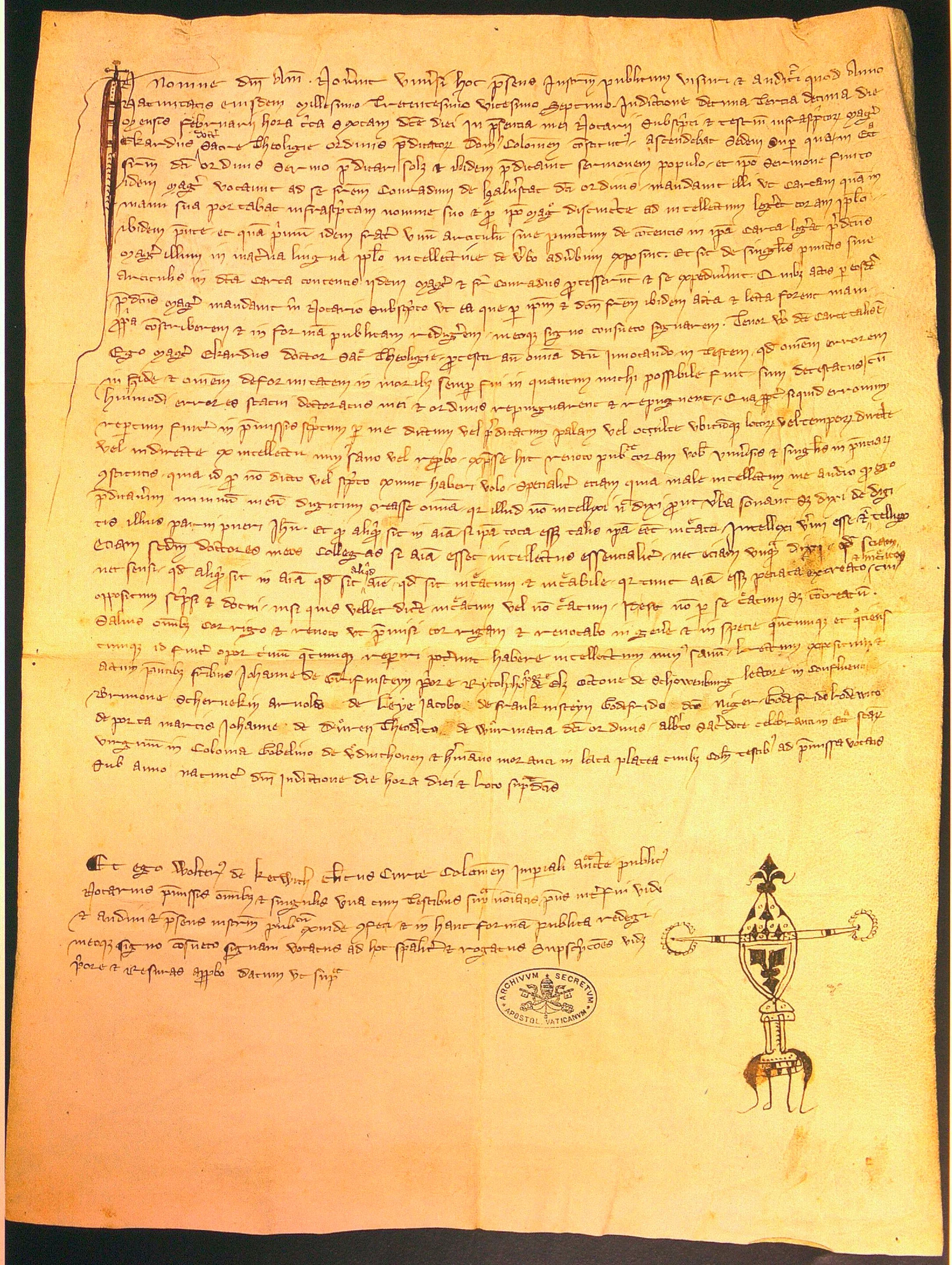
Meister Eckhart (about 1260-1328) was a German Dominican friar and teacher at Paris and Cologne. His sermons in Middle High German, preached mostly to nuns and lay people, speak of the birth of the Word in the ground of the soul, of letting go of every image, even of 'God', and of the Godhead beyond all names. Some of his statements were condemned after his death. Ten sermons are given here: the temple cleared, the little castle, God's ground as my ground, the poor in spirit, the one eye. Rendered in his own Christian sense first.
So the little word I set before you, 'God has sent his only-begotten Son into the world,' you should not take to mean the outer world, where he ate and drank with us; you should take it to mean the inner world. As truly as the Father in his simple nature begets his Son by nature, so truly he begets him in the innermost of the spirit, and that is the inner world.
Here God's is my and my is God's . Here I live from my own as God lives from his own. Whoever has looked into this even for a moment, to him a thousand marks of red minted gold are like a false penny. From this innermost you should do all your works .
God's ground is my ground and my ground is God's ground.
The person who stands in God's will in this way wants nothing other than what God is and what God's will is. If he were sick, he would not want to be well. All pain is a joy to him, all multiplicity is to him a bareness and a oneness, if he truly stands in God's will. Yes, even if the pain of hell depended on it, it would be joy and happiness to him. He is free and gone out of himself, and he must be free of all that he is to receive.
If my eye is to see colour, it must be free of all colour. If I see blue or white, the sight of my eye that sees the colour, the very thing that sees, is the same as what is seen by the eye. The eye in which I see God is the same eye in which God sees me: my eye and God's eye is one eye, and one seeing, and one knowing, and one love.
The eye in which I see God is the same eye in which God sees me.
What most readings miss
Eckhart is read either as a heretic who erased the line between God and creature, or as a preacher whose boldest lines are only rhetoric. The sermons are more careful than both. He keeps the difference: God is wholly in the soul 'and yet he is not the soul' (LVI.7). But in the ground there is 'one and not united' (XCVI.6), my eye and God's eye are one eye (XCVI.9), and the last poverty is to be no place for God (LXXXVII.10). None of it asks for leaving life: God is found by the fire and in the stable (XIII.6), and works are done 'without a why' (VI.2). This is close to Advaita: the I-claim falls, and the Godhead beyond 'God' answers to the whole beyond the order of things. It parts where Eckhart insists on grace and a created soul.