Naradaparivrajaka Upanishad
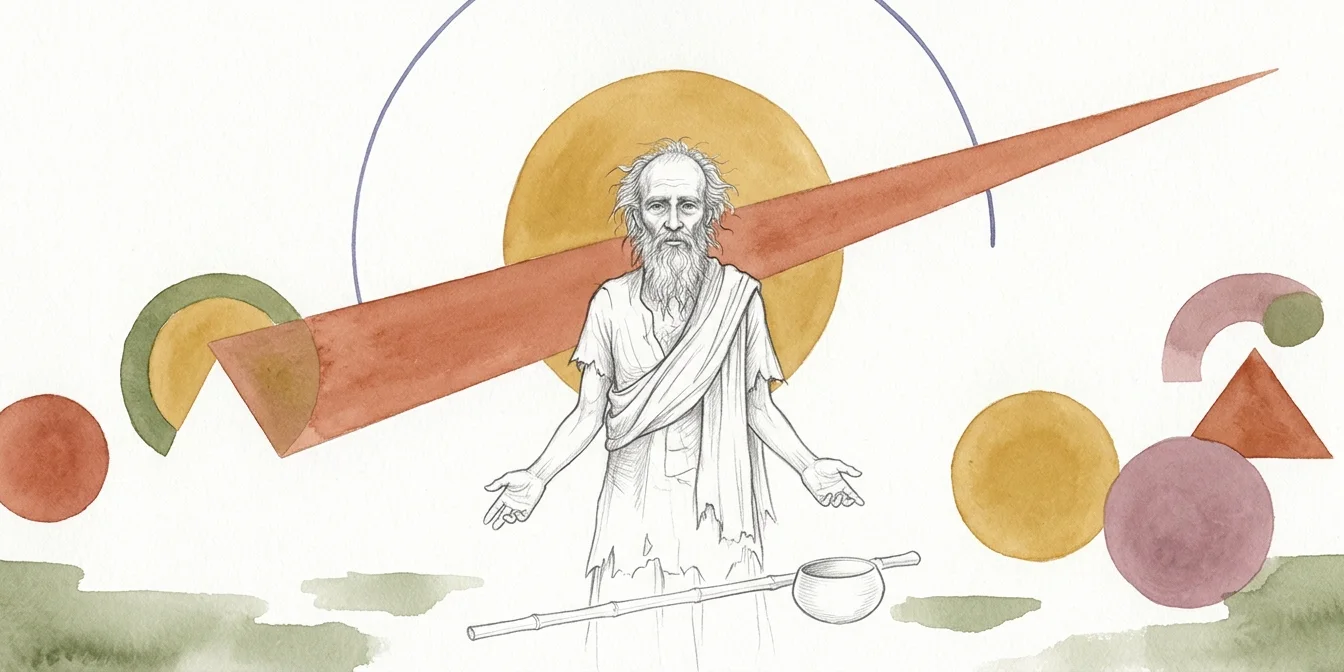
In the words of Pranav Ashar
How we renderThe heart of the Naradaparivrajaka
In brief
The Naradaparivrajaka begins with a whole life lived to its end and a renunciation that grows out of it, and ends with a wanderer who owns nothing and knows himself as Brahman. Between them it gives the rules of the renunciant's life in great detail. But at each step it undercuts its own rules: the mark of renunciation is knowledge, not the staff; for the knower of Brahman there is no rule and no prohibition. Its practice is a way of seeing, 'I am Brahman', held through waking, dream and sleep.
- Renunciation grows from ripeness
- Knowledge is the mark, not the staff
- The orders of monk and their rules
- 'I am Brahman' through every state
- No rule for the knower
- Om and the four quarters of the Self
Contents
- Opening
- 1
- 2
- 3.1
- 3.2
- 3.3
- 3.4
- 3.5
- 3.6
- 3.7
- 3.8
- 3.9
- 3.10
- 3.11
- 3.12
- 3.13
- 3.14
- 3.15
- 3.16
- 3.17
- 3.18
- 3.19
- 3.20
- 3.21
- 3.22
- 3.23
- 3.24
- 3.25
- 3.26
- 3.27
- 3.28
- 3.29
- 3.30
- 3.31
- 3.32
- 3.33
- 3.34
- 3.35
- 3.36
- 3.37
- 3.38
- 3.39
- 3.40
- 3.41
- 3.42
- 3.43
- 3.44
- 3.45
- 3.46
- 3.47
- 3.48
- 3.49
- 3.50
- 3.51
- 3.52
- 3.53
- 3.54
- 3.55
- 3.56
- 3.57
- 3.58
- 3.59
- 3.60
- 3.61
- 3.62
- 3.63
- 3.64
- 3.65
- 3.66
- 3.67
- 3.68
- 3.69
- 3.70
- 3.71
- 3.72
- 3.73
- 3.74
- 3.75
- 3.76
- 3.77
- 3.78
- 3.79
- 3.80
- 3.81
- 3.82
- 3.83
- 3.84
- 3.85
- 3 Closing
- 4.1
- 4.2
- 4.3
- 4.4
- 4.5
- 4.6
- 4.7
- 4.8
- 4.9
- 4.10
- 4.11
- 4.12
- 4.13
- 4.14
- 4.15
- 4.16
- 4.17
- 4.18
- 4.19
- 4.20
- 4.21
- 4.22
- 4.23
- 4.24
- 4.25
- 4.26
- 4.27
- 4.28
- 4.29
- 4.30
- 4.31
- 4.32
- 4.33
- 4.34
- 4.35
- 4.36
- 4.37
- 4 Rite 1
- 4 Rite 2
- 4 Rite 3
- 5 Prose 1
- 5 Prose 2
- 5 Prose 3
- 5 Prose 4
- 5 Prose 5
- 5 Prose 6
- 5 Prose 7
- 5 Prose 8
- 5.1
- 5.2
- 5.3
- 5.4
- 5.5
- 5.6
- 5.7
- 5.8
- 5.9
- 5.10
- 5.11
- 5.12
- 5.13
- 5.14
- 5.15
- 5.16
- 5.17
- 5.18
- 5.19
- 5.20
- 5.21
- 5.22
- 5.23
- 5.24
- 5.25
- 5.26
- 5.27
- 5.28
- 5.29
- 5.30
- 5.31
- 5.32
- 5.33
- 5.34
- 5.35
- 5.36
- 5.37
- 5.38
- 5 Closing
- 6 Prose 1
- 6 Prose 2
- 6 Prose 3
- 6 Prose 4
- 6 Prose 5
- 6.1
- 6.2
- 6.3
- 6.4
- 6.5
- 6.6
- 6.7
- 6.8
- 6.9
- 6.10
- 6.11
- 6.12
- 6.13
- 6.14
- 6.15
- 6.16
- 6.17
- 6.18
- 6.19
- 6.20
- 6.21
- 6.22
- 6.23
- 6.24
- 6.25
- 6.26
- 6.27
- 6.28
- 6.29
- 6.30
- 6.31
- 6.32
- 6.33
- 6.34
- 6.35
- 6.36
- 6.37
- 6 Closing
- 7
- 8 Prose
- 8.1
- 8.2
- 8.3
- 8.4
- 8.5
- 8.6
- 8.7
- 8.8
- 8.9
- 8.10
- 8.11
- 8.12
- 8.13
- 8.14
- 8.15
- 8.16
- 8.17
- 8.18
- 8.19
- 8 Closing
- 9 Prose
- 9.1
- 9.2
- 9.3
- 9.4
- 9.5
- 9.6
- 9.7
- 9.8
- 9.9
- 9.10
- 9.11
- 9.12
- 9.13
- 9.14
- 9.15
- 9.16
- 9.17a
- 9.17b
- 9.18
- 9 Closing
पारिव्राज्यधर्मपूगालङ्कारा यत्प्रबोधतः । दशप्रणवलक्ष्यार्थं यान्ति तं राममाश्रये ॥
pārivrājyadharmapūgālaṅkārā yatprabodhataḥ | daśapraṇavalakṣyārthaṃ yānti taṃ rāmamāśraye ||
Those adorned with all the duties of the wandering life reach, by awakening to him, what the tenfold Om points to: in him, Rama, I take refuge.
Note //
A dedicatory verse from the commentator's tradition (Upanishad Brahmayogin), placed before the text; it is not part of the numbered text. The edition then gives a half-verse listing the Upanishads that share this peace invocation.
अथ कदाचित्परिव्राजकाभरणो नारदः सर्वलोकसंचारं कुर्वन्नपूर्वपुण्यस्थलानि पुण्यतीर्थानि तीर्थीकुर्वन्नवलोक्य चित्तशुद्धिं प्राप्य निर्वैरः शान्तो दान्तः सर्वतो निर्वेदमासाद्य स्वरूपानुसन्धानमनुसन्धाय नियमानन्दविशेषगण्यं मुनिजनैरुपसंकीर्णं नैमिषारण्यं पुण्यस्थलमवलोक्य सरिगमपधनिससंज्ञैर्वैराग्यबोधकरैः स्वरविशेषैः प्रापञ्चिकपराङ्मुखैर्हरिकथालापैः स्थावरजङ्गमनामकैर्भगवद्भक्तिविशेषैर्नरमृगकिंपुरुषामरकिंनराप्सरोगणान्संमोहयन्नागतं ब्रह्मात्मजं भगवद्भक्तं नारदमवलोक्य द्वादशवर्षसत्रयागोपस्थिताः श्रुताध्ययनसम्पन्नाः सर्वज्ञास्तपोनिष्ठापराश्च ज्ञानवैराग्यसम्पन्नाः शौनकादिमहर्षयः प्रत्युत्थानं कृत्वा नत्वा यथोचितातिथ्यपूर्वकमुपवेशयित्वा स्वयं सर्वेऽप्युपविष्टा भो भगवन्ब्रह्मपुत्र कथं मुक्त्युपायोऽस्माकं वक्तव्य इत्युक्तस्तान्स होवाच नारदः सत्कुलभवोपनीतः सम्यगुपनयनपूर्वकं चतुश्चत्वारिंशत्संस्कारसम्पन्नः स्वाभिमतैकगुरुसमीपे स्वशाखाध्ययनपूर्वकं सर्वविद्याभ्यासं कृत्वा द्वादशवर्षशुश्रूषापूर्वकं ब्रह्मचर्यं पञ्चविंशतिवत्सरं गार्हस्थ्यं पञ्चविंशतिवत्सरं वानप्रस्थाश्रमं तद्विधिवत्क्रमान्निर्वर्त्य चतुर्विधब्रह्मचर्यं षड्विधं गार्हस्थ्यं चतुर्विधं वानप्रस्थधर्मं सम्यगभ्यस्य तदुचितं कर्म सर्वं निर्वर्त्य साधनचतुष्टयसम्पन्नः सर्वसंसारोपरि मनोवाक्कायकर्मभिर्यथाशानिवृत्तस्तथा वासनैषणोपर्यपि निर्वैरः शान्तो दान्तः संन्यासी परमहंसाश्रमेणास्खलितस्वस्वरूपध्यानेन देहत्यागं करोति स मुक्तो भवति स मुक्तो भवतीत्युपनिषत् ॥ १॥
atha kadācitparivrājakābharaṇo nāradaḥ sarvalokasaṃcāraṃ kurvannapūrvapuṇyasthalāni puṇyatīrthāni tīrthīkurvannavalokya cittaśuddhiṃ prāpya nirvairaḥ śānto dāntaḥ sarvato nirvedamāsādya svarūpānusandhānamanusandhāya niyamānandaviśeṣagaṇyaṃ munijanairupasaṃkīrṇaṃ naimiṣāraṇyaṃ puṇyasthalamavalokya sarigamapadhanisasaṃjñairvairāgyabodhakaraiḥ svaraviśeṣaiḥ prāpañcikaparāṅmukhairharikathālāpaiḥ sthāvarajaṅgamanāmakairbhagavadbhaktiviśeṣairnaramṛgakiṃpuruṣāmarakiṃnarāpsarogaṇānsaṃmohayannāgataṃ brahmātmajaṃ bhagavadbhaktaṃ nāradamavalokya dvādaśavarṣasatrayāgopasthitāḥ śrutādhyayanasampannāḥ sarvajñāstaponiṣṭhāparāśca jñānavairāgyasampannāḥ śaunakādimaharṣayaḥ pratyutthānaṃ kṛtvā natvā yathocitātithyapūrvakamupaveśayitvā svayaṃ sarve'pyupaviṣṭā bho bhagavanbrahmaputra kathaṃ muktyupāyo'smākaṃ vaktavya ityuktastānsa hovāca nāradaḥ satkulabhavopanītaḥ samyagupanayanapūrvakaṃ catuścatvāriṃśatsaṃskārasampannaḥ svābhimataikagurusamīpe svaśākhādhyayanapūrvakaṃ sarvavidyābhyāsaṃ kṛtvā dvādaśavarṣaśuśrūṣāpūrvakaṃ brahmacaryaṃ pañcaviṃśativatsaraṃ gārhasthyaṃ pañcaviṃśativatsaraṃ vānaprasthāśramaṃ tadvidhivatkramānnirvartya caturvidhabrahmacaryaṃ ṣaḍvidhaṃ gārhasthyaṃ caturvidhaṃ vānaprasthadharmaṃ samyagabhyasya taducitaṃ karma sarvaṃ nirvartya sādhanacatuṣṭayasampannaḥ sarvasaṃsāropari manovākkāyakarmabhiryathāśānivṛttastathā vāsanaiṣaṇoparyapi nirvairaḥ śānto dāntaḥ saṃnyāsī paramahaṃsāśrameṇāskhalitasvasvarūpadhyānena dehatyāgaṃ karoti sa mukto bhavati sa mukto bhavatītyupaniṣat || 1||
Once Narada, the ornament of wandering ascetics, was travelling through all the worlds. Making holy places holier by his visit, his mind made pure, without enmity, calm, restrained, having turned away from everything, and resting in attention to his own nature, he saw the holy Naimisha forest, crowded with sages, rich in the joy of discipline. He came there, enchanting the crowds of men, animals, kimpurushas, gods, kinnaras and apsarases with songs about Hari, in the notes sa, ri, ga, ma, pa, dha, ni, songs that awaken dispassion, turn the mind from the world, and stir devotion in all that moves and does not move. Shaunaka and the other great sages, who had gathered for a sacrifice of twelve years, learned in the Veda, knowing all, firm in austerity, rich in knowledge and dispassion, saw Narada, son of Brahma, devotee of the Lord, rose to meet him, bowed, and, receiving him as a guest, seated him. Then they sat down themselves and said: 'Lord, son of Brahma, tell us the way to freedom.' Narada said to them: 'One born in a good family, having received the sacred thread and the forty-four rites, studies his own branch of the Veda and all branches of knowledge under a teacher of his choosing; he keeps the student's life for twelve years in service, the householder's life for twenty-five years, the forest life for twenty-five years, completing each in order, according to its rules. Having practised well the four kinds of student life, the six kinds of household life and the four kinds of forest life, and done all the work that belongs to them, he gains the fourfold means. Then, his desire for the whole round of becoming turned back in mind, speech, body and action, and turned back too from tendencies and cravings, without enmity, calm, restrained, the renunciant, in the life of the highest swan, leaves the body in unbroken meditation on his own nature. He is free; he is free.' Such is the Upanishad.
Note //
The fourfold means (sadhana chatushtaya): discrimination, dispassion, the six virtues beginning with calm, and the longing for freedom. 'The highest swan' (paramahamsa): the highest order of renunciant. The edition's अनुसन्धय, पराङ्मुखाइर्, विशेषाइर् and किंनर-अप्सरो are corrected to अनुसन्धाय, पराङ्मुखैर्, विशेषैर् and किंनराप्सरो; यथाशानिवृत्तस् is obscure and kept as printed.
अथ हैनं भगवन्तं नारदं सर्वे शौनकादयः पप्रच्छुर्भो भगवन्संन्यासविधिं नो ब्रूहीति तानवलोक्य नारदस्तत्स्वरूपं सर्वं पितामहमुखेनैव ज्ञातुमुचितमित्युक्त्वा सत्रयागपूर्त्यनन्तरं तैः सह सत्यलोकं गत्वा विधिवद्ब्रह्मनिष्ठापरं परमेष्ठिनं नत्वा स्तुत्वा यथोचितं तदाज्ञया तैः सहोपविश्य नारदः पितामहमुवाच गुरुस्त्वं जनकस्त्वं सर्वविद्यारहस्यज्ञः सर्वज्ञस्त्वमतो मत्तो मदिष्टं रहस्यमेकं वक्तव्यं त्वद्विना मदभिमतरहस्यं वक्तुं कः समर्थः । किमितिचेत्पारिव्राज्यस्वरूपक्रमं नो ब्रूहीति नारदेन प्रार्थितः परमेष्ठी सर्वतः सर्वानवलोक्य मुहूर्तमात्रं समाधिनिष्ठो भूत्वा संसारार्तिनिवृत्त्यन्वेषण इति निश्चित्य नारदमवलोक्य तमाह पितामहः । पुरा मत्पुत्र पुरुषसूक्तोपनिषद्रहस्यप्रकारं निरतिशयाकारावलम्बिना विराट्पुरुषेणोपदिष्टं रहस्यं ते विविच्योच्यते तत्क्रममतिरहस्यं बाढमवहितो भूत्वा श्रूयतां भो नारद विधिवदादावनुपनीतोपनयानन्तरं तत्सत्कुलप्रसूतः पितृमातृविधेयः पितृसमीपादन्यत्र सत्सम्प्रदायस्थं श्रद्धावन्तं सत्कुलभवं श्रोत्रियं शास्त्रवात्सल्यं गुणवन्तमकुटिलं सद्गुरुमासाद्य नत्वा यथोपयोगशुश्रूषापूर्वकं स्वाभिमतं विज्ञाप्य द्वादशवर्षसेवापुरःसरं सर्वविद्याभ्यासं कृत्वा तदनुज्ञया स्वकुलानुरूपामभिमतकन्यां विवाह्य पञ्चविंशतिवत्सरं गुरुकुलवासं कृत्वाथ गुर्वनुज्ञया गृहस्थोचितकर्म कुर्वन्दौर्ब्राह्मण्यनिवृत्तिमेत्य स्ववंशवृद्धिकामः पुत्रमेकमासाद्य गार्हस्थ्योचितपञ्चविंशतिवत्सरं तीर्त्वा ततः पञ्चविंशतिवत्सरपर्यन्तं त्रिषवणमुदकस्पर्शनपूर्वकं चतुर्थकालमेकवारमाहारमाहरन्नयमेक एव वनस्थो भूत्वा पुरग्रामप्राक्तनसञ्चारं विहाय निकारविरहिततदाश्रितकर्मोचितकृत्यं निर्वर्त्य दृष्टश्रवणविषयवैतृष्ण्यमेत्य चत्वारिंशत्संस्कारसम्पन्नः सर्वतो विरक्तश्चित्तशुद्धिमेत्याशासूयेर्ष्याहङ्कारं दग्ध्वा साधनचतुष्टयसम्पन्नः संन्यस्तुमर्हतीत्युपनिषत् ॥ २॥
atha hainaṃ bhagavantaṃ nāradaṃ sarve śaunakādayaḥ papracchurbho bhagavansaṃnyāsavidhiṃ no brūhīti tānavalokya nāradastatsvarūpaṃ sarvaṃ pitāmahamukhenaiva jñātumucitamityuktvā satrayāgapūrtyanantaraṃ taiḥ saha satyalokaṃ gatvā vidhivadbrahmaniṣṭhāparaṃ parameṣṭhinaṃ natvā stutvā yathocitaṃ tadājñayā taiḥ sahopaviśya nāradaḥ pitāmahamuvāca gurustvaṃ janakastvaṃ sarvavidyārahasyajñaḥ sarvajñastvamato matto madiṣṭaṃ rahasyamekaṃ vaktavyaṃ tvadvinā madabhimatarahasyaṃ vaktuṃ kaḥ samarthaḥ | kimiticetpārivrājyasvarūpakramaṃ no brūhīti nāradena prārthitaḥ parameṣṭhī sarvataḥ sarvānavalokya muhūrtamātraṃ samādhiniṣṭho bhūtvā saṃsārārtinivṛttyanveṣaṇa iti niścitya nāradamavalokya tamāha pitāmahaḥ | purā matputra puruṣasūktopaniṣadrahasyaprakāraṃ niratiśayākārāvalambinā virāṭpuruṣeṇopadiṣṭaṃ rahasyaṃ te vivicyocyate tatkramamatirahasyaṃ bāḍhamavahito bhūtvā śrūyatāṃ bho nārada vidhivadādāvanupanītopanayānantaraṃ tatsatkulaprasūtaḥ pitṛmātṛvidheyaḥ pitṛsamīpādanyatra satsampradāyasthaṃ śraddhāvantaṃ satkulabhavaṃ śrotriyaṃ śāstravātsalyaṃ guṇavantamakuṭilaṃ sadgurumāsādya natvā yathopayogaśuśrūṣāpūrvakaṃ svābhimataṃ vijñāpya dvādaśavarṣasevāpuraḥsaraṃ sarvavidyābhyāsaṃ kṛtvā tadanujñayā svakulānurūpāmabhimatakanyāṃ vivāhya pañcaviṃśativatsaraṃ gurukulavāsaṃ kṛtvātha gurvanujñayā gṛhasthocitakarma kurvandaurbrāhmaṇyanivṛttimetya svavaṃśavṛddhikāmaḥ putramekamāsādya gārhasthyocitapañcaviṃśativatsaraṃ tīrtvā tataḥ pañcaviṃśativatsaraparyantaṃ triṣavaṇamudakasparśanapūrvakaṃ caturthakālamekavāramāhāramāharannayameka eva vanastho bhūtvā puragrāmaprāktanasañcāraṃ vihāya nikāravirahitatadāśritakarmocitakṛtyaṃ nirvartya dṛṣṭaśravaṇaviṣayavaitṛṣṇyametya catvāriṃśatsaṃskārasampannaḥ sarvato viraktaścittaśuddhimetyāśāsūyerṣyāhaṅkāraṃ dagdhvā sādhanacatuṣṭayasampannaḥ saṃnyastumarhatītyupaniṣat || 2||
Then Shaunaka and all the others asked the lord Narada: 'Lord, tell us the rules of renunciation.' Looking at them, Narada said: 'It is right to learn all of it from the mouth of the grandfather himself.' When the sacrifice was complete, he went with them to the world of truth, bowed to the supreme one, Brahma, who was absorbed in Brahman, praised him as was fitting, and at his bidding sat down with them. Narada said to the grandfather: 'You are the teacher, you are the father, you know the secret of all knowledge, you know all. So tell me a secret that is dear to me. Who but you could tell it? What is it? Tell us the true nature and order of the wandering life.' So asked by Narada, the supreme one looked at all of them on every side, rested a moment in absorption, and, satisfied that the question came from a wish to be free of the pain of becoming, looked at Narada and said: 'My son, the secret that was taught long ago by the cosmic Person of limitless form, in the way of the secret teaching of the Hymn of the Person, I will tell you in detail. It is a great secret; listen with full attention. Narada, one born in a good family, obedient to father and mother, after his initiation, in due order, should find, away from his father, a true teacher of a good tradition: one with faith, of good family, learned in the Veda, loving the scriptures, of good qualities, without guile. He should bow to him, serve him as is fitting, make his wish known, and, serving him for twelve years, study every branch of knowledge. Then, with his permission, he should marry a girl suited to his family and dear to him. After twenty-five years with his teacher, with his teacher's leave, he does the work of a householder, ends unworthiness as a Brahmin, and, wishing to continue his line, has one son. Having passed twenty-five years in the household life, for twenty-five years more he bathes three times a day and eats once, at the fourth meal-time, living alone in the forest, giving up his old wanderings in town and village. He does the work of that stage without wanting its fruit, and becomes free of thirst for what is seen and heard. Rich in the forty rites, turned away from everything, his mind made pure, having burnt desire, envy, jealousy and the I-claim, endowed with the fourfold means, he is fit to renounce.' Such is the Upanishad.
Note //
'The Hymn of the Person' (Purusha Sukta, Rig Veda 10.90). The edition's रहसज्ञः, पञ्चचिंशति, संकार and संसारातिनिवृत्यन्वेषण are corrected to रहस्यज्ञः, पञ्चविंशति, संस्कार and संसारार्तिनिवृत्त्यन्वेषण ('a wish to be free of the pain of becoming', as Aiyar). The text's numbers of years and rites differ between teachings 1 and 2 (forty-four and forty rites); both are kept.
अथ हैनं नारदः पितामहं पप्रच्छ भगवन्केन संन्यासाधिकारी वेत्येवमादौ संन्यासाधिकारिणं निरूप्य पश्चात्संन्यासविधिरुच्यते अवहितः शृणु । अथ षण्डः पतितोऽङ्गविकलः स्त्रैणो बधिरोऽर्भको मूकः पाषण्डश्चक्री लिङ्गी वैखानसहरद्विजौ भृतकाध्यापकः शिपिविष्टोऽनग्निको वैराग्यवन्तोऽप्येते न संन्यासार्हाः संन्यस्ता यद्यपि महावाक्योपदेशे नाधिकारिणः पूर्वसंन्यासी परमहंसाधिकारी ॥-परेणैवात्मनश्चापि परस्यैवात्मना तथा । अभयं समवाप्नोति स परिव्राडिति स्मृतिः ॥ १॥
atha hainaṃ nāradaḥ pitāmahaṃ papraccha bhagavankena saṃnyāsādhikārī vetyevamādau saṃnyāsādhikāriṇaṃ nirūpya paścātsaṃnyāsavidhirucyate avahitaḥ śṛṇu | atha ṣaṇḍaḥ patito'ṅgavikalaḥ straiṇo badhiro'rbhako mūkaḥ pāṣaṇḍaścakrī liṅgī vaikhānasaharadvijau bhṛtakādhyāpakaḥ śipiviṣṭo'nagniko vairāgyavanto'pyete na saṃnyāsārhāḥ saṃnyastā yadyapi mahāvākyopadeśe nādhikāriṇaḥ pūrvasaṃnyāsī paramahaṃsādhikārī ||-pareṇaivātmanaścāpi parasyaivātmanā tathā | abhayaṃ samavāpnoti sa parivrāḍiti smṛtiḥ || 1||
Then Narada asked the grandfather: 'Lord, who is fit for renunciation?' 'First I will describe who is fit, then the rule of renunciation will be told. Listen with attention. The impotent, the outcaste, the maimed, the one given to women, the deaf, the child, the dumb, the heretic, the one who bears the discus mark, the one who bears the linga, the forest-dweller of the Vaikhanasa order, the priest of Hara's banner, the one who teaches for wages, the bald from disease, the one without the sacred fires: even if they have dispassion, these are not fit for renunciation. Even if they have renounced, they are not fit to be taught the great sayings. The one who renounces as described before is fit for the highest renunciation. "One who has nothing to fear from others, and from whom others have nothing to fear, is called a wanderer": so says tradition.
Note //
The lists of the excluded (3.1-3.3) reflect the rules of the text's time and are rendered as a record. Aiyar takes 'the discus-bearer' and 'the linga-wearer' as members of sects. The edition's महावाक्योपदेशेन अधिकारिणः is corrected to महावाक्योपदेशे नाधिकारिणः ('not fit to be taught the great sayings'), as Aiyar requires.
षण्डोऽथ विकलोऽप्यन्धो बालकश्चापि पातकी । पतितश्च परद्वारी वैखानसहरद्विजौ ॥ २॥
ṣaṇḍo'tha vikalo'pyandho bālakaścāpi pātakī | patitaśca paradvārī vaikhānasaharadvijau || 2||
The impotent, the maimed, the blind, the child, the sinner, the outcaste, the one who goes to others' wives, the forest-dweller of the Vaikhanasa order, the priest of Hara,
Note //
चक्री लिङ्गी च पाषण्डी शिपिविष्टोऽप्यनग्निकः । द्वित्रिवारेण संन्यस्तो भृतकाध्यापकोऽपि च । एते नार्हन्ति संन्यासमातुरेण विना क्रमम् ॥ ३॥
cakrī liṅgī ca pāṣaṇḍī śipiviṣṭo'pyanagnikaḥ | dvitrivāreṇa saṃnyasto bhṛtakādhyāpako'pi ca | ete nārhanti saṃnyāsamātureṇa vinā kramam || 3||
the discus-bearer, the linga-bearer, the heretic, the bald from disease, the one without the sacred fires, the one who has renounced two or three times, and the one who teaches for wages: these are not fit for renunciation in the regular order, only for the renunciation of the afflicted.
Note //
आतुरकालः कथमार्यसंमतः ॥-प्राणस्योत्क्रमणासन्नकालस्त्वातुरसंज्ञकः । नेतरस्त्वातुरः कालो मुक्तिमार्गप्रवर्तकः ॥ ४॥
āturakālaḥ kathamāryasaṃmataḥ ||-prāṇasyotkramaṇāsannakālastvāturasaṃjñakaḥ | netarastvāturaḥ kālo muktimārgapravartakaḥ || 4||
What is the time of affliction, as the noble ones hold? The time when the breath is about to leave the body is called affliction. No other time of affliction opens the path to freedom.
Note //
Atura-sannyasa, 'the renunciation of the afflicted': renunciation taken at the point of death.
आतुरेऽपि च संन्यासे तत्तन्मन्त्रपुरःसरम् । मन्त्रावृत्तिं च कृत्वैव संन्यसेद्विधिवद्बुधः ॥ ५॥
āture'pi ca saṃnyāse tattanmantrapuraḥsaram | mantrāvṛttiṃ ca kṛtvaiva saṃnyasedvidhivadbudhaḥ || 5||
Even in the renunciation of the afflicted, the wise one should renounce according to rule, preceded by the proper mantras, repeating the mantras.
Note //
आतुरेऽपि क्रमे वापि प्रैषभेदो न कुत्रचित् । न मन्त्रं कर्मरहितं कर्म मन्त्रमपेक्षते ॥ ६॥
āture'pi krame vāpi praiṣabhedo na kutracit | na mantraṃ karmarahitaṃ karma mantramapekṣate || 6||
Whether in affliction or in the regular order, there is no difference in the call of renunciation. No mantra is without action, and action needs the mantra.
Note //
अकर्म मन्त्ररहितं नातो मन्त्रं परित्यजेत् । मन्त्रं विना कर्म कुर्याद्भस्मन्याहुतिवद्भवेत् ॥ ७॥
akarma mantrarahitaṃ nāto mantraṃ parityajet | mantraṃ vinā karma kuryādbhasmanyāhutivadbhavet || 7||
Without mantra it is no action; so do not give up the mantra. Action done without mantra is like an offering poured on ashes.
Note //
विध्युक्तकर्मसंक्षेपात्संन्यासस्त्वातुरः स्मृतः । तस्मादातुरसंन्यासे मन्त्रावृत्तिविधिर्मुने ॥ ८॥
vidhyuktakarmasaṃkṣepātsaṃnyāsastvāturaḥ smṛtaḥ | tasmādāturasaṃnyāse mantrāvṛttividhirmune || 8||
Renunciation in affliction is known as the rule of action shortened. So, sage, in the renunciation of the afflicted the rule is to repeat the mantras.
Note //
आहिताग्निर्विरक्तश्चेद्देशान्तरगतो यदि । प्राजापत्येष्टिमप्स्वेव निर्वृत्यैवाथ संन्यसेत् ॥ ९॥
āhitāgnirviraktaśceddeśāntaragato yadi | prājāpatyeṣṭimapsveva nirvṛtyaivātha saṃnyaset || 9||
If one who keeps the sacred fires becomes dispassionate while in another country, he should perform the Prajapati offering in water and then renounce.
Note //
मनसा वाथ विध्युक्तमन्त्रावृत्त्याथवा जले । श्रुत्यनुष्ठानमार्गेण कर्मानुष्ठानमेव वा ॥ १०॥
manasā vātha vidhyuktamantrāvṛttyāthavā jale | śrutyanuṣṭhānamārgeṇa karmānuṣṭhānameva vā || 10||
Either in the mind, or by repeating the mantras the rule prescribes, or in water, or by the way the Veda lays down, or by performing the rite itself,
Note //
समाप्य संन्यसेद्विद्वान्नो चेत्पातित्यमाप्नुयात् ॥ ११॥
samāpya saṃnyasedvidvānno cetpātityamāpnuyāt || 11||
having completed it, the wise should renounce; otherwise he falls.
Note //
यदा मनसि सञ्जातं वैतृष्ण्यं सर्ववस्तुषु । तदा संन्यासमिच्छेत पतितः स्याद्विपर्यये ॥ १२॥
yadā manasi sañjātaṃ vaitṛṣṇyaṃ sarvavastuṣu | tadā saṃnyāsamiccheta patitaḥ syādviparyaye || 12||
When indifference to all things has arisen in the mind, then one should wish to renounce; otherwise one falls.
Note //
विरक्तः प्रव्रजेद्धीमान्सरक्तस्तु गृहे वसेत् । सरागो नरकं याति प्रव्रजन्हि द्विजाधमः ॥ १३॥
viraktaḥ pravrajeddhīmānsaraktastu gṛhe vaset | sarāgo narakaṃ yāti pravrajanhi dvijādhamaḥ || 13||
The dispassionate wise one should go forth; the one with passion should stay at home. The one with passion who goes forth goes to hell, the lowest of the twice-born.
Note //
यस्यैतानि सुगुप्तानि जिह्वोपस्थोदरं करः । संन्यसेदकृतोद्वाहो ब्राह्मणो ब्रह्मचर्यवान् ॥ १४॥
yasyaitāni suguptāni jihvopasthodaraṃ karaḥ | saṃnyasedakṛtodvāho brāhmaṇo brahmacaryavān || 14||
The Brahmin whose tongue, sex, belly and hands are well guarded may renounce without marrying, living in chastity.
Note //
संसारमेव निःसारं दृष्ट्वा सारदिदृक्षया । प्रव्रजन्त्यकृतोद्वाहाः परं वैराग्यमाश्रिताः ॥ १५॥
saṃsārameva niḥsāraṃ dṛṣṭvā sāradidṛkṣayā | pravrajantyakṛtodvāhāḥ paraṃ vairāgyamāśritāḥ || 15||
Seeing that the round of becoming has no substance, wishing to see what has substance, some go forth without marrying, resting in the highest dispassion.
Note //
प्रवृत्तिलक्षणं कर्म ज्ञानं संन्यासलक्षणम् । तस्माज्ज्ञानं पुरस्कृत्य संन्यसेदिह बुद्धिवान् ॥ १६॥
pravṛttilakṣaṇaṃ karma jñānaṃ saṃnyāsalakṣaṇam | tasmājjñānaṃ puraskṛtya saṃnyasediha buddhivān || 16||
Action is the mark of ; knowledge is the mark of renunciation. So the wise, putting knowledge first, should renounce here.
Note //
Pravritti, the life of activity, and nivritti, the life of withdrawal, are marked by action and knowledge. The verse places renunciation in knowledge, not in the outward act.
यदा तु विदितं तत्त्वं परं ब्रह्म सनातनम् । तदैकदण्डं संगृह्य सोपवीतां शिखां त्यजेत् ॥ १७॥
yadā tu viditaṃ tattvaṃ paraṃ brahma sanātanam | tadaikadaṇḍaṃ saṃgṛhya sopavītāṃ śikhāṃ tyajet || 17||
When the truth has been known, the highest, eternal Brahman, then, taking a single staff, one should give up the tuft with the sacred thread.
Note //
परमात्मनि यो रक्तो विरक्तोऽपरमात्मनि । सर्वैषणाविनिर्मुक्तः स भैक्षं भोक्तुमर्हति ॥ १८॥
paramātmani yo rakto virakto'paramātmani | sarvaiṣaṇāvinirmuktaḥ sa bhaikṣaṃ bhoktumarhati || 18||
One who delights in the highest Self and is without passion for what is not the highest Self, free of every craving, is fit to live on alms.
Note //
पूजितो वन्दितश्चैव सुप्रसन्नो यथा भवेत् । तथा चेत्ताड्यमानस्तु तदा भवति भैक्षभुक् ॥ १९॥
pūjito vanditaścaiva suprasanno yathā bhavet | tathā cettāḍyamānastu tadā bhavati bhaikṣabhuk || 19||
If one is as calm when beaten as when honoured and saluted, then one is fit to live on alms.
Note //
अहमेवाक्षरं ब्रह्म वासुदेवाख्यमद्वयम् । इति भावो ध्रुवो यस्य तदा भवति भैक्षभुक् ॥ २०॥
ahamevākṣaraṃ brahma vāsudevākhyamadvayam | iti bhāvo dhruvo yasya tadā bhavati bhaikṣabhuk || 20||
'I alone am the imperishable Brahman, called Vasudeva, not two': when this conviction is firm, then one is fit to live on alms.
Note //
यस्मिञ्शान्तिः शमः शौचं सत्यं सन्तोष आर्जवम् । अकिञ्चनमदम्भश्च स कैवल्याश्रमे वसेत् ॥ २१॥
yasmiñśāntiḥ śamaḥ śaucaṃ satyaṃ santoṣa ārjavam | akiñcanamadambhaśca sa kaivalyāśrame vaset || 21||
One in whom there is peace, calm, purity, truth, contentment, straightforwardness, owning nothing, without pretence, lives in the stage of the alone.
Note //
Kaivalyashrama, 'the stage of the alone': the life of renunciation as a life of aloneness, kaivalya, which is also the name of freedom.
यदा न कुरुते भावं सर्वभूतेषु पापकम् । कर्मणा मनसा वाचा तदा भवति भैक्षभुक् ॥ २२॥
yadā na kurute bhāvaṃ sarvabhūteṣu pāpakam | karmaṇā manasā vācā tadā bhavati bhaikṣabhuk || 22||
When one bears no ill will towards any being, in action, mind or speech, then one is fit to live on alms.
Note //
दशलक्षणकं धर्ममनुतिष्ठन्समाहितः । वेदान्तान्विधिवच्छृत्वा संन्यसेदनृणो द्विजः ॥ २३॥
daśalakṣaṇakaṃ dharmamanutiṣṭhansamāhitaḥ | vedāntānvidhivacchṛtvā saṃnyasedanṛṇo dvijaḥ || 23||
Practising the dharma of ten marks, collected, having heard the Vedanta as it should be heard, the twice-born, free of debts, should renounce.
Note //
The edition's संन्यस्तेदनृणो is corrected to संन्यसेदनृणो. 'Free of debts': the three debts to the sages, the gods and the ancestors (study, sacrifice, offspring).
धृतिः क्षमा दमोऽस्तेयं शौचमिन्द्रियनिग्रहः । धीर्विद्या सत्यमक्रोधो दशकं धर्मलक्षणम् ॥ २४॥
dhṛtiḥ kṣamā damo'steyaṃ śaucamindriyanigrahaḥ | dhīrvidyā satyamakrodho daśakaṃ dharmalakṣaṇam || 24||
Steadiness, patience, self-control, not stealing, purity, mastery of the senses, understanding, knowledge, truth, freedom from anger: these ten are the marks of dharma.
Note //
The same list is in the Manusmriti (6.92).
अतीतान्न स्मरेद्भोगान्न तथानागतानपि । प्राप्तांश्च नामिनन्देद्यः स कैवल्याश्रमे वसेत् ॥ २५॥
atītānna smaredbhogānna tathānāgatānapi | prāptāṃśca nāminandedyaḥ sa kaivalyāśrame vaset || 25||
One who does not recall past pleasures, does not think of pleasures to come, and does not welcome those that come, lives in the stage of the alone.
Note //
अन्तस्थानीन्द्रियाण्यन्तर्बहिष्ठान्विषयान्बहिः । शक्नोति यः सदा कर्तुं स कैवल्याश्रमे वसेत् ॥ २६॥
antasthānīndriyāṇyantarbahiṣṭhānviṣayānbahiḥ | śaknoti yaḥ sadā kartuṃ sa kaivalyāśrame vaset || 26||
One who can always keep the senses inside, inside, and the objects outside, outside, lives in the stage of the alone.
Note //
प्राणे गते यथा देहः सुखं दुःखं न विन्दति । तथा चेत्प्राणयुक्तोऽपि स कैवल्याश्रमे वसेत् ॥ २७॥
prāṇe gate yathā dehaḥ sukhaṃ duḥkhaṃ na vindati | tathā cetprāṇayukto'pi sa kaivalyāśrame vaset || 27||
As the body, when the breath has gone, feels no pleasure or pain, so, if one is like that while still breathing, one lives in the stage of the alone.
Note //
कौपीनयुगलं कन्था दण्ड एकः परिग्रहः । यतेः परमहंसस्य नाधिकं तु विधीयते ॥ २८॥
kaupīnayugalaṃ kanthā daṇḍa ekaḥ parigrahaḥ | yateḥ paramahaṃsasya nādhikaṃ tu vidhīyate || 28||
Two loincloths, a patched cloak, a staff: these are the only possessions allowed to the renunciant of the highest kind; nothing more.
Note //
यदि वा कुरुते रागादधिकस्य परिग्रहम् । रौरवं नरकं गत्वा तिर्यग्योनिषु जायते ॥ २९॥
yadi vā kurute rāgādadhikasya parigraham | rauravaṃ narakaṃ gatvā tiryagyoniṣu jāyate || 29||
If out of attachment he takes more, he goes to the hell called Raurava and is born among the animals.
Note //
विशीर्णान्यमलान्येव चेलानि ग्रथितानि तु । कृत्वा कन्थां बहिर्वासो धारयेद्धातुरञ्जितम् ॥ ३०॥
viśīrṇānyamalānyeva celāni grathitāni tu | kṛtvā kanthāṃ bahirvāso dhārayeddhāturañjitam || 30||
Taking worn but clean rags, and stitching them into a cloak, he should wear it as his outer garment, dyed with red ochre.
Note //
एकवासा अवासा वा एकदृष्टिरलोलुपः । एक एव चरेन्नित्यं वर्षास्वेकत्र संवसेत् ॥ ३१॥
ekavāsā avāsā vā ekadṛṣṭiralolupaḥ | eka eva carennityaṃ varṣāsvekatra saṃvaset || 31||
With one garment or none, with a single gaze, without greed, he should always wander alone, staying in one place in the rains.
Note //
कुटुम्बं पुत्रदारांश्च वेदाङ्गानि च सर्वशः । यज्ञं यज्ञोपवीतं च त्यक्त्वा गूढश्चरेद्यतिः ॥ ३२॥
kuṭumbaṃ putradārāṃśca vedāṅgāni ca sarvaśaḥ | yajñaṃ yajñopavītaṃ ca tyaktvā gūḍhaścaredyatiḥ || 32||
Leaving family, sons and wife, the limbs of the Veda, all of them, the sacrifice and the sacred thread, the renunciant should wander unknown.
Note //
The edition's गूढश्चरीद्यतिः is corrected to गूढश्चरेद्यतिः.
कामः क्रोधस्तथा दर्पो लोभमोहादयश्च ये । तांस्तु दोषान्परित्यज्य परिव्राण्निर्ममो भवेत् ॥ ३३॥
kāmaḥ krodhastathā darpo lobhamohādayaśca ye | tāṃstu doṣānparityajya parivrāṇnirmamo bhavet || 33||
Desire, anger, pride, greed, confusion and the rest: leaving these faults, the wanderer should be free of 'mine'.
Note //
रागद्वेषवियुक्तात्मा समलोष्टाश्मकाञ्चनः । प्राणिहिंसानिवृत्तश्च मुनिः स्यात्सर्वनिःस्पृहः ॥ ३४॥
rāgadveṣaviyuktātmā samaloṣṭāśmakāñcanaḥ | prāṇihiṃsānivṛttaśca muniḥ syātsarvaniḥspṛhaḥ || 34||
Free of liking and dislike, seeing a clod, a stone and gold as the same, turned away from harming any creature, the sage should want nothing.
Note //
दम्भाहङ्कारनिर्मुक्तो हिंसापैशून्यवर्जितः । आत्मज्ञानगुणोपेतो यतिर्मोक्षमवाप्नुयात् ॥ ३५॥
dambhāhaṅkāranirmukto hiṃsāpaiśūnyavarjitaḥ | ātmajñānaguṇopeto yatirmokṣamavāpnuyāt || 35||
Free of pretence and the I-claim, without violence or slander, endowed with knowledge of the Self, the renunciant reaches freedom.
Note //
इन्द्रियाणां प्रसङ्गेन दोषमृच्छत्यसंशयः । संनियम्य तु तान्येव ततः सिद्धिं निगच्छति ॥ ३६॥
indriyāṇāṃ prasaṅgena doṣamṛcchatyasaṃśayaḥ | saṃniyamya tu tānyeva tataḥ siddhiṃ nigacchati || 36||
Through attachment of the senses one surely falls into fault; but by restraining them one reaches success.
Note //
Verses 3.36-3.37 are also in the Manusmriti (2.93-94).
न जातु कामः कामानामुपभोगेन शाम्यति । हविषा कृष्णवर्त्मेव भूय एवाभिवर्धते ॥ ३७॥
na jātu kāmaḥ kāmānāmupabhogena śāmyati | haviṣā kṛṣṇavartmeva bhūya evābhivardhate || 37||
Desire is never quenched by enjoying what is desired; like fire fed with butter, it only grows.
Note //
श्रुत्वा स्पृष्ट्वा च भुक्त्वा च दृष्ट्वा घ्रात्वा च यो नरः । न हृष्यति ग्लायति वा स विज्ञेयो जितेन्द्रियः ॥ ३८॥
śrutvā spṛṣṭvā ca bhuktvā ca dṛṣṭvā ghrātvā ca yo naraḥ | na hṛṣyati glāyati vā sa vijñeyo jitendriyaḥ || 38||
One who, hearing, touching, eating, seeing or smelling, is neither elated nor dejected is to be known as master of the senses.
Note //
यस्य वाङ्मनसी शुद्धे सम्यग्गुप्ते च सर्वदा । स वै सर्वमवाप्नोति वेदान्तोपगतं फलम् ॥ ३९॥
yasya vāṅmanasī śuddhe samyaggupte ca sarvadā | sa vai sarvamavāpnoti vedāntopagataṃ phalam || 39||
One whose speech and mind are pure and always well guarded gains the whole fruit that the Vedanta brings.
Note //
संमानाद्ब्राह्मणो नित्यमुद्विजेत विषादिव । अमृतस्येव चाकाङ्क्षेदवमानस्य सर्वदा ॥ ४०॥
saṃmānādbrāhmaṇo nityamudvijeta viṣādiva | amṛtasyeva cākāṅkṣedavamānasya sarvadā || 40||
A Brahmin should always shrink from honour as from poison, and always long for contempt as for nectar.
Note //
सुखं ह्यवमतः शेते सुखं च प्रतिबुध्यते । सुखं चरति लोकेऽस्मिन्नवमन्ता विनश्यति ॥ ४१॥
sukhaṃ hyavamataḥ śete sukhaṃ ca pratibudhyate | sukhaṃ carati loke'sminnavamantā vinaśyati || 41||
The one who is despised sleeps happily, wakes happily, and goes happily about this world; the one who despises perishes.
Note //
अतिवादांस्तितिक्षेत नावमन्येत कञ्चन । न चेमं देहमाश्रित्य वैरं कुर्वीत केनचित् ॥ ४२॥
ativādāṃstitikṣeta nāvamanyeta kañcana | na cemaṃ dehamāśritya vairaṃ kurvīta kenacit || 42||
He should bear harsh words and despise no one; and for the sake of this body he should make an enemy of no one.
Note //
क्रुध्यन्तं न प्रतिक्रुध्येदाक्रुष्टः कुशलं वदेत् । सप्तद्वारावकीर्णां च न वाचमनृतां वदेत् ॥ ४३॥
krudhyantaṃ na pratikrudhyedākruṣṭaḥ kuśalaṃ vadet | saptadvārāvakīrṇāṃ ca na vācamanṛtāṃ vadet || 43||
To one who is angry he should not return anger; when abused, he should speak kindly; and he should not speak untruth, scattered through the seven gates.
Note //
'The seven gates': the senses, or the seven openings of the head (Aiyar does not explain). The verse is also in the Manusmriti (6.48).
अध्यात्मरतिरासीनो निरपेक्षो निराशिषः । आत्मनैव सहायेन सुखार्थी विचरेदिह ॥ ४४॥
adhyātmaratirāsīno nirapekṣo nirāśiṣaḥ | ātmanaiva sahāyena sukhārthī vicarediha || 44||
Delighting in the Self, seated, needing nothing, wanting nothing, with the Self alone as his companion, seeking happiness, he should wander here.
Note //
इन्द्रियाणां निरोधेन रागद्वेषक्षयेण च । अहिंसया च भूतानाममृतत्वाय कल्पते ॥ ४५॥
indriyāṇāṃ nirodhena rāgadveṣakṣayeṇa ca | ahiṃsayā ca bhūtānāmamṛtatvāya kalpate || 45||
By restraining the senses, by the ending of liking and dislike, and by not harming any creature, one is fit for the deathless.
Note //
अस्थिस्थूणं स्नायुबद्धं मांसशोणितलेपितम् । चर्मावबद्धं दुर्गन्धि पूर्णं मूत्रपुरीषयोः ॥ ४६॥
asthisthūṇaṃ snāyubaddhaṃ māṃsaśoṇitalepitam | carmāvabaddhaṃ durgandhi pūrṇaṃ mūtrapurīṣayoḥ || 46||
With bones for its posts, tied with sinews, smeared with flesh and blood, covered with skin, foul-smelling, full of urine and dung,
Note //
जराशोकसमाविष्टं रोगायतनमातुरम् । रजस्वलमनित्यं च भूतावासमिमं त्यजेत् ॥ ४७॥
jarāśokasamāviṣṭaṃ rogāyatanamāturam | rajasvalamanityaṃ ca bhūtāvāsamimaṃ tyajet || 47||
seized by age and sorrow, the home of disease, ailing, full of dust, impermanent: this dwelling of the elements he should leave.
Note //
The edition's भूतावासैमं is corrected to भूतावासमिमं ('this dwelling of the elements'). Verses 3.46-3.47 are also in the Manusmriti (6.76-77).
मांसासृक्पूयविण्मूत्रस्नायुमज्जास्थिसंहतौ । देहे चेत्प्रीतिमान्मूढो भविता नरकेऽपि सः ॥ ४८॥
māṃsāsṛkpūyaviṇmūtrasnāyumajjāsthisaṃhatau | dehe cetprītimānmūḍho bhavitā narake'pi saḥ || 48||
The fool who takes pleasure in the body, a heap of flesh, blood, pus, dung, urine, sinew, marrow and bone, would take pleasure even in hell.
Note //
सा कालपुत्रपदवी सा महावीचिवागुरा । सासिपत्रवनश्रेणी या देहेऽहमिति स्थितिः ॥ ४९॥
sā kālaputrapadavī sā mahāvīcivāgurā | sāsipatravanaśreṇī yā dehe'hamiti sthitiḥ || 49||
The road of death's son, the net of the great Avichi hell, the row of sword-leaved forests: that is the state of taking the body as 'I'.
Note //
The hells named are images of suffering; the point is that suffering is the identification 'I am the body'. The edition's माहावीचि is corrected to महावीचि.
सा त्याज्या सर्वयत्नेन सर्वनाशेऽप्युपस्थिते । स्प्रष्टव्या सा न भव्येन सश्वमांसेव पुल्कसी ॥ ५०॥
sā tyājyā sarvayatnena sarvanāśe'pyupasthite | spraṣṭavyā sā na bhavyena saśvamāṃseva pulkasī || 50||
That state should be left with every effort, even when total ruin is at hand. The good should not touch it, as one would not touch an outcaste woman carrying dog's meat.
Note //
The image is the text's own, from its social world; it says only that the I-claim on the body is to be avoided at all costs.
प्रियेषु स्वेषु सुकृतमप्रियेषु च दुष्कृतम् । विसृज्य ध्यानयोगेन ब्रह्माप्येति सनातनम् ॥ ५१॥
priyeṣu sveṣu sukṛtamapriyeṣu ca duṣkṛtam | visṛjya dhyānayogena brahmāpyeti sanātanam || 51||
Leaving his good deeds to those he loves and his bad deeds to those he does not, by the yoga of meditation he reaches the eternal Brahman.
Note //
Compare Kaushitaki 1.4.
अनेन विधिना सर्वांस्त्यक्त्वा सङ्गाञ्शनैः शनैः । सर्वद्वन्द्वैर्विनिर्मुक्तो ब्रह्मण्येवावतिष्ठते ॥ ५२॥
anena vidhinā sarvāṃstyaktvā saṅgāñśanaiḥ śanaiḥ | sarvadvandvairvinirmukto brahmaṇyevāvatiṣṭhate || 52||
In this way, giving up all attachments little by little, free of all the pairs of opposites, he rests in Brahman alone.
Note //
एक एव चरेन्नित्यं सिद्ध्यर्थमसहायकः । सिद्धिमेकस्य पश्यन्हि न जहाति न हीयते ॥ ५३॥
eka eva carennityaṃ siddhyarthamasahāyakaḥ | siddhimekasya paśyanhi na jahāti na hīyate || 53||
He should always wander alone, without a companion, for the sake of success. Seeing that success belongs to the one alone, he neither forsakes nor is forsaken.
Note //
कपालं वृक्षमूलानि कुचेलान्यसहायता । समता चैव सर्वस्मिन्नैतन्मुक्तस्य लक्षणम् ॥ ५४॥
kapālaṃ vṛkṣamūlāni kucelānyasahāyatā | samatā caiva sarvasminnaitanmuktasya lakṣaṇam || 54||
A skull for a bowl, the roots of trees, coarse rags, no companion, and sameness towards everything: this is the mark of the free.
Note //
Verses 3.53-3.54 are also in the Manusmriti (6.42, 6.44).
सर्वभूतहितः शान्तस्त्रिदण्डी सकमण्डलुः । एकारामः परिव्रज्य भिक्षार्थं ग्राममाविशेत् ॥ ५५॥
sarvabhūtahitaḥ śāntastridaṇḍī sakamaṇḍaluḥ | ekārāmaḥ parivrajya bhikṣārthaṃ grāmamāviśet || 55||
Kind to all beings, at peace, with the triple staff and water-pot, delighting in the One, having gone forth, he enters a village to beg.
Note //
एको भिक्षुर्यथोक्तः स्याद्द्वावेव मिथुनं स्मृतम् । त्रयो ग्रामः समाख्यात ऊर्ध्वं तु नगरायते ॥ ५६॥
eko bhikṣuryathoktaḥ syāddvāveva mithunaṃ smṛtam | trayo grāmaḥ samākhyāta ūrdhvaṃ tu nagarāyate || 56||
One monk alone is as it should be; two are called a pair; three are called a village; more become a town.
Note //
The edition's स्याद्वावेव is corrected to स्याद्द्वावेव.
नगरं न हि कर्तव्यं ग्रामो वा मिथुनं तथा । एतत्त्रयं प्रकुर्वाणः स्वधर्माच्च्यवते यतिः ॥ ५७॥
nagaraṃ na hi kartavyaṃ grāmo vā mithunaṃ tathā | etattrayaṃ prakurvāṇaḥ svadharmāccyavate yatiḥ || 57||
He should not make a town, nor a village, nor a pair. A renunciant who makes these three falls from his own dharma.
Note //
राजवार्तादितेषां स्याद्भिक्षावार्ता परस्परम् । स्नेहपैशून्यमात्सर्यं संनिकर्षान्न संशयः ॥ ५८॥
rājavārtāditeṣāṃ syādbhikṣāvārtā parasparam | snehapaiśūnyamātsaryaṃ saṃnikarṣānna saṃśayaḥ || 58||
For among them there will be talk of kings and the like, talk of alms to one another, affection, slander and envy from being close together, no doubt.
Note //
एकाकी निःस्पृहस्तिष्ठेन्न हि केन सहालपेत् । दद्यान्नारायणेत्येव प्रतिवाक्यं सदा यतिः ॥ ५९॥
ekākī niḥspṛhastiṣṭhenna hi kena sahālapet | dadyānnārāyaṇetyeva prativākyaṃ sadā yatiḥ || 59||
He should stay alone, wanting nothing, and talk with no one. To whatever is said to him the renunciant should always answer 'Narayana'.
Note //
The edition's निःस्पृहस्तिष्ठेन हि is corrected to निःस्पृहस्तिष्ठेन्न हि.
एकाकी चिन्तयेद्ब्रह्म मनोवाक्कायकर्मभिः । मृत्युं च नाभिनन्देत जीवितं वा कथंचन ॥ ६०॥
ekākī cintayedbrahma manovākkāyakarmabhiḥ | mṛtyuṃ ca nābhinandeta jīvitaṃ vā kathaṃcana || 60||
Alone, he should think of Brahman in mind, speech, body and action. He should not welcome death, nor welcome life in any way.
Note //
कालमेव प्रतीक्षेत यावदायुः समाप्यते । नाभिनन्देत मरणं नाभिनन्देत जीवितम् ॥ ६१॥
kālameva pratīkṣeta yāvadāyuḥ samāpyate | nābhinandeta maraṇaṃ nābhinandeta jīvitam || 61||
He should only wait for his time until his span of life is complete. He should not welcome dying; he should not welcome living.
Note //
अजिह्वः षण्डकः पङ्गुरन्धो बधिर एव च । मुग्धश्च मुच्यते भिक्षुः षड्भिरेतैर्न संशयः ॥ ६२॥
ajihvaḥ ṣaṇḍakaḥ paṅgurandho badhira eva ca | mugdhaśca mucyate bhikṣuḥ ṣaḍbhiretairna saṃśayaḥ || 62||
Tongueless, impotent, lame, blind and deaf, and simple: by these six the monk is freed, no doubt.
Note //
Verses 3.62-3.68 redefine six disabilities as the marks of a free monk. The same verses are in other renunciation texts.
इदमिष्टमिदं नेति योऽश्नन्नपि न सज्जति । हितं सत्यं मितं वक्ति तमजिह्वं प्रचक्षते ॥ ६३॥
idamiṣṭamidaṃ neti yo'śnannapi na sajjati | hitaṃ satyaṃ mitaṃ vakti tamajihvaṃ pracakṣate || 63||
One who, even while eating, is not attached to 'this I like, this I do not', and speaks what is beneficial, true and measured, is called tongueless.
Note //
अद्यजातां यथा नारीं तथा षोडशवार्षिकीम् । शतवर्षं च यो दृष्ट्वा निर्विकारः स षण्डकः ॥ ६४॥
adyajātāṃ yathā nārīṃ tathā ṣoḍaśavārṣikīm | śatavarṣaṃ ca yo dṛṣṭvā nirvikāraḥ sa ṣaṇḍakaḥ || 64||
One who sees a girl born today, a girl of sixteen and a woman of a hundred alike, without stirring, is called impotent.
Note //
भिक्षार्थमटनं यस्य विण्मूत्रकरणाय च । योजनान्न परं याति सर्वथा पङ्गुरेव सः ॥ ६५॥
bhikṣārthamaṭanaṃ yasya viṇmūtrakaraṇāya ca | yojanānna paraṃ yāti sarvathā paṅgureva saḥ || 65||
One who walks only to beg and to answer the calls of the body, and never goes farther than a yojana, is truly lame.
Note //
तिष्ठतो व्रजतो वापि यस्य चक्षुर्न दूरगम् । चतुर्युगां भुवं मुक्त्वा परिव्राट् सोऽन्ध उच्यते ॥ ६६॥
tiṣṭhato vrajato vāpi yasya cakṣurna dūragam | caturyugāṃ bhuvaṃ muktvā parivrāṭ so'ndha ucyate || 66||
The wanderer whose eye, standing or walking, does not go farther than four yokes' length of ground is called blind.
Note //
हिताहितं मनोरामं वचः शोकावहं तु यत् । श्रुत्वापि न शृणोतीव बधिरः स प्रकीर्तितः ॥ ६७॥
hitāhitaṃ manorāmaṃ vacaḥ śokāvahaṃ tu yat | śrutvāpi na śṛṇotīva badhiraḥ sa prakīrtitaḥ || 67||
One who hears words, helpful or harmful, pleasing or grievous, as if he did not hear them, is called deaf.
Note //
सान्निध्ये विषयाणां यः समर्थो विकलेन्द्रियः । सुप्तवद्वर्तते नित्यं स भिक्षुर्मुग्ध उच्यते ॥ ६८॥
sānnidhye viṣayāṇāṃ yaḥ samartho vikalendriyaḥ | suptavadvartate nityaṃ sa bhikṣurmugdha ucyate || 68||
The monk who, in the presence of objects, able but with senses as if disabled, always behaves like one asleep, is called simple.
Note //
नटादिप्रेक्षणं द्यूतं प्रमदासुहृदं तथा । भक्ष्यं भोज्यमुदक्यां च षण्न पश्येत्कदाचन ॥ ६९॥
naṭādiprekṣaṇaṃ dyūtaṃ pramadāsuhṛdaṃ tathā | bhakṣyaṃ bhojyamudakyāṃ ca ṣaṇna paśyetkadācana || 69||
Shows of actors and the like, gambling, a woman's lover, things to eat and enjoy, a woman in her courses: these six he should never look at.
Note //
रागं द्वेषं मदं मायां द्रोहं मोहं परात्मसु । षडेतानि यतिर्नित्यं मनसापि न चिन्तयेत् ॥ ७०॥
rāgaṃ dveṣaṃ madaṃ māyāṃ drohaṃ mohaṃ parātmasu | ṣaḍetāni yatirnityaṃ manasāpi na cintayet || 70||
Liking, dislike, pride, deceit, treachery and confusion towards others: these six the renunciant should never dwell on, even in mind.
Note //
मञ्चकं शुक्लवस्त्रं च स्त्रीकथालौल्यमेव च । दिवा स्वापं च यानं च यतीनां पातकानि षट् ॥ ७१॥
mañcakaṃ śuklavastraṃ ca strīkathālaulyameva ca | divā svāpaṃ ca yānaṃ ca yatīnāṃ pātakāni ṣaṭ || 71||
A bed, white clothes, eagerness for talk of women, sleeping by day, and riding in a vehicle: these six are falls for renunciants.
Note //
दूरयात्रां प्रयत्नेन वर्जयेदात्मचिन्तकः । सदोपनिषदं विद्यामभ्यसेन्मुक्तिहैतुकीम् ॥ ७२॥
dūrayātrāṃ prayatnena varjayedātmacintakaḥ | sadopaniṣadaṃ vidyāmabhyasenmuktihaitukīm || 72||
One who reflects on the Self should carefully avoid long journeys, and always practise the knowledge of the Upanishads, which leads to freedom.
Note //
न तीर्थसेवी नित्यं स्यान्नोपवासपरो यतिः । न चाध्ययनशीलः स्यान्न व्याख्यानपरो भवेत् ॥ ७३॥
na tīrthasevī nityaṃ syānnopavāsaparo yatiḥ | na cādhyayanaśīlaḥ syānna vyākhyānaparo bhavet || 73||
The renunciant should not be always visiting holy places, nor always fasting, nor given to study, nor devoted to expounding.
Note //
अपापमशठं वृत्तमजिह्मं नित्यमाचरेत् । इन्द्रियाणि समाहृत्य कूर्मोऽङ्गानीव सर्वशः ॥ ७४॥
apāpamaśaṭhaṃ vṛttamajihmaṃ nityamācaret | indriyāṇi samāhṛtya kūrmo'ṅgānīva sarvaśaḥ || 74||
He should always act without wrong, without guile, without crookedness, drawing in his senses on all sides as a tortoise draws in its limbs.
Note //
क्षीणेन्द्रियमनोवृत्तिर्निराशीर्निष्परिग्रहः । निर्द्वन्द्वो निर्नमस्कारो निःस्वधाकार एव च ॥ ७५॥
kṣīṇendriyamanovṛttirnirāśīrniṣparigrahaḥ | nirdvandvo nirnamaskāro niḥsvadhākāra eva ca || 75||
With the movements of senses and mind worn away, without hope, without possessions, beyond the pairs, bowing to no one, offering no ancestral offerings,
Note //
निर्ममो निरहङ्कारो निरपेक्षो निराशिषः । विविक्तदेशसंसक्तो मुच्यते नात्र संशय इति ॥ ७६॥
nirmamo nirahaṅkāro nirapekṣo nirāśiṣaḥ | viviktadeśasaṃsakto mucyate nātra saṃśaya iti || 76||
free of 'mine', free of the I-claim, needing nothing, wanting nothing, devoted to a solitary place, he is freed; of this there is no doubt.
Note //
अप्रमत्तः कर्मभक्तिज्ञानसम्पन्नः स्वतन्त्रो वैराग्यमेत्य ब्रह्मचारी गृही वानप्रस्थो वा मुख्यवृत्तिका चेद्ब्रह्मचर्यं समाप्य गृही भवेद्गृहाद्वनी भूत्वा प्रव्रजेद्यदि वेतरथा ब्रह्मचर्यादेव प्रव्रजेद्गृहाद्वा वनाद्वाथ पुनरव्रती वा व्रती वा स्नातको वाऽस्नातको वोत्सन्नाग्निरनग्निको वा यदहरेव विरजेत्तदहरेव प्रव्रजेत्तद्धैके प्राजापत्यामेवेष्टिं कुर्वन्त्यथवा न कुर्यादाग्नेय्यमेव कुर्यादग्निर्हि प्राणः प्राणमेवैतया करोति तस्मात्त्रैधातवीयामेव कुर्यादेतयैव त्रयो धातवो यदुत सत्त्वं रजस्तम इति ॥ अयं ते योनिरृत्वियो यतो जातो अरोचथाः । तं जानन्नग्न आरोहाथा नो वर्धया रयिमित्यनेन मन्त्रेणाग्निमाजिघ्रेदेष वा अग्नेर्योनिर्यः प्राणः प्राणं गच्छ स्वां योनिं गच्छ स्वाहेत्येवमेवैतदाहवनीयादग्निमाहृत्य पूर्ववदग्निमाजिघ्रेद्यदग्निं न विन्देदप्सु जुहुयादापो वै सर्वा देवताः सर्वाभ्यो देवताभ्यो जुहोमि स्वाहेति हुत्वोद्धृत्य तदुदकं प्राश्नीयात्साज्यं हविरनामयं मोदमिति शिखां यज्ञोपवीतं पितरं पुत्रं कलत्रं कर्म चाध्ययनं मन्त्रान्तरं विसृज्यैव परिव्रजत्यात्मविन्मोक्षमन्त्रैस्त्रैधातवीयैर्विधेस्तद्ब्रह्म तदुपासितव्यमेवैतदिति ॥ पितामहं पुनः पप्रच्छ नारदः कथमयज्ञोपवीती ब्राह्मण इति ॥ तमाह पितामहः ॥ सशिखं वपनं कृत्वा बहिःसूत्रं त्यजेद्बुधः । यदक्षरं परं ब्रह्म तत्सूत्रमिति धारयेत् ॥ ७७॥
apramattaḥ karmabhaktijñānasampannaḥ svatantro vairāgyametya brahmacārī gṛhī vānaprastho vā mukhyavṛttikā cedbrahmacaryaṃ samāpya gṛhī bhavedgṛhādvanī bhūtvā pravrajedyadi vetarathā brahmacaryādeva pravrajedgṛhādvā vanādvātha punaravratī vā vratī vā snātako vā'snātako votsannāgniranagniko vā yadahareva virajettadahareva pravrajettaddhaike prājāpatyāmeveṣṭiṃ kurvantyathavā na kuryādāgneyyameva kuryādagnirhi prāṇaḥ prāṇamevaitayā karoti tasmāttraidhātavīyāmeva kuryādetayaiva trayo dhātavo yaduta sattvaṃ rajastama iti || ayaṃ te yonirṛtviyo yato jāto arocathāḥ | taṃ jānannagna ārohāthā no vardhayā rayimityanena mantreṇāgnimājighredeṣa vā agneryoniryaḥ prāṇaḥ prāṇaṃ gaccha svāṃ yoniṃ gaccha svāhetyevamevaitadāhavanīyādagnimāhṛtya pūrvavadagnimājighredyadagniṃ na vindedapsu juhuyādāpo vai sarvā devatāḥ sarvābhyo devatābhyo juhomi svāheti hutvoddhṛtya tadudakaṃ prāśnīyātsājyaṃ haviranāmayaṃ modamiti śikhāṃ yajñopavītaṃ pitaraṃ putraṃ kalatraṃ karma cādhyayanaṃ mantrāntaraṃ visṛjyaiva parivrajatyātmavinmokṣamantraistraidhātavīyairvidhestadbrahma tadupāsitavyamevaitaditi || pitāmahaṃ punaḥ papraccha nāradaḥ kathamayajñopavītī brāhmaṇa iti || tamāha pitāmahaḥ || saśikhaṃ vapanaṃ kṛtvā bahiḥsūtraṃ tyajedbudhaḥ | yadakṣaraṃ paraṃ brahma tatsūtramiti dhārayet || 77||
Heedful, rich in action, devotion and knowledge, free, having reached dispassion, whether a student, a householder or a forest-dweller: in the main way, he completes his studentship, becomes a householder, from the house goes to the forest, and then goes forth. Or otherwise he may go forth straight from studentship, or from the house, or from the forest; whether he has kept his vows or not, whether he has completed his studies or not, whether his fires have gone out or he has none: on the very day he becomes dispassionate, on that day he should go forth. Some perform the Prajapati offering; or he may not do it, and perform only the offering to Agni; for Agni is breath, and by it one makes the breath. So he should perform the offering of the three elements; by it the three elements, clarity, passion and dullness, are offered. With the mantra 'This is your womb, born in season, from which you were born and shone; knowing it, Agni, rise up, and increase our wealth', he should smell the fire. 'This is the womb of fire, which is breath. Go to breath, go to your own womb. Hail!' In this way he brings fire from the offering fire and smells it as before. If he cannot find fire, he should offer in water: 'The waters are all the gods; I offer to all the gods. Hail!' Having offered, he should take up that water and drink it: butter-mixed offering, healthy, joyful. Leaving the tuft, the sacred thread, father, son and wife, action and study and every other mantra, the knower of the Self goes forth, with the mantras of freedom of the three elements. That is Brahman; that is to be worshipped.' Narada asked the grandfather again: 'How is one without the sacred thread a Brahmin?' The grandfather said to him: 'Shaving the head together with the tuft, the wise should give up the outer thread. The imperishable, the highest Brahman: let him wear that as the thread.
Note //
Most of this section is from the Jabala Upanishad (4-5). The mantra 'This is your womb ...' is Rig Veda 3.29.10. 'The three elements' (traidhatavi): an offering whose three parts are taken as the three qualities. Corrections: यदिवेतरतथा to यदि वेतरथा, कुर्वन्यथवा to कुर्वन्त्यथवा, अग्नेय्यमेव to आग्नेय्यमेव, अग्निर्हिप्राणः to अग्निर्हि प्राणः, एतैव to एतयैव, आरोहाथानो to आरोहाथा नो, आजिघ्रेदेश to आजिघ्रेदेष, हुत्वोधृत्य to हुत्वोद्धृत्य. विधेस्तद्ब्रह्म is obscure; kept. Pending review.
सूचनात्सूत्रमित्याहुः सूत्रं नाम परं पदम् । तत्सूत्रं विदितं येन स विप्रो वेदपारगः ॥ ७८॥
sūcanātsūtramityāhuḥ sūtraṃ nāma paraṃ padam | tatsūtraṃ viditaṃ yena sa vipro vedapāragaḥ || 78||
Because it indicates (suchana), they call it the thread (sutra); the thread is the highest state. One who knows that thread is a Brahmin who has crossed the Veda.
Note //
येन सर्वमिदं प्रोतं सूत्रे मणिगणा इव । तत्सूत्रं धारयेद्योगी योगवित्तत्त्वदर्शनः ॥ ७९॥
yena sarvamidaṃ protaṃ sūtre maṇigaṇā iva | tatsūtraṃ dhārayedyogī yogavittattvadarśanaḥ || 79||
That thread on which all this is strung like beads on a string: let the yogi wear that thread, the knower of yoga who sees the truth.
Note //
Compare Bhagavad Gita 7.7.
बहिःसूत्रं त्यजेद्विद्वान्योगमुत्तममास्थितः । ब्रह्मभावमिदं सूत्रं धारयेद्यः सचेतनः । धारणात्तस्य सूत्रस्य नोच्छिष्टो नाशुचिर्भवेत् ॥ ८०॥
bahiḥsūtraṃ tyajedvidvānyogamuttamamāsthitaḥ | brahmabhāvamidaṃ sūtraṃ dhārayedyaḥ sacetanaḥ | dhāraṇāttasya sūtrasya nocchiṣṭo nāśucirbhavet || 80||
The wise, resting in the highest yoga, should give up the outer thread. One who, fully aware, wears this thread, the being of Brahman, is never impure or defiled, because he wears that thread.
Note //
सूत्रमन्तर्गतं येषां ज्ञानयज्ञोपवीतिनाम् । ते वै सूत्रविदो लोके ते च यज्ञोपवीतिनः ॥ ८१॥
sūtramantargataṃ yeṣāṃ jñānayajñopavītinām | te vai sūtravido loke te ca yajñopavītinaḥ || 81||
Those whose thread is within, who wear the sacred thread of knowledge, they are the knowers of the thread in the world; they wear the sacred thread.
Note //
ज्ञानशिखिनो ज्ञाननिष्ठा ज्ञानयज्ञोपवीतिनः । ज्ञानमेव परं तेषां पवित्रं ज्ञानमुच्यते ॥ ८२॥
jñānaśikhino jñānaniṣṭhā jñānayajñopavītinaḥ | jñānameva paraṃ teṣāṃ pavitraṃ jñānamucyate || 82||
With knowledge for their tuft, established in knowledge, with knowledge for their sacred thread: for them knowledge alone is highest; knowledge is called the purifier.
Note //
अग्नेरिव शिखा नान्या यस्य ज्ञानमयी शिखा । स शिखीत्युच्यते विद्वान्नेतरे केशधारिणः ॥ ८३॥
agneriva śikhā nānyā yasya jñānamayī śikhā | sa śikhītyucyate vidvānnetare keśadhāriṇaḥ || 83||
The wise one whose tuft is made of knowledge, like the flame of a fire, and no other, is called the one with the tuft; the others only wear hair.
Note //
कर्मण्यधिकृता ये तु वैदिके ब्राह्मणादयः । तेभिर्धार्यमिदं सूत्रं क्रियाङ्गं तद्धि वै स्मृतम् ॥ ८४॥
karmaṇyadhikṛtā ye tu vaidike brāhmaṇādayaḥ | tebhirdhāryamidaṃ sūtraṃ kriyāṅgaṃ taddhi vai smṛtam || 84||
Those Brahmins and others who are entitled to the Vedic rites should wear this thread, for it is known as a limb of the rite.
Note //
शिखा ज्ञानमयी यस्य उपवीतं च तन्मयम् । ब्राह्मण्यं सकलं तस्य इति ब्रह्मविदो विदुरिति ॥ ८५॥
śikhā jñānamayī yasya upavītaṃ ca tanmayam | brāhmaṇyaṃ sakalaṃ tasya iti brahmavido viduriti || 85||
One whose tuft is made of knowledge, and whose sacred thread is made of it, has the whole of Brahminhood: so the knowers of Brahman know.'
Note //
तदेतद्विज्ञाय ब्राह्मणः परिव्रज्य परिव्राडेकशाटी मुण्डोऽपरिग्रहः शरीरक्लेशासहिष्णुश्चेदथवा यथाविधिश्चेज्जातरूपधरो भूत्वा सपुत्रमित्रकलत्राप्तबन्ध्वादीनि स्वाध्यायं सर्वकर्माणि संन्यस्यायं ब्रह्माण्डं च सर्वं कौपीनं दण्डमाच्छादनं च त्यक्त्वा द्वन्द्वसहिष्णुर्न शीतं न चोष्णं न सुखं न दुःखं न निद्रा न मानावमाने च षडूर्मिवर्जितो निन्दाहङ्कारमत्सरगर्वदम्भेर्ष्यासूयेच्छाद्वेषसुखदुःखकामक्रोधलोभमोहादीन्विसृज्य स्ववपुः शवाकारमिव स्मृत्वा स्वव्यतिरिक्तं सर्वमन्तर्बहिरमन्यमानः कस्यापि वन्दनमकृत्वा न नमस्कारो न स्वाहाकारो न स्वधाकारो न निन्दास्तुतिर्यादृच्छिको भवेद्यदृच्छालाभसन्तुष्टः सुवर्णादीन्न परिग्रहेन्नावाहनं न विसर्जनं न मन्त्रं नामन्त्रं न ध्यानं नोपासनं न लक्ष्यं नालक्ष्यं न पृथक् नापृथक् न त्वन्यत्र सर्वत्रानिकेतः स्थिरमतिः शून्यागारवृक्षमूलदेवगृहतृणकूटकुलालशालाग्निहोत्रशालाग्निदिगन्तरनदीतटपुलिनभूगृहकन्दरनिर्झरस्थण्डिलेषु वने वा श्वेतकेतुऋभुनिदाघऋषभदुर्वासःसंवर्तकदत्तात्रेयरैवतकवदव्यक्तलिङ्गोऽव्यक्ताचारो बालोन्मत्तपिशाचवदनुन्मत्तोन्मत्तवदाचरंस्त्रिदण्डं शिक्यं पात्रं कमण्डलुं कटिसूत्रं च तत्सर्वं भूःस्वाहेत्यप्सु परित्यज्य कटिसूत्रं च कौपीनं दण्डं वस्त्रं कमण्डलुं सर्वमप्सु विसृज्याथ जातरूपधरश्चरेदात्मानमन्विच्छेद्यथा जातरूपधरो निर्द्वन्द्वो निष्परिग्रहस्तत्त्वब्रह्ममार्गे सम्यक् सम्पन्नः शुद्धमानसः प्राणसन्धारणार्थं यथोक्तकाले करपात्रेणान्येन वा याचिताहारमाहरन् लाभलाभे समो भूत्वा निर्ममः शुक्लध्यानपरायणोऽध्यात्मनिष्ठः शुभाशुभकर्मनिर्मूलनपरः संन्यस्य पूर्णानन्दैकबोधस्तद्ब्रह्माहमस्मीति ब्रह्मप्रणवमनुस्मरन्भ्रमरकीटन्यायेन शरीरत्रयमुत्सृज्य संन्यासेनैव देहत्यागं करोति स कृतकृत्यो भवतीत्युपनिषत् ॥
tadetadvijñāya brāhmaṇaḥ parivrajya parivrāḍekaśāṭī muṇḍo'parigrahaḥ śarīrakleśāsahiṣṇuścedathavā yathāvidhiścejjātarūpadharo bhūtvā saputramitrakalatrāptabandhvādīni svādhyāyaṃ sarvakarmāṇi saṃnyasyāyaṃ brahmāṇḍaṃ ca sarvaṃ kaupīnaṃ daṇḍamācchādanaṃ ca tyaktvā dvandvasahiṣṇurna śītaṃ na coṣṇaṃ na sukhaṃ na duḥkhaṃ na nidrā na mānāvamāne ca ṣaḍūrmivarjito nindāhaṅkāramatsaragarvadambherṣyāsūyecchādveṣasukhaduḥkhakāmakrodhalobhamohādīnvisṛjya svavapuḥ śavākāramiva smṛtvā svavyatiriktaṃ sarvamantarbahiramanyamānaḥ kasyāpi vandanamakṛtvā na namaskāro na svāhākāro na svadhākāro na nindāstutiryādṛcchiko bhavedyadṛcchālābhasantuṣṭaḥ suvarṇādīnna parigrahennāvāhanaṃ na visarjanaṃ na mantraṃ nāmantraṃ na dhyānaṃ nopāsanaṃ na lakṣyaṃ nālakṣyaṃ na pṛthak nāpṛthak na tvanyatra sarvatrāniketaḥ sthiramatiḥ śūnyāgāravṛkṣamūladevagṛhatṛṇakūṭakulālaśālāgnihotraśālāgnidigantaranadītaṭapulinabhūgṛhakandaranirjharasthaṇḍileṣu vane vā śvetaketuṛbhunidāghaṛṣabhadurvāsaḥsaṃvartakadattātreyaraivatakavadavyaktaliṅgo'vyaktācāro bālonmattapiśācavadanunmattonmattavadācaraṃstridaṇḍaṃ śikyaṃ pātraṃ kamaṇḍaluṃ kaṭisūtraṃ ca tatsarvaṃ bhūḥsvāhetyapsu parityajya kaṭisūtraṃ ca kaupīnaṃ daṇḍaṃ vastraṃ kamaṇḍaluṃ sarvamapsu visṛjyātha jātarūpadharaścaredātmānamanvicchedyathā jātarūpadharo nirdvandvo niṣparigrahastattvabrahmamārge samyak sampannaḥ śuddhamānasaḥ prāṇasandhāraṇārthaṃ yathoktakāle karapātreṇānyena vā yācitāhāramāharan lābhalābhe samo bhūtvā nirmamaḥ śukladhyānaparāyaṇo'dhyātmaniṣṭhaḥ śubhāśubhakarmanirmūlanaparaḥ saṃnyasya pūrṇānandaikabodhastadbrahmāhamasmīti brahmapraṇavamanusmaranbhramarakīṭanyāyena śarīratrayamutsṛjya saṃnyāsenaiva dehatyāgaṃ karoti sa kṛtakṛtyo bhavatītyupaniṣat ||
Knowing this, a Brahmin goes forth. The wanderer has a single cloth, a shaven head, no possessions; or, if he cannot bear bodily hardship, or if he follows the rule, he goes naked as he was born. Renouncing son, friend, wife, kin and relations, his own study and all action, giving up this whole universe, loincloth, staff and covering, bearing the pairs of opposites, he knows no cold or heat, no pleasure or pain, no sleep, no honour or dishonour, free of the six waves. Leaving blame, the I-claim, envy, pride, pretence, jealousy, spite, wishing and hating, pleasure and pain, desire, anger, greed, confusion and the rest, remembering his own body as a corpse, thinking nothing within or without as other than himself, he bows to no one, makes no salutation, no offering to the gods, no offering to the ancestors, neither blames nor praises, and lives by chance, content with what comes by chance. He accepts no gold or the like; no invoking, no dismissing, no mantra and no absence of mantra, no meditation, no worship, no aim and no absence of aim, nothing separate and nothing not separate, not here and not elsewhere: everywhere without a home, steady in mind, in an empty house, at the root of a tree, in a temple, a straw hut, a potter's shed, a fire-hall, at the edge of the quarters, on a riverbank, a sandbank, in a cellar, a cave, by a waterfall, on bare ground, or in the forest, like Shvetaketu, Ribhu, Nidagha, Rishabha, Durvasas, Samvartaka, Dattatreya and Raivataka, with no outward mark, no outward custom, like a child, a madman, a ghost, acting like a madman though he is not mad. Saying 'Bhuh, hail!', he throws into water the triple staff, the sling, the bowl, the water-pot and the waist-string, loincloth, staff, cloth, water-pot, all into the water, and goes naked as he was born, seeking the Self. Naked as he was born, beyond the pairs, without possessions, well established on the path to Brahman, the truth, pure in mind, for the sake of keeping the breath in the body, at the proper time, he takes food begged in the hollow of his hands or in some other vessel, the same in gain and loss, without 'mine', given to pure meditation, established in the Self, bent on rooting out good and bad action. Having renounced, awake as the one full fullness, remembering the Om of Brahman, 'I am that Brahman', like the wasp and the grub, he gives up the three bodies and leaves the body by renunciation itself. He has done what was to be done.' Such is the Upanishad.
Note //
Much of this passage is close to the Paramahamsa and Jabala Upanishads. 'The six waves': hunger, thirst, grief, confusion, old age and death. 'Like the wasp and the grub' (bhramara-kita-nyaya): a traditional image in which a grub, by constant thought of the wasp, becomes a wasp; so constant attention to 'I am Brahman' ends the sense of being a body. 'The three bodies': gross, subtle and causal. The edition's बन्धाद्वीनि and कौओपीनं are corrected to बन्ध्वादीनि and कौपीनं.
त्यक्त्वा लोकांश्च वेदांश्च विषयानिन्द्रियाणि च । आत्मन्येव स्थितो यस्तु स याति परमां गतिम् ॥ १॥
tyaktvā lokāṃśca vedāṃśca viṣayānindriyāṇi ca | ātmanyeva sthito yastu sa yāti paramāṃ gatim || 1||
Leaving the worlds and the Vedas, the objects and the senses, one who rests in the Self alone reaches the highest goal.
Note //
नामगोत्रादिवरणं देशं कालं श्रुतं कुलम् । वयो वृत्तं व्रतं शीलं ख्यापयेन्नैव सद्यतिः ॥ २॥
nāmagotrādivaraṇaṃ deśaṃ kālaṃ śrutaṃ kulam | vayo vṛttaṃ vrataṃ śīlaṃ khyāpayennaiva sadyatiḥ || 2||
Name, family and class, place, time, learning, lineage, age, conduct, vows and character: a true renunciant never makes these known.
Note //
The edition's ययो is corrected to वयो ('age').
न सम्भाषेत्स्त्रियं काञ्चित्पूर्वदृष्टां च न स्मरेत् । कथां च वर्जयेत्तासां न पश्येल्लिखितामपि ॥ ३॥
na sambhāṣetstriyaṃ kāñcitpūrvadṛṣṭāṃ ca na smaret | kathāṃ ca varjayettāsāṃ na paśyellikhitāmapi || 3||
He should not talk with any woman, nor remember one seen before; he should avoid talk of them, and not look even at a picture of one.
Note //
एतच्चतुष्टयं मोहात्स्त्रीणामाचरतो यतेः । चित्तं विक्रियतेऽवश्यं तद्विकारात्प्रणश्यति ॥ ४॥
etaccatuṣṭayaṃ mohātstrīṇāmācarato yateḥ | cittaṃ vikriyate'vaśyaṃ tadvikārātpraṇaśyati || 4||
The renunciant who out of confusion does these four things with women is sure to have his mind disturbed, and by that disturbance he is lost.
Note //
तृष्णा क्रोधोऽनृतं माया लोभमोहौ प्रियाप्रिये । शिल्पं व्याख्यानयोगश्च कामो रागपरिग्रहः ॥ ५॥
tṛṣṇā krodho'nṛtaṃ māyā lobhamohau priyāpriye | śilpaṃ vyākhyānayogaśca kāmo rāgaparigrahaḥ || 5||
Craving, anger, untruth, deceit, greed and confusion, liking and disliking, crafts, the pursuit of expounding, desire, attachment and possessions,
Note //
अहङ्कारो ममत्वं च चिकित्सा धर्मसाहसम् । प्रायश्चित्तं प्रवासश्च मन्त्रौषधगराशिषः ॥ ६॥
ahaṅkāro mamatvaṃ ca cikitsā dharmasāhasam | prāyaścittaṃ pravāsaśca mantrauṣadhagarāśiṣaḥ || 6||
the I-claim, the sense of 'mine', practising medicine, rash acts in the name of dharma, expiations, living abroad, mantras, herbs, poisons and blessings:
Note //
प्रतिषिद्धानि चैतानि सेवमानो व्रजेदधः । आगच्छ गच्छ तिष्ठेति स्वागतं सुहृदोऽपि वा ॥ ७॥
pratiṣiddhāni caitāni sevamāno vrajedadhaḥ | āgaccha gaccha tiṣṭheti svāgataṃ suhṛdo'pi vā || 7||
these are forbidden; one who indulges in them goes down. 'Come, go, stay', 'welcome', even to a friend,
Note //
सन्माननं च न ब्रूयान्मुनिर्मोक्षपरायणः । प्रतिग्रहं न गृह्णीयान्नैव चान्यं प्रदापयेत् ॥ ८॥
sanmānanaṃ ca na brūyānmunirmokṣaparāyaṇaḥ | pratigrahaṃ na gṛhṇīyānnaiva cānyaṃ pradāpayet || 8||
or words of honour, the sage intent on freedom should not say. He should not accept gifts, nor cause another to give,
Note //
प्रेरयेद्वा तया भिक्षुः स्वप्नेऽपि न कदाचन । जायाभ्रातृसुतादीनां बन्धूनां च शुभाशुभम् ॥ ९॥
prerayedvā tayā bhikṣuḥ svapne'pi na kadācana | jāyābhrātṛsutādīnāṃ bandhūnāṃ ca śubhāśubham || 9||
nor urge anyone to it, not even in a dream. Hearing or seeing good or ill of wife, brother, son or other kin,
Note //
श्रुत्वा दृष्ट्वा न कम्पेत शोकहर्षौ त्यजेद्यतिः । अहिंसासत्यमस्तेयब्रह्मचर्यापरिग्रहः ॥ १०॥
śrutvā dṛṣṭvā na kampeta śokaharṣau tyajedyatiḥ | ahiṃsāsatyamasteyabrahmacaryāparigrahaḥ || 10||
he should not be shaken; the renunciant should leave sorrow and joy. Non-harm, truth, not stealing, chastity, owning nothing,
Note //
अनौद्धत्यमदीनत्वं प्रसादः स्थैर्यमार्जवम् । अस्नेहो गुरुशुश्रूषा श्रद्धा क्षान्तिर्दमः शमः ॥ ११॥
anauddhatyamadīnatvaṃ prasādaḥ sthairyamārjavam | asneho guruśuśrūṣā śraddhā kṣāntirdamaḥ śamaḥ || 11||
humility, absence of misery, serenity, steadiness, straightforwardness, freedom from attachment, service to the teacher, faith, patience, restraint, calm,
Note //
The edition's अनौद्धत्त्यम् is corrected to अनौद्धत्यम्.
उपेक्षा धैर्यमाधुर्ये तितिक्षा करुणा तथा । ह्रीस्तथा ज्ञानविज्ञाने योगो लघ्वशनं धृतिः ॥ १२॥
upekṣā dhairyamādhurye titikṣā karuṇā tathā | hrīstathā jñānavijñāne yogo laghvaśanaṃ dhṛtiḥ || 12||
equanimity, courage, sweetness, endurance, compassion, modesty, knowledge and its realisation, yoga, light eating, steadiness:
Note //
एष स्वधर्मो विख्यातो यतीनां नियतात्मनाम् । निर्द्वन्द्वो नित्यसत्त्वस्थः सर्वत्र समदर्शनः ॥ १३॥
eṣa svadharmo vikhyāto yatīnāṃ niyatātmanām | nirdvandvo nityasattvasthaḥ sarvatra samadarśanaḥ || 13||
this is known as the dharma of renunciants who have mastered themselves. Beyond the pairs, always established in clarity, seeing the same everywhere,
Note //
तुरीयः परमो हंसः साक्षान्नारायणो यतिः । एकरात्रं वसेद्ग्रामे नगरे पञ्चरात्रकम् ॥ १४॥
turīyaḥ paramo haṃsaḥ sākṣānnārāyaṇo yatiḥ | ekarātraṃ vasedgrāme nagare pañcarātrakam || 14||
the renunciant of the fourth order, the highest swan, is Narayana himself. He should stay one night in a village, five nights in a city,
Note //
वर्षाभ्योऽन्यत्र वर्षासु मासांश्च चतुरो वसेत् । द्विरात्रं वा वसेद्ग्रामे भिक्षुर्यदि वसेत्तदा ॥ १५॥
varṣābhyo'nyatra varṣāsu māsāṃśca caturo vaset | dvirātraṃ vā vasedgrāme bhikṣuryadi vasettadā || 15||
except in the rains; in the rains he should stay four months in one place. If the monk stays two nights in a village,
Note //
रागादयः प्रसज्येरंस्तेनासौ नारकी भवेत् । ग्रामान्ते निर्जने देशे नियतात्माऽनिकेतनः ॥ १६॥
rāgādayaḥ prasajyeraṃstenāsau nārakī bhavet | grāmānte nirjane deśe niyatātmā'niketanaḥ || 16||
passion and the rest may cling to him, and by that he goes to hell. At the edge of a village, in a lonely place, self-controlled, without a home,
Note //
पर्यटेत्कीटवद्भूमौ वर्षास्वेकत्र संवसेत् । एकवासा अवासा वा एकदृष्टिरलोलुपः ॥ १७॥
paryaṭetkīṭavadbhūmau varṣāsvekatra saṃvaset | ekavāsā avāsā vā ekadṛṣṭiralolupaḥ || 17||
he should wander the earth like an insect, staying in one place in the rains, with one garment or none, with a single gaze, without greed.
Note //
अदूषयन्सतां मार्गं ध्यानयुक्तो महीं चरेत् । शुचौ देशे सदा भिक्षुः स्वधर्ममनुपालयन् ॥ १८॥
adūṣayansatāṃ mārgaṃ dhyānayukto mahīṃ caret | śucau deśe sadā bhikṣuḥ svadharmamanupālayan || 18||
Not spoiling the path of the good, absorbed in meditation, he should wander the earth. Always keeping his own dharma, the monk, in a clean place,
Note //
पर्यटेत सदा योगी वीक्षयन्वसुधातलम् । न रात्रौ न च मध्याह्ने सन्ध्ययोर्नैव पर्यटन् ॥ १९॥
paryaṭeta sadā yogī vīkṣayanvasudhātalam | na rātrau na ca madhyāhne sandhyayornaiva paryaṭan || 19||
the yogi should always walk looking at the ground before him; not at night, not at midday, not at the two twilights;
Note //
न शून्ये न च दुर्गे वा प्राणिबाधाकरे न च । एकरात्रं वसेद्ग्रामे पत्तने तु दिनत्रयम् ॥ २०॥
na śūnye na ca durge vā prāṇibādhākare na ca | ekarātraṃ vasedgrāme pattane tu dinatrayam || 20||
not in an empty place, not in a difficult place, not where he would harm creatures. He should stay one night in a village, three days in a market town,
Note //
'Looking at the ground' so as not to tread on living things (compare Manusmriti 6.46, 6.68).
पुरे दिनद्वयं भिक्षुर्नगरे पञ्चरात्रकम् । वर्षास्वेकत्र तिष्ठेत स्थाने पुण्यजलावृते ॥ २१॥
pure dinadvayaṃ bhikṣurnagare pañcarātrakam | varṣāsvekatra tiṣṭheta sthāne puṇyajalāvṛte || 21||
two days in a town, five nights in a city; in the rains he should stay in one place, surrounded by holy water.
Note //
आत्मवत्सर्वभूतानि पश्यन्भिक्षुश्चरेन्महीम् । अन्धवत्कुञ्जवच्चैव बधिरोन्मत्तमूकवत् ॥ २२॥
ātmavatsarvabhūtāni paśyanbhikṣuścarenmahīm | andhavatkuñjavaccaiva badhironmattamūkavat || 22||
Seeing all beings as himself, the monk should wander the earth like one blind, like a hunchback, like one deaf, mad or dumb.
Note //
स्नानं त्रिषवणं प्रोक्तं बहूदकवनस्थयोः । हंसे तु सकृदेव स्यात्परहंसे न विद्यते ॥ २३॥
snānaṃ triṣavaṇaṃ proktaṃ bahūdakavanasthayoḥ | haṃse tu sakṛdeva syātparahaṃse na vidyate || 23||
Bathing three times a day is prescribed for the bahudaka and the forest-dweller; for the hamsa, once only; for the paramahamsa there is none.
Note //
Bahudaka, hamsa and paramahamsa are three of the four orders of renunciants (with the kutichaka), in rising order.
मौनं योगासनं योगस्तितिक्षैकान्तशीलता । निःस्पृहत्वं समत्वं च सप्तैतान्यैकदण्डिनाम् ॥ २४॥
maunaṃ yogāsanaṃ yogastitikṣaikāntaśīlatā | niḥspṛhatvaṃ samatvaṃ ca saptaitānyaikadaṇḍinām || 24||
Silence, the yoga posture, yoga, endurance, a liking for solitude, wanting nothing, and sameness: these seven belong to those with a single staff.
Note //
परहंसाश्रमस्थो हि स्नानादेरविधानतः । अशेषचित्तवृत्तीनां त्यागं केवलमाचरेत् ॥ २५॥
parahaṃsāśramastho hi snānāderavidhānataḥ | aśeṣacittavṛttīnāṃ tyāgaṃ kevalamācaret || 25||
For one in the stage of the highest swan there is no rule of bathing and the rest; he should practise only the giving up of every movement of the mind.
Note //
त्वङ्मांसरुधिरस्नायुमज्जामेदोस्थिसंहतौ । विण्मूत्रपूये रमतां क्रिमीणां कियदन्तरम् ॥ २६॥
tvaṅmāṃsarudhirasnāyumajjāmedosthisaṃhatau | viṇmūtrapūye ramatāṃ krimīṇāṃ kiyadantaram || 26||
Between those who delight in a heap of skin, flesh, blood, sinew, marrow, fat and bone, in dung, urine and pus, and the worms that live in it, what difference is there?
Note //
क्व शरीरमशेषाणां श्लेष्मादीनां महाचयः । क्व चाङ्गशोभासौभाग्यकमनीयादयो गुणाः ॥ २७॥
kva śarīramaśeṣāṇāṃ śleṣmādīnāṃ mahācayaḥ | kva cāṅgaśobhāsaubhāgyakamanīyādayo guṇāḥ || 27||
Where is the body, a great heap of phlegm and all the rest, and where the qualities of the limbs, beauty, charm and loveliness?
Note //
मांसासृक्पूयविण्मूत्रस्नायुमज्जास्थिसंहतौ । देहे चेत्प्रीतिमान्मूढो भविता नरकेऽपि सः ॥ २८॥
māṃsāsṛkpūyaviṇmūtrasnāyumajjāsthisaṃhatau | dehe cetprītimānmūḍho bhavitā narake'pi saḥ || 28||
The fool who takes pleasure in the body, a heap of flesh, blood, pus, dung, urine, sinew, marrow and bone, would take pleasure even in hell.
Note //
The same verse as 3.48.
स्त्रीणामवाच्यदेशस्य क्लिन्ननाडीव्रणस्य च । अभेदेऽपि मनोभेदाज्जनः प्रायेण वञ्च्यते ॥ २९॥
strīṇāmavācyadeśasya klinnanāḍīvraṇasya ca | abhede'pi manobhedājjanaḥ prāyeṇa vañcyate || 29||
Though there is no difference between the private parts of women and a running sore, people are mostly deceived by a difference made in the mind.
Note //
The edition's मनोमेदात् is corrected to मनोभेदात् ('by a difference in the mind'). Verses 4.26-4.30 are meditations on the body addressed to a celibate renunciant; the point, as in 4.29, is that attraction is made by the mind.
चर्मखण्डं द्विधा भिन्नमपानोद्गारधूपितम् । ये रमन्ति नमस्तेभ्यः साहसं किमतः परम् ॥ ३०॥
carmakhaṇḍaṃ dvidhā bhinnamapānodgāradhūpitam | ye ramanti namastebhyaḥ sāhasaṃ kimataḥ param || 30||
A piece of skin split in two, perfumed by the breaking of wind: I bow to those who delight in it. What could be more reckless?
Note //
The irony is the text's own: 'I bow to them' means 'how bold they are'.
न तस्य विद्यते कार्यं न लिङ्गं वा विपश्चितः । निर्ममो निर्भयः शान्तो निर्द्वन्द्वोऽवर्णभोजनः ॥ ३१॥
na tasya vidyate kāryaṃ na liṅgaṃ vā vipaścitaḥ | nirmamo nirbhayaḥ śānto nirdvandvo'varṇabhojanaḥ || 31||
For the wise one there is nothing to do, and no mark to wear. Without 'mine', without fear, at peace, beyond the pairs, eating the food of any class,
Note //
मुनिः कौपीनवासाः स्यान्नग्नो वा ध्यानतत्परः । एवं ज्ञानपरो योगी ब्रह्मभूयाय कल्पते ॥ ३२॥
muniḥ kaupīnavāsāḥ syānnagno vā dhyānatatparaḥ | evaṃ jñānaparo yogī brahmabhūyāya kalpate || 32||
the sage may wear a loincloth or go naked, intent on meditation. A yogi devoted to knowledge in this way is fit to become Brahman.
Note //
लिङ्गे सत्यपि खल्वस्मिञ्ज्ञानमेव हि कारणम् । निर्मोक्षायेह भूतानां लिङ्गग्रामो निरर्थकः ॥ ३३॥
liṅge satyapi khalvasmiñjñānameva hi kāraṇam | nirmokṣāyeha bhūtānāṃ liṅgagrāmo nirarthakaḥ || 33||
Even with the mark, knowledge alone is the cause. For freeing beings here, the collection of marks is useless.
Note //
Linga, 'the mark': the outward signs of the renunciant, staff, robe, shaven head.
यन्न सन्तं न चासन्तं नाश्रुतं न बहुश्रुतम् । न सुवृत्तं न दुर्वृत्तं वेद कश्चित्स ब्राह्मणः ॥ ३४॥
yanna santaṃ na cāsantaṃ nāśrutaṃ na bahuśrutam | na suvṛttaṃ na durvṛttaṃ veda kaścitsa brāhmaṇaḥ || 34||
One whom no one knows as good or bad, as unlearned or very learned, as well-behaved or ill-behaved: he is a Brahmin.
Note //
तस्मादलिङ्गो धर्मज्ञो ब्रह्मवृत्तमनुव्रतम् । गूढधर्माश्रितो विद्वानज्ञानचरितं चरेत् ॥ ३५॥
tasmādaliṅgo dharmajño brahmavṛttamanuvratam | gūḍhadharmāśrito vidvānajñānacaritaṃ caret || 35||
So, without a mark, knowing dharma, following the way of Brahman, keeping his dharma hidden, the wise one should live as if he did not know.
Note //
सन्दिग्धः सर्वभूतानां वर्णाश्रमविवर्जितः । अन्धवज्जडवच्चापि मूकवच्च महीं चरेत् ॥ ३६॥
sandigdhaḥ sarvabhūtānāṃ varṇāśramavivarjitaḥ | andhavajjaḍavaccāpi mūkavacca mahīṃ caret || 36||
A puzzle to all beings, beyond class and stage of life, he should wander the earth like one blind, dull and dumb.
Note //
तं दृष्ट्वा शान्तमनसं स्पृहयन्ति दिवौकसः । लिङ्गाभावात्तु कैवल्यमिति ब्रह्मानुशासनमिति ॥ ३७॥
taṃ dṛṣṭvā śāntamanasaṃ spṛhayanti divaukasaḥ | liṅgābhāvāttu kaivalyamiti brahmānuśāsanamiti || 37||
Seeing him, his mind at peace, the gods long to be like him. 'Freedom is in having no mark': this is Brahma's teaching.
Note //
अथ नारदः पितामहं संन्यासविधिं नो ब्रूहीति पप्रच्छ । पितामहस्तथेत्यङ्गीकृत्यातुरे वा क्रमे वापि तुरीयाश्रमस्वीकारार्थं कृच्छ्रप्रायश्चित्तपूर्वकमष्टश्राद्धं कुर्याद्देवर्षिदिव्यमनुष्यभूतपितृमात्रात्मेत्यष्टश्राद्धानि कुर्यात् । प्रथमं सत्यवसुसंज्ञकान्विश्वान्देवान्देवश्राद्धे ब्रह्मविष्णुमहेश्वरानृषिश्राद्धे देवर्षिक्षत्रियर्षिमनुष्यर्षीन् दिव्यश्राद्धे वसुरुद्रादित्यरूपान्मनुष्यश्राद्धे सनकसनन्दनसनत्कुमारसनत्सुजातान्भूतश्राद्धे मातृपितामहीप्रपितामहीरात्मश्राद्धे आत्मपितृपितामहाञ्जीवत्पितृकश्चेत्पितरं त्यक्त्वा आत्मपितामहप्रपितामहानिति सर्वत्र युग्मक्लृप्त्या ब्राह्मणानर्चयेदेकाध्वरपक्षेऽष्टाध्वरपक्षे वा स्वशाखानुगतमन्त्रैरष्टश्राद्धान्यष्टदिनेषु वा एकदिने वा पितृयागोक्तविधानेन ब्राह्मणानभ्यर्च्य मुक्त्यन्तं यथाविधि निर्वर्त्य पिण्डप्रदानानि निर्वर्त्य दक्षिणातांबूलैस्तोषयित्वा ब्राह्मणान्प्रेषयित्वा शेषकर्मसिद्ध्यर्थं सप्तकेशान्विसृज्य शेषकर्मप्रसिद्ध्यर्थं केशान्सप्ताष्ट वा द्विजः । संक्षिप्य वापयेत्पूर्वं केशश्मश्रुनखानि चेति सप्तकेशान्संरक्ष्य कक्षोपस्थवर्जं क्षौरपूर्वकं स्नात्वा सायंसन्ध्यावन्दनं निर्वर्त्य सहस्रगायत्रीं जप्त्वा ब्रह्मयज्ञं निर्वर्त्य स्वाधीनाग्निमुपस्थाप्य स्वशाखोपसंहरणं कृत्वा तदुक्तप्रकारेणाज्याहुतिमाज्यभागान्तं हुत्वाहुतिविधीन् समाप्यात्मादिभिस्त्रिवारं सक्तुप्राशनं कृत्वाचमनपूर्वकमग्निं संरक्ष्य स्वयमग्नेरुत्तरतः कृष्णाजिनोपरि स्थित्वा पुराणश्रवणपूर्वकं जागरणं कृत्वा चतुर्थयामान्ते स्नात्वा तदग्नौ चरुं श्रपयित्वा पुरुषसूक्तेनान्नस्य षोडशाहुतिर्हुत्वा विरजाहोमं कृत्वा अथाचम्य सदक्षिणं वस्त्रं सुवर्णपात्रं धेनुं दत्वा समाप्य ब्रह्मोद्वासनं कृत्वा ।
atha nāradaḥ pitāmahaṃ saṃnyāsavidhiṃ no brūhīti papraccha | pitāmahastathetyaṅgīkṛtyāture vā krame vāpi turīyāśramasvīkārārthaṃ kṛcchraprāyaścittapūrvakamaṣṭaśrāddhaṃ kuryāddevarṣidivyamanuṣyabhūtapitṛmātrātmetyaṣṭaśrāddhāni kuryāt | prathamaṃ satyavasusaṃjñakānviśvāndevāndevaśrāddhe brahmaviṣṇumaheśvarānṛṣiśrāddhe devarṣikṣatriyarṣimanuṣyarṣīn divyaśrāddhe vasurudrādityarūpānmanuṣyaśrāddhe sanakasanandanasanatkumārasanatsujātānbhūtaśrāddhe mātṛpitāmahīprapitāmahīrātmaśrāddhe ātmapitṛpitāmahāñjīvatpitṛkaścetpitaraṃ tyaktvā ātmapitāmahaprapitāmahāniti sarvatra yugmaklṛptyā brāhmaṇānarcayedekādhvarapakṣe'ṣṭādhvarapakṣe vā svaśākhānugatamantrairaṣṭaśrāddhānyaṣṭadineṣu vā ekadine vā pitṛyāgoktavidhānena brāhmaṇānabhyarcya muktyantaṃ yathāvidhi nirvartya piṇḍapradānāni nirvartya dakṣiṇātāṃbūlaistoṣayitvā brāhmaṇānpreṣayitvā śeṣakarmasiddhyarthaṃ saptakeśānvisṛjya śeṣakarmaprasiddhyarthaṃ keśānsaptāṣṭa vā dvijaḥ | saṃkṣipya vāpayetpūrvaṃ keśaśmaśrunakhāni ceti saptakeśānsaṃrakṣya kakṣopasthavarjaṃ kṣaurapūrvakaṃ snātvā sāyaṃsandhyāvandanaṃ nirvartya sahasragāyatrīṃ japtvā brahmayajñaṃ nirvartya svādhīnāgnimupasthāpya svaśākhopasaṃharaṇaṃ kṛtvā taduktaprakāreṇājyāhutimājyabhāgāntaṃ hutvāhutividhīn samāpyātmādibhistrivāraṃ saktuprāśanaṃ kṛtvācamanapūrvakamagniṃ saṃrakṣya svayamagneruttarataḥ kṛṣṇājinopari sthitvā purāṇaśravaṇapūrvakaṃ jāgaraṇaṃ kṛtvā caturthayāmānte snātvā tadagnau caruṃ śrapayitvā puruṣasūktenānnasya ṣoḍaśāhutirhutvā virajāhomaṃ kṛtvā athācamya sadakṣiṇaṃ vastraṃ suvarṇapātraṃ dhenuṃ datvā samāpya brahmodvāsanaṃ kṛtvā |
Then Narada asked the grandfather: 'Tell us the rule of renunciation.' The grandfather agreed and said: 'Whether in affliction or in the regular order, to take up the fourth stage of life one should first perform a hard expiation, and then the eight ancestral offerings: to the gods, the sages, the divine ones, men, the beings, the fathers, the mothers and oneself. First, in the offering to the gods, the All-gods named Satya and Vasu; in the offering to the sages, Brahma, Vishnu and Maheshvara; in the divine offering, the divine sages, the royal sages and the human sages; in the offering to men, the Vasus, Rudras and Adityas; in the offering to the beings, Sanaka, Sanandana, Sanatkumara and Sanatsujata; in the offering to the mothers, mother, grandmother and great-grandmother; in the offering to oneself, oneself, father and grandfather, or, if one's father is living, leaving him out, oneself, grandfather and great-grandfather. In every case one should honour Brahmins in pairs, in one sacrifice or in eight, with the mantras of one's own branch of the Veda, on eight days or on one, by the rule of the ancestral sacrifice, and complete it as prescribed, giving the rice-balls, pleasing the Brahmins with fees and betel, and sending them away. To complete the rest of the rite one leaves seven hairs: "To complete the rest of the rite, the twice-born should leave seven or eight hairs, and first have the hair, beard and nails cut short." Keeping the seven hairs, having the rest shaved except the armpits and private parts, one bathes, performs the evening prayer, recites the Gayatri a thousand times, performs the offering to Brahman, sets up one's own fire, performs the closing rite of one's branch of the Veda, offers butter as it prescribes up to the butter portions, completes the rules of offering, eats barley meal three times with oneself and the others, sips water, keeps the fire, and, sitting on a black antelope skin to the north of the fire, keeps awake through the night listening to the old stories. At the end of the fourth watch one bathes, cooks rice in that fire, offers sixteen oblations of it with the Hymn of the Person, performs the Viraja offering, sips water, gives a cloth, a gold vessel and a cow with fees, completes the rite, and dismisses Brahma.
Note //
The rite of 4 Rite 1-3 is given as the text records it. The edition's स्वीकारारार्थं, रुद्रादुत्यरूपान्, ब्राह्मणन्प्रेषयित्वा, हुत्वाहुतिविधि,न् and कृष्णजिनोपरि are corrected to स्वीकारार्थं, रुद्रादित्यरूपान् ('Vasus, Rudras and Adityas', as Aiyar), ब्राह्मणान्प्रेषयित्वा, हुत्वाहुतिविधीन् and कृष्णाजिनोपरि. Viraja: the offering for purification in the rite of renunciation.
संमासिञ्चन्तु मरुतः समिन्द्रः संबृहस्पतिः । संमायमग्निः सिञ्चत्वायुषा च धनेन च बलेन चायुष्मन्तः करोतु मेति । या ते अग्ने यज्ञिया तनूस्तयेह्यारोहात्मात्मानम् । अच्छा वसूनि कृण्वन्नस्मे नर्या पुरूणि । यज्ञो भूत्वा यज्ञमासीद स्वां योनिं जातवेदो भुव आजायमानः स क्षय एधीत्यनेनाग्निमात्मन्यारोप्य ध्यात्वाग्निं प्रदक्षिणनमस्कारपूर्वकमुद्वास्य प्रातःसन्ध्यामुपास्य सहस्रगायत्रीपूर्वकं सूर्योपस्थानं कृत्वा नाभिदघ्नोदकमुपविश्य अष्टदिक्पालकार्घ्यपूर्वकं गायत्र्युद्वासनं कृत्वा सावित्रीं व्याहृतिषु प्रवेशयित्वा । अहं वृक्षस्य रेरिव । कीर्तिः पृष्ठं गिरेरिव । ऊर्ध्वपवित्रो वाजिनीवस्वमृतमस्मि । द्रविणं मे सवर्चसं सुमेधा अमृतोक्षितः । इति त्रिशङ्कोर्वेदानुवचनम् । यश्छन्दसामृषभो विश्वरूपः । छन्दोभ्योध्यमृतात्संबभूव । स मेन्द्रो मेधया स्पृणोतु । अमृतस्य देवधारणो भूयासम् । शरीरं मे विचर्षणम् । जिह्वा मे मधुमत्तमा । कर्णाभ्यां भूरि विश्रवम् । ब्रह्मणः कोशोऽसि मेधयापिहितः । श्रुतं मे गोपाय । दारेषणायाश्च वित्तेषणायाश्च लोकेषणायाश्च व्युत्थितोऽहं ॐ भूः संन्यस्तं मया ॐ भुवः संन्यस्तं मया ॐ सुवः संन्यस्तं मया ॐ भूर्भुवःसुवः संन्यस्तं मयेति मन्द्रमध्यमतालजध्वनिभिर्मनसा वाचोच्चार्याभयं सर्वभूतेभ्यो मत्तः सर्वं प्रवर्तते स्वाहेत्यनेन जलं प्राश्य प्राच्यां दिशि पूर्णाञ्जलिं प्रक्षिप्योंस्वाहेति शिखामुत्पाट्य । यज्ञोपवीतं परमं पवित्रं प्रजापतेर्यत्सहजं पुरस्तात् । आयुष्यमग्र्यं प्रतिमुञ्च शुभ्रं यज्ञोपवीतं बलमस्तु तेजः । यज्ञोपवीत बहिर्न निवसेत्त्वमन्तः प्रविश्य मध्ये ह्यजस्रं परमं पवित्रं यशो बलं ज्ञानवैराग्यं मेधां प्रयच्छेति यज्ञोपवीतं छित्त्वा उदकाञ्जलिना सह ॐ भूः समुद्रं गच्छ स्वाहेत्यप्सु जुहुयादों भूः संन्यस्तं मया ॐ भुवः संन्यस्तं मया ॐ सुवः संन्यस्तं मयेति त्रिरुक्त्वा त्रिवारमभिमन्त्र्य तज्जलं प्राश्याचम्य ॐ भूः स्वाहेत्यप्सु वस्त्रं कटिसूत्रमपि विसृज्य सर्वकर्मनिर्वर्तकोऽहमिति स्मृत्वा जातरूपधरो भूत्वा स्वरूपानुसन्धानपूर्वकमूर्ध्वबाहुरुदीचीं गच्छेत् ।
saṃmāsiñcantu marutaḥ samindraḥ saṃbṛhaspatiḥ | saṃmāyamagniḥ siñcatvāyuṣā ca dhanena ca balena cāyuṣmantaḥ karotu meti | yā te agne yajñiyā tanūstayehyārohātmātmānam | acchā vasūni kṛṇvannasme naryā purūṇi | yajño bhūtvā yajñamāsīda svāṃ yoniṃ jātavedo bhuva ājāyamānaḥ sa kṣaya edhītyanenāgnimātmanyāropya dhyātvāgniṃ pradakṣiṇanamaskārapūrvakamudvāsya prātaḥsandhyāmupāsya sahasragāyatrīpūrvakaṃ sūryopasthānaṃ kṛtvā nābhidaghnodakamupaviśya aṣṭadikpālakārghyapūrvakaṃ gāyatryudvāsanaṃ kṛtvā sāvitrīṃ vyāhṛtiṣu praveśayitvā | ahaṃ vṛkṣasya reriva | kīrtiḥ pṛṣṭhaṃ gireriva | ūrdhvapavitro vājinīvasvamṛtamasmi | draviṇaṃ me savarcasaṃ sumedhā amṛtokṣitaḥ | iti triśaṅkorvedānuvacanam | yaśchandasāmṛṣabho viśvarūpaḥ | chandobhyodhyamṛtātsaṃbabhūva | sa mendro medhayā spṛṇotu | amṛtasya devadhāraṇo bhūyāsam | śarīraṃ me vicarṣaṇam | jihvā me madhumattamā | karṇābhyāṃ bhūri viśravam | brahmaṇaḥ kośo'si medhayāpihitaḥ | śrutaṃ me gopāya | dāreṣaṇāyāśca vitteṣaṇāyāśca lokeṣaṇāyāśca vyutthito'haṃ oṃ bhūḥ saṃnyastaṃ mayā oṃ bhuvaḥ saṃnyastaṃ mayā oṃ suvaḥ saṃnyastaṃ mayā oṃ bhūrbhuvaḥsuvaḥ saṃnyastaṃ mayeti mandramadhyamatālajadhvanibhirmanasā vācoccāryābhayaṃ sarvabhūtebhyo mattaḥ sarvaṃ pravartate svāhetyanena jalaṃ prāśya prācyāṃ diśi pūrṇāñjaliṃ prakṣipyoṃsvāheti śikhāmutpāṭya | yajñopavītaṃ paramaṃ pavitraṃ prajāpateryatsahajaṃ purastāt | āyuṣyamagryaṃ pratimuñca śubhraṃ yajñopavītaṃ balamastu tejaḥ | yajñopavīta bahirna nivasettvamantaḥ praviśya madhye hyajasraṃ paramaṃ pavitraṃ yaśo balaṃ jñānavairāgyaṃ medhāṃ prayaccheti yajñopavītaṃ chittvā udakāñjalinā saha oṃ bhūḥ samudraṃ gaccha svāhetyapsu juhuyādoṃ bhūḥ saṃnyastaṃ mayā oṃ bhuvaḥ saṃnyastaṃ mayā oṃ suvaḥ saṃnyastaṃ mayeti triruktvā trivāramabhimantrya tajjalaṃ prāśyācamya oṃ bhūḥ svāhetyapsu vastraṃ kaṭisūtramapi visṛjya sarvakarmanirvartako'hamiti smṛtvā jātarūpadharo bhūtvā svarūpānusandhānapūrvakamūrdhvabāhurudīcīṃ gacchet |
"May the Maruts pour on me, and Indra, and Brihaspati; may this fire pour on me life, wealth and strength, and make me long-lived. Agni, your body that is fit for sacrifice: come with it, rise into my self, making many riches for us, good for men. Becoming the sacrifice, sit in the sacrifice; go to your own womb, knower of all, born from the waters; be our home." With this one takes the fire into oneself, meditates on it, walks round it, bows, and dismisses it. One performs the morning prayer, worships the sun with a thousand Gayatris, sits in water up to the navel, offers water to the eight guardians of the quarters, dismisses the Gayatri, and lets Savitri enter the sacred words. "I am the mover of the tree. My fame is like a mountain's peak. Pure on high, like the strength in the sun, I am the deathless. I am shining wealth; wise, deathless, unperishing." This is Trishanku's saying on the Veda. "The bull of the hymns, who has all forms, born from the hymns, from the deathless: may Indra strengthen me with wisdom. May I become a holder of the deathless, O god. May my body be vigorous, my tongue most sweet; may I hear much with my ears. You are the sheath of Brahman, covered by wisdom; guard what I have heard. I have risen above the desire for a wife, the desire for wealth, and the desire for worlds. Om bhuh: I have renounced. Om bhuvah: I have renounced. Om suvah: I have renounced. Om bhur bhuvah suvah: I have renounced." Saying this with mind and voice, in low, middle and high tones: "Fearlessness to all beings from me; all things proceed from me. Hail!" With this one sips water, throws a handful of water to the east, says "Om, hail!" and pulls out the tuft. "The sacred thread, the highest purifier, born with Prajapati at the beginning, giving long life, foremost: put on the bright sacred thread; let it be strength and brilliance. Sacred thread, do not stay outside; enter within and stay in the middle, always, the highest purifier, and give glory, strength, knowledge, dispassion and wisdom." Saying this, one breaks the sacred thread and, with a handful of water, offers it into the water: "Om bhuh, go to the ocean. Hail!" Saying three times "Om bhuh, I have renounced; Om bhuvah, I have renounced; Om suvah, I have renounced", consecrating the water three times, one drinks it, sips, and saying "Om bhuh, hail!" drops the cloth and the waist-string into the water. Remembering "I have finished with all action", naked as one was born, attending to one's own nature, with arms raised, one walks to the north.
Note //
The mantras are from the Taittiriya Samhita and Aranyaka: 'May the Maruts pour on me ...' and 'Agni, your body ...' (Taittiriya Samhita 3.5.11, Taittiriya Brahmana 2.5.8); 'I am the mover of the tree ...' is Trishanku's saying, quoted at Taittiriya Upanishad 1.10; 'The bull of the hymns ...' is Taittiriya Upanishad 1.4. The fire is not extinguished but taken into the self: the renunciant becomes the sacrifice. The edition's स्वहेत्यनेन, उत्पाठ्य and प्रतिमुञ्च्य are corrected to स्वाहेत्यनेन, उत्पाट्य and प्रतिमुञ्च. The translations of the mantras are free and follow their sense.
पूर्ववद्विद्वत्संन्यासी चेद्गुरोः सकाशात्प्रणवमहावाक्योपदेशं प्राप्य यथासुखं विहरन्मत्तः कश्चिन्नान्यो व्यतिरिक्त इति फलपत्रोदकाहारः पर्वतवनदेवालयेषु संचरेत्संन्यस्याथ दिगंबरः सकलसंचारकः सर्वदानन्दस्वानुभवैकपूर्णहृदयः कर्मातिदूरलाभः प्राणायामपरायणः फलरसत्वक्पत्रमूलोदकैर्मोक्षार्थी गिरिकन्दरेषु विसृजेद्देहं स्मरंस्तारकम् । विविदिषासंन्यासी चेच्छतपथं गत्वाचार्यादिभिर्विप्रैस्तिष्ठ तिष्ठ महाभाग दण्डं वस्त्रं कमण्डलुं गृहाण प्रणवमहावाक्यग्रहणार्थं गुरुनिकटमागच्छेत्याचार्यैर्दण्डकटिसूत्रकौपीनं शाटीमेकां कमण्डलुं पादादिमस्तकप्रमाणमव्रणं समं सौम्यमकाकपृष्ठं सलक्षणं वैणवं दण्डमेकमाचमनपूर्वकं सखा मा गोपायौजः सखायोऽसीन्द्रस्य वज्रोऽसि वार्त्रघ्नः शर्म मे भव यत्पापं तन्निवारयेति दण्डं परिग्रहेज्जगज्जीवनं जीवनाधारभूतं मा ते मा मन्त्रयस्व सर्वदा सर्वसौम्येति प्रणवपूर्वकं कमण्डलुं परिग्रह्य कौपीनाधारं कटिसूत्रमोमिति गुह्याच्छादकं कौपीनमोमिति शीतवातोष्णत्राणकरं देहैकरक्षणमोमिति कटिसूत्रकौपीनवस्त्रमाचमनपूर्वकं योगपट्टाभिषिक्तो भूत्वा कृतार्थोऽहमिति मत्वा स्वाश्रमाचारपरो भवेदित्युपनिषत् ॥
pūrvavadvidvatsaṃnyāsī cedguroḥ sakāśātpraṇavamahāvākyopadeśaṃ prāpya yathāsukhaṃ viharanmattaḥ kaścinnānyo vyatirikta iti phalapatrodakāhāraḥ parvatavanadevālayeṣu saṃcaretsaṃnyasyātha digaṃbaraḥ sakalasaṃcārakaḥ sarvadānandasvānubhavaikapūrṇahṛdayaḥ karmātidūralābhaḥ prāṇāyāmaparāyaṇaḥ phalarasatvakpatramūlodakairmokṣārthī girikandareṣu visṛjeddehaṃ smaraṃstārakam | vividiṣāsaṃnyāsī cecchatapathaṃ gatvācāryādibhirvipraistiṣṭha tiṣṭha mahābhāga daṇḍaṃ vastraṃ kamaṇḍaluṃ gṛhāṇa praṇavamahāvākyagrahaṇārthaṃ gurunikaṭamāgacchetyācāryairdaṇḍakaṭisūtrakaupīnaṃ śāṭīmekāṃ kamaṇḍaluṃ pādādimastakapramāṇamavraṇaṃ samaṃ saumyamakākapṛṣṭhaṃ salakṣaṇaṃ vaiṇavaṃ daṇḍamekamācamanapūrvakaṃ sakhā mā gopāyaujaḥ sakhāyo'sīndrasya vajro'si vārtraghnaḥ śarma me bhava yatpāpaṃ tannivārayeti daṇḍaṃ parigrahejjagajjīvanaṃ jīvanādhārabhūtaṃ mā te mā mantrayasva sarvadā sarvasaumyeti praṇavapūrvakaṃ kamaṇḍaluṃ parigrahya kaupīnādhāraṃ kaṭisūtramomiti guhyācchādakaṃ kaupīnamomiti śītavātoṣṇatrāṇakaraṃ dehaikarakṣaṇamomiti kaṭisūtrakaupīnavastramācamanapūrvakaṃ yogapaṭṭābhiṣikto bhūtvā kṛtārtho'hamiti matvā svāśramācāraparo bhavedityupaniṣat ||
As before, if he is a renunciant who already knows, he receives from the teacher the teaching of Om and the great sayings, and wanders as he pleases, knowing "there is nothing other than me, nothing separate"; eating fruit, leaves and water, he goes about mountains, forests and temples. Having renounced, clothed only by the sky, wandering everywhere, his heart always full of the one experience of his own fullness, far from any gain through action, given to breath control, eating fruit, juices, bark, leaves, roots and water, seeking freedom, he leaves the body in mountain caves, remembering the Om that carries across. If he is a renunciant who wants to know, after he has gone a hundred steps, the teacher and the other Brahmins say: "Stay, stay, fortunate one; take the staff, the cloth and the water-pot, and come to the teacher to receive Om and the great sayings." He receives from the teachers the staff, the waist-string, the loincloth, one cloth, the water-pot, and a bamboo staff that reaches from the feet to the head, without cracks, straight, pleasing, with no black back and with good marks. Sipping water, he takes the staff, saying: "You are my friend; guard my strength. You are my friend, the thunderbolt of Indra that slew Vritra. Be my shelter; ward off what is evil." Saying Om first, he takes the water-pot: "Life of the world, support of life, do not be harmful to me; be always wholly kind." With Om he takes the waist-string that holds the loincloth; with Om the loincloth that covers the private parts; with Om the cloth that protects from cold, wind and heat, the only protection of the body; sipping water, consecrated with the yoga cloth, he thinks "I have done what was to be done", and keeps to the conduct of his own stage of life.' Such is the Upanishad.
Note //
Two kinds of renunciant are distinguished: the vidvat-sannyasin, who renounces because he already knows, and the vividisha-sannyasin, who renounces in order to know. Only the second receives the staff and is told to go to a teacher. The edition's वार्त्रग्नः and प्रणव महावाक्य are corrected to वार्त्रघ्नः and प्रणवमहावाक्य. The mantras of the staff and water-pot are rendered freely.
अथ हैनं पितामहं नारदः पप्रच्छ भगवन्सर्वकर्मनिवर्तकः संन्यास इति त्वयैवोक्तः पुनः स्वाश्रमाचारपरो भवेदित्युच्यते । ततः पितामह उवाच । शरीरस्य देहिनो जाग्रत्स्वप्नसुषुप्तितुरीयावस्थाः सन्ति तदधीनाः कर्मज्ञानवैराग्यप्रवर्तकाः पुरुषा जन्तवस्तदनुकूलाचाराः सन्ति तथैव चेद्भगवन्संन्यासाः कतिभेदास्तदनुष्ठानभेदाः कीदृशास्तत्त्वतोऽस्माकं वक्तुमर्हसीति ।
atha hainaṃ pitāmahaṃ nāradaḥ papraccha bhagavansarvakarmanivartakaḥ saṃnyāsa iti tvayaivoktaḥ punaḥ svāśramācāraparo bhavedityucyate | tataḥ pitāmaha uvāca | śarīrasya dehino jāgratsvapnasuṣuptiturīyāvasthāḥ santi tadadhīnāḥ karmajñānavairāgyapravartakāḥ puruṣā jantavastadanukūlācārāḥ santi tathaiva cedbhagavansaṃnyāsāḥ katibhedāstadanuṣṭhānabhedāḥ kīdṛśāstattvato'smākaṃ vaktumarhasīti |
Then Narada asked the Grandfather: 'Lord, you yourself said that renunciation ends all action; and now it is said again that one should keep to the conduct of one's own order.' The Grandfather said: 'The one who lives in the body has four states, waking, dream, deep sleep and the fourth. Dependent on them, people are moved to action, to knowledge or to dispassion, and their conduct follows that.' 'If that is so, Lord, how many kinds of renunciation are there, and how do their practices differ? Please tell us truly.'
Note //
Brahma's first answer is brief: conduct differs because people stand in different states and are moved by different aims; the rule 'keep to your order' applies to that difference, not to the knower. Narada then asks for the kinds of renunciation. The speaker of the last sentence is taken to be Narada, as in Aiyar.
तथेत्यङ्गीकृत्य तु पितामहेन संन्यासभेदैराचारभेदः कथमिति चेत्तत्त्वतस्त्वेक एव संन्यासः अज्ञानेनाशक्तिवशात्कर्मलोपश्च त्रैविध्यमेत्य वैराग्यसंन्यासो ज्ञानवैराग्यसंन्यासः कर्मसंन्यासश्चेति चातुर्विध्यमुपागतस्तद्यथेति दुष्टमदनाभाच्चेति विषयवैतृष्ण्यमेत्य प्राक्पुण्यकर्मवशात्संन्यस्तः स वैराग्यसंन्यासी शास्त्रज्ञानात्पापपुण्यलोकानुभवश्रवणात्प्रपञ्चोपरतः क्रोधेर्ष्यासूयाहङ्काराभिमानात्मकसर्वसंसारं निर्वृत्य दारेषणाधनेषणालोकेषणात्मकदेहवासनां शास्त्रवासनां लोकवासनां त्यक्त्वा वमनान्नमिव प्रकृतीयं सर्वमिदं हेयं मत्वा साधनचतुष्टयसम्पन्नो यः संन्यसति स एव ज्ञानसंन्यासी । क्रमेण सर्वमभ्यस्य सर्वमनुभूय ज्ञानवैराग्याभ्यां स्वरूपानुसन्धानेन देहमात्रावशिष्टः संन्यस्य जातरूपधरो भवति स ज्ञानवैराग्यसंन्यासी । ब्रह्मचर्यं समाप्य गृही भूत्वा वानप्रस्थाश्रममेत्य वैराग्यभावेऽप्याश्रमक्रमानुसारेण यः संन्यस्यति स कर्मसंन्यासी । ब्रह्मचर्येण संन्यस्य संन्यासाज्जातरूपधरो वैराग्यसंन्यासी ।
tathetyaṅgīkṛtya tu pitāmahena saṃnyāsabhedairācārabhedaḥ kathamiti cettattvatastveka eva saṃnyāsaḥ ajñānenāśaktivaśātkarmalopaśca traividhyametya vairāgyasaṃnyāso jñānavairāgyasaṃnyāsaḥ karmasaṃnyāsaśceti cāturvidhyamupāgatastadyatheti duṣṭamadanābhācceti viṣayavaitṛṣṇyametya prākpuṇyakarmavaśātsaṃnyastaḥ sa vairāgyasaṃnyāsī śāstrajñānātpāpapuṇyalokānubhavaśravaṇātprapañcoparataḥ krodherṣyāsūyāhaṅkārābhimānātmakasarvasaṃsāraṃ nirvṛtya dāreṣaṇādhaneṣaṇālokeṣaṇātmakadehavāsanāṃ śāstravāsanāṃ lokavāsanāṃ tyaktvā vamanānnamiva prakṛtīyaṃ sarvamidaṃ heyaṃ matvā sādhanacatuṣṭayasampanno yaḥ saṃnyasati sa eva jñānasaṃnyāsī | krameṇa sarvamabhyasya sarvamanubhūya jñānavairāgyābhyāṃ svarūpānusandhānena dehamātrāvaśiṣṭaḥ saṃnyasya jātarūpadharo bhavati sa jñānavairāgyasaṃnyāsī | brahmacaryaṃ samāpya gṛhī bhūtvā vānaprasthāśramametya vairāgyabhāve'pyāśramakramānusāreṇa yaḥ saṃnyasyati sa karmasaṃnyāsī | brahmacaryeṇa saṃnyasya saṃnyāsājjātarūpadharo vairāgyasaṃnyāsī |
Agreeing, the Grandfather told the kinds of renunciation and how their conduct differs. 'In truth renunciation is one. Through ignorance, through lack of strength, and through the lapse of rites, it becomes threefold, and then fourfold: renunciation from dispassion, from knowledge, from knowledge and dispassion together, and from routine. One who has been in the grip of desire, then through good deeds done before turns away from objects and renounces: he renounces from dispassion. One who, from the teaching of the scriptures and from hearing what the worlds of merit and sin are like, has turned from the world; who has put an end to the whole round of anger, envy, spite, the I-claim and pride; who has dropped the habits of body, learning and world, the craving for a wife, for wealth, for a place among people; who sees all of this as fit to be left, like vomited food, and has the four means, and renounces: he renounces from knowledge. One who in due course has practised everything, experienced everything, and through knowledge and dispassion, attending to his own nature, with nothing left but the body, renounces and goes as he was born: he renounces from knowledge and dispassion. One who finishes his studentship, becomes a householder, goes to the forest stage, and renounces in the order of the stages even without dispassion: he renounces from routine. One who renounces straight from studentship and from renunciation goes naked: he too renounces from dispassion.'
Note //
The 'four means' (sadhana-chatushtaya) are discrimination, dispassion, the six inner disciplines and the longing for freedom. The edition's आचारभेदज़् (a broken letter) is read आचारभेदः; पितामहेन ('by the Grandfather') is kept, and the sentence is rendered by its sense, as in Aiyar. दुष्टमदनाभाच्चेति is obscure and kept as printed; it is rendered 'one who has been in the grip of desire', following Aiyar's sense. Pending review. The list counts four (dispassion, knowledge, knowledge-and-dispassion, routine), though the text says it first becomes threefold.
विद्वत्संन्यासी ज्ञानसंन्यासी विविदिषासंन्यासी कर्मसंन्यासी । कर्मसंन्यासोऽपि द्विविधः निमित्तसंन्यासोऽनिमित्तसंन्यासश्चेति । निमित्तस्त्वातुरः । अनिमित्तः क्रमसंन्यासः । आतुरः सर्वकर्मलोपः प्राणस्योत्क्रमणकालसंन्यासः स निमित्तसंन्यासः । दृढाङ्गो भूत्वा सर्वं कृतकं नश्वरमिति देहादिकं सर्वं हेयं प्राप्य । हंसः शुचिषद्वसुरन्तरिक्षसद्धोता वेदिषदतिथिर्दुरोणसत् । नृषद्वरसदृतसद्व्योमसदब्जा गोजा ऋतजा अद्रिजा ऋतं बृहत् । ब्रह्मव्यतिरिक्तं सर्वं नश्वरमिति निश्चित्याथो क्रमेण यः संन्यस्यति स संन्यासोऽनिमित्तसंन्यासः ।
vidvatsaṃnyāsī jñānasaṃnyāsī vividiṣāsaṃnyāsī karmasaṃnyāsī | karmasaṃnyāso'pi dvividhaḥ nimittasaṃnyāso'nimittasaṃnyāsaśceti | nimittastvāturaḥ | animittaḥ kramasaṃnyāsaḥ | āturaḥ sarvakarmalopaḥ prāṇasyotkramaṇakālasaṃnyāsaḥ sa nimittasaṃnyāsaḥ | dṛḍhāṅgo bhūtvā sarvaṃ kṛtakaṃ naśvaramiti dehādikaṃ sarvaṃ heyaṃ prāpya | haṃsaḥ śuciṣadvasurantarikṣasaddhotā vediṣadatithirduroṇasat | nṛṣadvarasadṛtasadvyomasadabjā gojā ṛtajā adrijā ṛtaṃ bṛhat | brahmavyatiriktaṃ sarvaṃ naśvaramiti niścityātho krameṇa yaḥ saṃnyasyati sa saṃnyāso'nimittasaṃnyāsaḥ |
'Another fourfold count: the renunciant who knows, the renunciant of knowledge, the renunciant who wants to know, and the renunciant of routine. Renunciation from routine is of two kinds, with a cause and without a cause. With a cause is the renunciation of the afflicted; without a cause is renunciation in due order. The afflicted one, when all rites have lapsed, renounces at the time the breath departs: that is renunciation with a cause. One who, while the body is still strong, sees that whatever is made will perish, and that the body and all the rest are to be left, and who knows: "The swan in the bright sky, the bright one in the middle air, the priest at the altar, the guest in the house, in men, in the highest, in truth, in space, born of water, of cows, of truth, of the mountains, he is the truth, the great", and is sure that all that is other than Brahman perishes, and then renounces in due order: that renunciation is without a cause.'
Note //
The verse 'The swan in the bright sky ...' is Rig Veda 4.40.5, quoted at Katha Upanishad 2.2.2: the one Self is the sun in the sky, the wind in the air, the fire on the altar and the guest in every house. The edition's वेदिषदतिधिः is corrected to वेदिषदतिथिः. The second fourfold list matches the four in the commentarial tradition (vidvat, jnana, vividisha, karma); Aiyar gives it in the same order.
संन्यासः षड्विधो भवति । कुटीचको बहूदको हंसः परमहंसः तुरीयातीतोऽवधूतश्चेति । कुटीचकः शिखायज्ञोपवीती दण्डकमण्डलुधरः कौपीनकन्थाधरः पितृमातृगुर्वाराधनपरः पिठरखनित्रशिक्यादिमन्त्रसाधनपर एकत्रान्नादनपरः श्वेतोर्ध्वपुण्ड्रधारी त्रिदण्डः । बहूदकः शिखादिकन्थाधरस्त्रिपुण्ड्रधारी कुटीचकवत्सर्वसमो मधुकरवृत्त्याष्टकवलाशी हंसो जटाधारी त्रिपुण्ड्रोर्ध्वपुण्ड्रधारी असंक्लृप्तमाधुकरान्नाशी कौपीनखण्डतुण्डधारी । परमहंसः शिखायज्ञोपवीतरहितः पञ्चगृहेष्वेकरात्रान्नादनपरः करपात्री एककौपीनधारी शाटीमेकामेकं वैणवं दण्डमेकशाटीधरो वा भस्मोद्धूलनपरः सर्वत्यागी । तुरीयातीतो गोमुखः फलाहारी । अन्नाहारी चेद्गृहत्रये देहमात्रावशिष्टो दिगंबरः कुणपवच्छरीरवृत्तिकः । अवधूतस्त्वनियमोऽभिशस्तपतितवर्जनपूर्वकं सर्ववर्णेष्वजगरवृत्त्याहारपरः स्वरूपानुसन्धानपरः । आतुरो जीवति चेत्क्रमसंन्यासः कर्तव्यः कुटीचकबहूदकहंसानां ब्रह्मचर्याश्रमादितुरीयाश्रमवत् कुटीचकादीनां संन्यासविधिः । परमहंसादित्रयाणां न कटीसूत्रं न कौपीनं न वस्त्रं न कमण्डलुर्न दण्डः सार्ववर्णैकभैक्षाटनपरत्वं जातरूपधरत्वं विधिः ।
saṃnyāsaḥ ṣaḍvidho bhavati | kuṭīcako bahūdako haṃsaḥ paramahaṃsaḥ turīyātīto'vadhūtaśceti | kuṭīcakaḥ śikhāyajñopavītī daṇḍakamaṇḍaludharaḥ kaupīnakanthādharaḥ pitṛmātṛgurvārādhanaparaḥ piṭharakhanitraśikyādimantrasādhanapara ekatrānnādanaparaḥ śvetordhvapuṇḍradhārī tridaṇḍaḥ | bahūdakaḥ śikhādikanthādharastripuṇḍradhārī kuṭīcakavatsarvasamo madhukaravṛttyāṣṭakavalāśī haṃso jaṭādhārī tripuṇḍrordhvapuṇḍradhārī asaṃklṛptamādhukarānnāśī kaupīnakhaṇḍatuṇḍadhārī | paramahaṃsaḥ śikhāyajñopavītarahitaḥ pañcagṛheṣvekarātrānnādanaparaḥ karapātrī ekakaupīnadhārī śāṭīmekāmekaṃ vaiṇavaṃ daṇḍamekaśāṭīdharo vā bhasmoddhūlanaparaḥ sarvatyāgī | turīyātīto gomukhaḥ phalāhārī | annāhārī cedgṛhatraye dehamātrāvaśiṣṭo digaṃbaraḥ kuṇapavaccharīravṛttikaḥ | avadhūtastvaniyamo'bhiśastapatitavarjanapūrvakaṃ sarvavarṇeṣvajagaravṛttyāhāraparaḥ svarūpānusandhānaparaḥ | āturo jīvati cetkramasaṃnyāsaḥ kartavyaḥ kuṭīcakabahūdakahaṃsānāṃ brahmacaryāśramāditurīyāśramavat kuṭīcakādīnāṃ saṃnyāsavidhiḥ | paramahaṃsāditrayāṇāṃ na kaṭīsūtraṃ na kaupīnaṃ na vastraṃ na kamaṇḍalurna daṇḍaḥ sārvavarṇaikabhaikṣāṭanaparatvaṃ jātarūpadharatvaṃ vidhiḥ |
'Renunciants are of six kinds: the hut-dweller, the wanderer to many waters, the swan, the highest swan, the one beyond the fourth, and the one who has shaken everything off. The hut-dweller keeps the tuft and the thread, carries staff and water-pot, wears a loincloth and a patched cloak, serves father, mother and teacher, keeps pot, spade and sling and his mantras, eats in one place, wears the white upright mark on his brow, and carries the triple staff. The wanderer to many waters keeps the tuft and the cloak as the hut-dweller does, wears the three lines of ash, is even towards all, and eats eight mouthfuls, gathered like a bee. The swan wears matted hair, the three lines and the upright mark, eats what he gathers without a fixed count, and wears a scrap of loincloth. The highest swan has no tuft and no thread, eats from five houses and stays one night, uses his hand as his bowl, wears one loincloth, or a single cloth, carries one bamboo staff, smears himself with ash, and has given up everything. The one beyond the fourth eats fruit, taking it with his mouth like a cow; if he eats food, it is from three houses; nothing is left him but the body; he is clothed by the sky, and his body goes on like a corpse. The one who has shaken everything off has no rule: avoiding only the accused and the fallen, he takes food among all classes as the python does, whatever comes to it, and is given only to attending to his own nature. If the afflicted one lives on, he must take renunciation in due order. For the hut-dweller, the wanderer and the swan, the rite of renunciation is as for the stages, from studentship to the fourth. For the three from the highest swan upward there is no waist-string, no loincloth, no cloth, no water-pot, no staff; their rule is to beg from all classes alike and to go as they were born.'
Note //
The edition's पञ्चगृहेश्वेकरात्रान्नादनपरः is corrected to पञ्चगृहेष्वेकरात्रान्नादनपरः. 'Like the python' (ajagara-vritti): living on whatever comes without seeking it, as the python was believed to lie still and eat what came near; Aiyar explains it the same way. The lists of marks differ in detail from the parallel lists in the Ashrama and Jabala texts; the rendering follows the edition.
संन्यासकालेऽप्यलंबुद्धिपर्यन्तमधीत्य तदनन्तरं कटीसूत्रं कौपीनं दण्डं वस्त्रं कमण्डलुं सर्वमप्सु विसृज्याथ जातरूपधरश्चरेन्न कन्थावेशो नाध्येतव्यो न श्रोतव्यमन्यत्किञ्चित्प्रणवादन्यं न तर्कं पठेन्न शब्दमपि बृहच्छब्दान्नाध्यापयेन्न महद्वाचोविग्लापनं गिरा पाण्यादिना संभाषणं नान्यस्माद्वा विशेषेण न शूद्रस्त्रीपतितोदक्यासंभाषणं न यतेर्देवपूजा नोत्सवदर्शनं तीर्थयात्रावृत्तिः । पुनर्यतिविशेषः । कुटीचकस्यैकत्र भिक्षा बहूदकस्यासंक्लृप्तं माधुकरं हंसस्याष्टगृहेष्वष्टकवलं परमहंसस्य पञ्चगृहेषु करपात्रं फलाहारो गोमुखं तुरीयातीतस्यावधूतस्याजगरवृत्तिः सार्ववर्णिकेषु यतिर्नैकरात्रं वसेन्न कस्यापि नमेत्तुरीयातीतावधूतयोर्न ज्येष्ठो यो न स्वरूपज्ञः स ज्येष्ठोऽपि कनिष्ठो हस्ताभ्यां नद्युत्तरणं न कुर्यान्न वृक्षमारोहेन्न यानादिरूढो न क्रयविक्रयपरो न किञ्चिद्विनिमयपरो न दाम्भिको नानृतवादी न यतेः किंचित्कर्तव्यमस्त्यस्ति चेत्सांकर्यम् । तस्मान्मननादौ संन्यासिनामधिकारः ।
saṃnyāsakāle'pyalaṃbuddhiparyantamadhītya tadanantaraṃ kaṭīsūtraṃ kaupīnaṃ daṇḍaṃ vastraṃ kamaṇḍaluṃ sarvamapsu visṛjyātha jātarūpadharaścarenna kanthāveśo nādhyetavyo na śrotavyamanyatkiñcitpraṇavādanyaṃ na tarkaṃ paṭhenna śabdamapi bṛhacchabdānnādhyāpayenna mahadvācoviglāpanaṃ girā pāṇyādinā saṃbhāṣaṇaṃ nānyasmādvā viśeṣeṇa na śūdrastrīpatitodakyāsaṃbhāṣaṇaṃ na yaterdevapūjā notsavadarśanaṃ tīrthayātrāvṛttiḥ | punaryativiśeṣaḥ | kuṭīcakasyaikatra bhikṣā bahūdakasyāsaṃklṛptaṃ mādhukaraṃ haṃsasyāṣṭagṛheṣvaṣṭakavalaṃ paramahaṃsasya pañcagṛheṣu karapātraṃ phalāhāro gomukhaṃ turīyātītasyāvadhūtasyājagaravṛttiḥ sārvavarṇikeṣu yatirnaikarātraṃ vasenna kasyāpi nametturīyātītāvadhūtayorna jyeṣṭho yo na svarūpajñaḥ sa jyeṣṭho'pi kaniṣṭho hastābhyāṃ nadyuttaraṇaṃ na kuryānna vṛkṣamārohenna yānādirūḍho na krayavikrayaparo na kiñcidvinimayaparo na dāmbhiko nānṛtavādī na yateḥ kiṃcitkartavyamastyasti cetsāṃkaryam | tasmānmananādau saṃnyāsināmadhikāraḥ |
'At the time of renouncing, he studies until he has had enough; then he lets go into the water waist-string, loincloth, staff, cloth and water-pot, all of it, and goes about as he was born. Not even a patched cloak. Nothing more is to be studied, nothing more heard but Om alone. He should not read logic or grammar, nor teach the great texts, nor tire his voice with much speaking, nor talk with his hands, nor speak another tongue, nor talk with the disreputable. For the renunciant there is no worship of images, no going to festivals, no round of pilgrimages. Further rules for the renunciant: the hut-dweller begs in one place, the wanderer gathers like a bee without a count, the swan takes eight mouthfuls from eight houses, the highest swan begs from five houses with his hand, the one beyond the fourth eats fruit like a cow, the one who has shaken everything off lives like the python among all classes. The renunciant does not stay more than one night, and bows to no one. Between the one beyond the fourth and the one who has shaken everything off there is no senior: one who does not know his own nature, though senior, is the junior. He does not swim a river with his arms, nor climb a tree, nor ride, nor buy or sell or barter, nor make a show, nor speak untruth. There is nothing at all for the renunciant to do; if there is, it is a confusion of the orders. So what is left to renunciants is reflection and what goes with it.'
Note //
'A confusion of the orders' (sankarya): a renunciant who still has duties has mixed his stage with the householder's. 'Reflection and what goes with it' (manana-adi): Aiyar 'reflection, etc.'; the sense is the hearing, reflection and contemplation of the Self. The edition's कुटीचस्य is corrected to कुटीचकस्य, and अस्तिचेत् is divided अस्ति चेत्. न शूद्रस्त्रीपतितोदक्यासंभाषणं (literally the shudra, women, the fallen and women in their periods) is rendered 'the disreputable', following Aiyar's free sense; the plain sense is the list. Pending review. The text says 'not more than one night' (नैकरात्रं वसेत्) where 5 Prose 4 allows the highest swan one night in five houses.
आतुरकुटीचकयोर्भूर्लोको बहूदकस्य स्वर्गलोको हंसस्य तपोलोकः परमहंसस्य सत्यलोकस्तुरीयातीतावधूतयोः स्वात्मन्येव कैवल्यं स्वरूपानुसन्धानेन भ्रमरकीटन्यायवत् । यं यं वापि स्मरन्भावं त्यजत्यन्ते कलेवरम् । तं तमेव समाप्नोति नान्यथा श्रुतिशासनम् । तदेवं ज्ञात्वा स्वरूपानुसन्धानं विनान्यथाचारपरो न भवेत्तदाचारवशात्तत्तल्लोकप्राप्तिर्ज्ञानवैराग्यसम्पन्नस्य स्वस्मिन्नेव मुक्तिरिति न सर्वत्राचारप्रसक्तिस्तदाचारः ।
āturakuṭīcakayorbhūrloko bahūdakasya svargaloko haṃsasya tapolokaḥ paramahaṃsasya satyalokasturīyātītāvadhūtayoḥ svātmanyeva kaivalyaṃ svarūpānusandhānena bhramarakīṭanyāyavat | yaṃ yaṃ vāpi smaranbhāvaṃ tyajatyante kalevaram | taṃ tameva samāpnoti nānyathā śrutiśāsanam | tadevaṃ jñātvā svarūpānusandhānaṃ vinānyathācāraparo na bhavettadācāravaśāttattallokaprāptirjñānavairāgyasampannasya svasminneva muktiriti na sarvatrācāraprasaktistadācāraḥ |
'The afflicted and the hut-dweller reach the earth-world, the wanderer the heaven-world, the swan the world of austerity, the highest swan the world of truth. For the one beyond the fourth and the one who has shaken everything off, there is aloneness in their own Self, by attending to their own nature, as the worm becomes the wasp it dwells on. "Whatever one holds in mind when at the end one leaves the body, that alone one reaches": this is the teaching of scripture, and no other. Knowing this, one should give oneself to nothing but attending to one's own nature. By a conduct one reaches that conduct's world; for one who has knowledge and dispassion freedom is in himself. So he is not bound to conduct of every kind: that is his conduct.'
Note //
'As the worm becomes the wasp' (bhramara-kita-nyaya): a worm sealed in a wasp's nest was believed to become a wasp by dwelling on it in fear. The verse 'Whatever one holds in mind ...' is Bhagavad Gita 8.6, adapted. 'Aloneness' (kaivalya) is freedom with nothing besides the Self. The last sentence is compressed; the rendering follows the sense that the knower's 'conduct' is precisely not being attached to conduct. Pending review.
जाग्रत्स्वप्नसुषुप्तेष्वेकशरीरस्य जाग्रत्काले विश्वः स्वप्नकाले तैजसः सुषुप्तिकाले प्राज्ञः अवस्थाभेदादवस्थेश्वरभेदः कार्यभेदात्कारणभेदस्तासु चतुर्दशकारणानां बाह्यवृत्तयोऽन्तर्वृत्तयस्तेषामुपादानकारणम् । वृत्तयश्चत्वारः मनोबुद्धिरहङ्कारश्चित्तं चेति । तत्तद्वृत्तिव्यापारभेदेन पृथगाचारभेदः । नेत्रस्थं जागरितं विद्यात्कण्ठे स्वप्नं समाविशत् । सुषुप्तं हृदयस्थं तु तुरीयं मूर्ध्नि संस्थितम् । तुरीयमक्षरमिति ज्ञात्वा जागरिते सुषुप्त्यवस्थापन्न इव यद्यच्छ्रुतं यद्यद्दृष्टं तत्तत्सर्वमविज्ञातमिव यो वसेत्तस्य स्वप्नावस्थायामपि तादृगवस्था भवति । स जीवन्मुक्त इति वदन्ति । सर्वश्रुत्यर्थप्रतिपादनमपि तस्यैव मुक्तिरिति ।
jāgratsvapnasuṣupteṣvekaśarīrasya jāgratkāle viśvaḥ svapnakāle taijasaḥ suṣuptikāle prājñaḥ avasthābhedādavastheśvarabhedaḥ kāryabhedātkāraṇabhedastāsu caturdaśakāraṇānāṃ bāhyavṛttayo'ntarvṛttayasteṣāmupādānakāraṇam | vṛttayaścatvāraḥ manobuddhirahaṅkāraścittaṃ ceti | tattadvṛttivyāpārabhedena pṛthagācārabhedaḥ | netrasthaṃ jāgaritaṃ vidyātkaṇṭhe svapnaṃ samāviśat | suṣuptaṃ hṛdayasthaṃ tu turīyaṃ mūrdhni saṃsthitam | turīyamakṣaramiti jñātvā jāgarite suṣuptyavasthāpanna iva yadyacchrutaṃ yadyaddṛṣṭaṃ tattatsarvamavijñātamiva yo vasettasya svapnāvasthāyāmapi tādṛgavasthā bhavati | sa jīvanmukta iti vadanti | sarvaśrutyarthapratipādanamapi tasyaiva muktiriti |
'In waking, dream and deep sleep the one who lives in the one body is called the waking one when awake, the shining one in dream, the knowing one in deep sleep. Because the states differ, their lords seem to differ; because the effects differ, the causes seem to differ. In these states the fourteen instruments move outward and inward, and their movements are the material they act through. The inner movements are four: mind, intellect, the I-claim and memory. As the work of each movement differs, so conduct differs. Know waking as seated in the eyes, dream as entering the throat, deep sleep as seated in the heart, and the fourth as seated in the crown of the head. Knowing the fourth as the imperishable, one who lives in waking as if in deep sleep, and whatever he hears and whatever he sees is to him as if not known, for him even in dream the state is the same. They call him free while living. And all the scriptures, whatever they teach, teach freedom for him alone.'
Note //
The names are those of the Mandukya Upanishad: Vishva (the waking one), Taijasa (the shining one), Prajna (the knowing one); the Self is one, and only the states differ. The 'fourteen instruments' are the ten senses of knowing and acting and the four inner faculties named next. 'As if in deep sleep' does not mean dullness: in deep sleep nothing seen or heard takes hold, and the knower lives so while awake. The edition's अतर्वृतयस्, यद्यच्छृतं, यद्यदृष्टं and तत्सत्सर्वम् are corrected to अन्तर्वृत्तयस्, यद्यच्छ्रुतं, यद्यद्दृष्टं and तत्तत्सर्वम्.
भिक्षुर्नैहिकामुष्मिकापेक्षः । यद्यपेक्षास्ति तदनुरूपो भवति । स्वरूपानुसन्धानव्यतिरिक्तान्यशास्त्राभ्यासैरुष्ट्रकुङ्कुमभारवद्व्यर्थो न योगशास्त्रप्रवृत्तिर्न साङ्ख्यशास्त्राभ्यासो न मन्त्रतन्त्रव्यापारः । इतरशास्त्रप्रवृत्तिर्यतेरस्ति चेच्छवालङ्कारवच्चर्मकारवदतिविदूरकर्माचारविद्यादूरो न प्रणवकीर्तनपरो यद्यत्कर्म करोति तत्तत्फलमनुभवति एरण्डतैलफेनवदतः सर्वं परित्यज्य तत्प्रसक्तं मनोदण्डं करपात्रं दिगम्बरं दृष्ट्वा परिव्रजेद्भिक्षुः । बालोन्मत्तपिशाचवन्मरणं जीवितं वा न काङ्क्षेत कालमेव प्रतीक्षेत निर्देशभृतकन्यायेन परिव्राडिति ।
bhikṣurnaihikāmuṣmikāpekṣaḥ | yadyapekṣāsti tadanurūpo bhavati | svarūpānusandhānavyatiriktānyaśāstrābhyāsairuṣṭrakuṅkumabhāravadvyartho na yogaśāstrapravṛttirna sāṅkhyaśāstrābhyāso na mantratantravyāpāraḥ | itaraśāstrapravṛttiryaterasti cecchavālaṅkāravaccarmakāravadatividūrakarmācāravidyādūro na praṇavakīrtanaparo yadyatkarma karoti tattatphalamanubhavati eraṇḍatailaphenavadataḥ sarvaṃ parityajya tatprasaktaṃ manodaṇḍaṃ karapātraṃ digambaraṃ dṛṣṭvā parivrajedbhikṣuḥ | bālonmattapiśācavanmaraṇaṃ jīvitaṃ vā na kāṅkṣeta kālameva pratīkṣeta nirdeśabhṛtakanyāyena parivrāḍiti |
'The monk looks for nothing in this world or the next; if he looks for something, he becomes like what he looks for. Study of other teachings apart from attending to his own nature is as useless to him as saffron to the camel that carries it. No taking up of yoga texts, no study of Sankhya, no business with mantras and tantras. If a renunciant takes up other teachings, it is like ornaments on a corpse; like a tanner, he is far from rites, conduct and knowledge, and is not given to Om. Whatever action he does, he tastes its fruit, as the froth on castor oil. So, giving up all of that, taking the mind itself as his staff, his hand as his bowl, clothed by the sky, the monk should wander. Like a child, a madman, a ghost, he wants neither death nor life, but only waits for the time, as a hired man waits for his wages: such is the wanderer.'
Note //
'Like saffron on a camel': the camel carries the precious load and gets nothing from it. 'As the froth on castor oil' is obscure; Aiyar's rendering is broken at this point in the scan. It is rendered literally. Pending review. 'Like a tanner' (charmakara-vat), 'far from rites, conduct and knowledge', is also obscure and is rendered literally. 'Taking the mind itself as his staff' (manodanda): the true staff is the mind restrained, as 5.2 says of the staff of knowledge.
तितिक्षाज्ञानवैराग्यशमादिगुणवर्जितः । भिक्षामात्रेण जीवी स्यात्स यतिर्यतिवृत्तिहा ॥ १॥
titikṣājñānavairāgyaśamādiguṇavarjitaḥ | bhikṣāmātreṇa jīvī syātsa yatiryativṛttihā || 1||
One without patience, knowledge, dispassion, calm and the other virtues, who lives on alms alone: that renunciant destroys the renunciant's way of life.
Note //
The edition's जीवि is corrected to जीवी.
न दण्डधारणेन न मुण्डनेन न वेषेण न दम्भाचारेण मुक्तिः । ज्ञानदण्डो धृतो येन एकदण्डी स उच्यते । काष्ठदण्डो धृतो येन सर्वाशी ज्ञानवर्जितः । स याति नरकान्घोरान्महारौरवसंज्ञितान् ॥ २॥
na daṇḍadhāraṇena na muṇḍanena na veṣeṇa na dambhācāreṇa muktiḥ | jñānadaṇḍo dhṛto yena ekadaṇḍī sa ucyate | kāṣṭhadaṇḍo dhṛto yena sarvāśī jñānavarjitaḥ | sa yāti narakānghorānmahārauravasaṃjñitān || 2||
Not by carrying a staff, not by shaving the head, not by dress, not by a show of practice is there freedom. One who holds the staff of knowledge is called the one-staffed monk. One who holds a staff of wood, eats anything and has no knowledge, goes to the terrible hells called the Great Howling.
Note //
प्रतिष्ठा सूकरीविष्ठासमा गीता महर्षिभिः । तस्मादेनां परित्यज्य कीटवत्पर्यटेद्यतिः ॥ ३॥
pratiṣṭhā sūkarīviṣṭhāsamā gītā maharṣibhiḥ | tasmādenāṃ parityajya kīṭavatparyaṭedyatiḥ || 3||
Standing among people, the great sages sing, is like the dung of a sow. So, giving it up, the renunciant should go about like a worm.
Note //
'Standing among people' (pratishtha): reputation, being someone. 'Like a worm': low and unnoticed.
अयाचितं यथालाभं भोजनाच्छादनं भवेत् । परेच्छया च दिग्वासाः स्नानं कुर्यात्परेच्छया ॥ ४॥
ayācitaṃ yathālābhaṃ bhojanācchādanaṃ bhavet | parecchayā ca digvāsāḥ snānaṃ kuryātparecchayā || 4||
Let his food and covering be unasked for, whatever comes. Clothed by the sky, he bathes when others wish it.
Note //
स्वप्नेऽपि यो युक्तः स्याज्जाग्रतीव विशेषतः । ईदृक्चेष्टः स्मृतः श्रेष्ठो वरिष्ठो ब्रह्मवादिनाम् ॥ ५॥
svapne'pi yo yuktaḥ syājjāgratīva viśeṣataḥ | īdṛkceṣṭaḥ smṛtaḥ śreṣṭho variṣṭho brahmavādinām || 5||
One who is absorbed even in dream, and all the more in waking: one who lives like this is called the best, the foremost of those who speak of Brahman.
Note //
The first quarter is a syllable short in the edition; kept as printed.
अलाभे न विषादी स्याल्लाभे चैव न हर्षयेत् । प्राणयात्रिकमात्रः स्यान्मात्रासङ्गाद्विनिर्गतः ॥ ६॥
alābhe na viṣādī syāllābhe caiva na harṣayet | prāṇayātrikamātraḥ syānmātrāsaṅgādvinirgataḥ || 6||
He is not downcast when nothing comes, nor glad when something does; he takes only what keeps the breath going, free from clinging to the things of sense.
Note //
Matra here is the contact of the senses with their objects, as in Bhagavad Gita 2.14.
अभिपूजितलाभांश्च जुगुप्सेतैव सर्वशः । अभिपूजितलाभैस्तु यतिर्मुक्तोऽपि बध्यते ॥ ७॥
abhipūjitalābhāṃśca jugupsetaiva sarvaśaḥ | abhipūjitalābhaistu yatirmukto'pi badhyate || 7||
He should shun altogether gifts that come with honour; by gifts that come with honour even a free renunciant is bound.
Note //
प्राणयात्रानिमित्तं च व्यङ्गारे भुक्तवज्जने । काले प्रशस्ते वर्णानां भिक्षार्थं पर्यटेद्गृहान् ॥ ८॥
prāṇayātrānimittaṃ ca vyaṅgāre bhuktavajjane | kāle praśaste varṇānāṃ bhikṣārthaṃ paryaṭedgṛhān || 8||
To keep the breath going, when the cooking fires are out and the people have eaten, at the proper time he goes round the houses for alms.
Note //
The same rule is in Manu 6.56: the monk begs late, when the household has finished, so as to take nothing that is needed.
पाणिपात्रश्चरन्योगी नासकृद्भैक्षमाचरेत् । तिष्ठन्भुञ्ज्याच्चरन्भुञ्ज्यान्मध्येनाचमनं तथा ॥ ९॥
pāṇipātraścaranyogī nāsakṛdbhaikṣamācaret | tiṣṭhanbhuñjyāccaranbhuñjyānmadhyenācamanaṃ tathā || 9||
The yogi wandering with his hand as bowl should not beg more than once. He may eat standing, eat walking, and need not sip water in the middle of the meal.
Note //
मध्येनाचमनं is taken as मध्ये न आचमनम्, 'no sipping in the middle', against Aiyar, who reads 'he may sip water in the middle'. The rules of household eating are what is set aside here. Pending review.
अब्धिवद्धृतमर्यादा भवन्ति विशदाशयाः । नियतिं न विमुञ्चन्ति महान्तो भास्करा इव ॥ १०॥
abdhivaddhṛtamaryādā bhavanti viśadāśayāḥ | niyatiṃ na vimuñcanti mahānto bhāskarā iva || 10||
Those whose hearts are clear keep their bounds as the ocean does; the great do not leave their course, like the sun.
Note //
The edition's विशादाशयाः and भास्करा एव are corrected to विशदाशयाः and भास्करा इव.
आस्येन तु यदाहारं गोवन्मृगयते मुनिः । तदा समः स्यात्सर्वेषु सोऽमृतत्वाय कल्पते ॥ ११॥
āsyena tu yadāhāraṃ govanmṛgayate muniḥ | tadā samaḥ syātsarveṣu so'mṛtatvāya kalpate || 11||
When the sage seeks his food with his mouth alone, like a cow, then he is the same towards all, and he is fit for deathlessness.
Note //
अनिन्द्यं वै व्रजन्गेहं निन्द्यं गेहं तु वर्जयेत् । अनावृते विशेद्द्वारि गेहे नैवावृते व्रजेत् ॥ १२॥
anindyaṃ vai vrajangehaṃ nindyaṃ gehaṃ tu varjayet | anāvṛte viśeddvāri gehe naivāvṛte vrajet || 12||
He goes to a house that is not blamed and avoids a house that is; where the door is open he may enter; where it is shut he does not go.
Note //
पांसुना च प्रतिच्छन्नशून्यागारप्रतिश्रयः । वृक्षमूलनिकेतो वा त्यक्तसर्वप्रियाप्रियः ॥ १३॥
pāṃsunā ca praticchannaśūnyāgārapratiśrayaḥ | vṛkṣamūlaniketo vā tyaktasarvapriyāpriyaḥ || 13||
Covered with dust, sheltering in an empty house, or with the foot of a tree for his home, he has left behind all liking and disliking.
Note //
यत्रास्तमितशायी स्यान्निरग्निरनिकेतनः । यथालब्धोपजीवी स्यान्मुनिर्दान्तो जितेन्द्रियः ॥ १४॥
yatrāstamitaśāyī syānniragniraniketanaḥ | yathālabdhopajīvī syānmunirdānto jitendriyaḥ || 14||
He sleeps wherever the sun sets, with no fire and no home; he lives on whatever comes, the sage, restrained, master of his senses.
Note //
निष्क्रम्य वनमास्थाय ज्ञानयज्ञो जितेन्द्रियः । कालकाङ्क्षी चरन्नेव ब्रह्मभूयाय कल्पते ॥ १५॥
niṣkramya vanamāsthāya jñānayajño jitendriyaḥ | kālakāṅkṣī caranneva brahmabhūyāya kalpate || 15||
Going out, settling in the forest, with knowledge as his sacrifice and his senses mastered, waiting for his time as he goes about, he is fit to become Brahman.
Note //
अभयं सर्वभूतेभ्यो दत्त्वा चरति यो मुनिः । न तस्य सर्वभूतेभ्यो भयमुत्पद्यते क्वचित् ॥ १६॥
abhayaṃ sarvabhūtebhyo dattvā carati yo muniḥ | na tasya sarvabhūtebhyo bhayamutpadyate kvacit || 16||
The sage who goes about having given fearlessness to every being has nothing to fear from any being, anywhere.
Note //
निर्मानश्चानहङ्कारो निर्द्वन्द्वश्छिन्नसंशयः । नैव क्रुध्यति न द्वेष्टि नानृतं भाषते गिरा ॥ १७॥
nirmānaścānahaṅkāro nirdvandvaśchinnasaṃśayaḥ | naiva krudhyati na dveṣṭi nānṛtaṃ bhāṣate girā || 17||
Without pride, without the I-claim, beyond the pairs, his doubts cut away, he is never angry, never hates, and never speaks an untrue word.
Note //
पुण्यायतनचारी च भूतानामविहिंसकः । काले प्राप्ते भवद्भैक्षं कल्प्यते ब्रह्मभूयसे ॥ १८॥
puṇyāyatanacārī ca bhūtānāmavihiṃsakaḥ | kāle prāpte bhavadbhaikṣaṃ kalpyate brahmabhūyase || 18||
Going about holy places, harming no creature, taking alms when the time comes, he is made ready to become Brahman.
Note //
भवद्भैक्षं is obscure; taken with Aiyar as 'gets alms at the proper time'. Kept as printed.
वानप्रस्थगृहस्थाभ्यां न संसृज्येत कर्हिचित् । अज्ञातचर्यां लिप्सेत न चैनं हर्ष आविशेत् ॥ १९॥
vānaprasthagṛhasthābhyāṃ na saṃsṛjyeta karhicit | ajñātacaryāṃ lipseta na cainaṃ harṣa āviśet || 19||
He should never keep company with forest-dwellers or householders. He should want to live unknown, and let no excitement take hold of him.
Note //
अध्वा सूर्येण निर्दिष्टः कीटवद्विचरेन्महीम् । आशीर्युक्तानि कर्माणि हिंसायुक्तानि यानि च ॥ २०॥
adhvā sūryeṇa nirdiṣṭaḥ kīṭavadvicarenmahīm | āśīryuktāni karmāṇi hiṃsāyuktāni yāni ca || 20||
His road is shown by the sun; he should wander the earth like a worm. Acts bound up with wishes, and those bound up with harm,
Note //
लोकसंग्रहयुक्तानि नैव कुर्यान्न कारयेत् । नासच्छात्रेषु सज्जेत नोपजीवेत जीविकाम् । अतिवादांस्त्यजेत्तर्कान्पक्षं कञ्चन नाश्रयेत् ॥ २१॥
lokasaṃgrahayuktāni naiva kuryānna kārayet | nāsacchātreṣu sajjeta nopajīveta jīvikām | ativādāṃstyajettarkānpakṣaṃ kañcana nāśrayet || 21||
and those meant to hold the world together, he should neither do nor have done. He should not cling to false teachings, nor live by any trade. He should leave off wrangling and argument and take no side.
Note //
'To hold the world together' (loka-sangraha): the phrase of Bhagavad Gita 3.20, where the knower acts for the world's sake. Here the renunciant is told to give even that up. असच्छात्रेषु is read as असच्छास्त्रेषु ('false teachings'), as Aiyar takes it; kept as printed.
न शिष्याननुबध्नीत ग्रन्थान्नैवाभ्यसेद्बहून् । न व्याख्यामुपयुञ्जीत नारम्भानारभेत्क्वचित् ॥ २२॥
na śiṣyānanubadhnīta granthānnaivābhyasedbahūn | na vyākhyāmupayuñjīta nārambhānārabhetkvacit || 22||
He should not tie disciples to himself, nor study many books, nor take up expounding, nor begin any undertaking.
Note //
The same verse is in the Bhagavata Purana (book 7).
अव्यक्तलिङ्गोऽव्यक्तार्थो मुनिरुन्मत्तबालवत् । कविर्मूकवदात्मानं तद्दृष्ट्या दर्शयेन्नृणाम् ॥ २३॥
avyaktaliṅgo'vyaktārtho munirunmattabālavat | kavirmūkavadātmānaṃ taddṛṣṭyā darśayennṛṇām || 23||
With no outward mark, no purpose shown, the sage seems like a madman or a child; wise, he shows himself to people as if dumb, his sight resting on That.
Note //
The Bhagavata Purana (book 7) has the same verse. 'His sight resting on That' (tad-drishtya): Aiyar 'ever intent upon the Brahmic vision'.
न कुर्यान्न वदेत्किञ्चिन्न ध्यायेत्साध्वसाधु वा । आत्मारामोऽनया वृत्त्या विचरेज्जडवन्मुनिः ॥ २४॥
na kuryānna vadetkiñcinna dhyāyetsādhvasādhu vā | ātmārāmo'nayā vṛttyā vicarejjaḍavanmuniḥ || 24||
He should do nothing, say nothing, think of nothing good or bad. Delighting in the Self, living this way, the sage goes about like one who is dull.
Note //
एकश्चरेन्महीमेतां निःसङ्गः संयतेन्द्रियः । आत्मक्रीड आत्मरतिरात्मवान्समदर्शनः ॥ २५॥
ekaścarenmahīmetāṃ niḥsaṅgaḥ saṃyatendriyaḥ | ātmakrīḍa ātmaratirātmavānsamadarśanaḥ || 25||
Alone he should wander this earth, unattached, his senses held, playing in the Self, delighting in the Self, one with the Self, seeing all as the same.
Note //
बुधो बालकवत्क्रीडेत्कुशलो जडवच्चरेत् । वदेदुन्मत्तवद्विद्वान् गोचर्यां नैगमश्चरेत् ॥ २६॥
budho bālakavatkrīḍetkuśalo jaḍavaccaret | vadedunmattavadvidvān gocaryāṃ naigamaścaret || 26||
The awake one should play like a child, the skilled one go about like a dullard, the learned one speak like a madman, the one versed in the Veda live like a cow.
Note //
The same verse is in the Bhagavata Purana (book 11). 'Live like a cow' (go-charya): without plans, taking what is given, harming no one.
क्षिप्तोऽवमानितोऽसद्भिः प्रलब्धोऽसूयितोऽपि वा । ताडितः संनिरुद्धो वा वृत्त्या वा परिहापितः ॥ २७॥
kṣipto'vamānito'sadbhiḥ pralabdho'sūyito'pi vā | tāḍitaḥ saṃniruddho vā vṛttyā vā parihāpitaḥ || 27||
Insulted, despised by the wicked, cheated, envied, beaten, held back, or robbed of his living,
Note //
The edition's क्षिप्रो is corrected to क्षिप्तो ('insulted') as in the parallel verse of the Bhagavata Purana (book 11).
विष्ठितो मूत्रितो वाज्ञैर्बहुधैवं प्रकम्पितः । श्रेयस्कामः कृच्छ्रगत आत्मनात्मानमुद्धरेत् ॥ २८॥
viṣṭhito mūtrito vājñairbahudhaivaṃ prakampitaḥ | śreyaskāmaḥ kṛcchragata ātmanātmānamuddharet || 28||
fouled and urinated on by fools, shaken in many such ways, in that hardship, wanting the highest good, he should lift himself by himself.
Note //
'Lift himself by himself' echoes Bhagavad Gita 6.5. Aiyar takes it as lifting the offenders; the grammar points to the monk himself.
संमाननं परां हानिं योगर्द्धेः कुरुते यतः । जनेनावमतो योगी योगसिद्धिं च विन्दति ॥ २९॥
saṃmānanaṃ parāṃ hāniṃ yogarddheḥ kurute yataḥ | janenāvamato yogī yogasiddhiṃ ca vindati || 29||
Being honoured does the greatest harm to the growth of yoga; the yogi despised by people reaches the fulfilment of yoga.
Note //
तथा चरेत वै योगी सतां धर्ममदूषयन् । जना यथावमन्येरन्गच्छेयुर्नैव सङ्गतिम् ॥ ३०॥
tathā careta vai yogī satāṃ dharmamadūṣayan | janā yathāvamanyerangaccheyurnaiva saṅgatim || 30||
So the yogi should live, without spoiling the dharma of the good, that people look down on him and do not seek his company.
Note //
जरायुजाण्डजादीनां वाङ्मनःकायकर्मभिः । युक्तः कुर्वीत न द्रोहं सर्वसङ्गांश्च वर्जयेत् ॥ ३१॥
jarāyujāṇḍajādīnāṃ vāṅmanaḥkāyakarmabhiḥ | yuktaḥ kurvīta na drohaṃ sarvasaṅgāṃśca varjayet || 31||
Disciplined, he should do no harm by word, mind, body or act to beings born from the womb, the egg or any other way, and he should give up all attachment.
Note //
कामक्रोधौ तथा दर्पलोभमोहादयश्च ये । तांस्तु दोषान्परित्यज्य परिव्राड् भयवर्जितः ॥ ३२॥
kāmakrodhau tathā darpalobhamohādayaśca ye | tāṃstu doṣānparityajya parivrāḍ bhayavarjitaḥ || 32||
Desire and anger, pride, greed, confusion and the rest: leaving these faults behind, the wanderer is free of fear.
Note //
भैक्षाशनं च मौनित्वं तपो ध्यानं विशेषतः । सम्यग्ज्ञानं च वैराग्यं धर्मोऽयं भिक्षुके मतः ॥ ३३॥
bhaikṣāśanaṃ ca maunitvaṃ tapo dhyānaṃ viśeṣataḥ | samyagjñānaṃ ca vairāgyaṃ dharmo'yaṃ bhikṣuke mataḥ || 33||
Living on alms, silence, austerity and above all meditation, right knowledge and dispassion: this is held to be the monk's dharma.
Note //
Aiyar's 'Hating alms-food' is a misreading of भैक्षाशनम् ('eating alms').
काषायवासाः सततं ध्यानयोगपरायणः । ग्रामान्ते वृक्षमूले वा वसेद्देवालयेऽपि वा ॥ ३४॥
kāṣāyavāsāḥ satataṃ dhyānayogaparāyaṇaḥ | grāmānte vṛkṣamūle vā vaseddevālaye'pi vā || 34||
Wearing ochre, always given to meditation, he should live at the edge of a village, at the foot of a tree, or in a temple.
Note //
भैक्षेण वर्तयेन्नित्यं नैकान्नाशी भवेत्क्वचित् । चित्तशुद्धिर्भवेद्यावत्तावन्नित्यं चरेत्सुधीः ॥ ३५॥
bhaikṣeṇa vartayennityaṃ naikānnāśī bhavetkvacit | cittaśuddhirbhavedyāvattāvannityaṃ caretsudhīḥ || 35||
He should always live on alms and never eat from one house alone. Until the mind is clear, the wise one should keep to this.
Note //
ततः प्रव्रज्य शुद्धात्मा संचरेद्यत्र कुत्रचित् । बहिरन्तश्च सर्वत्र सम्पश्यन्हि जनार्दनम् ॥ ३६॥
tataḥ pravrajya śuddhātmā saṃcaredyatra kutracit | bahirantaśca sarvatra sampaśyanhi janārdanam || 36||
Then, gone forth, his mind made clear, he may go anywhere, seeing Janardana everywhere, outside and within.
Note //
Janardana is a name of Vishnu; in this text Vishnu is the Self (5.38). Seeing him 'outside and within' is seeing one being in all.
सर्वत्र विचरेन्मौनी वायुवद्वीतकल्मषः । समदुःखसुखः क्षान्तो हस्तप्राप्तं च भक्षयेत् ॥ ३७॥
sarvatra vicarenmaunī vāyuvadvītakalmaṣaḥ | samaduḥkhasukhaḥ kṣānto hastaprāptaṃ ca bhakṣayet || 37||
Silent, he should go everywhere, stainless as the wind, the same in sorrow and joy, patient, eating whatever comes to his hand.
Note //
निर्वैरेण समं पश्यन्द्विजगोश्वमृगादिषु । भावयन्मनसा विष्णुं परमात्मानमीश्वरम् ॥ ३८॥
nirvaireṇa samaṃ paśyandvijagośvamṛgādiṣu | bhāvayanmanasā viṣṇuṃ paramātmānamīśvaram || 38||
Seeing the same, without enmity, in the Brahmin, the cow, the horse, the deer and all, he holds in his mind Vishnu, the highest Self, the Lord.
Note //
चिन्मयं परमानन्दं ब्रह्मैवाहमिति स्मरन् । ज्ञात्वैवं मनोदण्डं धृत्वा आशानिवृत्तो भूत्वा आशाम्बरधरो भूत्वा सर्वदा मनोवाक्कायकर्मभिः सर्वसंसारमुत्सृज्य प्रपञ्चावाङ्मुखः स्वरूपानुसन्धानेन भ्रमरकीटन्यायेन मुक्तो भवतीत्युपनिषत् ॥
cinmayaṃ paramānandaṃ brahmaivāhamiti smaran | jñātvaivaṃ manodaṇḍaṃ dhṛtvā āśānivṛtto bhūtvā āśāmbaradharo bhūtvā sarvadā manovākkāyakarmabhiḥ sarvasaṃsāramutsṛjya prapañcāvāṅmukhaḥ svarūpānusandhānena bhramarakīṭanyāyena mukto bhavatītyupaniṣat ||
Remembering, 'I am Brahman alone, made of the light, the highest joy', knowing this, holding the mind as his staff, his wanting at an end, the quarters of space his only clothing, leaving the whole round of becoming always, in mind, speech, body and act, his face turned away from the spread of the world, by attending to his own nature, as the worm becomes the wasp, he is free. Such is the Upanishad.
Note //
The first line is the second half of a verse whose first half closes 5.38; the edition runs it into the closing prose. 'The quarters of space his only clothing' (asha-ambara) plays on asha, which means both 'desire' and 'quarter of space': his wanting has ended, and the quarters are his clothes.
अथ नारदः पितामहमुवाच । भगवन् तदभ्यासवशात् भ्रमरकीटन्यायवत्तदभ्यासः कथमिति । तमाह पितामहः । सत्यवाग्ज्ञानवैराग्याभ्यां विशिष्टदेहावशिष्टो वसेत् । ज्ञानं शरीरं वैराग्यं जीवनं विद्धि शान्तिदान्ती नेत्रे मनोमुखं बुद्धिः कला पञ्चविंशतितत्त्वान्यवयवा अवस्थाः पञ्चमहाभूतानि कर्म भक्तिज्ञानवैराग्यं शाखा जाग्रत्स्वप्नसुषुप्तितुरीयाश्चतुर्दशकरणानि पङ्कस्तम्भाकाराणीति ।
atha nāradaḥ pitāmahamuvāca | bhagavan tadabhyāsavaśāt bhramarakīṭanyāyavattadabhyāsaḥ kathamiti | tamāha pitāmahaḥ | satyavāgjñānavairāgyābhyāṃ viśiṣṭadehāvaśiṣṭo vaset | jñānaṃ śarīraṃ vairāgyaṃ jīvanaṃ viddhi śāntidāntī netre manomukhaṃ buddhiḥ kalā pañcaviṃśatitattvānyavayavā avasthāḥ pañcamahābhūtāni karma bhaktijñānavairāgyaṃ śākhā jāgratsvapnasuṣuptiturīyāścaturdaśakaraṇāni paṅkastambhākārāṇīti |
Then Narada said to the Grandfather: 'Lord, you said freedom comes by practice, as the worm becomes the wasp. What is that practice?' The Grandfather said to him: 'Truthful in speech, marked out by knowledge and dispassion, with nothing left him but the body, so he should live. Know knowledge as his body, dispassion as his life, calm and restraint as his eyes, mind as his face, intellect as his skill, the twenty-five principles as his limbs, the states as the five elements, action, devotion, knowledge and dispassion as his branches. Waking, dream, deep sleep and the fourth, and the fourteen instruments, are like posts sunk in mud.'
Note //
The edition's भ्रमकीटन्यायवत् is corrected to भ्रमरकीटन्यायवत्, and अवयव अवस्था to अवयवा अवस्थाः. 'Posts sunk in mud': fixed things the knower steers among, as the next section explains. 'Intellect as his skill' renders बुद्धिः कला; Aiyar 'as kala (parts of effulgence)'.
एवमपि नावमतिपङ्कं कर्णधार इव यन्तेव गजं स्वबुद्ध्या वशीकृत्य स्वव्यतिरिक्तं सर्वं कृतकं नश्वरमिति मत्वा विरक्तः पुरुषः सर्वदा ब्रह्माहमिति व्यवहरेन्नान्यत्किञ्चिद्वेदितव्यं स्वव्यतिरेकेण । जीवन्मुक्तो वसेत्कृतकृत्यो भवति । न नाहं ब्रह्मेति व्यवहरेत्किन्तु ब्रह्माहमस्मीत्यजस्रं जाग्रत्स्वप्नसुषुप्तिषु । तुरीयावस्थां प्राप्य तुरीयातीतत्वं व्रजेत् ।
evamapi nāvamatipaṅkaṃ karṇadhāra iva yanteva gajaṃ svabuddhyā vaśīkṛtya svavyatiriktaṃ sarvaṃ kṛtakaṃ naśvaramiti matvā viraktaḥ puruṣaḥ sarvadā brahmāhamiti vyavaharennānyatkiñcidveditavyaṃ svavyatirekeṇa | jīvanmukto vasetkṛtakṛtyo bhavati | na nāhaṃ brahmeti vyavaharetkintu brahmāhamasmītyajasraṃ jāgratsvapnasuṣuptiṣu | turīyāvasthāṃ prāpya turīyātītatvaṃ vrajet |
'Even so, as a helmsman steers his boat through the mud, as a driver masters his elephant, he masters them by his own understanding. Seeing that all that is other than himself is made and will perish, the man of dispassion should always "I am Brahman". There is nothing else to be known apart from oneself. Free while living, let him live on: he has done what was to be done. He should never say "I am not Brahman", but "I am Brahman", unceasingly, in waking, dream and deep sleep. Reaching the fourth state, let him go beyond the fourth.'
Note //
नावमतिपङ्कं is obscure; it is taken as 'the boat in the mud' (नावमिव पङ्के), following Aiyar's 'like a boatman regarding the boat immersed in the mire'. Kept as printed. Pending review. 'Speak and live as' renders व्यवहरेत्, which covers both saying and acting. 'Beyond the fourth' (turiyatita): not a fifth state, but the fourth no longer counted as one state among others.
दिवा जाग्रन्नक्तं स्वप्नं सुषुप्तमर्धरात्रं गतमित्येकावस्थायां चतस्रोऽवस्थास्त्वेकैककरणाधीनानां चतुर्दशकरणानां व्यापारश्चक्षुरादीनाम् । चक्षुषो रूपग्रहणं श्रोत्रयोः शब्दग्रहणं जिह्वाया रसास्वादनं घ्राणस्य गन्धग्रहणं वचसो वाग्व्यापारः पाणेरादानं पादयोः संचारः पायोरुत्सर्ग उपस्थस्यानन्दग्रहणं त्वचः स्पर्शग्रहणम् । तदधीना च विषयग्रहणबुद्धिः बुद्ध्या बुध्यति चित्तेन चेतयत्यहङ्कारेणाहङ्करोति । विसृज्य जीव एतान्देहाभिमानेन जीवो भवति । गृहाभिमानेन गृहस्थ इव शरीरे जीवः संचरति ।
divā jāgrannaktaṃ svapnaṃ suṣuptamardharātraṃ gatamityekāvasthāyāṃ catasro'vasthāstvekaikakaraṇādhīnānāṃ caturdaśakaraṇānāṃ vyāpāraścakṣurādīnām | cakṣuṣo rūpagrahaṇaṃ śrotrayoḥ śabdagrahaṇaṃ jihvāyā rasāsvādanaṃ ghrāṇasya gandhagrahaṇaṃ vacaso vāgvyāpāraḥ pāṇerādānaṃ pādayoḥ saṃcāraḥ pāyorutsarga upasthasyānandagrahaṇaṃ tvacaḥ sparśagrahaṇam | tadadhīnā ca viṣayagrahaṇabuddhiḥ buddhyā budhyati cittena cetayatyahaṅkāreṇāhaṅkaroti | visṛjya jīva etāndehābhimānena jīvo bhavati | gṛhābhimānena gṛhastha iva śarīre jīvaḥ saṃcarati |
'Waking by day, dream by night, deep sleep at midnight: so it is said; and within each one state there are all four. The fourteen instruments, the eye and the rest, each depend on one another and each has its work: the eye takes in form, the ears sound, the tongue tastes flavour, the nose takes in smell, speech speaks, the hand takes hold, the feet move, the organ of excretion lets go, the organ of generation takes pleasure, the skin takes in touch. Dependent on these is the mind that grasps objects: with the intellect one understands, with memory one recalls, with the I-claim one says "I". Letting these go, the jiva is a jiva only by claiming the body: as a householder by claiming a house, so the jiva moves about in the body.'
Note //
बुद्ध्या बुद्ध्यति is corrected to बुद्ध्या बुध्यति. The last sentence is compressed: 'letting go' (विसृज्य) is taken with Aiyar as 'all these should be abandoned'; the point is that being a jiva consists in the claim to the body, as being a householder consists in the claim to a house.
प्राग्दले पुण्यावृत्तिराग्नेयां निद्रालस्यौ दक्षिणायां क्रौर्यबुद्धिर्नैरृत्यां पापबुद्धिः पश्चिमे क्रीडारतिर्वायव्यां गमने बुद्धिरुत्तरे शान्तिरीशान्ये ज्ञानं कर्णिकायां वैराग्यं केसरेष्वात्मचिन्ता इत्येवं वक्त्रं ज्ञात्वा जीवदवस्थां प्रथमं जाग्रद्द्वितीयं स्वप्नं तृतीयं सुषुप्तं चतुर्थं तुरीयं चतुर्भिर्विरहितं तुरीयातीतम् । विश्वतैजसप्राज्ञतटस्थभेदैरेक एव एको देवः साक्षी निर्गुणश्च तद्ब्रह्माहमिति व्याहरेत् ।
prāgdale puṇyāvṛttirāgneyāṃ nidrālasyau dakṣiṇāyāṃ krauryabuddhirnairṛtyāṃ pāpabuddhiḥ paścime krīḍāratirvāyavyāṃ gamane buddhiruttare śāntirīśānye jñānaṃ karṇikāyāṃ vairāgyaṃ kesareṣvātmacintā ityevaṃ vaktraṃ jñātvā jīvadavasthāṃ prathamaṃ jāgraddvitīyaṃ svapnaṃ tṛtīyaṃ suṣuptaṃ caturthaṃ turīyaṃ caturbhirvirahitaṃ turīyātītam | viśvataijasaprājñataṭasthabhedaireka eva eko devaḥ sākṣī nirguṇaśca tadbrahmāhamiti vyāharet |
'In the eastern petal of the heart the turn is towards merit; in the south-east, sleep and sloth; in the south, cruelty; in the south-west, wrongdoing; in the west, love of play; in the north-west, the wish to travel; in the north, peace; in the north-east, knowledge; in the centre, dispassion; in the filaments, thought of the Self. Knowing this face of things, know the states of the living one: the first is waking, the second dream, the third deep sleep, the fourth the fourth; what is free of all four is beyond the fourth. As the waking one, the shining one, the knowing one and the one who stands apart, there is only one: the one God, the witness, without qualities. "That Brahman I am": so one should say.'
Note //
The eight-petalled lotus of the heart, with a mood for each direction, is found also in the Hamsa Upanishad. पुण्यावृत्तिः and वक्त्रं ज्ञात्वा are kept as printed and rendered by sense. 'The one who stands apart' (tatastha), the onlooker, is Aiyar's 'the neutral'; here the Self as onlooker of the three states.
नो चेज्जाग्रदवस्थायां जाग्रदादिचतस्रोऽवस्थाः स्वप्ने स्वप्नादिचतस्रोऽवस्थाः सुषुप्ते सुषुप्त्यादिचतस्रोऽवस्थाः तुरीये तुरीयादिचतस्रोऽवस्थाः नत्वेवं तुरीयातीतस्य निर्गुणस्य । स्थूलसूक्ष्मकारणरूपैर्विश्वतैजसप्राज्ञेश्वरैः सर्वावस्थासु साक्षी त्वेक एवावतिष्ठते । उत तटस्थो द्रष्टा तटस्थो न द्रष्टा द्रष्टृत्वान्न द्रष्टैव कर्तृत्वभोक्तृत्वाहङ्कारादिभिः स्पृष्टो जीवः जीवेतरो न स्पृष्टः । जीवोऽपि न स्पृष्ट इति चेन्न । जीवाभिमानेन क्षेत्राभिमानः । शरीराभिमानेन जीवत्वम् । जीवत्वं घटाकाशमहाकाशवद्व्यवधानेऽस्ति । व्यवधानवशादेव हंसः सोऽहमिति मन्त्रेणोच्छ्वासनिःश्वासव्यपदेशेनानुसन्धानं करोति । एवं विज्ञाय शरीराभिमानं त्यजेन्न शरीराभिमानी भवति । स एव ब्रह्मेत्युच्यते ।
no cejjāgradavasthāyāṃ jāgradādicatasro'vasthāḥ svapne svapnādicatasro'vasthāḥ suṣupte suṣuptyādicatasro'vasthāḥ turīye turīyādicatasro'vasthāḥ natvevaṃ turīyātītasya nirguṇasya | sthūlasūkṣmakāraṇarūpairviśvataijasaprājñeśvaraiḥ sarvāvasthāsu sākṣī tveka evāvatiṣṭhate | uta taṭastho draṣṭā taṭastho na draṣṭā draṣṭṛtvānna draṣṭaiva kartṛtvabhoktṛtvāhaṅkārādibhiḥ spṛṣṭo jīvaḥ jīvetaro na spṛṣṭaḥ | jīvo'pi na spṛṣṭa iti cenna | jīvābhimānena kṣetrābhimānaḥ | śarīrābhimānena jīvatvam | jīvatvaṃ ghaṭākāśamahākāśavadvyavadhāne'sti | vyavadhānavaśādeva haṃsaḥ so'hamiti mantreṇocchvāsaniḥśvāsavyapadeśenānusandhānaṃ karoti | evaṃ vijñāya śarīrābhimānaṃ tyajenna śarīrābhimānī bhavati | sa eva brahmetyucyate |
'Otherwise, in waking there are four states, waking and the rest; in dream four, dream and the rest; in deep sleep four; in the fourth four. Not so for the one beyond the fourth, which has no qualities. Through the gross, the subtle and the causal, through the waking one, the shining one, the knowing one and the Lord, in every state the witness alone remains, one. Is the onlooker the seer, or is he not? He is not the seer, for seeing would make him a seer: he is not even that. The jiva is touched by doing, enjoying, the I-claim and the rest; what is other than the jiva is not touched. If it is said, "the jiva too is not touched": no. By claiming to be the jiva one claims the field, the body; by claiming the body one is a jiva. Jiva-ness exists in a separation, as the space in a pot is separated from the great space. Only because of that separation does one dwell on the mantra "hamsa, so'ham", "I am He", which the breath says going out and coming in. Knowing this, he should give up claiming the body, and then he is no longer one who claims the body. He alone is called Brahman.'
Note //
The argument is compressed. 'He is not the seer, for seeing would make him a seer': the witness is not an agent who sees; seeing is attributed to it as heat to fire. Aiyar takes the passage differently. Pending review. 'Hamsa, so'ham': the breath is said to sound 'ham' going out and 'sa' coming in, so that breathing repeats 'I am He'. The text says this practice exists only because of the separation. The edition's कर्तृत्वभोक्तृत्व अहङ्कारादिभिः is joined.
त्यक्तसङ्गो जितक्रोधो लघ्वाहारो जितेन्द्रियः । पिधाय बुद्ध्या द्वाराणि मनो ध्याने निवेशयेत् ॥ १॥
tyaktasaṅgo jitakrodho laghvāhāro jitendriyaḥ | pidhāya buddhyā dvārāṇi mano dhyāne niveśayet || 1||
Free of attachment, anger mastered, eating lightly, senses mastered, closing the doors with understanding, he should settle the mind in meditation.
Note //
'The doors' are the senses.
शून्येष्वेवावकाशेषु गुहासु च वनेषु च । नित्ययुक्तः सदा योगी ध्यानं सम्यगुपक्रमेत् ॥ २॥
śūnyeṣvevāvakāśeṣu guhāsu ca vaneṣu ca | nityayuktaḥ sadā yogī dhyānaṃ samyagupakramet || 2||
In empty places, in caves and in forests, always disciplined, the yogi should take up meditation as it should be done.
Note //
आतिथ्यश्राद्धयज्ञेषु देवयात्रोत्सवेषु च । महाजनेषु सिद्ध्यर्थी न गच्छेद्योगवित्क्वचित् ॥ ३॥
ātithyaśrāddhayajñeṣu devayātrotsaveṣu ca | mahājaneṣu siddhyarthī na gacchedyogavitkvacit || 3||
To feasts for guests, rites for the dead, sacrifices, processions of the gods and festivals, or among crowds, the knower of yoga who seeks the goal never goes.
Note //
यथैनमवमन्यन्ते जनाः परिभवन्ति च । तथा युक्तश्चेद्योगी सतां वर्त्म न दूषयेत् ॥ ४॥
yathainamavamanyante janāḥ paribhavanti ca | tathā yuktaścedyogī satāṃ vartma na dūṣayet || 4||
The disciplined yogi should live so that people look down on him and pass him over, but without spoiling the path of the good.
Note //
वाग्दण्डः कर्मदण्डश्च मनोदण्डश्च ते त्रयः । यस्यैते नियता दण्डाः स त्रिदण्डी महायतिः ॥ ५॥
vāgdaṇḍaḥ karmadaṇḍaśca manodaṇḍaśca te trayaḥ | yasyaite niyatā daṇḍāḥ sa tridaṇḍī mahāyatiḥ || 5||
The staff on speech, the staff on action, the staff on the mind: these are the three. One in whom these three are firm is the three-staffed monk, the great renunciant.
Note //
The three bamboo staffs carried by some monks stand for these three restraints; the same verse is in Manu 12.10.
विधूमे च प्रशान्ताग्नौ यस्तु माधुकरीं चरेत् । गृहे च विप्रमुख्यानां यतिः सर्वोत्तमः स्मृतः ॥ ६॥
vidhūme ca praśāntāgnau yastu mādhukarīṃ caret | gṛhe ca vipramukhyānāṃ yatiḥ sarvottamaḥ smṛtaḥ || 6||
One who gathers alms like a bee when the smoke has gone and the fire is out, in the houses of good Brahmins, is held the best of renunciants.
Note //
The edition's विप्र्मुख्यानां is corrected to विप्रमुख्यानां.
दण्डभिक्षां च यः कुर्यात्स्वधर्मे व्यसनं विना । यस्तिष्ठति न वैराग्यं याति नीचयतिर्हि सः ॥ ७॥
daṇḍabhikṣāṃ ca yaḥ kuryātsvadharme vyasanaṃ vinā | yastiṣṭhati na vairāgyaṃ yāti nīcayatirhi saḥ || 7||
One who carries the staff and begs, with no zeal for his own dharma, who stays put and does not come to dispassion, is a low renunciant.
Note //
The verse is compressed and partly obscure; 'with no zeal' renders व्यसनं विना, literally 'without devotion to'. Aiyar's rendering is damaged here. Pending review.
यस्मिन्गृहे विशेषेण लभेद्भिक्षां च वासनात् । तत्र नो याति यो भूयः स यतिर्नेतरः स्मृतः ॥ ८॥
yasmingṛhe viśeṣeṇa labhedbhikṣāṃ ca vāsanāt | tatra no yāti yo bhūyaḥ sa yatirnetaraḥ smṛtaḥ || 8||
A house where he got special alms, or where he is drawn by habit, one who does not go there again is a renunciant; no other is.
Note //
वासनात् is obscure (perhaps वा सदा); it is rendered 'drawn by habit'. Aiyar: 'or which he already visited'.
यः शरीरेन्द्रियादिभ्यो विहीनं सर्वसाक्षिणम् । पारमार्थिकविज्ञानं सुखात्मानं स्वयंप्रभम् ॥ ९॥
yaḥ śarīrendriyādibhyo vihīnaṃ sarvasākṣiṇam | pāramārthikavijñānaṃ sukhātmānaṃ svayaṃprabham || 9||
One who knows the highest reality, free of body, senses and the rest, the witness of all, knowing that is real in the highest sense, whose nature is joy, shining by itself,
Note //
The edition's पारमार्थिक विज्ञानं is joined. The sentence runs on into 6.10.
परतत्त्वं विजानाति सोऽतिवर्णाश्रमी भवेत् । वर्णाश्रमादयो देहे मायया परिकल्पिताः ॥ १०॥
paratattvaṃ vijānāti so'tivarṇāśramī bhavet | varṇāśramādayo dehe māyayā parikalpitāḥ || 10||
he is beyond caste and stage of life. Caste, stage of life and the rest are imagined on the body by maya.
Note //
Maya: the power by which things appear as what they are not; here it is what lays caste and stage of life on the body, never on the Self.
नात्मनो बोधरूपस्य मम ते सन्ति सर्वदा । इति यो वेद वेदान्तैः सोऽतिवर्णाश्रमी भवेत् ॥ ११॥
nātmano bodharūpasya mama te santi sarvadā | iti yo veda vedāntaiḥ so'tivarṇāśramī bhavet || 11||
'They never belong to me, the Self whose form is knowing': one who knows this through the Upanishads is beyond caste and stage of life.
Note //
यस्य वर्णाश्रमाचारो गलितः स्वात्मदर्शनात् । स वर्णानाश्रमान्सर्वानतीत्य स्वात्मनि स्थितः ॥ १२॥
yasya varṇāśramācāro galitaḥ svātmadarśanāt | sa varṇānāśramānsarvānatītya svātmani sthitaḥ || 12||
One from whom the conduct of caste and stage has dropped away through seeing his own Self has gone beyond all castes and stages and rests in his own Self.
Note //
योऽतीत्य स्वाश्रमान्वर्णानात्मन्येव स्थितः पुमान् । सोऽतिवर्णाश्रमी प्रोक्तः सर्ववेदार्थवेदिभिः ॥ १३॥
yo'tītya svāśramānvarṇānātmanyeva sthitaḥ pumān | so'tivarṇāśramī proktaḥ sarvavedārthavedibhiḥ || 13||
The one who has gone beyond his stages and castes and rests in the Self alone is called beyond caste and stage of life by those who know the meaning of all the Vedas.
Note //
तस्मादन्यगता वर्णा आश्रमा अपि नारद । आत्मन्यारोपिताः सर्वे भ्रान्त्या तेनात्मवेदिना ॥ १४॥
tasmādanyagatā varṇā āśramā api nārada | ātmanyāropitāḥ sarve bhrāntyā tenātmavedinā || 14||
So castes and stages, Narada, belong to what is other; they are all laid on the Self by error, and the one who knows the Self knows this.
Note //
तेनात्मवेदिना is awkward ('by him, the knower of the Self'); Aiyar reads 'by the ignorant'. The rendering takes it loosely as 'the knower of the Self sees that they are laid on by error'. Pending review.
न विधिर्न निषेधश्च वर्ज्यावर्ज्यकल्पना । ब्रह्मविज्ञानिनामस्ति तथा नान्यच्च नारद ॥ १५॥
na vidhirna niṣedhaśca varjyāvarjyakalpanā | brahmavijñānināmasti tathā nānyacca nārada || 15||
No rule, no prohibition, no thought of what to shun and what not: for those who know Brahman there is none of this, Narada, nor anything else.
Note //
The edition's वर्ज्यावर्ज्य कल्पना is joined.
विरज्य सर्वभूतेभ्य आविरिञ्चिपदादपि । घृणां विपाट्य सर्वस्मिन्पुत्रमित्रादिकेष्वपि ॥ १६॥
virajya sarvabhūtebhya āviriñcipadādapi | ghṛṇāṃ vipāṭya sarvasminputramitrādikeṣvapi || 16||
Turning from all beings, up to the very seat of Brahma, tearing out fondness for everything, even for son and friend,
Note //
The edition's विपाठ्य is corrected to विपाट्य ('tearing out'). The sentence runs on to 6.17.
श्रद्धालुर्मुक्तिमार्गेषु वेदान्तज्ञानलिप्सया । उपायनकरो भूत्वा गुरुं ब्रह्मविदं व्रजेत् ॥ १७॥
śraddhālurmuktimārgeṣu vedāntajñānalipsayā | upāyanakaro bhūtvā guruṃ brahmavidaṃ vrajet || 17||
with faith in the ways to freedom, wanting the knowledge the Upanishads give, he should go with a gift in his hands to a teacher who knows Brahman.
Note //
सेवाभिः परितोष्यैनं चिरकालं समाहितः । सदा वेदान्तवाक्यार्थं शृणुयात्सुसमाहितः ॥ १८॥
sevābhiḥ paritoṣyainaṃ cirakālaṃ samāhitaḥ | sadā vedāntavākyārthaṃ śṛṇuyātsusamāhitaḥ || 18||
Pleasing him with service for a long time, attentive, he should keep hearing, wholly attentive, the meaning of the sayings of the Upanishads.
Note //
The edition's श्रुणुयात् is corrected to शृणुयात्.
निर्ममो निरहङ्कारः सर्वसङ्गविवर्जितः । सदा शान्त्यादियुक्तः सन्नात्मन्यात्मानमीक्षते ॥ १९॥
nirmamo nirahaṅkāraḥ sarvasaṅgavivarjitaḥ | sadā śāntyādiyuktaḥ sannātmanyātmānamīkṣate || 19||
Without 'mine', without the I-claim, free of every attachment, always calm and the rest, he sees the Self in himself.
Note //
The edition's सन्नात्मन्वात्मानम् is corrected to सन्नात्मन्यात्मानम्.
संसारदोषदृष्ट्यैव विरक्तिर्जायते सदा । विरक्तस्य तु संसारात्संन्यासः स्यान्न संशयः ॥ २०॥
saṃsāradoṣadṛṣṭyaiva viraktirjāyate sadā | viraktasya tu saṃsārātsaṃnyāsaḥ syānna saṃśayaḥ || 20||
From seeing the faults of the round of becoming dispassion is always born; for one who has turned from it, renunciation follows, no doubt.
Note //
मुमुक्षुः परहंसाख्यः साक्षान्मोक्षैकसाधनम् । अभ्यसेद्ब्रह्मविज्ञानं वेदान्तश्रवणादिना ॥ २१॥
mumukṣuḥ parahaṃsākhyaḥ sākṣānmokṣaikasādhanam | abhyasedbrahmavijñānaṃ vedāntaśravaṇādinā || 21||
The seeker of freedom called the highest swan should practise the knowledge of Brahman, the one direct means to freedom, by hearing the Upanishads and what follows.
Note //
'What follows': reflection and contemplation.
ब्रह्मविज्ञानलाभाय परहंससमाह्वयः । शान्तिदान्त्यादिभिः सर्वैः साधनैः सहितो भवेत् ॥ २२॥
brahmavijñānalābhāya parahaṃsasamāhvayaḥ | śāntidāntyādibhiḥ sarvaiḥ sādhanaiḥ sahito bhavet || 22||
To gain the knowledge of Brahman, the one named the highest swan should have all the means, calm, restraint and the rest.
Note //
The edition's परहंस समाह्वयः is joined.
वेदान्ताभ्यासनिरतः शान्तो दान्तो जितेन्द्रियः । निर्भयो निर्ममो नित्यो निर्द्वन्द्वो निष्परिग्रहः ॥ २३॥
vedāntābhyāsanirataḥ śānto dānto jitendriyaḥ | nirbhayo nirmamo nityo nirdvandvo niṣparigrahaḥ || 23||
Given to the study of the Upanishads, calm, restrained, master of the senses, fearless, without 'mine', steady, beyond the pairs, owning nothing,
Note //
जीर्णकौपीनवासाः स्यान्मुण्डी नग्नोऽथवा भवेत् । प्राज्ञो वेदान्तविद्योगी निर्ममो निरहङ्कृतिः ॥ २४॥
jīrṇakaupīnavāsāḥ syānmuṇḍī nagno'thavā bhavet | prājño vedāntavidyogī nirmamo nirahaṅkṛtiḥ || 24||
he should wear a worn loincloth, shaven, or else go naked: wise, knowing the Upanishads, a yogi, without 'mine', without the I-claim.
Note //
मित्रादिषु समो मैत्रः समस्तेष्वेव जन्तुषु । एको ज्ञानी प्रशान्तात्मा स सन्तरति नेतरः ॥ २५॥
mitrādiṣu samo maitraḥ samasteṣveva jantuṣu | eko jñānī praśāntātmā sa santarati netaraḥ || 25||
The same to friend and stranger, friendly to every creature, the knower alone, at peace within, crosses over; no other.
Note //
गुरूणां च हिते युक्तस्तत्र संवत्सरं वसेत् । नियमेष्वप्रमत्तस्तु यमेषु च सदा भवेत् ॥ २६॥
gurūṇāṃ ca hite yuktastatra saṃvatsaraṃ vaset | niyameṣvapramattastu yameṣu ca sadā bhavet || 26||
Devoted to his teachers' good, he should live there a year, always careful in the observances and the restraints.
Note //
The edition's नियमेष्वप्रमात्तस्तु and सदाभवेत् are corrected to नियमेष्वप्रमत्तस्तु and सदा भवेत्.
प्राप्य चान्ते ततश्चैव ज्ञानयोगमनुत्तमम् । अविरोधेन धर्मस्य संचरेत्पृथिवीमिमाम् ॥ २७॥
prāpya cānte tataścaiva jñānayogamanuttamam | avirodhena dharmasya saṃcaretpṛthivīmimām || 27||
At the end of it, having gained the unsurpassed discipline of knowledge, he should wander this earth without going against dharma.
Note //
ततः संवत्सरस्यान्ते ज्ञानयोगमनुत्तमम् । आश्रमत्रयमुत्सृज्य प्राप्तश्च परमाश्रमम् ॥ २८॥
tataḥ saṃvatsarasyānte jñānayogamanuttamam | āśramatrayamutsṛjya prāptaśca paramāśramam || 28||
Then, at the end of the year, with the unsurpassed discipline of knowledge, having left the three stages and reached the highest one,
Note //
अनुज्ञाप्य गुरूंश्चैव चरेद्धि पृथिवीमिमाम् । त्यक्तसङ्गो जितक्रोधो लघ्वाहारो जितेन्द्रियः ॥ २९॥
anujñāpya gurūṃścaiva careddhi pṛthivīmimām | tyaktasaṅgo jitakrodho laghvāhāro jitendriyaḥ || 29||
taking leave of his teachers, he should wander this earth, free of attachment, anger mastered, eating lightly, senses mastered.
Note //
द्वाविमौ न विरज्येते विपरीतेन कर्मणा । निरारम्भो गृहस्थश्च कार्यवांश्चैव भिक्षुकः ॥ ३०॥
dvāvimau na virajyete viparītena karmaṇā | nirārambho gṛhasthaśca kāryavāṃścaiva bhikṣukaḥ || 30||
These two do not shine, each by doing the opposite of his part: the householder who undertakes nothing, and the monk who is busy.
Note //
न विरज्येते is taken in the sense of 'do not shine' (from रञ्ज्, 'to be bright, to please'), as in a parallel Mahabharata verse that has न शोभेते. Aiyar: 'both become fallen'.
माद्यति प्रमदां दृष्ट्वा सुरां पीत्वा च माद्यति । तस्माद्दृष्टिविषं नारीं दूरतः परिवर्जयेत् ॥ ३१॥
mādyati pramadāṃ dṛṣṭvā surāṃ pītvā ca mādyati | tasmāddṛṣṭiviṣaṃ nārīṃ dūrataḥ parivarjayet || 31||
One is made drunk by seeing a woman, and made drunk by drinking wine; so he should keep far from a woman, whose very sight is poison.
Note //
Addressed to the male monk, in the idiom of the renunciate texts; the point is the power of desire, not the worth of women.
संभाषणं सह स्त्रीभिरालापः प्रेक्षणं तथा । नृत्तं गानं सहासं च परिवादांश्च वर्जयेत् ॥ ३२॥
saṃbhāṣaṇaṃ saha strībhirālāpaḥ prekṣaṇaṃ tathā | nṛttaṃ gānaṃ sahāsaṃ ca parivādāṃśca varjayet || 32||
Talking with women, chatting, gazing at them, dancing, singing, laughter and slander: he should avoid them.
Note //
सहासं is read as 'laughter' (सहासम्); Aiyar: 'using violence against persons'.
न स्नानं न जपः पूजा न होमो नैव साधनम् । नाग्निकार्यादिकार्यं च नैतस्यास्तीह नारद ॥ ३३॥
na snānaṃ na japaḥ pūjā na homo naiva sādhanam | nāgnikāryādikāryaṃ ca naitasyāstīha nārada || 33||
No bathing, no repeating of mantras, no worship, no fire-offering, no practice, no tending of the fire or other rites: none of this is his, Narada.
Note //
नार्चनं पितृकार्यं च तीर्थयात्रा व्रतानि च । धर्माधर्मादिकं नास्ति न विधिर्लौकिकी क्रिया ॥ ३४॥
nārcanaṃ pitṛkāryaṃ ca tīrthayātrā vratāni ca | dharmādharmādikaṃ nāsti na vidhirlaukikī kriyā || 34||
No offering of flowers, no rites for the ancestors, no pilgrimages, no vows; for him there is no dharma and no adharma, no rule, no worldly act.
Note //
सन्त्यजेत्सर्वकर्माणि लोकाचारं च सर्वशः । कृमीकीटपतङ्गाश्च तथा योगी वनस्पतीन् ॥ ३५॥
santyajetsarvakarmāṇi lokācāraṃ ca sarvaśaḥ | kṛmīkīṭapataṅgāśca tathā yogī vanaspatīn || 35||
He should give up all rites and the ways of the world entirely. Worms, insects, moths, and trees too, the yogi
Note //
न नाशयेद्बुधो जीवन्परमार्थमतिर्यतिः । नित्यमन्तर्मुखः स्वच्छः प्रशान्तात्मा स्वपूर्णधीः ॥ ३६॥
na nāśayedbudho jīvanparamārthamatiryatiḥ | nityamantarmukhaḥ svacchaḥ praśāntātmā svapūrṇadhīḥ || 36||
should not destroy, while he lives, the wise renunciant whose mind is on the highest. Always turned within, clear, at peace, his understanding full in itself,
Note //
अन्तःसङ्गपरित्यागी लोके विहर नारद । नाराजके जनपदे चरत्येकचरो मुनिः ॥ ३७॥
antaḥsaṅgaparityāgī loke vihara nārada | nārājake janapade caratyekacaro muniḥ || 37||
having given up attachment within, wander the world, Narada. The sage who goes alone does not wander in a land without a king.
Note //
'Wander' is addressed to Narada himself (विहर, imperative). 'A land without a king': a lawless land, where begging and wandering are unsafe; a rule of the law-books.
निःस्तुतिर्निर्नमस्कारो निःस्वधाकार एव च । चलाचलनिकेतश्च यतिर्यादृच्छिको भवेदित्युपनिषत् ॥
niḥstutirnirnamaskāro niḥsvadhākāra eva ca | calācalaniketaśca yatiryādṛcchiko bhavedityupaniṣat ||
Without praise, without bowing, without offerings to the ancestors, his home the moving and the unmoving, the renunciant should take what chance brings. Such is the Upanishad.
Note //
'His home the moving and the unmoving' (chala-achala-niketa): Aiyar 'his abode changeful (in body), or changeless (in Atma)'; the line is also read as 'his only home the body, which moves, and the Self, which does not'. The verse echoes the Mahabharata's description of the true Brahmin, with यतिः for the subject. The edition gives it no number.
अथ यतेर्नियमः कथमिति पृष्टं नारदं पितामहः पुरस्कृत्य विरक्तः सन् यो वर्षासु ध्रुवशीलोऽष्टौ मास्येकाकी चरन्नेकत्र निवसेद्भिक्षुर्भयात्सारङ्गवदेकत्र न तिष्ठेत्स्वगमननिरोधग्रहणं न कुर्याद्धस्ताभ्यां नद्युत्तरणं न कुर्यान्न वृक्षारोहणमपि न देवोत्सवदर्शनं कुर्यान्नैकत्राशी न बाह्यदेवार्चनं कुर्यात्स्वव्यतिरिक्तं सर्वं त्यक्त्वा मधुकरवृत्त्याहारमाहरन्कृशो भूत्वा मेदोवृद्धिमकुर्वन्नाज्यं रुधिरमिव त्यजेदेकत्रान्नं पललमिव गन्धलेपनमशुद्धिलेपनमिव क्षारमन्त्यजमिव वस्त्रमुच्छिष्टपात्रमिवाभ्यङ्गं स्त्रीसङ्गमिव मित्राह्लादकं मूत्रमिव स्पृहां गोमांसमिव ज्ञातचरदेशं चण्डालवाटिकामिव स्त्रियमहिमिव सुवर्णं कालकूटमिव सभास्थलं श्मशानस्थलमिव राजधानीं कुम्भीपाकमिव शवपिण्डवदेकत्रान्नं न देहान्तरदर्शनं प्रपञ्चवृत्तिं परित्यज्य स्वदेशमुत्सृज्य ज्ञातचरदेशं विहाय विस्मृतपदार्थं पुनः प्राप्तहर्ष इव स्वमानन्दमनुस्मरन्स्वशरीराभिमानदेशविस्मरणं मत्वा शवमिव हेयमुपगम्य कारागृहविनिर्मुक्तचोरवत्पुत्राप्तबन्धुभवस्थलं विहाय दूरतो वसेत् । अयत्नेन प्राप्तमाहरन्ब्रह्मप्रणवध्यानानुसन्धानपरो भूत्वा सर्वकर्मनिर्मुक्तः कामक्रोधलोभमोहमदमात्सर्यादिकं दग्ध्वा त्रिगुणातीतः षडूर्मिरहितः षड्भावविकारशून्यः । सत्यवाक्छुचिरद्रोही ग्राम एकरात्रं पत्तने पञ्चरात्रं क्षेत्रे पञ्चरात्रं तीर्थे पञ्चरात्रमनिकेतः स्थिरमतिर्नानृतवादी गिरिकन्दरेषु वसेदेक एव द्वौ वा चरेत् ग्रामं त्रिभिर्नगरं चतुर्भिर्ग्राममित्येकश्चरेत् । भिक्षुश्चतुर्दशकरणानां न तत्रावकाशं दद्यादविच्छिन्नज्ञानाद्वैराग्यसम्पत्तिमनुभूय मत्तो न कश्चिन्नान्यो व्यतिरिक्त इत्यात्मन्यालोच्य सर्वतः स्वरूपमेव पश्यञ्जीवन्मुक्तिमवाप्य प्रारब्धप्रतिभासनाशपर्यन्तं चतुर्विधं स्वरूपं ज्ञात्वा देहपतनपर्यन्तं स्वरूपानुसन्धानेन वसेत् । त्रिषवणस्नानं कुटीचकस्य बहूदकस्य द्विवारं हंसस्यैकवारं परमहंसस्य मानसस्नानं तुरीयातीतस्य भस्मस्नानमवधूतस्य वायव्यस्नानं ऊर्ध्वपुण्ड्रं कुटीचकस्य त्रिपुण्ड्रं बहूदकस्य ऊर्ध्वपुण्ड्रं त्रिपुण्ड्रं हंसस्य भस्मोद्धूलनं परमहंसस्य तुरीयातीतस्य तिलकपुण्ड्रमवधूतस्य न किञ्चित् । तुरीयातीतावधूतयोः ऋतुक्षौरं कुटीचकस्य ऋतुद्वयक्षौरं बहूदकस्य न क्षौरं हंसस्य परमहंसस्य च न क्षौरम् । अस्ति चेदयनक्षौरम् । तुरीयातीतावधूतयोः न क्षौरम् । कुटीचकस्यैकान्नं माधुकरं बहूदकस्य हंसपरमहंसयोः करपात्रं तुरीयातीतस्य गोमुखं अवधूतस्याजगरवृत्तिः । शाटिद्वयं कुटीचकस्य बहूदकस्यैकशाटी हंसस्य खण्डं दिगंबरं परमहंसस्य एककौपीनं वा तुरीयातीतावधूतयोर्जातरूपधरत्वं हंसपरमहंसयोरजिनं न त्वन्येषाम् । कुटीचकबहूदकयोर्देवार्चनं हंसपरमहंसयोर्मानसार्चनं तुरीयातीतावधूतयोः सोहंभावना । कुटीचकबहूदकयोर्मन्त्रजपाधिकारो हंसपरमहंसयोर्ध्यानाधिकारस्तुरीयातीतावधूतयोर्न त्वन्याधिकारस्तुरीयातीतावधूतयोर्महावाक्योपदेशाधिकारः परमहंसस्यापि । कुटीचकबहूदकहंसानां नान्यस्योपदेशाधिकारः । कुटीचकबहूदकयोर्मानुषप्रणवः हंसपरमहंसयोरान्तरप्रणवः तुरीयातीतावधूतयोर्ब्रह्मप्रणवः । कुटीचकबहूदकयोः श्रवणं हंसपरमहंसयोर्मननं तुरीयातीतावधूतयोर्निदिध्यासः । सर्वेषामात्मानुसन्धानं विधिरित्येव मुमुक्षुः सर्वदा संसारतारकं तारकमनुस्मरञ्जीवन्मुक्तो वसेदधिकारविशेषेण कैवल्यप्राप्त्युपायमन्विष्येद्यतिरित्युपनिषत् ॥
atha yaterniyamaḥ kathamiti pṛṣṭaṃ nāradaṃ pitāmahaḥ puraskṛtya viraktaḥ san yo varṣāsu dhruvaśīlo'ṣṭau māsyekākī carannekatra nivasedbhikṣurbhayātsāraṅgavadekatra na tiṣṭhetsvagamananirodhagrahaṇaṃ na kuryāddhastābhyāṃ nadyuttaraṇaṃ na kuryānna vṛkṣārohaṇamapi na devotsavadarśanaṃ kuryānnaikatrāśī na bāhyadevārcanaṃ kuryātsvavyatiriktaṃ sarvaṃ tyaktvā madhukaravṛttyāhāramāharankṛśo bhūtvā medovṛddhimakurvannājyaṃ rudhiramiva tyajedekatrānnaṃ palalamiva gandhalepanamaśuddhilepanamiva kṣāramantyajamiva vastramucchiṣṭapātramivābhyaṅgaṃ strīsaṅgamiva mitrāhlādakaṃ mūtramiva spṛhāṃ gomāṃsamiva jñātacaradeśaṃ caṇḍālavāṭikāmiva striyamahimiva suvarṇaṃ kālakūṭamiva sabhāsthalaṃ śmaśānasthalamiva rājadhānīṃ kumbhīpākamiva śavapiṇḍavadekatrānnaṃ na dehāntaradarśanaṃ prapañcavṛttiṃ parityajya svadeśamutsṛjya jñātacaradeśaṃ vihāya vismṛtapadārthaṃ punaḥ prāptaharṣa iva svamānandamanusmaransvaśarīrābhimānadeśavismaraṇaṃ matvā śavamiva heyamupagamya kārāgṛhavinirmuktacoravatputrāptabandhubhavasthalaṃ vihāya dūrato vaset | ayatnena prāptamāharanbrahmapraṇavadhyānānusandhānaparo bhūtvā sarvakarmanirmuktaḥ kāmakrodhalobhamohamadamātsaryādikaṃ dagdhvā triguṇātītaḥ ṣaḍūrmirahitaḥ ṣaḍbhāvavikāraśūnyaḥ | satyavākchuciradrohī grāma ekarātraṃ pattane pañcarātraṃ kṣetre pañcarātraṃ tīrthe pañcarātramaniketaḥ sthiramatirnānṛtavādī girikandareṣu vasedeka eva dvau vā caret grāmaṃ tribhirnagaraṃ caturbhirgrāmamityekaścaret | bhikṣuścaturdaśakaraṇānāṃ na tatrāvakāśaṃ dadyādavicchinnajñānādvairāgyasampattimanubhūya matto na kaścinnānyo vyatirikta ityātmanyālocya sarvataḥ svarūpameva paśyañjīvanmuktimavāpya prārabdhapratibhāsanāśaparyantaṃ caturvidhaṃ svarūpaṃ jñātvā dehapatanaparyantaṃ svarūpānusandhānena vaset | triṣavaṇasnānaṃ kuṭīcakasya bahūdakasya dvivāraṃ haṃsasyaikavāraṃ paramahaṃsasya mānasasnānaṃ turīyātītasya bhasmasnānamavadhūtasya vāyavyasnānaṃ ūrdhvapuṇḍraṃ kuṭīcakasya tripuṇḍraṃ bahūdakasya ūrdhvapuṇḍraṃ tripuṇḍraṃ haṃsasya bhasmoddhūlanaṃ paramahaṃsasya turīyātītasya tilakapuṇḍramavadhūtasya na kiñcit | turīyātītāvadhūtayoḥ ṛtukṣauraṃ kuṭīcakasya ṛtudvayakṣauraṃ bahūdakasya na kṣauraṃ haṃsasya paramahaṃsasya ca na kṣauram | asti cedayanakṣauram | turīyātītāvadhūtayoḥ na kṣauram | kuṭīcakasyaikānnaṃ mādhukaraṃ bahūdakasya haṃsaparamahaṃsayoḥ karapātraṃ turīyātītasya gomukhaṃ avadhūtasyājagaravṛttiḥ | śāṭidvayaṃ kuṭīcakasya bahūdakasyaikaśāṭī haṃsasya khaṇḍaṃ digaṃbaraṃ paramahaṃsasya ekakaupīnaṃ vā turīyātītāvadhūtayorjātarūpadharatvaṃ haṃsaparamahaṃsayorajinaṃ na tvanyeṣām | kuṭīcakabahūdakayordevārcanaṃ haṃsaparamahaṃsayormānasārcanaṃ turīyātītāvadhūtayoḥ sohaṃbhāvanā | kuṭīcakabahūdakayormantrajapādhikāro haṃsaparamahaṃsayordhyānādhikārasturīyātītāvadhūtayorna tvanyādhikārasturīyātītāvadhūtayormahāvākyopadeśādhikāraḥ paramahaṃsasyāpi | kuṭīcakabahūdakahaṃsānāṃ nānyasyopadeśādhikāraḥ | kuṭīcakabahūdakayormānuṣapraṇavaḥ haṃsaparamahaṃsayorāntarapraṇavaḥ turīyātītāvadhūtayorbrahmapraṇavaḥ | kuṭīcakabahūdakayoḥ śravaṇaṃ haṃsaparamahaṃsayormananaṃ turīyātītāvadhūtayornididhyāsaḥ | sarveṣāmātmānusandhānaṃ vidhirityeva mumukṣuḥ sarvadā saṃsāratārakaṃ tārakamanusmarañjīvanmukto vasedadhikāraviśeṣeṇa kaivalyaprāptyupāyamanviṣyedyatirityupaniṣat ||
Narada asked, 'What is the rule for the renunciant?' The Grandfather, honouring him, said: 'One who has turned away from the world stays in one place through the rains, steady in his ways, and for the other eight months wanders alone. Like a deer, out of caution, the monk should not stay in one place. He should take on nothing that would stop his going. He should not swim a river with his arms, nor climb a tree, nor go to see the festivals of the gods, nor eat in one place, nor worship gods outside himself. Leaving all that is other than himself, gathering his food like a bee, let him grow thin and put on no fat. Let him leave ghee as if it were blood, food from one house as if it were meat, perfumed ointment as if it were filth, salt as if it were an outcaste, clothes as if they were a used dish, oil-baths as if they were sex, the pleasure of friends as if it were urine, longing as if it were cow's flesh, places where he is known as if they were outcastes' quarters, women as if they were snakes, gold as if it were deadly poison, assembly halls as if they were burning grounds, the royal city as if it were a hell, food from one house as if it were a ball of rice offered to the dead. Looking to no other body, giving up the ways of the world, leaving his own country, leaving the places where he is known, remembering his own joy like the joy of finding again something lost, counting the place where he claimed the body as forgotten, seeing the body as fit to be left, like a corpse, like a thief freed from prison he should leave behind the place of son, kin and friends, and live far away. Taking what comes without effort, given to meditating on Om, which is Brahman, free of all action, having burned up desire, anger, greed, confusion, pride, envy and the rest, beyond the three qualities, free of the six waves, empty of the six changes, truthful, pure, harming no one, he stays one night in a village, five in a town, five in a holy field, five at a holy ford, with no home, steady of mind, never speaking untruth. He should live in mountain caves, alone; two together already make a village, three a town, four a city; so he should go alone. The monk should give the fourteen instruments no room there. Having tasted the wealth of dispassion that comes from unbroken knowledge, and having seen within himself "there is no one apart from me, no other, nothing separate", seeing only his own nature everywhere, gaining freedom while living, until what has begun to bear fruit has ceased to appear, knowing his own nature as fourfold, until the body falls he should live attending to his own nature. The hut-dweller bathes three times a day, the wanderer twice, the swan once; the highest swan bathes in the mind, the one beyond the fourth in ash, the one who has shaken everything off in the wind. The hut-dweller wears the upright mark, the wanderer the three lines, the swan both, the highest swan smears himself with ash, the one beyond the fourth wears a dot, the one who has shaken everything off wears nothing, nor do the two together. The hut-dweller shaves every two months, the wanderer every four; the swan and the highest swan do not shave, or if they do, once in half a year; the one beyond the fourth and the one who has shaken everything off never shave. The hut-dweller eats from one house, the wanderer gathers like a bee, the swan and the highest swan use the hand as bowl, the one beyond the fourth eats like a cow, the one who has shaken everything off lives like the python. The hut-dweller has two cloths, the wanderer one, the swan a strip, the highest swan is naked or wears one loincloth, the one beyond the fourth and the one who has shaken everything off go as they were born. The swan and the highest swan have a deerskin; the others do not. The hut-dweller and the wanderer worship images, the swan and the highest swan worship in the mind, the one beyond the fourth and the one who has shaken everything off dwell on "I am He". The hut-dweller and the wanderer may repeat mantras, the swan and the highest swan may meditate, the one beyond the fourth and the one who has shaken everything off have no other calling than to be taught the great sayings, and so has the highest swan. The hut-dweller, the wanderer and the swan may not teach others. For the hut-dweller and the wanderer Om is spoken aloud, for the swan and the highest swan it is inward, for the one beyond the fourth and the one who has shaken everything off it is Om as Brahman. For the hut-dweller and the wanderer there is hearing, for the swan and the highest swan reflection, for the one beyond the fourth and the one who has shaken everything off contemplation. For all of them the rule is attending to the Self. So the seeker of freedom, always remembering Om, which carries one across the round of becoming, should live free while living, and, each according to his fitness, the renunciant should seek the means to aloneness.' Such is the Upanishad.
Note //
Teaching 7 is one prose passage and is numbered by the teaching alone, as announced in part 1. Corrections to the edition: सन्यो divided सन् यो; तिष्ठेस्व- corrected to तिष्ठेत्स्व-; मधुकरवृत्त्याहारमहारन् to -माहरन्; अशुद्धिलेपनमैव to -लेपनमिव; स्मशान- to श्मशान-; अस्तिचेत् divided; सर्वेषामात्मनुसन्धानं to सर्वेषामात्मानुसन्धानं. The 'six waves' are hunger, thirst, grief, confusion, old age and death; the 'six changes' are birth, being, growth, change, decline and destruction (Aiyar's footnote gives the same). 'Two together already make a village': the edition's द्वौ वा चरेत् ग्रामं त्रिभिर्नगरं चतुर्भिर्ग्रामम् is garbled; the rendering follows Aiyar's sense and the parallel in other renunciate texts ('one is a monk, two a pair, three a village'). Pending review. The fourfold nature (चतुर्विधं स्वरूपं) is not explained in the text; Aiyar's footnote connects it with the words and meanings of 'That you are'. In the table, the stray तुरीयातीतावधूतयोः after 'wears nothing' is rendered 'nor do the two together', following Aiyar. 'Every two months' and 'every four' render ऋतु (a season of two months) and ऋतुद्वय; 'once in half a year' renders अयन (Aiyar 'once in a year'). मानुषप्रणवः ('human Om') is rendered 'spoken aloud'; Aiyar reads 'mental pranava'. Pending review.
अथ हैनं भगवन्तं परमेष्ठिनं नारदः पप्रच्छ संसारतारकं प्रसन्नो ब्रूहीति । तथेति परमेष्ठी वक्तुमुपचक्रमे ओमिति ब्रह्मेति व्यष्टिसमष्टिप्रकारेण । का व्यष्टिः का समष्टिः संहारप्रणवः सृष्टिप्रणवश्चान्तर्बहिश्चोभयात्मकत्वात्त्रिविधो ब्रह्मप्रणवः । अन्तःप्रणवो व्यावहारिकप्रणवः । बाह्यप्रणव आर्षप्रणवः । उभयात्मको विराट्प्रणवः । संहारप्रणवो ब्रह्मप्रणव अर्धमात्राप्रणवः । ओमिति ब्रह्म । ओमित्येकाक्षरमन्तःप्रणवं विद्धि । स चाष्टधा भिद्यते । अकारोकारमकारार्धमात्रानादबिन्दुकलाशक्तिश्चेति । तत्र चत्वार अकारश्चायुतावयवान्वित उकारः सहस्रावयवान्वितो मकारः शतावयवोपेतोऽर्धमात्राप्रणवोऽनन्तावयवाकारः । सगुणो विराट्प्रणवः संहारो निर्गुणप्रणव उभयात्मकोत्पत्तिप्रणवो यथाप्लुतो विराट्प्लुतः प्लुतसंहारो विराट्प्रणवः षोडशमात्रात्मकः षट्त्रिंशत्तत्त्वातीतः । षोडशमात्रात्मकत्वं कथमित्युच्यते । अकारः प्रथमोकारो द्वितीया मकारस्तृतीयार्धमात्रा चतुर्थी नादः पञ्चमी बिन्दुः षष्ठी कला सप्तमी कलातीताष्टमी शान्तिर्नवमी शान्त्यतीता दशमी उन्मन्येकादशी मनोन्मनी द्वादशी पुरी त्रयोदशी मध्यमा चतुर्दशी पश्यन्ती पञ्चदशी परा षोडशी । पुनश्चतुःषष्टिमात्रा प्रकृतिपुरुषद्वैविध्यमासाद्याष्टाविंशत्युत्तरभेदमात्रास्वरूपमासाद्य सगुणनिर्गुणत्वमुपेत्यैकोऽपि ब्रह्मप्रणवः ।
atha hainaṃ bhagavantaṃ parameṣṭhinaṃ nāradaḥ papraccha saṃsāratārakaṃ prasanno brūhīti | tatheti parameṣṭhī vaktumupacakrame omiti brahmeti vyaṣṭisamaṣṭiprakāreṇa | kā vyaṣṭiḥ kā samaṣṭiḥ saṃhārapraṇavaḥ sṛṣṭipraṇavaścāntarbahiścobhayātmakatvāttrividho brahmapraṇavaḥ | antaḥpraṇavo vyāvahārikapraṇavaḥ | bāhyapraṇava ārṣapraṇavaḥ | ubhayātmako virāṭpraṇavaḥ | saṃhārapraṇavo brahmapraṇava ardhamātrāpraṇavaḥ | omiti brahma | omityekākṣaramantaḥpraṇavaṃ viddhi | sa cāṣṭadhā bhidyate | akārokāramakārārdhamātrānādabindukalāśaktiśceti | tatra catvāra akāraścāyutāvayavānvita ukāraḥ sahasrāvayavānvito makāraḥ śatāvayavopeto'rdhamātrāpraṇavo'nantāvayavākāraḥ | saguṇo virāṭpraṇavaḥ saṃhāro nirguṇapraṇava ubhayātmakotpattipraṇavo yathāpluto virāṭplutaḥ plutasaṃhāro virāṭpraṇavaḥ ṣoḍaśamātrātmakaḥ ṣaṭtriṃśattattvātītaḥ | ṣoḍaśamātrātmakatvaṃ kathamityucyate | akāraḥ prathamokāro dvitīyā makārastṛtīyārdhamātrā caturthī nādaḥ pañcamī binduḥ ṣaṣṭhī kalā saptamī kalātītāṣṭamī śāntirnavamī śāntyatītā daśamī unmanyekādaśī manonmanī dvādaśī purī trayodaśī madhyamā caturdaśī paśyantī pañcadaśī parā ṣoḍaśī | punaścatuḥṣaṣṭimātrā prakṛtipuruṣadvaividhyamāsādyāṣṭāviṃśatyuttarabhedamātrāsvarūpamāsādya saguṇanirguṇatvamupetyaiko'pi brahmapraṇavaḥ |
Then Narada asked the Lord, the Highest One: 'Be gracious and tell me what carries one across the round of becoming.' 'So be it,' said the Highest One, and began: 'Om is Brahman, taken as the single and as the whole. What is the single, what the whole? Om as Brahman is threefold: Om of withdrawal, Om of creation, and Om that is both, being inward and outward. The inward Om is the Om of daily use; the outward Om is the Om of the seers; the Om that is both is the Om of the cosmic form; the Om of withdrawal is Om as Brahman, the Om of the half-measure. Om is Brahman. Know the one syllable Om as the inward Om. It divides eightfold: a, u, m, the half-measure, the sound, the point, the part and the power. Of these, four: a has ten thousand parts, u a thousand, m a hundred, and the half-measure has endless parts. With qualities it is the Om of the cosmic form; without qualities, the Om of withdrawal; both together, the Om of arising. Prolonged, it is the cosmic form; prolonged further, withdrawal. The Om of the cosmic form has sixteen measures and is beyond the thirty-six principles. How sixteen? A is the first, u the second, m the third, the half-measure the fourth, the sound the fifth, the point the sixth, the part the seventh, beyond the part the eighth, peace the ninth, beyond peace the tenth, the raised mind the eleventh, the mind beyond mind the twelfth, the city the thirteenth, the middle the fourteenth, the seeing the fifteenth, the highest the sixteenth. Again, of sixty-four measures, doubled as nature and spirit, taking the form of a hundred and twenty-eight, with qualities and without, Om as Brahman is yet one.'
Note //
A technical passage from the yoga of sound: the measures of Om beyond a, u and m (the 'half-measure', nada, bindu and the rest) are stages of the sound fading into silence, and the last names (madhyama, pashyanti, para) are the levels of speech, from the uttered word back to its source. The point of the list is its last word: however many measures, Om as Brahman is one. Several sentences are obscure in the edition ('both' and 'arising', 'prolonged' and 'prolonged further') and are rendered literally. Corrections: वक्तुमुचक्रमे to वक्तुमुपचक्रमे, ओमितिब्रह्म divided, सचाष्टधा divided; the edition's danda before षोडशी is moved after it, so that परा is the sixteenth, as Aiyar reads. Pending review.
सर्वाधारः परंज्योतिरेष सर्वेश्वरो विभुः । सर्वदेवमयः सर्वप्रपञ्चाधारगर्भितः ॥ १॥
sarvādhāraḥ paraṃjyotireṣa sarveśvaro vibhuḥ | sarvadevamayaḥ sarvaprapañcādhāragarbhitaḥ || 1||
It is the support of all, the highest light, the Lord of all, everywhere; all the gods are in it, and it holds within it the ground of the whole world.
Note //
The edition runs this verse on from the prose; it is separated here.
सर्वाक्षरमयः कालः सर्वागममयः शिवः । सर्वश्रुत्युत्तमो मृग्यः सकलोपनिषन्मयः ॥ २॥
sarvākṣaramayaḥ kālaḥ sarvāgamamayaḥ śivaḥ | sarvaśrutyuttamo mṛgyaḥ sakalopaniṣanmayaḥ || 2||
It is made of all the letters, it is time, it is made of all the scriptures, it is the good; highest of all the Vedas, it is to be sought, and all the Upanishads are made of it.
Note //
भूतं भव्यं भविष्यद्यत्त्रिकालोदितमव्ययम् । तदप्योङ्कारमेवायं विद्धि मोक्षप्रदायकम् ॥ ३॥
bhūtaṃ bhavyaṃ bhaviṣyadyattrikāloditamavyayam | tadapyoṅkāramevāyaṃ viddhi mokṣapradāyakam || 3||
What was, what is, what will be, told in three times, and what does not pass: know that all this too is Om, the giver of freedom.
Note //
Compare Mandukya 1: 'All this is Om: what was, what is and what will be, and what is beyond the three times.'
तमेवात्मानमित्येतद्ब्रह्मशब्देन वर्णितम् । तदेकममृतमजरमनुभूय तथोमिति ॥ ४॥
tamevātmānamityetadbrahmaśabdena varṇitam | tadekamamṛtamajaramanubhūya tathomiti || 4||
That is the Self: this is what the word Brahman describes. Knowing it in experience as the one, deathless and unageing, know it so as Om.
Note //
सशरीरं समारोप्य तन्मयत्वं तथोमिति । त्रिशरीरं तमात्मानं परंब्रह्म विनिश्चिनु ॥ ५॥
saśarīraṃ samāropya tanmayatvaṃ tathomiti | triśarīraṃ tamātmānaṃ paraṃbrahma viniścinu || 5||
Laying Om on oneself, body and all, so that one is made of it, be sure that the Self with its three bodies is the highest Brahman.
Note //
The first line is compressed; Aiyar 'having brought about the Brahma-nature in this body'. The 'three bodies' are the gross, the subtle and the causal. Pending review.
परंब्रह्मानुसन्दध्याद्विश्वादीनां क्रमः क्रमात् । स्थूलत्वात्स्थूलभुक्त्वाच्च सूक्ष्मत्वात्सूक्ष्मभुक् परम् ॥ ६॥
paraṃbrahmānusandadhyādviśvādīnāṃ kramaḥ kramāt | sthūlatvātsthūlabhuktvācca sūkṣmatvātsūkṣmabhuk param || 6||
One should dwell on the highest Brahman through the waking one and the others, step by step: gross and the enjoyer of the gross, subtle and the enjoyer of the subtle,
Note //
ऐकत्वानन्दभोगाच्च सोऽयमात्मा चतुर्विधः । चतुष्पाज्जागरितः स्थूलः स्थूलप्रज्ञो हि विश्वभुक् ॥ ७॥
aikatvānandabhogācca so'yamātmā caturvidhaḥ | catuṣpājjāgaritaḥ sthūlaḥ sthūlaprajño hi viśvabhuk || 7||
and as oneness and the enjoyer of joy, this Self is fourfold: it has four quarters. In waking it is gross, aware of the gross, enjoying the whole world.
Note //
Verses 8.6-8.19 follow the Mandukya Upanishad and Gaudapada's verses on it: the one Self as waking (Vishva), dream (Taijasa), deep sleep (Prajna) and the fourth.
एकोनविंशतिमुखः साष्टाङ्गः सर्वगः प्रभुः । स्थूलभुक् चतुरात्माथ विश्वो वैश्वानरः पुमान् ॥ ८॥
ekonaviṃśatimukhaḥ sāṣṭāṅgaḥ sarvagaḥ prabhuḥ | sthūlabhuk caturātmātha viśvo vaiśvānaraḥ pumān || 8||
With nineteen mouths and eight limbs, going everywhere, the lord, enjoyer of the gross, fourfold in himself, he is Vishva, the person common to all men.
Note //
The edition's प्रभु is corrected to प्रभुः. The Mandukya has 'seven limbs'; this text has 'eight'. The nineteen 'mouths' are the five senses, the five organs of action, the five breaths and the four inner faculties (Aiyar's footnote gives the same).
विश्वजित्प्रथमः पादः स्वप्नस्थानगतः प्रभुः । सूक्ष्मप्रज्ञः स्वतोऽष्टाङ्ग एको नान्यः परंतप ॥ ९॥
viśvajitprathamaḥ pādaḥ svapnasthānagataḥ prabhuḥ | sūkṣmaprajñaḥ svato'ṣṭāṅga eko nānyaḥ paraṃtapa || 9||
Conqueror of the world, he is the first quarter. Gone to the place of dream, the lord is aware of the subtle, with eight limbs of his own, one and no other, scorcher of foes.
Note //
'Scorcher of foes' (paramtapa) is an address to Narada.
सूक्ष्मभुक् चतुरात्माथ तैजसो भूतराडयम् । हिरण्यगर्भः स्थूलोऽन्तर्द्वितीयः पाद उच्यते ॥ १०॥
sūkṣmabhuk caturātmātha taijaso bhūtarāḍayam | hiraṇyagarbhaḥ sthūlo'ntardvitīyaḥ pāda ucyate || 10||
Enjoyer of the subtle, fourfold in himself, he is Taijasa, the shining one, king of beings, Hiranyagarbha, the gross within: he is called the second quarter.
Note //
'The gross within' (स्थूलोऽन्तः) is obscure; Aiyar 'presiding over the gross (or subtle matter rather)'. Kept as printed.
कामं कामयते यावद्यत्र सुप्तो न कञ्चन । स्वप्नं पश्यति नैवात्र तत्सुषुप्तमपि स्फुटम् ॥ ११॥
kāmaṃ kāmayate yāvadyatra supto na kañcana | svapnaṃ paśyati naivātra tatsuṣuptamapi sphuṭam || 11||
Where the sleeper wants no wanting and sees no dream at all, that clearly is deep sleep.
Note //
The verse follows Mandukya 5, with यावत् where the Mandukya has न कञ्चन; the sense is the same.
एकीभूतः सुषुप्तस्थः प्रज्ञानघनवान्सुखी । नित्यानन्दमयोऽप्यात्मा सर्वजीवान्तरस्थितः ॥ १२॥
ekībhūtaḥ suṣuptasthaḥ prajñānaghanavānsukhī | nityānandamayo'pyātmā sarvajīvāntarasthitaḥ || 12||
Become one, abiding in deep sleep, a mass of knowing, at ease, made of joy that does not end, the Self within all living beings,
Note //
तथाप्यानन्दभुक् चेतोमुखः सर्वगतोऽव्ययः । चतुरात्मेश्वरः प्राज्ञस्तृतीयः पादसंज्ञितः ॥ १३॥
tathāpyānandabhuk cetomukhaḥ sarvagato'vyayaḥ | caturātmeśvaraḥ prājñastṛtīyaḥ pādasaṃjñitaḥ || 13||
yet still an enjoyer of joy, its mouth the mind, everywhere and undying, fourfold, the Lord, the knowing one: it is called the third quarter.
Note //
एष सर्वेश्वरश्चैष सर्वज्ञः सूक्ष्मभावनः । एषोऽन्तर्याम्येष योनिः सर्वस्य प्रभवाप्ययौ ॥ १४॥
eṣa sarveśvaraścaiṣa sarvajñaḥ sūkṣmabhāvanaḥ | eṣo'ntaryāmyeṣa yoniḥ sarvasya prabhavāpyayau || 14||
This is the Lord of all, the knower of all, subtle in its thought; this is the inner ruler, the womb of all, the arising and the passing of beings.
Note //
भूतानां त्रयमप्येतत्सर्वोपरमबाधकम् । तत्सुषुप्तं हि यत्स्वप्नं मायामात्रं प्रकीर्तितम् ॥ १५॥
bhūtānāṃ trayamapyetatsarvoparamabādhakam | tatsuṣuptaṃ hi yatsvapnaṃ māyāmātraṃ prakīrtitam || 15||
These three, for beings, stand in the way of their coming to rest. Deep sleep is like dream: it is declared mere appearance.
चतुर्थश्चतुरात्मापि सच्चिदेकरसो ह्ययम् । तुरीयावसितत्त्वाच्च एकैकत्वनुसारतः ॥ १६॥
caturthaścaturātmāpi saccidekaraso hyayam | turīyāvasitattvācca ekaikatvanusārataḥ || 16||
The fourth, though also fourfold, is being and light, of one taste, because it is what is left as the fourth and runs through each of them, one by one.
Note //
The second line is obscure; एकैकत्वनुसारतः is taken as 'running through each', following Aiyar's '(follows upon the heels of each of the above states)'. Kept as printed. Pending review.
ज्ञातानुज्ञात्रननुज्ञातृविकल्पज्ञानसाधनम् । विकल्पत्रयमत्रापि सुषुप्तं स्वप्नमान्तरम् ॥ १७॥
jñātānujñātrananujñātṛvikalpajñānasādhanam | vikalpatrayamatrāpi suṣuptaṃ svapnamāntaram || 17||
Knower, permitter, not-permitter: the means by which divided knowing works. Here too there are three divisions, deep sleep, dream and the inner,
Note //
Obscure. In the Nrisimha-uttara-tapani Upanishad the fourth is called 'the woven-through, the permitter, the permission and the undivided' (ota, anujnatri, anujna, avikalpa); this line seems to echo that list in a corrupt form. Kept as printed and rendered literally. Pending review.
मायामात्रं विदित्वैवं सच्चिदेकरसो ह्ययम् । विभक्तो ह्ययमादेशो न स्थूलप्रज्ञमन्वहम् ॥ १८॥
māyāmātraṃ viditvaivaṃ saccidekaraso hyayam | vibhakto hyayamādeśo na sthūlaprajñamanvaham || 18||
and, knowing them as mere appearance, this is being and light, of one taste. This is the teaching, given part by part: not aware of the gross, ever,
Note //
'The teaching given part by part' (vibhakta adesha): the description of the fourth by negations, taken one at a time, as in Mandukya 7.
न सूक्ष्मप्रज्ञमत्यन्तं न प्रज्ञं न क्वचिन्मुने । नैवाप्रज्ञं नोभयतःप्रज्ञं न प्रज्ञमान्तरम् ॥ १९॥
na sūkṣmaprajñamatyantaṃ na prajñaṃ na kvacinmune | naivāprajñaṃ nobhayataḥprajñaṃ na prajñamāntaram || 19||
not aware of the subtle at all, not aware, sage, in any way, not unaware, not aware both ways, not aware within,
Note //
नाप्रज्ञमपि न प्रज्ञाघनं चादृष्टमेव च । तदलक्षणमग्राह्यं यदव्यवहार्यमचिन्त्यमव्यपदेश्यमेकात्मप्रत्ययसारं प्रपञ्चोपशमं शिवं शान्तमद्वैतं चतुर्थं मन्यन्ते स ब्रह्मप्रणवः स विज्ञेयो नापरस्तुरीयः सर्वत्र भानुवन्मुमुक्षूणामाधारः स्वयंज्योतिर्ब्रह्माकाशः सर्वदा विराजते परंब्रह्मत्वादित्युपनिषत् ॥
nāprajñamapi na prajñāghanaṃ cādṛṣṭameva ca | tadalakṣaṇamagrāhyaṃ yadavyavahāryamacintyamavyapadeśyamekātmapratyayasāraṃ prapañcopaśamaṃ śivaṃ śāntamadvaitaṃ caturthaṃ manyante sa brahmapraṇavaḥ sa vijñeyo nāparasturīyaḥ sarvatra bhānuvanmumukṣūṇāmādhāraḥ svayaṃjyotirbrahmākāśaḥ sarvadā virājate paraṃbrahmatvādityupaniṣat ||
not unaware, not a mass of knowing, not seen. That which has no mark, cannot be grasped, cannot be dealt with, cannot be thought, cannot be pointed to, whose essence is the one certainty of the Self, in which the spread of the world comes to rest, the good, the peaceful, the not-two: this they think of as the fourth. That is Om as Brahman; that is to be known. There is no other fourth. Everywhere, like the sun, it is the support of those who seek freedom: self-luminous, the space that is Brahman, it always shines, because it is the highest Brahman. Such is the Upanishad.
Note //
Mandukya 7, the classic description of the fourth. The edition's यद्व्यवहार्यम् is corrected to यदव्यवहार्यम् ('cannot be dealt with'), as in the Mandukya. 'The fourth' is not a fourth state beside the three, but what the three appear in; that is why 'there is no other fourth'.
अथ ब्रह्मस्वरूपं कथमिति नारदः पप्रच्छ । तं होवाच पितामहः किं ब्रह्मस्वरूपमिति । अन्योऽसावन्योऽहमस्मीति ये विदुस्ते पशवो न स्वभावपशवस्तमेवं ज्ञात्वा विद्वान्मृत्युमुखात्प्रमुच्यते नान्यः पन्था विद्यतेऽयनाय ।
atha brahmasvarūpaṃ kathamiti nāradaḥ papraccha | taṃ hovāca pitāmahaḥ kiṃ brahmasvarūpamiti | anyo'sāvanyo'hamasmīti ye viduste paśavo na svabhāvapaśavastamevaṃ jñātvā vidvānmṛtyumukhātpramucyate nānyaḥ panthā vidyate'yanāya |
Narada asked, 'What is the nature of Brahman?' The Grandfather said to him: 'What is the nature of Brahman? Those who think, "He is one, I am another", are beasts, though not beasts by birth. Knowing him so, the wise one is freed from the mouth of death. There is no other path to go.'
Note //
'He is one, I am another' is from Brihadaranyaka 1.4.10: one who worships a god as other than himself 'does not know; he is like a beast for the gods'. 'Freed from the mouth of death' is Katha 1.3.15; 'There is no other path to go' is Shvetashvatara 3.8. The edition's अन्योसावन्योहमस्मीति is written with avagraha. 'Knowing him so' means knowing him as oneself.
कालः स्वभावो नियतिर्यदृच्छा भूतानि योनिः पुरुष इति चिन्त्यम् । संयोग एषां नत्वात्मभावादात्मा ह्यनीशः सुखदुःखहेतोः ॥ १॥
kālaḥ svabhāvo niyatiryadṛcchā bhūtāni yoniḥ puruṣa iti cintyam | saṃyoga eṣāṃ natvātmabhāvādātmā hyanīśaḥ sukhaduḥkhahetoḥ || 1||
Time, nature, necessity, chance, the elements, the womb, the person: this is to be considered. Not their combination, for there is the self; and the self too is not the lord, being subject to the causes of pleasure and pain.
Note //
Shvetashvatara 1.2, the question of the first cause. The edition reads चिन्त्यम् and आत्मा ह्यनीशः where the Shvetashvatara has चिन्त्या and आत्माप्यनीशः; the sense is the same and the edition is kept. The 'self' here is the individual self, which cannot be the cause since it is bound.
ते ध्यानयोगानुगता अपश्यन् देवात्मशक्तिं स्वगुणैर्निगूढाम् । यः कारणानि निखिलानि तानि कालात्मयुक्तान्यधितिष्ठत्येकः ॥ २॥
te dhyānayogānugatā apaśyan devātmaśaktiṃ svaguṇairnigūḍhām | yaḥ kāraṇāni nikhilāni tāni kālātmayuktānyadhitiṣṭhatyekaḥ || 2||
Following the discipline of meditation, they saw the power of God, which is the Self, hidden by its own qualities: the One who presides over all those causes, from time to the self.
Note //
Shvetashvatara 1.3. 'The power of God, which is the Self' (devatma-shakti): Shankara takes it as the power that is not separate from God himself.
तमेकनेमिं त्रिवृतं षोडशान्तं शतार्धारं विंशतिप्रत्यराभिः । अष्टकैः षड्भिर्विश्वरूपैकपाशं त्रिमार्गभेदं द्विनिमित्तैकमोहम् ॥ ३॥
tamekanemiṃ trivṛtaṃ ṣoḍaśāntaṃ śatārdhāraṃ viṃśatipratyarābhiḥ | aṣṭakaiḥ ṣaḍbhirviśvarūpaikapāśaṃ trimārgabhedaṃ dvinimittaikamoham || 3||
We understand him as a wheel with one rim, three layers, sixteen ends, fifty spokes, twenty counter-spokes, six sets of eight, one rope of many forms, three different paths, and one confusion born of two causes.
Note //
Shvetashvatara 1.4, the wheel of the world, which Shankara explains part by part. The edition's तमेकस्मिंस्त्रिवृतं and विंशप्रतित्यराभिः are corrected to तमेकनेमिं त्रिवृतं and विंशतिप्रत्यराभिः, as in the Shvetashvatara.
पञ्चस्रोतोम्बुं पञ्चयोन्युग्रवक्रां पञ्चप्राणोर्मिं पञ्चबुद्ध्यादिमूलाम् । पञ्चावर्तां पञ्चदुःखौघवेगां पञ्चाशद्भेदां पञ्चपर्वामधीमः ॥ ४॥
pañcasrotombuṃ pañcayonyugravakrāṃ pañcaprāṇormiṃ pañcabuddhyādimūlām | pañcāvartāṃ pañcaduḥkhaughavegāṃ pañcāśadbhedāṃ pañcaparvāmadhīmaḥ || 4||
We understand it as a river whose waters are the five streams, fierce and winding from five sources, whose waves are the five breaths, whose source is the fivefold knowing, with five whirlpools, a flood of five sorrows rushing on, fifty divisions and five branches.
Note //
Shvetashvatara 1.5. The edition's उग्रवक्त्रां and पञ्चशद्भेदां are corrected to उग्रवक्रां and पञ्चाशद्भेदां.
सर्वाजीवे सर्वसंस्थे बृहन्ते तस्मिन्हंसो भ्राम्यते ब्रह्मचक्रे । पृथगात्मानं प्रेरितारं च मत्वा जुष्टस्ततस्तेनामृतत्वमेति ॥ ५॥
sarvājīve sarvasaṃsthe bṛhante tasminhaṃso bhrāmyate brahmacakre | pṛthagātmānaṃ preritāraṃ ca matvā juṣṭastatastenāmṛtatvameti || 5||
In this great wheel of Brahman, on which all live and in which all end, the swan goes round and round, thinking itself apart from the one who moves it. Then, received by him, it comes to deathlessness.
Note //
Shvetashvatara 1.6. The swan is the individual self. The edition has तस्मिन् for the Shvetashvatara's अस्मिन्. Shankara reads the last line as: when it knows itself as one with the mover, it becomes immortal.
उद्गीथमेतत्परमं तु ब्रह्म तस्मिंस्त्रयं सुप्रतिष्ठाक्षरं च । अत्रान्तरं वेदविदो विदित्वा लीनाः परे ब्रह्मणि तत्परायणाः ॥ ६॥
udgīthametatparamaṃ tu brahma tasmiṃstrayaṃ supratiṣṭhākṣaraṃ ca | atrāntaraṃ vedavido viditvā līnāḥ pare brahmaṇi tatparāyaṇāḥ || 6||
This is sung as the highest Brahman. In it the three rest firmly, and it is the imperishable. Knowing what lies within it, the knowers of the Veda dissolve into the highest Brahman, given wholly to it.
Note //
Shvetashvatara 1.7, in this text's own form: उद्गीथम् for उद्गीतम्, वेदविदो for ब्रह्मविदो, and a different last quarter ('given wholly to it' for 'freed from the womb'). The edition's स्वप्रतिष्ठा is corrected to सुप्रतिष्ठा. 'The three': the enjoyer, the enjoyed and the mover (9.11).
संयुक्तमेतत्क्षरमक्षरं च व्यक्ताव्यक्तं भरते विश्वमीशः । अनीशश्चात्मा बध्यते भोक्तृभावाज्ज्ञात्वा देवं मुच्यते सर्वपाशैः ॥ ७॥
saṃyuktametatkṣaramakṣaraṃ ca vyaktāvyaktaṃ bharate viśvamīśaḥ | anīśaścātmā badhyate bhoktṛbhāvājjñātvā devaṃ mucyate sarvapāśaiḥ || 7||
The Lord carries this whole world, the perishable and the imperishable joined, the manifest and the unmanifest. The self, not lord, is bound by being an enjoyer; knowing God, it is freed from every bond.
Note //
ज्ञाज्ञौ द्वावजावीशनीशावजा ह्येका भोक्तृभोग्यार्थयुक्ता । अनन्तश्चात्मा विश्वरूपो ह्यकर्ता त्रयं यदा विन्दते ब्रह्ममेतत् ॥ ८॥
jñājñau dvāvajāvīśanīśāvajā hyekā bhoktṛbhogyārthayuktā | anantaścātmā viśvarūpo hyakartā trayaṃ yadā vindate brahmametat || 8||
Two unborn ones, the knowing and the unknowing, the lord and the not-lord; and one unborn she, bound up with the enjoyer and what he enjoys. And the Self is endless, the form of everything, not a doer. When one finds these three, that is Brahman.
Note //
Shvetashvatara 1.9. The edition's भोगार्थ is corrected to भोग्यार्थ. 'The unborn she' is nature (prakriti).
क्षरं प्रधानममृताक्षरं हरः क्षरात्मानावीशते देव एकः । तस्याभिध्यानाद्योजनात्तत्त्वभावाद्भूयश्चान्ते विश्वमायानिवृत्तिः ॥ ९॥
kṣaraṃ pradhānamamṛtākṣaraṃ haraḥ kṣarātmānāvīśate deva ekaḥ | tasyābhidhyānādyojanāttattvabhāvādbhūyaścānte viśvamāyānivṛttiḥ || 9||
Nature is the perishable; Hara, the deathless, is the imperishable. One God rules the perishable and the self. By meditating on him, by joining with him, by becoming what he is, again and again, in the end the whole appearance of the world falls away.
Note //
Shvetashvatara 1.10. 'The whole appearance of the world' renders vishva-maya; Shankara: the cessation of the maya that is the world.
ज्ञात्वा देवं मुच्यते सर्वपाशैः क्षीणैः क्लेशैर्जन्ममृत्युप्रहाणिः । तस्याभिध्यानात्तृतीयं देहभेदे विश्वैश्वर्यं केवल आप्तकामः ॥ १०॥
jñātvā devaṃ mucyate sarvapāśaiḥ kṣīṇaiḥ kleśairjanmamṛtyuprahāṇiḥ | tasyābhidhyānāttṛtīyaṃ dehabhede viśvaiśvaryaṃ kevala āptakāmaḥ || 10||
Knowing God, one is freed from every bond; when the afflictions are worn away, birth and death are gone. By meditating on him, when the body falls there is a third state, lordship over all; and then, alone, one has all one wanted.
Note //
Shvetashvatara 1.11. The edition's first quarter repeats 9.7 (मुच्यते सर्वपाशैः) where the Shvetashvatara has सर्वपाशापहानिः; the sense is the same and the edition is kept. Its तृतयं and आत्मकामः are corrected to तृतीयं and आप्तकामः. Shankara: the 'third' is the lordship of the meditator, which the knower leaves behind for aloneness.
एतज्ज्ञेयं नित्यमेवात्मसंस्थं नातः परं वेदितव्यं हि किञ्चित् । भोक्ता भोग्यं प्रेरितारं च मत्वा सर्वं प्रोक्तं त्रिविधं ब्रह्ममेतत् ॥ ११॥
etajjñeyaṃ nityamevātmasaṃsthaṃ nātaḥ paraṃ veditavyaṃ hi kiñcit | bhoktā bhogyaṃ preritāraṃ ca matvā sarvaṃ proktaṃ trividhaṃ brahmametat || 11||
This is to be known, always present in oneself; beyond it there is nothing at all to know. The enjoyer, the enjoyed and the mover: knowing these, all has been said. This is Brahman, threefold.
Note //
आत्मविद्या तपोमूलं तद्ब्रह्मोपनिषत्परम् । य एवं विदित्वा स्वरूपमेवानुचिन्तयंस्तत्र को मोहः कः शोक एकत्वमनुपश्यतः ॥ १२॥
ātmavidyā tapomūlaṃ tadbrahmopaniṣatparam | ya evaṃ viditvā svarūpamevānucintayaṃstatra ko mohaḥ kaḥ śoka ekatvamanupaśyataḥ || 12||
Knowledge of the Self, rooted in austerity: that is Brahman, the highest teaching. One who knows this and keeps dwelling on his own nature: what confusion is there, what sorrow, for one who sees oneness?
Note //
The first line is the end of Shvetashvatara 1.16; the last is Isha 7.
तस्माद्विराड्भूतं भव्यं भविष्यद्भवत्यनश्वरस्वरूपम् । अणोरणीयान्महतो महीयानात्मास्य जन्तोर्निहितो गुहायाम् । तमक्रतुं पश्यति वीतशोको धातुः प्रसादान्महिमानमीशम् ॥ १३॥
tasmādvirāḍbhūtaṃ bhavyaṃ bhaviṣyadbhavatyanaśvarasvarūpam | aṇoraṇīyānmahato mahīyānātmāsya jantornihito guhāyām | tamakratuṃ paśyati vītaśoko dhātuḥ prasādānmahimānamīśam || 13||
So the cosmic form, what was, is and will be, is imperishable in its nature. Smaller than the small, greater than the great, the Self is hidden in the heart of this creature. One free of wanting sees it, beyond sorrow, by the grace of the Creator: the greatness, the Lord.
Note //
The second and third lines are Katha 1.2.20 and Shvetashvatara 3.20, in a mixed form: the edition's line order follows the Katha, its last words the Shvetashvatara. 'By the grace of the Creator' (dhatuh prasadat); Shankara on the Katha reads dhatu-prasadat, 'by the clearness of the senses'. The edition's तस्माविराड् is corrected to तस्माद्विराड्.
अपाणिपादो जवनो ग्रहीता पश्यत्यचक्षुः स शृणोत्यकर्णः । स वेत्ति वेद्यं न च तस्यास्ति वेत्ता तमाहुरग्र्यं पुरुषं महान्तम् ॥ १४॥
apāṇipādo javano grahītā paśyatyacakṣuḥ sa śṛṇotyakarṇaḥ | sa vetti vedyaṃ na ca tasyāsti vettā tamāhuragryaṃ puruṣaṃ mahāntam || 14||
Without hands or feet, he moves fast and grasps; without eyes he sees, without ears he hears. He knows what is to be known, and there is no one who knows him. They call him the first, the great Person.
Note //
Shvetashvatara 3.19. The edition's श्रुणोति is corrected to शृणोति.
अशरीरं शरीरेष्वनवस्थेष्ववस्थितम् । महान्तं विभुमात्मानं मत्वा धीरो न शोचति ॥ १५॥
aśarīraṃ śarīreṣvanavastheṣvavasthitam | mahāntaṃ vibhumātmānaṃ matvā dhīro na śocati || 15||
Bodiless among bodies, unmoving among the moving, great and everywhere: knowing the Self so, the wise one does not grieve.
Note //
Katha 1.2.22. The edition's अनवस्थेश्ववस्थितम् is corrected to अनवस्थेष्ववस्थितम्.
सर्वस्य धातारमचिन्त्यशक्तिं सर्वागमान्तार्थविशेषवेद्यम् । परात्परं परमं वेदितव्यं सर्वावसाने सकृद्वेदितव्यम् ॥ १६॥
sarvasya dhātāramacintyaśaktiṃ sarvāgamāntārthaviśeṣavedyam | parātparaṃ paramaṃ veditavyaṃ sarvāvasāne sakṛdveditavyam || 16||
The upholder of all, whose power cannot be thought, known through the meaning of the end of all the scriptures, higher than the high, the highest, to be known: when all is ended, to be known once and for all.
Note //
'Known once and for all' (sakrid veditavyam): knowledge of the Self, once it has arisen, does not have to be repeated. The verse and the next two are not from the principal Upanishads.
कविं पुराणं पुरुषोत्तमोत्तमं सर्वेश्वरं सर्वदेवैरुपास्यम् । अनादिमध्यान्तमनन्तमव्ययं शिवाच्युताम्भोरुहगर्भभूधरम् ॥ १७॥
kaviṃ purāṇaṃ puruṣottamottamaṃ sarveśvaraṃ sarvadevairupāsyam | anādimadhyāntamanantamavyayaṃ śivācyutāmbhoruhagarbhabhūdharam || 17||
The seer, the ancient, higher than the highest person, Lord of all, worshipped by all the gods, without beginning, middle or end, endless, undying, upholder of Shiva, Vishnu and the lotus-born Brahma,
Note //
The edition numbers this and the next verse both 17; they are given here as 9.17a and 9.17b. The edition's अनादि मध्यान्तम् is joined. The sentence runs on through 9.17b and is completed by 'the wise one does not grieve' implied from 9.15, as Aiyar takes it.
स्वेनावृतं सर्वमिदं प्रपञ्चं पञ्चात्मकं पञ्चसु वर्तमानम् । पञ्चीकृतानन्तभवप्रपञ्चं पञ्चीकृतस्वावयवैरसंवृतम् । परात्परं यन्महतो महान्तं स्वरूपतेजोमयशाश्वतं शिवम् ॥ १७॥
svenāvṛtaṃ sarvamidaṃ prapañcaṃ pañcātmakaṃ pañcasu vartamānam | pañcīkṛtānantabhavaprapañcaṃ pañcīkṛtasvāvayavairasaṃvṛtam | parātparaṃ yanmahato mahāntaṃ svarūpatejomayaśāśvataṃ śivam || 17||
by whom this whole spread of the world is covered, made of the five, moving in the five; the spread of endless births of the compounded elements, yet not covered by its own compounded parts; higher than the high, greater than the great, made of its own light, eternal, the good.
Note //
'The compounded elements' (panchikrita): in Vedanta the five gross elements are formed by mixing the five subtle ones; the Self is the ground of all of them and is not covered by them.
नाविरतो दुश्चरितान्नाशान्तो नासमाहितः । नाशान्तमानसो वापि प्रज्ञानेनैनमाप्नुयात् ॥ १८॥
nāvirato duścaritānnāśānto nāsamāhitaḥ | nāśāntamānaso vāpi prajñānenainamāpnuyāt || 18||
Not one who has not turned from wrongdoing, not one who is not calm, not one who is not collected, not one whose mind is not at peace, can reach him by knowing.
Note //
Katha 1.2.24. The edition's नाशान्तमनसो is corrected to नाशान्तमानसो. Shankara: knowledge is the means, but only in one whose life has become quiet.
नान्तःप्रज्ञं न बहिःप्रज्ञं न स्थूलं नास्थूलं न ज्ञानं नाज्ञानं नोभयतःप्रज्ञमग्राह्यमव्यवहार्यं स्वान्तःस्थितः स्वयमेवेति य एवं वेद स मुक्तो भवति स मुक्तो भवतीत्याह भगवान्पितामहः । स्वस्वरूपज्ञः परिव्राट् परिव्राडेकाकी चरति भयत्रस्तसारङ्गवत्तिष्ठति । गमनविरोधं न करोति । स्वशरीरव्यतिरिक्तं सर्वं त्यक्त्वा षट्पदवृत्त्या स्थित्वा स्वरूपानुसन्धानं कुर्वन्सर्वमनन्यबुद्ध्या स्वस्मिन्नेव मुक्तो भवति । स परिव्राट् सर्वक्रियाकारकनिवर्तको गुरुशिष्यशास्त्रादिविनिर्मुक्तः सर्वसंसारं विसृज्य चामोहितः परिव्राट् कथं निर्धनिकः सुखी धनवाञ्ज्ञानाज्ञानोभयातीतः सुखदुःखातीतः स्वयंज्योतिप्रकाशः सर्ववेद्यः सर्वज्ञः सर्वसिद्धिदः सर्वेश्वरः सोऽहमिति । तद्विष्णोः परमं पदं यत्र गत्वा न निवर्तन्ते योगिनः । सूर्यो न तत्र भाति न शशाङ्कोऽपि न स पुनरावर्तते न स पुनरावर्तते तत्कैवल्यमित्युपनिषत् ॥
nāntaḥprajñaṃ na bahiḥprajñaṃ na sthūlaṃ nāsthūlaṃ na jñānaṃ nājñānaṃ nobhayataḥprajñamagrāhyamavyavahāryaṃ svāntaḥsthitaḥ svayameveti ya evaṃ veda sa mukto bhavati sa mukto bhavatītyāha bhagavānpitāmahaḥ | svasvarūpajñaḥ parivrāṭ parivrāḍekākī carati bhayatrastasāraṅgavattiṣṭhati | gamanavirodhaṃ na karoti | svaśarīravyatiriktaṃ sarvaṃ tyaktvā ṣaṭpadavṛttyā sthitvā svarūpānusandhānaṃ kurvansarvamananyabuddhyā svasminneva mukto bhavati | sa parivrāṭ sarvakriyākārakanivartako guruśiṣyaśāstrādivinirmuktaḥ sarvasaṃsāraṃ visṛjya cāmohitaḥ parivrāṭ kathaṃ nirdhanikaḥ sukhī dhanavāñjñānājñānobhayātītaḥ sukhaduḥkhātītaḥ svayaṃjyotiprakāśaḥ sarvavedyaḥ sarvajñaḥ sarvasiddhidaḥ sarveśvaraḥ so'hamiti | tadviṣṇoḥ paramaṃ padaṃ yatra gatvā na nivartante yoginaḥ | sūryo na tatra bhāti na śaśāṅko'pi na sa punarāvartate na sa punarāvartate tatkaivalyamityupaniṣat ||
'Not aware within, not aware without, not gross, not not-gross, not knowledge, not ignorance, not aware both ways, not to be grasped, not to be dealt with, standing within oneself, oneself alone: one who knows it so is free, one who knows it so is free,' said the Lord, the Grandfather. 'The wanderer is one who knows his own nature. The wanderer goes alone. Like a deer startled by fear, he does not stay; he puts nothing in the way of his going. Leaving all but his own body, living as the bee does, attending to his own nature, seeing nothing as other than himself, he is free in himself. That wanderer has put an end to every act, every doer and every means; he is free of teacher, pupil and scripture; he has let go of the whole round of becoming and is not confused. How is the wanderer? Without wealth, yet happy, yet rich, beyond knowledge and ignorance, beyond pleasure and pain, shining with his own light, known through all, knowing all, the giver of every attainment, the Lord of all: "I am He". That is the highest place of Vishnu, to which the yogis go and do not come back. The sun does not shine there, nor the moon. He does not come back, he does not come back. That is aloneness.' Such is the Upanishad.
Note //
The opening negations echo Mandukya 7. 'The highest place of Vishnu' is the Rig Veda's phrase (1.22.20), used in the Katha (1.3.9); 'the sun does not shine there' is Katha 2.2.15 and Bhagavad Gita 15.6. 'How is the wanderer? Without wealth, yet happy, yet rich': the edition's कथं is taken as a question, and धनवान् as 'rich' in the sense of lacking nothing; Aiyar 'able to get wealth (if wanted)'. 'Free of teacher, pupil and scripture': not a rejection of them, but the end of the need for them. The edition's ष्ट्पदवृत्त्या is corrected to षट्पदवृत्त्या ('as the bee does'); स्वयंज्योतिप्रकाशः is kept as printed (for स्वयंज्योतिःप्रकाशः).
The renderings on this page are shared under CC BY-NC 4.0, in the words of Pranav Ashar.