Zhuangzi
In the words of Pranav Ashar
How we renderThe heart of the Zhuangzi
In brief
The Zhuangzi is a Daoist classic of the fourth to third centuries BCE, named after Zhuang Zhou. Its seven 'inner' chapters, closest to him, are given here. In stories, jokes and arguments it frees the reader from narrow views: a giant bird and a laughing dove, a cook whose knife never dulls, trees that live long because they are useless, friends who laugh at death, a man who dreams he is a butterfly. Right and wrong, life and death, use and uselessness depend on each other. What is asked is to follow the course things take of themselves.
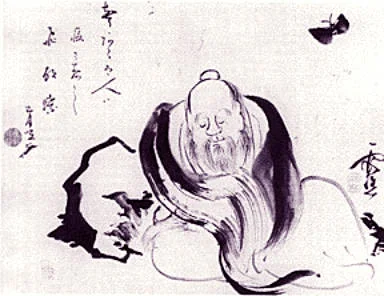
Once Zhuang Zhou dreamed he was a butterfly, a butterfly fluttering about, happy with itself and doing as it pleased. He did not know he was Zhou. Suddenly he woke, and there he was, solidly Zhou. He did not know whether he was Zhou who had dreamed he was a butterfly, or a butterfly dreaming it was Zhou. Between Zhou and the butterfly there must be some difference. This is called the changing of things.
The butterfly dream: which is the dreamer, and what is the change of things?
Yan Hui went to see Confucius and asked leave to travel. 'Where to?' 'To Wei.' 'What will you do there?' 'I have heard that the ruler of Wei is young in years and willful in what he does. He uses his state lightly and does not see his own faults. He uses his people's lives lightly, and the dead fill the state like fallen leaves in a marsh. The people have nowhere to turn. I have heard you say, Master: "Leave the well-run state; go to the state in disorder. At a doctor's gate there are many sick." I want to put what I have heard into practice, and perhaps that state can be healed.' Confucius said: 'Ah! You will probably go and be punished. does not want to be mixed. Mixed, it becomes many; many, it becomes confused; confused, it brings worry; and with worry there is no saving anyone. The perfect people of old first made it secure in themselves, and only then in others. When what is secure in yourself is not yet settled, what time do you have to deal with a tyrant's conduct? 'And do you know what wears virtue away, and where knowing comes from? Virtue is worn away by reputation; knowing comes out of contention. Reputation is people crushing one another; knowing is a tool for contending. Both are dangerous tools, not things for perfecting conduct. Even if your virtue is deep and your good faith solid, you have not yet reached the man's temper; even if you do not compete for reputation, you have not yet reached his . If you force talk of kindness and duty, of rule and line, on him in front of a tyrant, you use his ugliness to show off your own fine qualities. That is called harming people, and whoever harms people will surely be harmed in turn. You are likely to be harmed! 'Besides, if he really liked the worthy and disliked the unworthy, why would he need you to be any different? Unless you say nothing at all, the king will seize on your words and pit his wits against you. Your eyes will be dazzled, your face will try to look calm, your mouth will make excuses, your manner will bend to him, and your will end by agreeing with him. That is using fire to fight fire and water to fight water; it is called adding more. Once you begin to give way, there is no end to it. If you speak bluntly to a man who does not trust you, you will surely die at the tyrant's hands. 'Long ago Jie killed Guan Longfeng and Zhou killed Prince Bigan. Both had cultivated themselves and, as subjects, cared for the ruler's people, and so offended their rulers. Their rulers brought them down because of their cultivation. They were men who loved a good name. Long ago Yao attacked Congzhi and Xu-ao, and Yu attacked Youhu. Those states were laid waste, their people turned to ghosts, their rulers put to death, because they never stopped using arms and never stopped seeking gain. All of them sought name and gain. Have you not heard? Name and gain are too much even for sages, let alone for you. Still, you must have some plan. Try telling it to me.' Yan Hui said: 'If I am upright and empty, diligent and single-minded, will that do?' 'Ah, how could that do? The man is full of swagger and shows it, and his moods are never steady. Ordinary people do not oppose him; he presses on what they feel in order to have his own way. Even virtue that grows day by day would not work on him, let alone great virtue. He will hold fast and not change. He may agree on the outside, but inside he will not reflect. How could that do?' 'Then I will be straight inside and bending outside, and I will give my words in the form of the ancients. Straight inside means being a companion of . One who is a companion of knows that the Son of and himself are alike children of . Why should he care whether people approve of his words or not? People call such a one a child. This is being a companion of . Bending outside means being a companion of people. Raising the tablet, kneeling, bowing: these are the rites of a minister. Everyone does them; how would I dare not to? If I do what others do, no one will find fault with me. This is being a companion of people. Giving my words in the form of the ancients means being a companion of the past. My words may be teaching and reproof, but they belong to the ancients, not to me. That way, even if I am blunt, I will not be blamed. This is being a companion of the past. Will that do?' Confucius said: 'Ah, how could that do? Too many methods, and no understanding of the man. It is firm, and it may keep you from blame, but that is all. How could it change him? You are still taking your own as your teacher.' Yan Hui said: 'I have nothing more to offer. May I ask ?' Confucius said: 'Fast, and I will tell you. To do things while you have something in mind: is that easy? Whoever finds it easy is not in accord with bright .' Yan Hui said: 'My family is poor. I have not drunk wine or eaten strong food for months. Can that count as fasting?' 'That is the fasting for sacrifices, not the fasting of the .' 'May I ask what the fasting of the is?' Confucius said: 'Make your will one. Do not listen with your ears; listen with your . Do not listen with your ; listen with breath (qi). Listening stops at the ears; the stops at matching things to its signs. Breath is empty and waits for things. gathers only in emptiness. Emptiness is the fasting of the .' Yan Hui said: 'Before I was able to receive this, I was really Hui. Now that I have received it, there has never been any Hui. Can this be called emptiness?' The Master said: 'That is all of it. Let me tell you. You can go and wander in his cage without being moved by his reputation. If he listens, sing; if not, stop. Have no door and no remedy. Make your home in oneness and lodge in what cannot be helped. Then you will be close. 'To leave no footprints is easy; to walk without touching the ground is hard. When you are sent by people, it is easy to be false; when you are sent by , it is hard to be false. You have heard of flying with wings, but not of flying without wings. You have heard of knowing by knowledge, but not of knowing by not-knowing. Look at that empty space: the empty room gives off light, and good fortune comes to rest in stillness. If you do not rest, that is called sitting while galloping. Let your ears and eyes open inward and put the 's knowing outside, and even spirits will come to lodge with you, let alone people. This is how the ten thousand things are changed, what Yu and Shun held to, what Fu Xi and Ji Qu practised to the end. How much more so for ordinary people!'
The fasting of the heart: listen with emptiness, and Hui is gone.
What most readings miss
The Zhuangzi is often read as relativism, as if anything goes, or as escape from the world. Neither fits. It takes apart fixed views of 'this' and 'that' (2.3) to rest in 'the pivot of the Way', where opposites are seen together. Its sages do not leave life: the cook keeps cutting (3.2), the tutor still serves a cruel prince (4.3), Confucius stays inside the bounds (6.7). What drops is the one who claims: 'I lost myself' (2.1), 'there has never been any Hui' (4.1), 'sitting and forgetting' (6.10). Death is met with change itself, not comfort (6.6). In the site's reading this is close to Advaita on the I-claim. It parts at one point: the Zhuangzi asks who knows (2.2) but leaves it open, while Advaita names awareness as what remains.
The renderings on this page are shared under CC BY-NC 4.0, in the words of Pranav Ashar.