Zhuangzi
In the words of Pranav Ashar
How we renderChapter 2: Making All Things Equal
齊物論
南郭子綦隱几而坐,仰天而噓,嗒焉似喪其耦。顏成子游立侍乎前,曰:「何居乎?形固可使如槁木,而心固可使如死灰乎?今之隱几者,非昔之隱几者也。」子綦曰:「偃,不亦善乎,而問之也!今者吾喪我,汝知之乎?汝聞人籟而未聞地籟,汝聞地籟而未聞天籟夫!」子游曰:「敢問其方?」子綦曰:「夫大塊噫氣,其名爲風。是唯无作,作則萬竅怒呺。而獨不聞之翏翏乎?山林之畏隹,大木百圍之竅穴,似鼻,似口,似耳,似枅,似圈,似臼,似洼者,似汙者。激者,謞者,叱者,吸者,叫者,譹者,宎者,咬者,前者唱于,而隨者唱喁,泠風則小和,飄風則大和,厲風濟則衆竅爲虛。而獨不見之調調之刁刁乎?」子游曰:「地籟則衆竅是已,人籟則比竹是已。敢問天籟?」子綦曰:「夫吹萬不同而使其自己也,咸其自取,怒者其誰邪?」
nán guō zi qí yǐn jǐ ér zuò, yǎng tiān ér xū, dā yān shì sàng qí ǒu. yán chéng zi yóu lì shì hū qián, yuē: “hé jū hū? xíng gù kě shǐ rú gǎo mù, ér xīn gù kě shǐ rú sǐ huī hū? jīn zhī yǐn jǐ zhě, fēi xī zhī yǐn jǐ zhě yě.” zi qí yuē: “yǎn, bù yì shàn hū, ér wèn zhī yě! jīn zhě wú sàng wǒ, rǔ zhī zhī hū? rǔ wén rén lài ér wèi wén dì lài, rǔ wén dì lài ér wèi wén tiān lài fú!” zi yóu yuē: “gǎn wèn qí fāng?” zi qí yuē: “fú dà kuài yī qì, qí míng wéi fēng. shì wéi wú zuò, zuò zé wàn qiào nù xiāo. ér dú bù wén zhī liù liù hū? shān lín zhī wèi zhuī, dà mù bǎi wéi zhī qiào xué, shì bí, shì kǒu, shì ěr, shì jī, shì quān, shì jiù, shì wā zhě, shì wū zhě. jī zhě, hè zhě, chì zhě, xī zhě, jiào zhě, háo zhě, yǎo zhě, yǎo zhě, qián zhě chàng yú, ér suí zhě chàng yóng, líng fēng zé xiǎo hé, piāo fēng zé dà hé, lì fēng jì zé zhòng qiào wéi xū. ér dú bù jiàn zhī diào diào zhī diāo diāo hū?” zi yóu yuē: “dì lài zé zhòng qiào shì yǐ, rén lài zé bǐ zhú shì yǐ. gǎn wèn tiān lài?” zi qí yuē: “fú chuī wàn bù tóng ér shǐ qí zì jǐ yě, xián qí zì qǔ, nù zhě qí shuí yé?”
Ziqi of the southern wall sat leaning on his armrest, looked up at the sky and breathed out slowly, lost, as if he had let go of his other half. Yancheng Ziyou, standing in attendance before him, said: 'What is this? Can the body really be made like dry wood, and the mind like ? The one leaning on the armrest now is not the one who leaned on it before.' Ziqi said: 'Yan, it is good that you ask. Just now . Do you understand? You have heard the of people but not the of the earth; or you have heard the of the earth but not the of .' Ziyou said: 'May I ask what you mean?' Ziqi said: 'The great clod breathes out, and its name is wind. As long as it does not start up, nothing happens; when it does, ten thousand hollows howl. Have you never heard its long roar? The steep heights of the mountain forest, the holes and hollows in huge trees a hundred spans round, like noses, like mouths, like ears, like jar-sockets, like cups, like mortars, like ponds, like puddles: they hiss, they whiz, they scold, they suck, they shout, they wail, they moan, they snap. The ones in front sing out "yu", the ones behind answer "yong". In a light breeze the chorus is small; in a gale it is great. When the fierce wind passes, . Have you never seen the swaying and the trembling that is left?' Ziyou said: 'So the of the earth is all those hollows, and the of people is bamboo pipes. May I ask about the of ?' Ziqi said: 'It blows through the ten thousand in different ways, so that each is itself, each takes what it takes. '
Note //
'I lost myself' (吾喪我): the I that claims (我) is lost; the self (吾) that speaks remains. The piping of heaven is each hollow sounding by itself, with no one behind it; there is no further sound to listen for. In the site's reading this is close to the I-claim falling while life goes on (position 6); the question 'who rouses them?' is left open, and Advaita would answer it differently from the Daoist.
大知閑閑,小知間間。大言炎炎,小言詹詹。其寐也魂交,其覺也形開。與接爲構,日以心鬭,縵者,窖者,密者。小恐惴惴,大恐縵縵。其發若機栝,其司是非之謂也。其留如詛盟,其守勝之謂也。其殺如秋冬,以言其日消也。其溺之所爲之,不可使復之也。其厭也如緘,以言其老洫也。近死之心,莫使復陽也。喜怒哀樂,慮嘆變慹,姚佚啓態,樂出虛,蒸成菌,日夜相代乎前,而莫知其所萌。已乎已乎,旦暮得此其所由以生乎?非彼无我,非我无所取,是亦近矣,而不知其所爲使。若有眞宰,而特不得其朕,可行已信,而不見其形,有情而无形。百骸九竅六藏,賅而存焉,吾誰與爲親?汝皆悅之乎?其有私焉?如是,皆有爲臣妾乎?其臣妾不足以相治乎?其遞相爲君臣乎?其有眞君存焉。如求得其情與不得,无益損乎其眞。一受其成形,不亡以待盡,與物相刃相靡,其行盡如馳,而莫之能止,不亦悲乎!終身役役,而不見其成功,薾然疲役,而不知其所歸,可不哀邪?人謂之不死,奚益?其形化,其心與之然,可不謂大哀乎?人之生也,固若是芒乎?其我獨芒,而人亦有不芒者乎?夫隨其成心而師之,誰獨且无師乎?奚必知代而心自取者有之,愚者與有焉。未成乎心而有是非,是今日適越而昔至也,是以无有爲有。无有爲有,雖有神禹,且不能知,吾獨且奈何哉?
dà zhì xián xián, xiǎo zhī jiān jiān. dà yán yán yán, xiǎo yán zhān zhān. qí mèi yě hún jiāo, qí jué yě xíng kāi. yǔ jiē wéi gòu, rì yǐ xīn dòu, màn zhě, jiào zhě, mì zhě. xiǎo kǒng zhuì zhuì, dà kǒng màn màn. qí fā ruò jī guā, qí sī shì fēi zhī wèi yě. qí liú rú zǔ méng, qí shǒu shèng zhī wèi yě. qí shā rú qiū dōng, yǐ yán qí rì xiāo yě. qí nì zhī suǒ wéi zhī, bù kě shǐ fù zhī yě. qí yàn yě rú jiān, yǐ yán qí lǎo xù yě. jìn sǐ zhī xīn, mò shǐ fù yáng yě. xǐ nù āi lè, lǜ tàn biàn zhí, yáo yì qǐ tài, yuè chū xū, zhēng chéng jūn, rì yè xiāng dài hū qián, ér mò zhī qí suǒ méng. yǐ hū yǐ hū, dàn mù dé cǐ qí suǒ yóu yǐ shēng hū? fēi bǐ wú wǒ, fēi wǒ wú suǒ qǔ, shì yì jìn yǐ, ér bù zhī qí suǒ wéi shǐ. ruò yǒu zhēn zǎi, ér tè bù dé qí zhèn, kě xíng yǐ xìn, ér bù jiàn qí xíng, yǒu qíng ér wú xíng. bǎi hái jiǔ qiào liù cáng, gāi ér cún yān, wú shuí yǔ wéi qīn? rǔ jiē yuè zhī hū? qí yǒu sī yān? rú shì, jiē yǒu wéi chén qiè hū? qí chén qiè bù zú yǐ xiāng zhì hū? qí dì xiāng wéi jūn chén hū? qí yǒu zhēn jūn cún yān. rú qiú dé qí qíng yǔ bù dé, wú yì sǔn hū qí zhēn. yī shòu qí chéng xíng, bù wáng yǐ dài jǐn, yǔ wù xiāng rèn xiāng mí, qí xíng jǐn rú chí, ér mò zhī néng zhǐ, bù yì bēi hū! zhōng shēn yì yì, ér bù jiàn qí chéng gōng, ěr rán pí yì, ér bù zhī qí suǒ guī, kě bù āi yé? rén wèi zhī bù sǐ, xī yì? qí xíng huà, qí xīn yǔ zhī rán, kě bù wèi dà āi hū? rén zhī shēng yě, gù ruò shì máng hū? qí wǒ dú máng, ér rén yì yǒu bù máng zhě hū? fú suí qí chéng xīn ér shī zhī, shuí dú qiě wú shī hū? xī bì zhī dài ér xīn zì qǔ zhě yǒu zhī, yú zhě yǔ yǒu yān. wèi chéng hū xīn ér yǒu shì fēi, shì jīn rì shì yuè ér xī zhì yě, shì yǐ wú yǒu wéi yǒu. wú yǒu wéi yǒu, suī yǒu shén yǔ, qiě bù néng zhī, wú dú qiě nài hé zāi?
Great knowing is wide and easy; small knowing picks and pries. Great words are clear and bright; small words are chatter. In sleep the spirits mingle; awake, the body opens. Tangled with whatever they meet, day after day minds fight it out: some slow, some deep, some secretive. Small fears are anxious; great fears numb. The mind shoots out like an arrow from a crossbow, which is to say it sets itself up as judge of right and wrong. It holds fast as if sworn to an oath, which is to say it clings to what it has won. It withers as in autumn and winter, which is to say it wastes away day by day. Sunk in what it does, it cannot be brought back. It closes up as if sealed, which is to say it grows old and dry. A mind near death cannot be brought back to the light. Joy and anger, grief and delight, worry and regret, change and fixity, rashness and ease, openness and pose: music coming out of empty holes, mushrooms rising from steam. Day and night they take turns in front of us, and no one knows where they sprout from. Enough, enough! Morning and evening we have them; is this where we come from? Without them there is no I; without an I there is nothing for them to take hold of. This is close, but we do not know what makes it so. It seems there is a true ruler, but we cannot find its trace. That it works is plain enough, but we do not see its form. It has reality but no form. The hundred bones, the nine openings, the six organs are all here together. Which am I closest to? Do you like them all equally, or have you a favourite? Are they all servants? Can servants not govern each other? Do they take turns as ruler and servant? Or is there a true lord among them? Whether or not we find out what it is, that adds nothing to its truth and takes nothing away. Once we have received this formed body, we hold on to it, waiting for the end. Cutting and grinding against things, we gallop on to the end and nothing can stop us. Isn't it sad? Toiling all our lives and never seeing the work done, worn out with labour and not knowing where it is all going: isn't it a pity? People say 'at least he is not dead', but what good is that? The body changes and the mind goes with it: can this not be called a great sorrow? Is human life really this muddled? Am I the only one muddled, or are there others who are not? If each follows his own settled mind and takes it as teacher, who is without a teacher? Why should only those who understand change and choose for themselves have one? The fool has one too. To have right and wrong before a settled mind is formed is like setting off for Yue today and arriving yesterday. It is making what is not into what is. Even the spirit-like Yu could not make sense of that; what could I do?
Note //
'A true ruler' (真宰) and 'a true lord' (真君) are asked about, not asserted: it works, but no form or trace is found. Readers in many traditions have heard here a pointer to what knows the passing moods. In the site's reading that is the witness (position 8); the text itself leaves the question open, and Giles renders 真宰 as 'a soul'.
夫言非吹也,言者有言,其所言者特未定也。果有言邪?其未嘗有言邪?其以爲異於鷇音,亦有辯乎?其无辯乎?道惡乎隱而有眞僞?言惡乎隱而有是非?道惡乎往而不存?言惡乎存而不可?道隱於小成,言隱於榮華,故有儒墨之是非,以是其所非而非其所是。欲是其所非而非其所是,則莫若以明。物无非彼,物无非是,自彼則不見,自知則知之。故曰:「彼出於是,是亦因彼。」彼是,方生之說也。雖然,方生方死,方死方生,方可方不可,方不可方可。因是因非,因非因是,是以聖人不由,而照之于天,亦因是也。是亦彼也,彼亦是也。彼亦一是非,此亦一是非。果且有彼是乎哉?果且无彼是乎哉?彼是莫得其偶,謂之道樞。樞始得其環中,以應无窮。是亦一无窮,非亦一无窮也,故曰「莫若以明」。
fú yán fēi chuī yě, yán zhě yǒu yán, qí suǒ yán zhě tè wèi dìng yě. guǒ yǒu yán yé? qí wèi cháng yǒu yán yé? qí yǐ wéi yì yú kòu yīn, yì yǒu biàn hū? qí wú biàn hū? dào wū hū yǐn ér yǒu zhēn wěi? yán wū hū yǐn ér yǒu shì fēi? dào wū hū wǎng ér bù cún? yán wū hū cún ér bù kě? dào yǐn yú xiǎo chéng, yán yǐn yú róng huá, gù yǒu rú mò zhī shì fēi, yǐ shì qí suǒ fēi ér fēi qí suǒ shì. yù shì qí suǒ fēi ér fēi qí suǒ shì, zé mò ruò yǐ míng. wù wú fēi bǐ, wù wú fēi shì, zì bǐ zé bù jiàn, zì zhī zé zhī zhī. gù yuē: “bǐ chū yú shì, shì yì yīn bǐ.” bǐ shì, fāng shēng zhī shuō yě. suī rán, fāng shēng fāng sǐ, fāng sǐ fāng shēng, fāng kě fāng bù kě, fāng bù kě fāng kě. yīn shì yīn fēi, yīn fēi yīn shì, shì yǐ shèng rén bù yóu, ér zhào zhī yú tiān, yì yīn shì yě. shì yì bǐ yě, bǐ yì shì yě. bǐ yì yī shì fēi, cǐ yì yī shì fēi. guǒ qiě yǒu bǐ shì hū zāi? guǒ qiě wú bǐ shì hū zāi? bǐ shì mò dé qí ǒu, wèi zhī dào shū. shū shǐ dé qí huán zhōng, yǐ yīng wú qióng. shì yì yī wú qióng, fēi yì yī wú qióng yě, gù yuē“mò ruò yǐ míng” .
Speech is not just blowing breath. Speakers have something to say, but what they say is never fixed. Have they really said something? Or have they never said anything? We think it is different from the peeping of fledglings; is there a difference, or isn't there? How is hidden, that there is true and false? How are words hidden, that there is right and wrong? Where can go and not be there? Where can words be and not be allowed? is hidden by small achievements; words are hidden by fine show. So we have the right and wrong of the Confucians and the Mohists, each calling right what the other calls wrong and wrong what the other calls right. If you want to call right what they call wrong and wrong what they call right, nothing is better than clarity. There is nothing that is not 'that', nothing that is not 'this'. From 'that' you cannot see it; from knowing yourself you know it. So it is said: 'That comes out of this, and this depends on that.' This is the theory that 'this' and 'that' are born together. Still, together with birth there is death, together with death there is birth; together with 'allowed' there is 'not allowed', together with 'not allowed' there is 'allowed'. Going by 'right' there is 'wrong'; going by 'wrong' there is 'right'. So the sage does not take this road but lets things shine in the light of . That too is going by 'this'. 'This' is also 'that'; 'that' is also 'this'. 'That' has its right and wrong; 'this' has its right and wrong. Is there really a 'this' and a 'that'? Or is there really no 'this' and 'that'? Where 'this' and 'that' no longer find their opposite: that is called the pivot of . When the pivot has found the centre of the ring, it can answer endlessly. 'Right' is one endless series, 'wrong' is another. So it is said: nothing is better than clarity.
Note //
'Clarity' (以明) is seeing positions from the still centre of the ring, from no position of its own, where every 'this' is someone's 'that'. Giles renders 是/彼 as 'subjective/objective' and 天 here as 'God'; the Chinese is simpler: this and that.
以指喻指之非指,不若以非指喻指之非指也;以馬喻馬之非馬,不若以非馬喻馬之非馬也。天地,一指也;萬物,一馬也。可乎可,不可乎不可。道,行之而成;物,謂之而然。惡乎然?然於然。惡乎不然?不然於不然。物固有所然,物固有所可。无物不然,无物不可。故(爲是)舉莛與楹,厲與西施,恢恑憰怪,道通爲一。其分也,成也;其成也,毀也。凡物无成與毀,復通爲一。唯達者知通爲一,爲是不用而寓諸庸。庸也者,用也;用也者,通也;通也者,得也;適得而幾矣,因是已。已而不知其然謂之道。勞神明爲一,而不知其同也,謂之朝三。「何謂朝三?」(曰):「狙公賦芧曰:『朝三(而)暮四。』衆狙皆怒;曰:『然則朝四而暮三。』衆狙皆悅。」名實未虧,而喜怒爲用,亦因是也。是以聖人和之以是非,而休乎天均,是之謂兩行。
yǐ zhǐ yù zhǐ zhī fēi zhǐ, bù ruò yǐ fēi zhǐ yù zhǐ zhī fēi zhǐ yě; yǐ mǎ yù mǎ zhī fēi mǎ, bù ruò yǐ fēi mǎ yù mǎ zhī fēi mǎ yě. tiān dì, yī zhǐ yě; wàn wù, yī mǎ yě. kě hū kě, bù kě hū bù kě. dào, xíng zhī ér chéng; wù, wèi zhī ér rán. wū hū rán? rán yú rán. wū hū bù rán? bù rán yú bù rán. wù gù yǒu suǒ rán, wù gù yǒu suǒ kě. wú wù bù rán, wú wù bù kě. gù( wéi shì) jǔ tíng yǔ yíng, lì yǔ xī shī, huī guǐ jué guài, dào tōng wéi yī. qí fēn yě, chéng yě; qí chéng yě, huǐ yě. fán wù wú chéng yǔ huǐ, fù tōng wéi yī. wéi dá zhě zhī tōng wéi yī, wéi shì bù yòng ér yù zhū yōng. yōng yě zhě, yòng yě; yòng yě zhě, tōng yě; tōng yě zhě, dé yě; shì dé ér jǐ yǐ, yīn shì yǐ. yǐ ér bù zhī qí rán wèi zhī dào. láo shén míng wéi yī, ér bù zhī qí tóng yě, wèi zhī cháo sān. “hé wèi cháo sān?” ( yuē) : “jū gōng fù xù yuē: ‘cháo sān( ér) mù sì.’ zhòng jū jiē nù; yuē: ‘rán zé cháo sì ér mù sān.’ zhòng jū jiē yuè.” míng shí wèi kuī, ér xǐ nù wéi yòng, yì yīn shì yě. shì yǐ shèng rén hé zhī yǐ shì fēi, ér xiū hū tiān jūn, shì zhī wèi liǎng xíng.
To use a finger to show that a finger is not a finger is not as good as to use what is not a finger to show that a finger is not a finger. To use a horse to show that a horse is not a horse is not as good as to use what is not a horse. and earth are one finger; the ten thousand things are one horse. Allowed? Allowed. Not allowed? Not allowed. A way comes about by being walked; a thing is so by being called so. Why so? So because so. Why not so? Not so because not so. Things have what makes them so; things have what makes them allowable. There is nothing that is not so, nothing that is not allowable. So a stalk and a pillar, a leper and the beauty Xi Shi, the wild, the weird, the strange and the uncanny: connects them and makes them one. Their dividing is their forming; their forming is their ruin. All things, without forming or ruin, connect again and are one. Only those who see through know how they connect and are one. So they do not use their own view but lodge in the ordinary. The ordinary is the useful; the useful is the connecting; the connecting is the getting it; and getting it you are almost there. Just go by 'this', and stop. Stopping and not knowing it is so: that is called . To wear out your spirit trying to make things one, without knowing that they are already the same, is called 'three in the morning'. What is 'three in the morning'? A monkey keeper handing out nuts said, 'Three in the morning and four in the evening.' The monkeys were all furious. 'Then four in the morning and three in the evening.' The monkeys were all delighted. Nothing was lost in name or substance, yet joy and anger came into play: he too went by 'this'. So the sage harmonises right and wrong and rests in the balance of . This is called walking two roads.
Note //
The finger and horse refer to the logicians' paradoxes ('a white horse is not a horse'); Zhuangzi turns them: from the Way, everything is equally one finger, one horse. 'Walking two roads' (兩行): letting both sides go on, while resting in what does not take sides.
古之人,其知有所至矣。惡乎至?有以爲未始有物者,至矣,盡矣,不可以加矣。其次以爲有物矣而未始有封也,其次以爲有封焉而未始有是非也。是非之彰也,道之所以虧也。道之所以虧,愛之所以成。果且有成與虧乎哉?果且无成與虧乎哉?有成與虧,故昭氏之鼔琴也;无成與虧,故昭氏之不鼔琴也。昭文之鼔琴也,師曠之枝策也,惠子之據梧也,三子之知,幾乎,皆其盛者也,故載之末年。唯其好之也,以異於彼其好之也,欲以明之,彼非所明而明之,故以堅白之昧終;而其子又以文之綸終,終身无成。若是而可謂成乎,雖我亦成也;若是而不可謂成乎,物與我无成也。是故滑疑之耀,聖人之所圖也,爲是不用而寓諸庸,此之謂以明。
gǔ zhī rén, qí zhī yǒu suǒ zhì yǐ. wū hū zhì? yǒu yǐ wéi wèi shǐ yǒu wù zhě, zhì yǐ, jǐn yǐ, bù kě yǐ jiā yǐ. qí cì yǐ wéi yǒu wù yǐ ér wèi shǐ yǒu fēng yě, qí cì yǐ wéi yǒu fēng yān ér wèi shǐ yǒu shì fēi yě. shì fēi zhī zhāng yě, dào zhī suǒ yǐ kuī yě. dào zhī suǒ yǐ kuī, ài zhī suǒ yǐ chéng. guǒ qiě yǒu chéng yǔ kuī hū zāi? guǒ qiě wú chéng yǔ kuī hū zāi? yǒu chéng yǔ kuī, gù zhāo shì zhī gǔ qín yě; wú chéng yǔ kuī, gù zhāo shì zhī bù gǔ qín yě. zhāo wén zhī gǔ qín yě, shī kuàng zhī zhī cè yě, huì zi zhī jù wú yě, sān zi zhī zhī, jǐ hū, jiē qí shèng zhě yě, gù zài zhī mò nián. wéi qí hào zhī yě, yǐ yì yú bǐ qí hào zhī yě, yù yǐ míng zhī, bǐ fēi suǒ míng ér míng zhī, gù yǐ jiān bái zhī mèi zhōng; ér qí zi yòu yǐ wén zhī lún zhōng, zhōng shēn wú chéng. ruò shì ér kě wèi chéng hū, suī wǒ yì chéng yě; ruò shì ér bù kě wèi chéng hū, wù yǔ wǒ wú chéng yě. shì gù huá yí zhī yào, shèng rén zhī suǒ tú yě, wéi shì bù yòng ér yù zhū yōng, cǐ zhī wèi yǐ míng.
The people of old had knowing that went all . How far? Some thought there had never yet begun to be things: that is the furthest, the utmost, nothing can be added. Next were those who thought there were things, but never yet any boundaries between them. Next were those who thought there were boundaries, but never yet any right and wrong. When right and wrong showed themselves, was damaged. Where was damaged, love came to be formed. But is there really forming and damage? Or is there really no forming and damage? There is forming and damage: that is Zhao Wen playing the zither. There is no forming and damage: that is Zhao Wen not playing the zither. Zhao Wen playing the zither, Music Master Kuang keeping time, Huizi leaning on his desk: the knowing of these three was nearly complete. Each was at the height of his art, and so it was handed down to later years. Only, what they loved they wanted to set apart from others, and what they loved they wanted to make clear to others. They made clear what is not to be made clear, and so ended in the darkness of 'hard and white'. Their sons, too, ended with the strings of their fathers' art, and achieved nothing all their lives. If this can be called achievement, then I too have achieved; if this cannot be called achievement, then neither things nor I have achieved anything. So the glimmer of confusion and doubt is what the sage steers by. He does not use his own view but lodges in the ordinary. This is called clarity.
Note //
Each note struck on the zither leaves out the others; not playing leaves the whole of music unbroken. 'Hard and white' is a logicians' debate about whether the hardness and whiteness of a stone are separate.
今且有言於此,不知其與是類乎?其與是不類乎?類與不類,相與爲類,則與彼无以異矣。雖然,請嘗言之:有始也者,有未始有始也者,有未始有夫未始有始也者;有有也者,有无也者,有未始有无也者,有未始有夫未始有无也者。俄而有无矣,而未知有无之果孰有孰无也。今我則已有謂矣,而未知吾所謂之,其果有謂乎?其果无謂乎?天下莫大於秋豪之末而太山爲小,莫壽乎殤子而彭祖爲夭,天地與我並生,(而)萬物與我爲一。旣已爲一矣,且得有言乎?旣已謂之一矣,且得无言乎?一與言爲二,二與一爲三。自此以往,巧歷不能得,而況其凡乎?故自无適有以至於三,而況自有適有乎?无適焉,因是已。
jīn qiě yǒu yán yú cǐ, bù zhī qí yǔ shì lèi hū? qí yǔ shì bù lèi hū? lèi yǔ bù lèi, xiāng yǔ wéi lèi, zé yǔ bǐ wú yǐ yì yǐ. suī rán, qǐng cháng yán zhī: yǒu shǐ yě zhě, yǒu wèi shǐ yǒu shǐ yě zhě, yǒu wèi shǐ yǒu fū wèi shǐ yǒu shǐ yě zhě; yǒu yǒu yě zhě, yǒu wú yě zhě, yǒu wèi shǐ yǒu wú yě zhě, yǒu wèi shǐ yǒu fū wèi shǐ yǒu wú yě zhě. é ér yǒu wú yǐ, ér wèi zhī yǒu wú zhī guǒ shú yǒu shú wú yě. jīn wǒ zé yǐ yǒu wèi yǐ, ér wèi zhī wú suǒ wèi zhī, qí guǒ yǒu wèi hū? qí guǒ wú wèi hū? tiān xià mò dà yú qiū háo zhī mò ér tài shān wéi xiǎo, mò shòu hū shāng zi ér péng zǔ wéi yāo, tiān dì yǔ wǒ bìng shēng, ( ér) wàn wù yǔ wǒ wéi yī. jì yǐ wéi yī yǐ, qiě dé yǒu yán hū? jì yǐ wèi zhī yī yǐ, qiě dé wú yán hū? yī yǔ yán wéi èr, èr yǔ yī wéi sān. zì cǐ yǐ wǎng, qiǎo lì bù néng dé, ér kuàng qí fán hū? gù zì wú shì yǒu yǐ zhì yú sān, ér kuàng zì yǒu shì yǒu hū? wú shì yān, yīn shì yǐ.
Now suppose I say something here. I don't know whether it belongs with the rest or not. Whether it belongs or not, saying it puts it in a class with them, so it is no different from them. Still, let me try to say it. There is a beginning. There is a not-yet-beginning-to-be-a-beginning. There is a not-yet-beginning-to-be-a-not-yet-beginning-to-be-a-beginning. There is being. There is non-being. There is a not-yet-beginning-to-be-non-being. There is a not-yet-beginning-to-be-a-not-yet-beginning-to-be-non-being. Suddenly there is non-being, and we do not know, of being and non-being, which is really being and which is really non-being. Now I have said something, but I do not know whether what I have said has really said something, or has not said anything. Nothing under is bigger than the tip of an autumn hair, and Mount Tai is small. No one lives longer than a child who dies young, and Peng Zu died early. and earth are born together with me, and the ten thousand things are one with me. Since we are already one, can there be anything to say? Since I have already called it one, can there be nothing to say? The one and my saying make two; two and one make three. From here on even a skilled reckoner cannot keep count, let alone an ordinary person. If going from nothing to something we reach three, how much further if we go from something to something! Don't go anywhere. Just go by 'this', and stop.
Note //
The regress of beginnings mocks any attempt to state the origin. 'Heaven and earth are born together with me, and the ten thousand things are one with me' (天地與我並生,而萬物與我爲一) is the most quoted line of the chapter; the next sentence asks whether it can even be said. In the site's reading this is close to the whole that cannot be made an object of speech (position 1).
夫道未始有封,言未始有常,爲是而有畛也。請言其畛:有左有右,有倫有義,有分有辯,有競有爭,此之謂八德。六合之外,聖人存而不論。六合之內,聖人論而不議。春秋經世,先王之志,聖人議而不辯。故分也者,有不分也;辯也者,有不辯也。曰:何也?聖人懷之,衆人辯之以相示也,故曰:「辯也者,有不見也。」夫大道不稱,大辯不言,大仁不仁,大廉不嗛,大勇不忮。道昭而不道,言辯而不及,仁常而不成,廉清而不信,勇忮而不成,五者园而幾向方矣。故知止其所不知,至矣。孰知不言之辯,不道之道?若有能知,此之謂天府。注焉而不滿,酌焉而不竭,而不知其所由來,此之謂葆光。
fú dào wèi shǐ yǒu fēng, yán wèi shǐ yǒu cháng, wéi shì ér yǒu zhěn yě. qǐng yán qí zhěn: yǒu zuǒ yǒu yòu, yǒu lún yǒu yì, yǒu fēn yǒu biàn, yǒu jìng yǒu zhēng, cǐ zhī wèi bā dé. liù hé zhī wài, shèng rén cún ér bù lùn. liù hé zhī nèi, shèng rén lùn ér bù yì. chūn qiū jīng shì, xiān wáng zhī zhì, shèng rén yì ér bù biàn. gù fēn yě zhě, yǒu bù fēn yě; biàn yě zhě, yǒu bù biàn yě. yuē: hé yě? shèng rén huái zhī, zhòng rén biàn zhī yǐ xiāng shì yě, gù yuē: “biàn yě zhě, yǒu bù jiàn yě.” fú dà dào bù chēng, dà biàn bù yán, dà rén bù rén, dà lián bù qiǎn, dà yǒng bù zhì. dào zhāo ér bù dào, yán biàn ér bù jí, rén cháng ér bù chéng, lián qīng ér bù xìn, yǒng zhì ér bù chéng, wǔ zhě yuán ér jǐ xiàng fāng yǐ. gù zhī zhǐ qí suǒ bù zhī, zhì yǐ. shú zhī bù yán zhī biàn, bù dào zhī dào? ruò yǒu néng zhī, cǐ zhī wèi tiān fǔ. zhù yān ér bù mǎn, zhuó yān ér bù jié, ér bù zhī qí suǒ yóu lái, cǐ zhī wèi bǎo guāng.
has never had boundaries, and words have never had constancy. It is because of 'this' that there are borders. Let me speak of the borders: there is left and there is right, there are relations and there are duties, there are divisions and there are disputes, there is competing and there is contending. These are called the eight virtues. What lies beyond the six directions the sage leaves there and does not discuss. What lies within the six directions he discusses but does not judge. On the Spring and Autumn annals, the records of the former kings who ordered the world, he judges but does not argue. So in dividing, something is left undivided; in arguing, something is left unargued. What does this mean? The sage holds it in his embrace; ordinary people argue it out to show each other. So it is said: arguing is not seeing. The great Way is not named; the great argument is not spoken; great kindness is not kind; great integrity is not fussy; great courage does not wound. A way that is made plain is not ; words that argue do not reach; kindness that is constant does not get done; integrity that is spotless is not trusted; courage that wounds does not succeed. These five are round but tend to become square. So knowing that stops at what it does not know is the utmost. Who knows the argument without words, that is not a way? If anyone can know it, this is called the storehouse of : pour into it and it is never full, ladle from it and it is never exhausted, and no one knows where it comes from. This is called the shaded light.
Note //
'Knowing that stops at what it does not know' is the chapter's own humility. 'The shaded light' (葆光) is a light that does not dazzle, kept hidden and so never used up. Giles has 'of God' where the Chinese says 'the storehouse of heaven' (天府).
故昔者堯問於舜曰:「我欲伐宗、膾、胥敖,南面而不釋然,其故何也?」舜曰:「夫三子者,猶存乎蓬艾之間。若不釋然,何哉?昔者十日並出,萬物皆照,而況德之進乎日者乎?」
gù xī zhě yáo wèn yú shùn yuē: “wǒ yù fá zōng, kuài, xū áo, nán miàn ér bù shì rán, qí gù hé yě?” shùn yuē: “fú sān zi zhě, yóu cún hū péng ài zhī jiān. ruò bù shì rán, hé zāi? xī zhě shí rì bìng chū, wàn wù jiē zhào, ér kuàng dé zhī jìn hū rì zhě hū?”
So long ago Yao asked Shun: 'I want to attack Zong, Kuai and Xu'ao. Even sitting on the throne facing south I cannot let it go. Why is that?' Shun said: 'These three rulers still live among the weeds and brambles. Why can't you let it go? Once ten suns came out together, and all things were lit by them. How much more a that goes beyond the sun!'
Note //
A virtue greater than ten suns lights everyone without conquering anyone.
齧缺問乎王倪曰:「子知物之所同是乎?」曰:「吾惡乎知之?」「子知子之所不知邪?」曰:「吾惡乎知之?」「然則物无知邪?」曰:「吾惡乎知之?雖然,嘗試言之:庸詎知吾所謂『知之』非不知邪?庸詎知吾所謂『不知』之非知邪?且吾嘗試問乎汝:民溼寢,則腰疾偏死,鰌然乎哉?木處,則惴慄恂懼,猨猴然乎哉?三者孰知正處?民食芻豢,麋鹿食薦,蝍蛆甘帶,鴟鴉嗜鼠,四者孰知正味?猨,猵狙以爲雌,麋與鹿交,鰌與魚游。毛嬙、麗姬,人之所美也,魚見之深入,鳥見之高飛,麋鹿見之決驟,四者孰知天下之正色哉?自我觀之,仁義之端,是非之塗,樊然殽亂,吾惡能知其辯?」齧缺曰:「子不知利害,則至人固不知利害乎?」王倪曰:「至人,神矣!大澤焚而不能熱,河漢冱而不能寒,疾雷破山、風振海而不能驚。若然者,乘雲氣,騎日月,而遊乎四海之外,死生无變於己,而況利害之端乎?」
niè quē wèn hū wáng ní yuē: “zi zhī wù zhī suǒ tóng shì hū?” yuē: “wú wū hū zhī zhī?” “zi zhī zi zhī suǒ bù zhī yé?” yuē: “wú wū hū zhī zhī?” “rán zé wù wú zhī yé?” yuē: “wú wū hū zhī zhī? suī rán, cháng shì yán zhī: yōng jù zhī wú suǒ wèi‘zhī zhī’ fēi bù zhī yé? yōng jù zhī wú suǒ wèi‘bù zhī’ zhī fēi zhī yé? qiě wú cháng shì wèn hū rǔ: mín shī qǐn, zé yāo jí piān sǐ, qiū rán hū zāi? mù chù, zé zhuì lì xún jù, yuán hóu rán hū zāi? sān zhě shú zhī zhèng chù? mín shí chú huàn, mí lù shí jiàn, jí qū gān dài, chī yā shì shǔ, sì zhě shú zhī zhèng wèi? yuán, biān jū yǐ wéi cí, mí yǔ lù jiāo, qiū yǔ yú yóu. máo qiáng, lì jī, rén zhī suǒ měi yě, yú jiàn zhī shēn rù, niǎo jiàn zhī gāo fēi, mí lù jiàn zhī jué zhòu, sì zhě shú zhī tiān xià zhī zhèng sè zāi? zì wǒ guān zhī, rén yì zhī duān, shì fēi zhī tú, fán rán xiáo luàn, wú wū néng zhī qí biàn?” niè quē yuē: “zi bù zhī lì hài, zé zhì rén gù bù zhī lì hài hū?” wáng ní yuē: “zhì rén, shén yǐ! dà zé fén ér bù néng rè, hé hàn hù ér bù néng hán, jí léi pò shān, fēng zhèn hǎi ér bù néng jīng. ruò rán zhě, chéng yún qì, qí rì yuè, ér yóu hū sì hǎi zhī wài, sǐ shēng wú biàn yú jǐ, ér kuàng lì hài zhī duān hū?”
Nie Que asked Wang Ni: 'Do you know what all things agree is so?' 'How would I know that?' 'Do you know what you do not know?' 'How would I know that?' 'Then can nothing know anything?' 'How would I know that? Still, let me try to say something. How do I know that what I call knowing is not not knowing? How do I know that what I call not knowing is not knowing? 'Let me ask you. If people sleep in a damp place, their backs ache and they are half paralysed; is that so for an eel? If they live in trees, they shake with fright; is that so for a monkey? Of these three, which knows the right place to live? People eat the meat of grain-fed animals, deer eat grass, centipedes like snakes, owls and crows love mice. Of these four, which knows the right taste? Monkeys take gibbons as mates, deer go with deer, eels swim with fish. Mao Qiang and Lady Li were thought beautiful by people, but fish seeing them dived deep, birds seeing them flew high, deer seeing them broke into a run. Of these four, which knows the right beauty under ? As I see it, the starting points of kindness and duty and the paths of right and wrong are hopelessly tangled. How could I know how to tell them apart?' Nie Que said: 'If you do not know benefit and harm, does the utmost person not know benefit and harm either?' Wang Ni said: 'The utmost person is a spirit. Though the great marshes burn, he cannot be made hot; though the great rivers freeze, he cannot be made cold; though sudden thunder splits the mountains and wind shakes the sea, he cannot be startled. Such a one rides the clouds, mounts the sun and moon, and wanders beyond the four seas. Death and life make no change in him; how much less the starting points of benefit and harm!'
Note //
Every standard of place, taste and beauty is a standard from somewhere. The three 'How would I know?' are not a plea of ignorance; they refuse to set up a view from nowhere.
瞿鵲子問乎長梧子曰:「吾聞諸夫子:『聖人不從事於務,不就利,不違害,不喜求,不緣道,无謂有謂,有謂无謂,而遊乎塵垢之外。』夫子以爲孟浪之言,而我以爲妙道之行也。吾子以爲奚若?」長梧子曰:「是黃帝之所聽瑩也,而丘也何足以知之?且汝亦大早計,見卵而求時夜,見彈而求鴞炙。予嘗爲汝妄言之,汝以妄聽之奚?旁日月,挾宇宙,爲其䐇合,置其滑涽,以隸相尊;衆人役役,聖人愚芚,參萬歲而一成純。萬物盡然,而以是相蘊。予惡乎知悅生之非惑邪?予惡乎知惡死之非弱喪而不知歸者邪?麗之姬,艾封人之子也,晉國之始得之也,涕泣沾襟;及其至於王所,與王同匡牀,食芻豢,而後悔其泣也。予惡乎知夫死者不悔其始之蘄生乎?夢飲酒者,旦而哭泣;夢哭泣者,旦而田獵。方其夢也,不知其夢也,夢之中又占其夢(焉),覺而後知其夢也。且有大覺,而後知此其大夢也,而愚者自以爲覺,竊竊然知之。君乎?牧乎?固哉!丘也與汝皆夢也,予謂汝夢,亦夢也。是其言也,其名爲弔詭。萬世之後而一遇大聖,知其解者,是旦暮遇之也。旣使我與若辯矣,若勝我,我不若勝,若果是也,我果非也邪?我勝若,若不吾勝,我果是也,而果非也邪?其或是也,其或非也邪?其俱是也,其俱非也邪?我與若,不能相知也,則人固受其黮闇,吾誰使正之?使同乎若者正之,旣與若同矣,惡能正之?使同乎我者正之,旣同乎我矣,惡能正之?使異乎我與若者正之,旣異乎我與若矣,惡能正之?使同乎我與若者正之,旣同乎我與若矣,惡能正之?然則我與若與人,俱不能相知也,而待彼也邪?」
qú què zi wèn hū cháng wú zi yuē: “wú wén zhū fū zǐ: ‘shèng rén bù cóng shì yú wù, bù jiù lì, bù wéi hài, bù xǐ qiú, bù yuán dào, wú wèi yǒu wèi, yǒu wèi wú wèi, ér yóu hū chén gòu zhī wài.’ fū zǐ yǐ wéi mèng làng zhī yán, ér wǒ yǐ wéi miào dào zhī xíng yě. wú zǐ yǐ wéi xī ruò?” cháng wú zi yuē: “shì huáng dì zhī suǒ tīng yíng yě, ér qiū yě hé zú yǐ zhī zhī? qiě rǔ yì dà zǎo jì, jiàn luǎn ér qiú shí yè, jiàn dàn ér qiú xiāo zhì. yǔ cháng wéi rǔ wàng yán zhī, rǔ yǐ wàng tīng zhī xī? páng rì yuè, xié yǔ zhòu, wéi qí wěn hé, zhì qí huá hūn, yǐ lì xiāng zūn; zhòng rén yì yì, shèng rén yú tún, cān wàn suì ér yì chéng chún. wàn wù jǐn rán, ér yǐ shì xiāng yùn. yǔ wū hū zhī yuè shēng zhī fēi huò yé? yǔ wū hū zhī wù sǐ zhī fēi ruò sàng ér bù zhī guī zhě yé? lì zhī jī, ài fēng rén zhī zi yě, jìn guó zhī shǐ dé zhī yě, tì qì zhān jīn; jí qí zhì yú wáng suǒ, yǔ wáng tóng kuāng chuáng, shí chú huàn, ér hòu huǐ qí qì yě. yǔ wū hū zhī fū sǐ zhě bù huǐ qí shǐ zhī qí shēng hū? mèng yǐn jiǔ zhě, dàn ér kū qì; mèng kū qì zhě, dàn ér tián liè. fāng qí mèng yě, bù zhī qí mèng yě, mèng zhī zhōng yòu zhàn qí mèng( yān) , jué ér hòu zhī qí mèng yě. qiě yǒu dà jué, ér hòu zhī cǐ qí dà mèng yě, ér yú zhě zì yǐ wéi jué, qiè qiè rán zhī zhī. jūn hū? mù hū? gù zāi! qiū yě yǔ rǔ jiē mèng yě, yǔ wèi rǔ mèng, yì mèng yě. shì qí yán yě, qí míng wéi diào guǐ. wàn shì zhī hòu ér yī yù dà shèng, zhī qí jiě zhě, shì dàn mù yù zhī yě. jì shǐ wǒ yǔ ruò biàn yǐ, ruò shèng wǒ, wǒ bù ruò shèng, ruò guǒ shì yě, wǒ guǒ fēi yě yé? wǒ shèng ruò, ruò bù wú shèng, wǒ guǒ shì yě, ér guǒ fēi yě yé? qí huò shì yě, qí huò fēi yě yé? qí jù shì yě, qí jù fēi yě yé? wǒ yǔ ruò, bù néng xiāng zhī yě, zé rén gù shòu qí dǎn àn, wú shuí shǐ zhèng zhī? shǐ tóng hū ruò zhě zhèng zhī, jì yǔ ruò tóng yǐ, wū néng zhèng zhī? shǐ tóng hū wǒ zhě zhèng zhī, jì tóng hū wǒ yǐ, wū néng zhèng zhī? shǐ yì hū wǒ yǔ ruò zhě zhèng zhī, jì yì hū wǒ yǔ ruò yǐ, wū néng zhèng zhī? shǐ tóng hū wǒ yǔ ruò zhě zhèng zhī, jì tóng hū wǒ yǔ ruò yǐ, wū néng zhèng zhī? rán zé wǒ yǔ ruò yǔ rén, jù bù néng xiāng zhī yě, ér dài bǐ yě yé?”
Ququezi asked Changwuzi: 'I heard from the Master that the sage does not busy himself with affairs, does not go after profit or avoid harm, does not delight in seeking, does not cling to ; he says something without saying, says nothing while saying, and wanders beyond the dust and grime. The Master thought these were wild words, but I think they are the practice of the wonderful Way. What do you think?' Changwuzi said: 'The Yellow Emperor himself would be puzzled by this; how could Qiu understand it? And you are counting too early: you see an egg and expect the cock to crow, you see a crossbow pellet and expect roast owl. Let me say some wild words to you, and you listen wildly. Leaning on the sun and moon, holding the universe under his arm, he makes himself one with everything, leaves the muddle as it is, and treats the lowly and the honoured alike. Ordinary people toil and labour; the sage is dull and simple. He takes part in ten thousand years and makes them one, whole and pure. All the ten thousand things are just so, and in this he holds them all. 'How do I know that loving life is not a delusion? How do I know that hating death is not like being lost young and not knowing home? Lady Li was the daughter of the border guard of Ai. When the state of Jin first took her, she wept until her robe was soaked. But when she came to the king's palace, shared his fine bed and ate his grain-fed meats, she was sorry she had wept. How do I know the dead are not sorry they ever longed for life? 'Someone who dreams of drinking wine may weep in the morning; someone who dreams of weeping may go hunting in the morning. While dreaming he does not know it is a dream; in the dream he may even interpret a dream, and only on waking knows it was a dream. And there is a great waking, after which we will know this is a great dream. Yet fools think they are awake and know it all very well: rulers, herdsmen, how fixed they are! Qiu and you are both dreaming; and I who say you are dreaming am dreaming too. These words are called a riddle. If after ten thousand generations we meet one great sage who knows how to solve it, it will be as if we met him between morning and evening. 'Suppose you and I argue. If you beat me and I don't beat you, are you really right and I really wrong? If I beat you and you don't beat me, am I really right and you really wrong? Is one of us right and one wrong? Are both right, or both wrong? You and I cannot know, and others are in the dark as well. Whom shall I get to decide? If I get someone who agrees with you, since he agrees with you, how can he decide? If I get someone who agrees with me, how can he decide? If I get someone who differs from both of us, or agrees with both of us, how can he decide? Then you and I and others cannot know each other; shall we wait for someone else?'
Note //
The great dream and the great waking: even the one who says 'you are dreaming' is in the dream. In the site's reading Advaita uses the same image (waking reveals the dream), with the difference that it names what knows both dream and waking (position 8). 'Qiu' is Confucius' personal name.
「何謂和之以天倪?」曰:「是不是,然不然。是若果是也,則是之異乎不是也,亦无辯;然若果然也,則然之異乎不然也,亦无辯。化聲之相待,若其不相待。和之以天倪,因之以曼衍,所以窮年也。忘年忘義,振於无竟,故寓諸无竟。」
“hé wèi hé zhī yǐ tiān ní?” yuē: “shì bú shì, rán bù rán. shì ruò guǒ shì yě, zé shì zhī yì hū bú shì yě, yì wú biàn; rán ruò guǒ rán yě, zé rán zhī yì hū bù rán yě, yì wú biàn. huà shēng zhī xiāng dài, ruò qí bù xiāng dài. hé zhī yǐ tiān ní, yīn zhī yǐ màn yǎn, suǒ yǐ qióng nián yě. wàng nián wàng yì, zhèn yú wú jìng, gù yù zhū wú jìng.”
'What is meant by harmonising them in the balance of ? It is this: "right" and "not right", "so" and "not so". If right were really right, its difference from not right would need no argument. If so were really so, its difference from not so would need no argument. Changing voices depending on each other are as good as not depending on each other. Harmonise them in the balance of , let them flow on without end, and so live out your years. Forget the years, forget the arguments, leap into the boundless, and make your home there.'
Note //
'The balance of heaven' (天倪) is the natural levelling in which opposites even out. Giles renders it 'the obliterating unity of God'; the Chinese names no personal god here.
罔兩問景曰:「曩子行,今子止,曩子坐,今子起,何其无特操與?」景曰:「吾有待而然者邪?吾所待,又有待而然者邪?吾待,蛇蚹蜩翼邪?惡識所以然?惡識所以不然?」
wǎng liǎng wèn jǐng yuē: “nǎng zi xíng, jīn zi zhǐ, nǎng zi zuò, jīn zi qǐ, hé qí wú tè cāo yú?” jǐng yuē: “wú yǒu dài ér rán zhě yé? wú suǒ dài, yòu yǒu dài ér rán zhě yé? wú dài, shé fù tiáo yì yé? wū shí suǒ yǐ rán? wū shí suǒ yǐ bù rán?”
The penumbra asked the shadow: 'A moment ago you were walking, now you have stopped; a moment ago you were sitting, now you have stood up. Why do you have no mind of your own?' The shadow said: 'Do I depend on something to be as I am? And does what I depend on depend on something else to be as it is? Do I depend a snake depends on its scales, or a cicada on its wings? How would I know why I am so? How would I know why I am not so?'
Note //
Dependence goes back without end, and the shadow does not pretend to find its beginning.
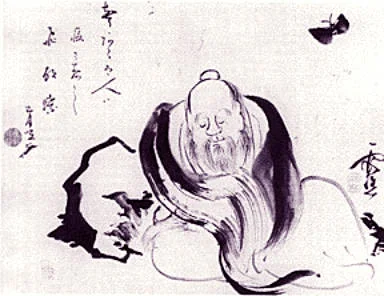
昔者莊周夢爲胡蝶,栩栩然胡蝶也,自喻適志與,不知周也。俄然覺,則蘧蘧然周也。不知周之夢爲胡蝶與?胡蝶之夢爲周與?周與胡蝶,則必有分矣,此之謂物化。
xī zhě zhuāng zhōu mèng wéi hú dié, xǔ xǔ rán hú dié yě, zì yù shì zhì yú, bù zhī zhōu yě. é rán jué, zé qú qú rán zhōu yě. bù zhī zhōu zhī mèng wéi hú dié yú? hú dié zhī mèng wéi zhōu yú? zhōu yǔ hú dié, zé bì yǒu fēn yǐ, cǐ zhī wèi wù huà.
Once Zhuang Zhou dreamed he was a butterfly, a butterfly fluttering about, happy with itself and doing as it pleased. He did not know he was Zhou. Suddenly he woke, and there he was, solidly Zhou. He did not know whether he was Zhou who had dreamed he was a butterfly, or a butterfly dreaming it was Zhou. Between Zhou and the butterfly there must be some difference. This is called .
Note //
The most famous passage of the book. It does not erase the difference between Zhou and the butterfly ('there must be some difference'); it calls the passage between them 'the changing of things' (物化). Giles's 'Metempsychosis' reads in a doctrine of rebirth that the text does not state.
Touch an underlined word to see the Chinese behind it. The lighter lines are how the tradition read the verse; the rest is the verse.
The renderings on this page are shared under CC BY-NC 4.0, in the words of Pranav Ashar.