Gopala-Tapani Upanishad
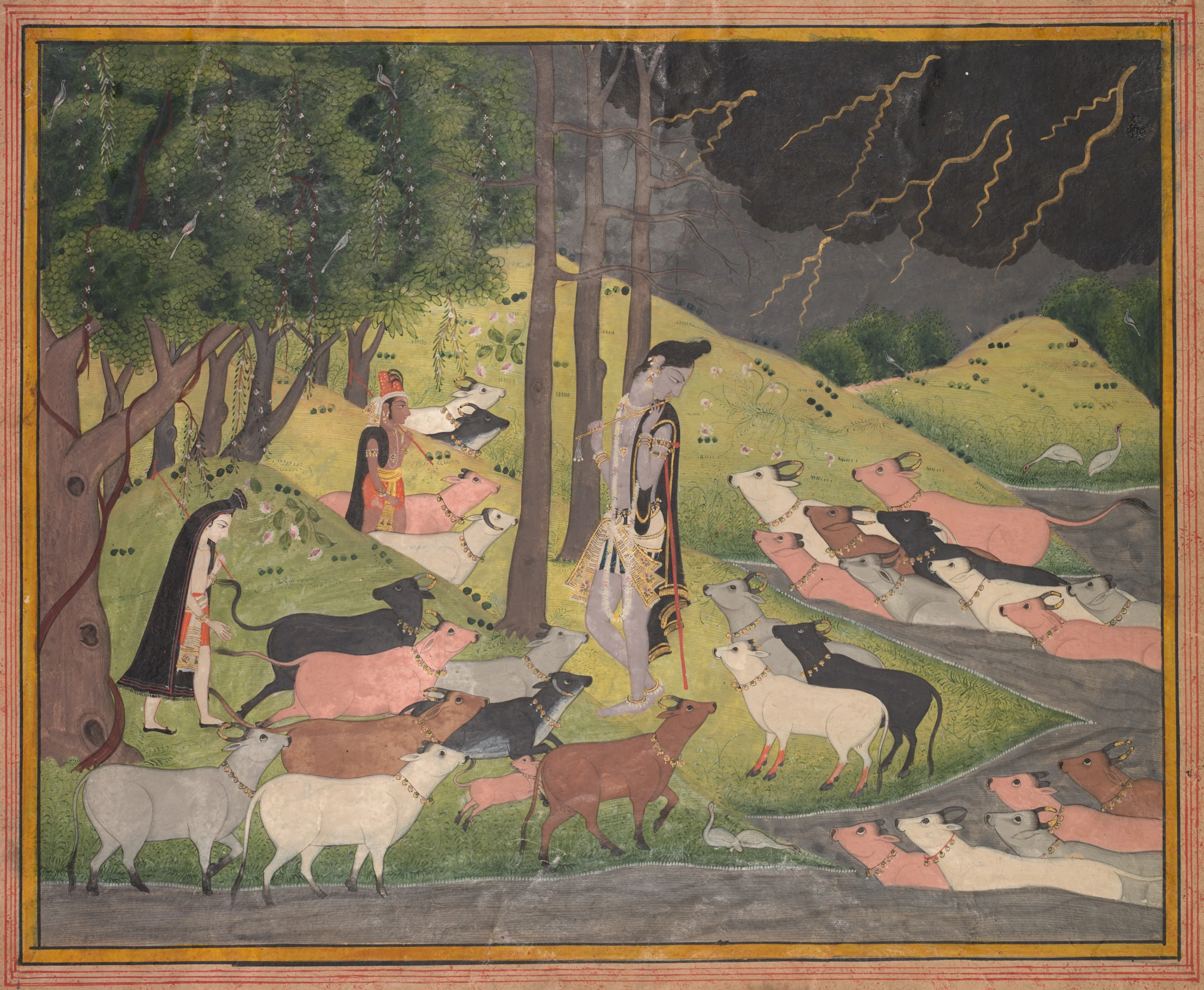
In the words of Pranav Ashar
How we renderThe heart of the Gopala-Tapani
In brief
Krishna is the highest god; death fears Govinda. Devotion is setting the mind on him with no hope from limiting conditions; that alone is freedom from action. In the second part, Durvasa teaches the cowherd women that the Self stands in space, fire, water and earth and is known by none of them, so 'how can I be an enjoyer?' Krishna is the bird that does not eat, the witness; and Narayana teaches Brahma that Brahman is one alone, fourfold only by maya, and that the one who holds 'I am He' should contemplate 'I am Gopala'.
- Devotion as freedom from action
- The Self that is not the enjoyer
- The two birds: one eats, one witnesses
- I am Gopala
- One Brahman, fourfold by maya
- Mathura as the heart
Contents
ॐ कृषिर्भूवाचकः शब्दो णश्च निर्वृतिवाचकः । तयोरैक्यं परं ब्रह्म कृष्ण इत्यभिधीयते ॥ ॐ सच्चिदानन्दरूपाय कृष्णायाक्लिष्टकर्मणे । नमो वेदान्तवेद्याय गुरवे बुद्धिसाक्षिणे ॥
oṃ kṛṣirbhūvācakaḥ śabdo ṇaśca nirvṛtivācakaḥ | tayoraikyaṃ paraṃ brahma kṛṣṇa ityabhidhīyate || oṃ saccidānandarūpāya kṛṣṇāyākliṣṭakarmaṇe | namo vedāntavedyāya gurave buddhisākṣiṇe ||
Om. 'Kṛṣ' is the word for being, 'ṇa' the word for bliss. Their oneness is the highest Brahman, and it is called Krishna. Om. Homage to Krishna, whose form is being, the light and bliss, whose works cost him no effort, who is known through Vedanta, the teacher, the witness of the mind.
Note //
Two opening verses. The first, which explains the name, is in the Adyar and Deccan College copies but not in sanskritdocuments.org; it is also found in the Mahabharata tradition. Both copies print 'naś ca'; the usual form of the verse has 'ṇaś ca', given here. In the second, 'being, the light and bliss' is sat-cit-ānanda; 'the witness of the mind' (buddhi-sākṣin) is the Self that sees the mind's working. Editions: 'akliṣṭakarmaṇe' (Deccan College, sanskritdocuments.org) over 'akliṣṭakāriṇe' (Adyar).
मुनयो ह वै ब्राह्मणमूचुः । कः परमो देवः कुतो मृत्युर्बिभेति कस्य विज्ञानेनाखिलं भाति केनेदं विश्वं संसरतीति । तदु होवाच ब्राह्मणः । श्रीकृष्णो वै परमं दैवतं गोविन्दान्मृत्युर्बिभेति गोपीजनवल्लभज्ञानेन तज्ज्ञातं भवति स्वाहेदं विश्वं संसरतीति । तदु होचुः कः कृष्णो गोविन्दश्च कोऽसाविति गोपीजनवल्लभश्च कः का स्वाहेति । तानुवाच ब्राह्मणः पापकर्षणो गोभूमिवेदविदितो गोपीजनविद्याकलापप्रेरकः । तन्माया चेति सकलं परं ब्रह्मैतत् । यो ध्यायति रसति भजति सोऽमृतो भवति सोऽमृतो भवतीति ॥
munayo ha vai brāhmaṇamūcuḥ | kaḥ paramo devaḥ kuto mṛtyurbibheti kasya vijñānenākhilaṃ bhāti kenedaṃ viśvaṃ saṃsaratīti | tadu hovāca brāhmaṇaḥ | śrīkṛṣṇo vai paramaṃ daivataṃ govindānmṛtyurbibheti gopījanavallabhajñānena tajjñātaṃ bhavati svāhedaṃ viśvaṃ saṃsaratīti | tadu hocuḥ kaḥ kṛṣṇo govindaśca ko'sāviti gopījanavallabhaśca kaḥ kā svāheti | tānuvāca brāhmaṇaḥ pāpakarṣaṇo gobhūmivedavidito gopījanavidyākalāpaprerakaḥ | tanmāyā ceti sakalaṃ paraṃ brahmaitat | yo dhyāyati rasati bhajati so'mṛto bhavati so'mṛto bhavatīti ||
The sages said to Brahma: Who is the highest god? Whom does death fear? By knowing what does everything shine? By what does this world turn? Brahma said to them: Krishna is the highest god. Death fears Govinda. By knowing the beloved of the cowherd women that is known. By svaha this world turns. They asked: Who is Krishna? Who is Govinda? Who is the beloved of the cowherd women? What is svaha? Brahma said to them: Krishna is the one who draws away wrong. Govinda is the one known by the cows, by the earth and by the Vedas. The beloved of the cowherd women is the one who moves the arts of knowledge. Svaha is his maya. All this is the highest Brahman. Whoever meditates on him, savours him, worships him, becomes deathless, becomes deathless.
Note //
The opening questions echo Mundaka 1.1.3 ('by knowing what is all this known?'). The answers take the five parts of the mantra and explain each by its sound: Krishna from 'kṛṣ', draw away; Govinda from 'go', cow, earth, Veda, and 'vid', know. 'Brāhmaṇa' here is read as Brahma, who is called 'Hairanya', born of the golden egg, in the next section. Svaha, the word said at the end of an offering, is Krishna's power, his maya; and with it 'all this is the highest Brahman'. Editions: Adyar and Deccan College read 'akhilaṃ bhāti' and 'śrīkṛṣṇo'; sanskritdocuments.org has 'akhilaṃ vijñātaṃ bhavati' and 'kṛṣṇo'. 'gopījanavidyākalāpaprerakaḥ' (Deccan College, sanskritdocuments.org) over the garbled Adyar reading. Pending review.
ते होचुः किं तद्रूपं किं रसनं कथं वाहो तद्भजनं तत्सर्वं विविदिषतामाख्याहीति । तदु होवाच हैरण्यो गोपवेषमभ्राभं तरुणं कल्पद्रुमाश्रितम् । तदिह श्लोका भवन्ति । सत्पुण्डरीकनयनं मेघाभं वैद्युताम्बरम् । द्विभुजं ज्ञानमुद्राढ्यं वनमालिनमीश्वरम् ॥ गोपगोपाङ्गनावीतं सुरद्रुमतलाश्रितम् । दिव्यालङ्करणोपेतं रत्नपङ्कजमध्यगम् ॥ कालिन्दीजलकल्लोलसङ्गिमारुतसेवितम् । चिन्तयंश्चेतसा कृष्णं मुक्तो भवति संसृतेः ॥ इति ।
te hocuḥ kiṃ tadrūpaṃ kiṃ rasanaṃ kathaṃ vāho tadbhajanaṃ tatsarvaṃ vividiṣatāmākhyāhīti | tadu hovāca hairaṇyo gopaveṣamabhrābhaṃ taruṇaṃ kalpadrumāśritam | tadiha ślokā bhavanti | satpuṇḍarīkanayanaṃ meghābhaṃ vaidyutāmbaram | dvibhujaṃ jñānamudrāḍhyaṃ vanamālinamīśvaram || gopagopāṅganāvītaṃ suradrumatalāśritam | divyālaṅkaraṇopetaṃ ratnapaṅkajamadhyagam || kālindījalakallolasaṅgimārutasevitam | cintayaṃścetasā kṛṣṇaṃ mukto bhavati saṃsṛteḥ || iti |
They said: What is his form? What is savouring him? How is he worshipped? Tell all this to us who want to know. Hairanya, Brahma, said: He wears the dress of a cowherd, dark as a rain cloud, young, resting under the wish-fulfilling tree. On this there are these verses: Eyes like a fine lotus, coloured like a cloud, clothed in lightning, two-armed, his hand in the sign of knowledge, wearing a garland of forest flowers, the Lord; surrounded by cowherds, their women and cows, resting at the foot of the tree of the gods, wearing heavenly ornaments, seated in the middle of a jewelled lotus, fanned by the breeze that has touched the waves of the Yamuna: one who thinks of Krishna in this way is freed from the round of birth.
Note //
The form for meditation. 'The sign of knowledge' (jñāna-mudrā) is the hand with thumb and forefinger joined, the gesture of the teacher. The Kalindi is the Yamuna. Editions: 'abhrābhaṃ taruṇaṃ' (Adyar; 'abhrāmaṃ' Deccan College); 'gopagopāṅganāvītaṃ' (Adyar) over 'gopagopāṅgavāvītaṃ' (Deccan College) and 'gopagopīgavāvītaṃ' (sanskritdocuments.org).
तस्य पुना रसनभजनभूमीन्दुसम्पाताः कामादि कृष्णायेत्येकं पदं गोविन्दायेति द्वितीयं गोपीजनेति तृतीयं वल्लभायेति तुरीयं स्वाहेति पञ्चममिति पञ्चपदीं प्रजपन्पञ्चाङ्गं द्यावाभूमी सूर्याचन्द्रमसौ साग्नी तद्रूपतया ब्रह्म सम्पद्यते ब्रह्म सम्पद्यत इति ॥
tasya punā rasanabhajanabhūmīndusampātāḥ kāmādi kṛṣṇāyetyekaṃ padaṃ govindāyeti dvitīyaṃ gopījaneti tṛtīyaṃ vallabhāyeti turīyaṃ svāheti pañcamamiti pañcapadīṃ prajapanpañcāṅgaṃ dyāvābhūmī sūryācandramasau sāgnī tadrūpatayā brahma sampadyate brahma sampadyata iti ||
Now its savouring: the seed-syllable made of desire, joined with earth and the moon, comes first. 'To Krishna' is the first word, 'to Govinda' the second, 'cowherd women' the third, 'beloved' the fourth, 'svaha' the fifth. Repeating the five words, with their five limbs, heaven and earth, sun and moon, and fire, one becomes Brahman in their form, becomes Brahman.
Note //
The 'savouring' (rasana) is the mantra. Its seed-syllable klīṃ is described in code: 'desire' (kāma) is the letter k, 'earth' is l, 'the moon' is the dot of the nasal; this reading is tentative. The opening words are garbled in every edition (sanskritdocuments.org 'rasanam iti jalabhūmiṃ tu sampātāḥ'). Editions: 'vallabhāyeti' for 'vallabhārya iti' (Adyar, Deccan College) and 'vallabheti' (sanskritdocuments.org). Pending review.
तदेष श्लोकः । क्लीमित्येवादावादाय कृष्णाय योगं गोविन्दायोत च । गोपीजनवल्लभाय बृहद्घनं श्यामं तदप्युच्चरेद्यो गतिस्तस्यास्ति मङ्क्षु नान्या गतिः स्यादिति । भक्तिरस्य भजनं तदिहामुत्रोपाधिनैराश्येनैवामुष्मिन्मनःकल्पनमेतदेव च नैष्कर्म्यम् । कृष्णं सन्तं विप्रा बहुधा यजन्ति गोविन्दं सन्तं बहुधा रसन्ति । गोपीजनवल्लभो भुवनानि दध्रे स्वाहाश्रितो जगदैजयत्सुरेताः ॥ वायुर्यथैको भुवनं प्रविष्टो जन्ये जन्ये पञ्चरूपो बभूव । कृष्णस्तथैकोऽपि जगद्धितार्थं शब्देनासौ पञ्चपदो विभातीति ॥
tadeṣa ślokaḥ | klīmityevādāvādāya kṛṣṇāya yogaṃ govindāyota ca | gopījanavallabhāya bṛhadghanaṃ śyāmaṃ tadapyuccaredyo gatistasyāsti maṅkṣu nānyā gatiḥ syāditi | bhaktirasya bhajanaṃ tadihāmutropādhinairāśyenaivāmuṣminmanaḥkalpanametadeva ca naiṣkarmyam | kṛṣṇaṃ santaṃ viprā bahudhā yajanti govindaṃ santaṃ bahudhā rasanti | gopījanavallabho bhuvanāni dadhre svāhāśrito jagadaijayatsuretāḥ || vāyuryathaiko bhuvanaṃ praviṣṭo janye janye pañcarūpo babhūva | kṛṣṇastathaiko'pi jagaddhitārthaṃ śabdenāsau pañcapado vibhātīti ||
A verse says this: Whoever takes 'klim' first, then 'to Krishna', 'to Govinda', 'to the beloved of the cowherd women', and utters the mantra, deep and dark as a cloud, reaches the goal quickly; there is no other goal. Devotion is his worship: setting the mind on him with no hope at all from limiting conditions, here or hereafter. That alone is freedom from action. The wise worship him, Krishna, in many ways; they savour him, Govinda, in many ways. The beloved of the cowherd women holds the worlds; relying on svaha, his power, he of the potent seed set the world moving. As the one wind, entering the world, becomes fivefold in every living thing, so Krishna, though one, for the good of the world, shines in sound as the five words.
Note //
The verse on the mantra is garbled in both the Adyar and Deccan College copies (given here as they print it; sanskritdocuments.org has 'bṛhanmānavy āsakṛd uccared yo 'sau gatis tasyāsti', 'whoever utters this great mantra again and again'); the rendering follows the sense the editions share. 'Freedom from action' (naiṣkarmya) is the word of the Gita (3.4, 18.49) and of Vedanta for the state of the knower; devotion without hope of reward is given the same name. 'Fivefold': the five breaths. The last verse reworks Katha 2.2.9-10 ('as one fire, as one wind, entering the world...'). Editions: 'nairāśyenaiva' (Adyar, Deccan College) over 'nairāśye' (sanskritdocuments.org); 'jagad aijayat' (Adyar) over 'jagad etat' (sanskritdocuments.org). Pending review.
ते होचुरुपासनमेतस्य परमात्मनो गोविन्दस्याखिलाधारिणो ब्रूहीति । तानुवाच यत्तस्य पीठं हैरण्यमष्टपलाशमम्बुजं तदन्तरालिकानलास्रयुगं तदन्तराद्यार्णं विलिखेत्कृष्णाय नम इति बीजाढ्यं सब्रह्माणमाधायानङ्गगायत्रीं यथावद्व्यालिख्य भूमण्डलं शूलवेष्टितं कृत्वाङ्गवासुदेवादिरुक्मिण्यादिस्वशक्तीन्द्रादिवसुदेवादिपार्थादिनिध्यावीतं यजेत्सन्ध्यासु प्रतिपत्तिभिरुपचारैस्तेनास्याखिलं भवत्यखिलं भवतीति ॥
te hocurupāsanametasya paramātmano govindasyākhilādhāriṇo brūhīti | tānuvāca yattasya pīṭhaṃ hairaṇyamaṣṭapalāśamambujaṃ tadantarālikānalāsrayugaṃ tadantarādyārṇaṃ vilikhetkṛṣṇāya nama iti bījāḍhyaṃ sabrahmāṇamādhāyānaṅgagāyatrīṃ yathāvadvyālikhya bhūmaṇḍalaṃ śūlaveṣṭitaṃ kṛtvāṅgavāsudevādirukmiṇyādisvaśaktīndrādivasudevādipārthādinidhyāvītaṃ yajetsandhyāsu pratipattibhirupacāraistenāsyākhilaṃ bhavatyakhilaṃ bhavatīti ||
They said: Tell us how to worship this highest Self, Govinda, the support of all. He said to them: His seat is a golden lotus of eight petals. Within it, two triangles of fire, interlaced; within these, write the first letter, with 'to Krishna, homage', rich with the seed-syllable, together with Brahma. Write the Gayatri of the god of love as it should be, draw the circle of the earth enclosed by tridents, and surround it with his limbs, with Vasudeva and the rest, with his own powers, Rukmini and the rest, with Indra and the rest, with Vasudeva and his kin, with Arjuna and the others, and with the treasures. One should worship there at the twilights with the offerings of service. By this, everything becomes his, everything becomes his.
Note //
The diagram (yantra) of the Gopala mantra, with its circles of attendant deities. The editions differ in almost every word of this sentence (the Adyar copy has 'vilikhīta', 'sa brāhmaṇam ādhāya', 'anaṅgamanu gāyatrīṃ yathāvad vyāsajya' and 'mūlaveṣṭitam'; sanskritdocuments.org has 'anaṅgagāyatrīṃ yathāvad ālikhya' and 'śūlaveṣṭitam'); the text given combines the clearest readings, and the details are pending review. 'The Gayatri of the god of love' (anaṅga-gāyatrī) is the Kama-Gayatri of Krishna worship.
तदिह श्लोका भवन्ति । एको वशी सर्वगः कृष्ण ईड्य एकोऽपि सन्बहुधा यो विभाति । तं पीठस्थं येऽनुभजन्ति धीरास्तेषां सुखं शाश्वतं नेतरेषाम् ॥
tadiha ślokā bhavanti | eko vaśī sarvagaḥ kṛṣṇa īḍya eko'pi sanbahudhā yo vibhāti | taṃ pīṭhasthaṃ ye'nubhajanti dhīrāsteṣāṃ sukhaṃ śāśvataṃ netareṣām ||
On this there are these verses: One, in control, everywhere, Krishna is to be praised: one, he shines as many. The wise who worship him in his seat have lasting happiness, and no others.
Note //
A reworking of Katha 2.2.12 ('the one controller, the inner Self of all beings, who makes one form many: the wise who see him standing in themselves have lasting happiness, and no others'), with Krishna named and 'in his seat' (the diagram of P1.4) for 'in themselves'. Editions: 'pīṭhasthaṃ ... sukhaṃ śāśvatam' (Adyar, Deccan College); sanskritdocuments.org has 'pīṭhaṃ ... siddhiḥ śāśvatī', the ending of the next verse.
नित्यो नित्यानां चेतनश्चेतनानामेको बहूनां यो विदधाति कामान् । तं पीठगं येऽनुयजन्ति विप्रास्तेषां सिद्धिः शाश्वती नेतरेषाम् ॥
nityo nityānāṃ cetanaścetanānāmeko bahūnāṃ yo vidadhāti kāmān | taṃ pīṭhagaṃ ye'nuyajanti viprāsteṣāṃ siddhiḥ śāśvatī netareṣām ||
Eternal among the eternal, the light within all who know, the one who grants the wishes of the many: the wise who worship him in his seat have lasting fulfilment, and no others.
Note //
Katha 2.2.13 and Shvetashvatara 6.13, again with 'in his seat'. 'The light within all who know' renders 'cetanaś cetanānām', the conscious among the conscious. Editions: 'anuyajanti viprāḥ ... siddhiḥ' (Adyar, Deccan College) over 'anubhajanti dhīrāḥ ... sukham' (sanskritdocuments.org).
एतद्विष्णोः परमं पदं ये नित्योद्युक्ताः संयजन्ते न कामात् । तेषामसौ गोपरूपः प्रयत्नात्प्रकाशयेदात्मपदं तदेव ॥
etadviṣṇoḥ paramaṃ padaṃ ye nityodyuktāḥ saṃyajante na kāmāt | teṣāmasau goparūpaḥ prayatnātprakāśayedātmapadaṃ tadeva ||
Those who, always intent, worship this highest step of Vishnu, not out of desire: to them, by his own care, he in the form of the cowherd reveals that very place, the Self.
Note //
'The highest step of Vishnu' is Rig Veda 1.22.20. What the worship reveals is 'the place of the Self' (ātma-pada). Editions agree.
यो ब्रह्माणं विदधाति पूर्वं यो विद्यास्तस्मै गापयति स्म कृष्णः । तं ह देवमात्मबुद्धिप्रकाशं मुमुक्षुर्वै शरणममुं व्रजेत् ॥
yo brahmāṇaṃ vidadhāti pūrvaṃ yo vidyāstasmai gāpayati sma kṛṣṇaḥ | taṃ ha devamātmabuddhiprakāśaṃ mumukṣurvai śaraṇamamuṃ vrajet ||
Krishna, who first made Brahma and had him sing the Vedas; that god, who lights up the mind with the Self: one who seeks freedom should go to him for refuge.
Note //
Shvetashvatara 6.18 ('who first made Brahma and gave him the Vedas, that god who lights up the mind with the Self, I, seeking freedom, go to for refuge'), with Krishna named. Editions: 'vidyās tasmai gāpayati' (Adyar) for 'vedāṃś ca prahiṇoti' in the Shvetashvatara; 'ātmabuddhiprakāśam' (Deccan College, sanskritdocuments.org, as in the Shvetashvatara) over 'ātmavṛtti' (Adyar).
ओङ्कारेणान्तरितं ये जपन्ति गोविन्दस्य पञ्चपदं मनुं तम् । तेषामसौ दर्शयेदात्मरूपं तस्मान्मुमुक्षुरभ्यसेन्नित्यशान्त्यै ॥
oṅkāreṇāntaritaṃ ye japanti govindasya pañcapadaṃ manuṃ tam | teṣāmasau darśayedātmarūpaṃ tasmānmumukṣurabhyasennityaśāntyai ||
To those who repeat Govinda's mantra of five words, enclosed in Om, he shows his own form, the Self. So one who seeks freedom should practise it, for lasting peace.
Note //
Editions: 'ye japanti ... teṣām' (sanskritdocuments.org; the Deccan College copy has 'ye japanti ... tesyaiva', the Adyar copy 'yo japati ... tasyaiva'); 'nityaśāntyai' (Adyar, Deccan College) over 'nityaśāntiḥ' (sanskritdocuments.org).
एतस्मादन्ये पञ्चपदादभूवन्गोविन्दस्य मनवो मानवानाम् । दशार्णाद्यास्तेऽपि सङ्क्रन्दनाद्यैरभ्यस्यन्ते भूतिकामैर्यथावत् ॥
etasmādanye pañcapadādabhūvangovindasya manavo mānavānām | daśārṇādyāste'pi saṅkrandanādyairabhyasyante bhūtikāmairyathāvat ||
From this mantra of five words came Govinda's other mantras for people, the ten-syllabled and the rest; those who want prosperity, Indra and the others, practise these as prescribed.
Note //
'Saṅkrandana' is a name of Indra. Editions agree, apart from 'anye' (Adyar, Deccan College) and 'eva' (sanskritdocuments.org).
तदेतस्य स्वरूपार्थं वाचा वेदयेति ते पप्रच्छुस्तदु होवाच ब्राह्मणः । अनवरतं मया ध्यातस्ततः परार्धान्ते सोऽबुध्यत गोपवेषो मे पुरस्तादाविर्बभूव । ततः प्रणतो मया अनुकूलेन हृदा मह्यमष्टादशार्णं स्वरूपं सृष्टये दत्त्वान्तर्हितः । पुनः सिसृक्षा मे प्रादुरभूत्तेष्वक्षरेषु भविष्यज्जगद्रूपं प्रकाशयंस्तदाह तदाह ॥
tadetasya svarūpārthaṃ vācā vedayeti te papracchustadu hovāca brāhmaṇaḥ | anavarataṃ mayā dhyātastataḥ parārdhānte so'budhyata gopaveṣo me purastādāvirbabhūva | tataḥ praṇato mayā anukūlena hṛdā mahyamaṣṭādaśārṇaṃ svarūpaṃ sṛṣṭaye dattvāntarhitaḥ | punaḥ sisṛkṣā me prādurabhūtteṣvakṣareṣu bhaviṣyajjagadrūpaṃ prakāśayaṃstadāha tadāha ||
They asked: 'Tell us in words what this is in its own nature.' Brahma said: I meditated on him without a break. Then, at the end of the age of Brahma, he awoke, and stood before me in the dress of a cowherd. I bowed down, and with a kind heart he gave me his own form, the eighteen syllables, for the work of creation, and vanished. Again the wish to create arose in me, and in those syllables he showed me the form of the world to come. That is what he said, what he said.
Note //
The eighteen syllables are the mantra 'klīṃ kṛṣṇāya govindāya gopījanavallabhāya svāhā'. 'The end of the age of Brahma' (parārdha) is the end of the great cycle. Editions: 'prādurabhūt teṣv akṣareṣu' (Deccan College; Adyar 'prādurabhūteṣv'); 'mahyam' (Deccan College) over 'madyam' (Adyar). The sanskritdocuments.org text of this section differs considerably ('ko 'padeṣṭā me puruṣaḥ', 'māyānukūlena'). Pending review.
अनुकूलेन हृदा मह्यमष्टादशार्णं स्वरूपं सृष्टये दत्त्वान्तर्हित इति । आकाशादापो जलात्पृथ्वी ततोऽग्निर्बिन्दोरिन्दुस्तत्सम्पातादर्क इति । क्लीङ्कारादसृजं कृष्णादाकाशं खाद्वायुरित्युत्तरात्सुरभिविद्याः प्रादुरकार्षं तदुत्तरात्तु स्त्रीपुमादि चेदं सकलमिदं सकलमिति ॥
anukūlena hṛdā mahyamaṣṭādaśārṇaṃ svarūpaṃ sṛṣṭaye dattvāntarhita iti | ākāśādāpo jalātpṛthvī tato'gnirbindorindustatsampātādarka iti | klīṅkārādasṛjaṃ kṛṣṇādākāśaṃ khādvāyurityuttarātsurabhividyāḥ prādurakārṣaṃ taduttarāttu strīpumādi cedaṃ sakalamidaṃ sakalamiti ||
'With a kind heart he gave me his own form, the eighteen syllables, for creation, and vanished': From space came water, from water earth, then fire; from the dot, the moon; from their meeting, the sun. From 'klim' I brought forth; from 'Krishna', space; from space, wind; from what follows, the cow of plenty and the sciences; from what follows that, woman and man and the rest: all this, all this.
Note //
Brahma tells how the world came from the syllables of the mantra. The order of the elements is unusual and the sentence is compressed in every edition; the rendering follows the Adyar and Deccan College copies, which agree. 'prādur akārṣam', 'I brought forth' (Deccan College, sanskritdocuments.org) over 'prādur akāryam' (Adyar). Pending review.
एतस्यैव यजनेन चन्द्रध्वजो गतमोहमात्मानं वेदयित्वोङ्कारान्तरालिकं मनुमावर्तयन्सङ्गरहितोऽत्यापतत् । तद्विष्णोः परमं पदं सदा पश्यन्ति सूरयः । दिवीव चक्षुराततम् । तस्मादेतन्नित्यमभ्यसेन्नित्यमभ्यसेदिति ॥
etasyaiva yajanena candradhvajo gatamohamātmānaṃ vedayitvoṅkārāntarālikaṃ manumāvartayansaṅgarahito'tyāpatat | tadviṣṇoḥ paramaṃ padaṃ sadā paśyanti sūrayaḥ | divīva cakṣurātatam | tasmādetannityamabhyasennityamabhyasediti ||
By worshipping this alone, Chandradhvaja knew the Self, with his delusion gone, and repeating the mantra enclosed in Om, free of attachment, he went beyond. 'The wise always see that highest step of Vishnu, spread like an eye in the sky.' So one should practise this always, practise it always.
Note //
Chandradhvaja is a king of the old stories. The verse is Rig Veda 1.22.20. What the worship gives is the knowledge of the Self 'with delusion gone'. Editions agree, apart from 'ty āpatat' (Adyar, Deccan College), 'went beyond'; sanskritdocuments.org has 'abhyānayat'.
तदाहुरेके यस्य प्रथमपदाद्भूमिर्द्वितीयपदाज्जलं तृतीयपदात्तेजश्चतुर्थाद्वायुश्चरमाद्व्योमेति वैष्णवं पञ्चव्याहृतिमयं मन्त्रं कृष्णावभासकं कैवल्यसृत्यै सततमावर्तयेदिति । तदत्र गाथाः । यस्य पूर्वपदाद्भूमिर्द्वितीयात्सलिलोद्भवः । तृतीयात्तेज उद्भूतं चतुर्थाद्गन्धवाहनः ॥ पञ्चमादम्बरोत्पत्तिस्तमेवैकं समभ्यसेत् । चन्द्रध्वजोऽगमद्विष्णोः परमं पदमव्ययम् ॥
tadāhureke yasya prathamapadādbhūmirdvitīyapadājjalaṃ tṛtīyapadāttejaścaturthādvāyuścaramādvyometi vaiṣṇavaṃ pañcavyāhṛtimayaṃ mantraṃ kṛṣṇāvabhāsakaṃ kaivalyasṛtyai satatamāvartayediti | tadatra gāthāḥ | yasya pūrvapadādbhūmirdvitīyātsalilodbhavaḥ | tṛtīyātteja udbhūtaṃ caturthādgandhavāhanaḥ || pañcamādambarotpattistamevaikaṃ samabhyaset | candradhvajo'gamadviṣṇoḥ paramaṃ padamavyayam ||
Some say: from its first word came earth, from the second water, from the third fire, from the fourth wind, from the last space. This mantra of Vishnu, made of five great words, which makes Krishna shine, one should repeat always, for the path to aloneness. On this there are these verses: The one from whose first word came earth, from the second water, from the third fire, from the fourth the bearer of scents, wind, from the fifth space: him alone one should practise. Chandradhvaja went to the highest, unchanging step of Vishnu.
Note //
'Aloneness' (kaivalya) is freedom: the Self alone, with nothing second. Editions agree.
ततो विशुद्धं विमलं विशोकमशेषलोभादिनिरस्तसङ्गम् । यत्तत्पदं पञ्चपदं तदेव स वासुदेवो न यतोऽन्यदस्ति ॥ तमेकं गोविन्दं सच्चिदानन्दविग्रहं पञ्चपदं वृन्दावने सुरभूरुहतलासीनं सततं समरुद्गणोऽहं परमया स्तुत्या तोषयामि ॥
tato viśuddhaṃ vimalaṃ viśokamaśeṣalobhādinirastasaṅgam | yattatpadaṃ pañcapadaṃ tadeva sa vāsudevo na yato'nyadasti || tamekaṃ govindaṃ saccidānandavigrahaṃ pañcapadaṃ vṛndāvane surabhūruhatalāsīnaṃ satataṃ samarudgaṇo'haṃ paramayā stutyā toṣayāmi ||
Then: pure, stainless, beyond sorrow, free of every tie, of greed and all the rest: that place is the place of the five words; that is Vasudeva, other than whom there is nothing. Him, the one Govinda, whose body is being, the light and bliss, the five words, seated under the tree of the gods in Vrindavana, I, with the hosts of the winds, please always with the highest hymn.
Note //
The end of the first section. 'Other than whom there is nothing' (na yato 'nyad asti): the place the mantra leads to is the one without a second. Editions: 'toṣayāmi' (Adyar) or 'stoṣyāmi', 'I will praise' (Deccan College, sanskritdocuments.org).
ॐ नमो विश्वरूपाय विश्वस्थित्यन्तहेतवे । विश्वेश्वराय विश्वाय गोविन्दाय नमो नमः ॥ नमो विज्ञानरूपाय परमानन्दरूपिणे । कृष्णाय गोपीनाथाय गोविन्दाय नमो नमः ॥ नमः कमलनेत्राय नमः कमलमालिने । नमः कमलनाभाय कमलापतये नमः ॥
oṃ namo viśvarūpāya viśvasthityantahetave | viśveśvarāya viśvāya govindāya namo namaḥ || namo vijñānarūpāya paramānandarūpiṇe | kṛṣṇāya gopīnāthāya govindāya namo namaḥ || namaḥ kamalanetrāya namaḥ kamalamāline | namaḥ kamalanābhāya kamalāpataye namaḥ ||
Om. Homage to the one whose form is the universe, the cause of its staying and its end, the lord of all, who is all: to Govinda, homage, homage. Homage to the one whose form is knowing, whose form is the highest bliss, to Krishna, lord of the cowherd women, to Govinda, homage, homage. Homage to the lotus-eyed, homage to the one garlanded with lotuses, homage to the one with a lotus at his navel, to the husband of Kamala, homage.
Note //
The second section is Brahma's hymn of twelve verses. Kamala is Lakshmi. Editions: 'viśvarūpāya' (Adyar) or 'viśvasvarūpāya' (Deccan College, sanskritdocuments.org).
बर्हापीडाभिरामाय रामायाकुण्ठमेधसे । रमामानसहंसाय गोविन्दाय नमो नमः ॥ कंसवंशविनाशाय केशिचाणूरघातिने । वृषभध्वजवन्द्याय पार्थसारथये नमः ॥ वेणुवादनशीलाय गोपालायाहिमर्दिने । कालिन्दीकूललोलाय लोलकुण्डलधारिणे ॥
barhāpīḍābhirāmāya rāmāyākuṇṭhamedhase | ramāmānasahaṃsāya govindāya namo namaḥ || kaṃsavaṃśavināśāya keśicāṇūraghātine | vṛṣabhadhvajavandyāya pārthasārathaye namaḥ || veṇuvādanaśīlāya gopālāyāhimardine | kālindīkūlalolāya lolakuṇḍaladhāriṇe ||
To the one lovely with a crown of peacock feathers, to the delightful one, whose mind is never dulled, the swan on the lake of Rama's heart, to Govinda, homage, homage. To the destroyer of Kamsa's line, the slayer of Keshi and Chanura, honoured by the one whose banner is the bull, to the charioteer of Arjuna, homage. To the one who loves to play the flute, to the cowherd who crushed the serpent, who wanders on the banks of the Yamuna, wearing swinging earrings,
Note //
Episodes of Krishna's life: Kamsa, Keshi and Chanura are enemies he killed; the serpent is Kaliya; 'the one whose banner is the bull' is Shiva. 'Rama' in the third line is Rama, Lakshmi. Editions: 'veṇuvādanaśīlāya' (Adyar, Deccan College) over 'veṇunādavinodāya' (sanskritdocuments.org).
बल्लवीनयनाम्भोजमालिने नृत्यशालिने । नमः प्रणतपालाय श्रीकृष्णाय नमो नमः ॥ नमः पापप्रणाशाय गोवर्धनधराय च । पूतनाजीवितान्ताय तृणावर्तासुहारिणे ॥ निष्कलाय विमोहाय शुद्धायाशुद्धवैरिणे । अद्वितीयाय महते श्रीकृष्णाय नमो नमः ॥
ballavīnayanāmbhojamāline nṛtyaśāline | namaḥ praṇatapālāya śrīkṛṣṇāya namo namaḥ || namaḥ pāpapraṇāśāya govardhanadharāya ca | pūtanājīvitāntāya tṛṇāvartāsuhāriṇe || niṣkalāya vimohāya śuddhāyāśuddhavairiṇe | advitīyāya mahate śrīkṛṣṇāya namo namaḥ ||
garlanded by the lotus eyes of the cowherd women, graceful in the dance: homage to the protector of those who bow, to Shri Krishna, homage, homage. Homage to the destroyer of wrong, who held up Mount Govardhana, who ended Putana's life, who took Trinavarta's breath; to the one without parts, without delusion, pure, the enemy of the impure, the one without a second, the great, to Shri Krishna, homage, homage.
Note //
Putana and Trinavarta are demons of the childhood stories. The hymn turns at the end from the stories to 'without parts' and 'without a second'. Editions: 'ballavīnayana' (Adyar; 'pallavīnayana' Deccan College); 'nṛtyaśāline' (Adyar, Deccan College) over 'nṛttaśāline'; 'namo namaḥ' for 'namonanamaḥ' (Deccan College).
प्रसीद परमानन्द प्रसीद परमेश्वर । आधिव्याधिभुजङ्गेन दष्टं मामुद्धर प्रभो ॥ श्रीकृष्ण रुक्मिणीकान्त गोपीजनमनोहर । संसारसागरे मग्नं मामुद्धर जगद्गुरो ॥ केशव क्लेशहरण नारायण जनार्दन । गोविन्द परमानन्द मां समुद्धर माधव ॥
prasīda paramānanda prasīda parameśvara | ādhivyādhibhujaṅgena daṣṭaṃ māmuddhara prabho || śrīkṛṣṇa rukmiṇīkānta gopījanamanohara | saṃsārasāgare magnaṃ māmuddhara jagadguro || keśava kleśaharaṇa nārāyaṇa janārdana | govinda paramānanda māṃ samuddhara mādhava ||
Be gracious, highest bliss; be gracious, highest Lord. I am bitten by the snake of sorrow and sickness: lift me out, Lord. Shri Krishna, beloved of Rukmini, who steals the hearts of the cowherd women, I am sunk in the ocean of becoming: lift me out, teacher of the world. Keshava, remover of affliction, Narayana, Janardana, Govinda, highest bliss, lift me out, Madhava.
Note //
Editions agree.
अथ हैवं स्तुतिभिराराधयामि तथा यूयं पञ्चपदं जपन्तः श्रीकृष्णं ध्यायन्तः संसृतिं तरिष्यथेति स होवाच हैरण्यः । अमुं पञ्चपदं मन्त्रमावर्तयेद्यः स यात्यनायासतः केवलं तत् । अनेजदेकं मनसो जवीयो नैनद्देवा आप्नुवन्पूर्वमर्षदिति । तस्मात्कृष्ण एव परो देवस्तं ध्यायेत्तं रसयेत्तं भजेत्तं भजेदित्यों तत्सदिति ॥
atha haivaṃ stutibhirārādhayāmi tathā yūyaṃ pañcapadaṃ japantaḥ śrīkṛṣṇaṃ dhyāyantaḥ saṃsṛtiṃ tariṣyatheti sa hovāca hairaṇyaḥ | amuṃ pañcapadaṃ mantramāvartayedyaḥ sa yātyanāyāsataḥ kevalaṃ tat | anejadekaṃ manaso javīyo nainaddevā āpnuvanpūrvamarṣaditi | tasmātkṛṣṇa eva paro devastaṃ dhyāyettaṃ rasayettaṃ bhajettaṃ bhajedityoṃ tatsaditi ||
'So I worship him with hymns. In the same way, you, repeating the five words and meditating on Shri Krishna, will cross over the round of birth,' said Hairanya. Whoever repeats this mantra of five words goes without effort to that aloneness. 'Unmoving, one, swifter than the mind; the senses never reached it; it went ahead of them.' So Krishna alone is the highest god. One should meditate on him, savour him, worship him, worship him. Om, that is the real.
Note //
The end of the first part. The verse quoted is Isha 4, on the Self that does not move and yet outruns everything. 'Om tat sat' (Gita 17.23) closes the part. Editions: 'ārādhayāmi tathā yūyam' for 'ārādhayāmi te yūyaṃ tathā' (Adyar, Deccan College); 'mantram āvartayed' (Adyar) over 'mantram ārtayeyed' (Deccan College); 'nainad' (Deccan College, as in the Isha) over 'naitad' (Adyar); 'rasayet' for 'rasey/raset' (Adyar, Deccan College), as in sanskritdocuments.org.
ॐ एकदा हि व्रजस्त्रियः सकामाः शर्वरीमुषित्वा सर्वेश्वरं गोपालं कृष्णं हि ता ऊचिरे । उवाच ताः कृष्णः । अमुकस्मै ब्राह्मणाय भैक्षं दातव्यं भवति दुर्वाससेति । कथं यास्यामोऽतीर्त्वा जलं यमुनायाः यतः श्रेयो भवति कृष्णेति । कृष्णो ब्रह्मचारीत्युक्त्वा मार्गं वो दास्यति । यं मां स्मृत्वा अगाधा गाधा भवति यं मां स्मृत्वा अपूतः पूतो भवति यं मां स्मृत्वाव्रती व्रती भवति यं मां स्मृत्वा सकामो निष्कामो भवति यं मां स्मृत्वा अश्रोत्रियः श्रोत्रियो भवति । श्रुत्वा तद्वाक्यं हि वै स्मृत्वा तद्वाक्येन तीर्त्वा तां सौर्यां हि वै गत्वाश्रमं पुण्यतमं नत्वा मुनिं श्रेष्ठतमं हि रौद्रं चेति दत्त्वास्मै ब्राह्मणाय क्षीरमयं घृतमयं मिष्टतमं हि वा इष्टतमं स तुष्टः स्नात्वा भुक्त्वाशिषं प्रयोज्याज्ञामदात् । कथं यास्यामोऽतीर्त्वा सौर्याम् । स होवाच मुनिर्दुर्वासिनं मां स्मृत्वा वो दास्यतीति मार्गम् । तासां मध्ये श्रेष्ठा गान्धर्वी होवाच सहैवैताभिरेवं विचार्य कथं कृष्णो ब्रह्मचारी कथं दुर्वासिनो मुनिरिति । तां हि मुख्यां विधाय पूर्वमनु कृत्वा तूष्णीमासुः ।
oṃ ekadā hi vrajastriyaḥ sakāmāḥ śarvarīmuṣitvā sarveśvaraṃ gopālaṃ kṛṣṇaṃ hi tā ūcire | uvāca tāḥ kṛṣṇaḥ | amukasmai brāhmaṇāya bhaikṣaṃ dātavyaṃ bhavati durvāsaseti | kathaṃ yāsyāmo'tīrtvā jalaṃ yamunāyāḥ yataḥ śreyo bhavati kṛṣṇeti | kṛṣṇo brahmacārītyuktvā mārgaṃ vo dāsyati | yaṃ māṃ smṛtvā agādhā gādhā bhavati yaṃ māṃ smṛtvā apūtaḥ pūto bhavati yaṃ māṃ smṛtvāvratī vratī bhavati yaṃ māṃ smṛtvā sakāmo niṣkāmo bhavati yaṃ māṃ smṛtvā aśrotriyaḥ śrotriyo bhavati | śrutvā tadvākyaṃ hi vai smṛtvā tadvākyena tīrtvā tāṃ sauryāṃ hi vai gatvāśramaṃ puṇyatamaṃ natvā muniṃ śreṣṭhatamaṃ hi raudraṃ ceti dattvāsmai brāhmaṇāya kṣīramayaṃ ghṛtamayaṃ miṣṭatamaṃ hi vā iṣṭatamaṃ sa tuṣṭaḥ snātvā bhuktvāśiṣaṃ prayojyājñāmadāt | kathaṃ yāsyāmo'tīrtvā sauryām | sa hovāca munirdurvāsinaṃ māṃ smṛtvā vo dāsyatīti mārgam | tāsāṃ madhye śreṣṭhā gāndharvī hovāca sahaivaitābhirevaṃ vicārya kathaṃ kṛṣṇo brahmacārī kathaṃ durvāsino muniriti | tāṃ hi mukhyāṃ vidhāya pūrvamanu kṛtvā tūṣṇīmāsuḥ |
Once the women of Vraja, full of desire, having spent the night with him, spoke to Gopala, Krishna, the lord of all. Krishna said to them: 'Alms are to be given to a certain brahmin, Durvasa.' 'How shall we go, without crossing the water of the Yamuna? Tell us, Krishna, how it may go well.' 'Say "Krishna the celibate", and the river will give you a way. Remembering me, the deep becomes shallow; remembering me, the impure becomes pure; remembering me, one without vows keeps vows; remembering me, one full of desire is free of desire; remembering me, one without learning becomes learned.' Hearing his words, remembering them, they crossed by those words, went to the most holy hermitage on the far bank of the sun's daughter, and bowed to the sage, the best of sages, the fierce one. They gave the brahmin food made of milk and ghee, the sweetest and the choicest. Pleased, he bathed, ate, gave them his blessing, and let them go. 'How shall we go back, without crossing the sun's daughter?' The sage said: 'Remember me, Durvasa who lives on grass, and the river will give you a way.' The best among them, Gandharvi, having thought it over with the others, said: 'How is Krishna a celibate? How is Durvasa one who lives on grass?' Making her their leader, the others followed her and fell silent.
Note //
The second part begins. The Yamuna is the daughter of the sun (saurī). The riddle: Krishna, who has just spent the night with the cowherd women, is to be called 'the celibate', and Durvasa, who has just eaten their milk and butter, 'the one who lives on durva grass', that is, who never truly eats. Both names work, and the rest of the part explains why. The wording is uncertain in every edition. Editions: the Adyar copy is followed in most places; 'sakāmo niṣkāmo' (sanskritdocuments.org) over 'niṣkāmaḥ sakāmo' (Adyar); 'durvāsinam', 'who lives on grass' (Adyar) over 'durvāsanam' (sanskritdocuments.org). Pending review.
शब्दवानाकाशः शब्दाकाशाभ्यां भिन्नस्तस्मिन्नाकाशे तिष्ठत्याकाशस्तं न वेद स ह्यात्माहं कथं भोक्ता भवामि ॥
śabdavānākāśaḥ śabdākāśābhyāṃ bhinnastasminnākāśe tiṣṭhatyākāśastaṃ na veda sa hyātmāhaṃ kathaṃ bhoktā bhavāmi ||
Space has sound; he is other than sound and space. He stands in space, and space does not know him. He is the Self. How can I be an ?
Note //
Durvasa's answer begins. 'He stands in space, and space does not know him' is the teaching of the inner controller, Brihadaranyaka 3.7.12. Durvasa speaks as the Self: the Self in him did not eat. Editions: 'taṃ na veda' (sanskritdocuments.org) over 'tan na veda' (Adyar).
स्पर्शवान्वायुः स्पर्शवायुभ्यां भिन्नस्तस्मिन्वायौ तिष्ठति वायुर्न वेद तं स ह्यात्माहं कथं भोक्ता भवामि । रूपवदिदं तेजो रूपाग्निभ्यां भिन्नस्तस्मिन्नग्नौ तिष्ठत्यग्निर्न वेद तं स ह्यात्माहं कथं भोक्ता भवामि ॥
sparśavānvāyuḥ sparśavāyubhyāṃ bhinnastasminvāyau tiṣṭhati vāyurna veda taṃ sa hyātmāhaṃ kathaṃ bhoktā bhavāmi | rūpavadidaṃ tejo rūpāgnibhyāṃ bhinnastasminnagnau tiṣṭhatyagnirna veda taṃ sa hyātmāhaṃ kathaṃ bhoktā bhavāmi ||
Wind has touch; he is other than touch and wind. He stands in wind, and wind does not know him. He is the Self. How can I be an ? This fire has form; he is other than form and fire. He stands in fire, and fire does not know him. He is the Self. How can I be an ?
Note //
Each element is known by its quality (sound, touch, form, taste, smell), and the Self is other than both the element and its quality. Editions: the Adyar copy; sanskritdocuments.org lacks the sentence on wind and garbles the one on fire ('bhinnam').
रसवत्य आपो रसाद्भ्यो भिन्नस्तास्वप्सु तिष्ठत्यापो न विदुस्तं स ह्यात्माहं कथं भोक्ता भवामि ॥
rasavatya āpo rasādbhyo bhinnastāsvapsu tiṣṭhatyāpo na vidustaṃ sa hyātmāhaṃ kathaṃ bhoktā bhavāmi ||
Water has taste; he is other than taste and water. He stands in water, and water does not know him. He is the Self. How can I be an ?
Note //
Editions: 'bhinnaḥ', 'he is other', as in the other sentences, for 'bhinnāḥ' (Adyar), which would make the waters other than taste and water.
गन्धवती भूमिर्गन्धभूमिभ्यां भिन्नस्तस्यां भूमौ तिष्ठति भूमिर्न वेद तं स ह्यात्माहं कथं भोक्ता भवामि ॥
gandhavatī bhūmirgandhabhūmibhyāṃ bhinnastasyāṃ bhūmau tiṣṭhati bhūmirna veda taṃ sa hyātmāhaṃ kathaṃ bhoktā bhavāmi ||
Earth has smell; he is other than smell and earth. He stands in earth, and earth does not know him. He is the Self. How can I be an ?
Note //
Editions: Adyar; sanskritdocuments.org has 'bhinnā', 'the earth is other'.
इदं हि मनस्तेष्वेवं हि मनुते तानिदं गृह्णाति । यत्र हि सर्वमात्मैवाभूत्तत्र वा कुत्र मनुते क्व वा गच्छतीति स ह्यात्माहं कथं भोक्ता भवामि ॥
idaṃ hi manasteṣvevaṃ hi manute tānidaṃ gṛhṇāti | yatra hi sarvamātmaivābhūttatra vā kutra manute kva vā gacchatīti sa hyātmāhaṃ kathaṃ bhoktā bhavāmi ||
This mind thinks in this way among these things, and takes hold of them. But where all has become the Self, where would it think, where would it go? He is the Self. How can I be an ?
Note //
'Where all has become the Self': Brihadaranyaka 2.4.14 and 4.5.15. The mind moves among the five elements and their qualities; where there is nothing but the Self, there is nothing for it to think about or go to. So the one who ate the food never ate. Editions: Adyar.
अयं हि कृष्णो यो वो हि प्रेष्ठः शरीरद्वयकारणं भवति । द्वौ सुपर्णौ भवतो ब्रह्मणोऽंशभूतस्तथेतरो भोक्ता भवति । अन्यो हि साक्षी भवतीति ॥ वृक्षधर्मे तौ तिष्ठतोऽभोक्तृभोक्तारौ । पूर्वो हि भोक्ता भवति । तथेतरोऽभोक्ता कृष्णो भवतीति । यत्र विद्याविद्ये न विदामो विद्याविद्याभ्यां भिन्नो विद्यामयो यः स कथं विषयी भवतीति ॥
ayaṃ hi kṛṣṇo yo vo hi preṣṭhaḥ śarīradvayakāraṇaṃ bhavati | dvau suparṇau bhavato brahmaṇo'ṃśabhūtastathetaro bhoktā bhavati | anyo hi sākṣī bhavatīti || vṛkṣadharme tau tiṣṭhato'bhoktṛbhoktārau | pūrvo hi bhoktā bhavati | tathetaro'bhoktā kṛṣṇo bhavatīti | yatra vidyāvidye na vidāmo vidyāvidyābhyāṃ bhinno vidyāmayo yaḥ sa kathaṃ viṣayī bhavatīti ||
This Krishna, who is dearest to you, is the cause of the two bodies. There are two birds: one, a portion of Brahman, and the other, the eater. The other is the witness. They stand on the tree, the one not eating, the one eating. The first is the eater; the other, who does not eat, is Krishna. Where we do not know knowledge and ignorance, the one who is other than knowledge and ignorance, made of knowing: how can he be ?
Note //
Mundaka 3.1.1 and Shvetashvatara 4.6: two birds on one tree; one eats the sweet fruit, the other looks on without eating. 'The two bodies' are the gross and the subtle. The phrasing is tangled in both editions (sanskritdocuments.org has 'brahmaṇo 'haṃ sambhūtaḥ', 'I was born of Brahman'); the sense is clear: Krishna is the witness who does not eat. That is why he is 'the celibate': nothing in him goes after objects. The two sections are taken together, as on the earlier key-verses page. Pending review.
यो हि वै कामेन कामान्कामयते स कामी भवति । यो हि वै त्वकामेन कामान्न कामयते सोऽकामी भवतीति । जन्मजराभ्यां भिन्नः स्थाणुरयमच्छेद्योऽयम् । योऽसौ सूर्ये तिष्ठति योऽसौ गोषु तिष्ठति योऽसौ गोपान्पालयति योऽसौ गोपेषु तिष्ठति योऽसौ सर्वेषु देवेषु तिष्ठति योऽसौ सर्वैर्वेदैर्गीयते योऽसौ सर्वेषु भूतेष्वाविश्य तिष्ठति भूतानि च विदधाति स वो हि स्वामी भवतीति ॥
yo hi vai kāmena kāmānkāmayate sa kāmī bhavati | yo hi vai tvakāmena kāmānna kāmayate so'kāmī bhavatīti | janmajarābhyāṃ bhinnaḥ sthāṇurayamacchedyo'yam | yo'sau sūrye tiṣṭhati yo'sau goṣu tiṣṭhati yo'sau gopānpālayati yo'sau gopeṣu tiṣṭhati yo'sau sarveṣu deveṣu tiṣṭhati yo'sau sarvairvedairgīyate yo'sau sarveṣu bhūteṣvāviśya tiṣṭhati bhūtāni ca vidadhāti sa vo hi svāmī bhavatīti ||
Whoever desires desires with desire is one who desires. Whoever, without desire, does not desire desires is free of desire. Other than birth and old age, this one is unmoving, this one cannot be cut. The one who stands in the sun, who stands in the cows, who guards the cowherds, who stands in the cowherds, who stands in all the gods, who is sung by all the Vedas, who enters all beings and stands in them and orders them: he is your master.
Note //
This answers how Krishna, the lover, is celibate: there is no desire in him that desires. 'Cannot be cut' (acchedya): Gita 2.24. The list of 'the one who stands in...' echoes the inner controller of Brihadaranyaka 3.7. Editions: the Adyar copy reads 'akāmena kāmān na kāmayate'; sanskritdocuments.org 'akāmena kāmān kāmayate' (desires desires without desire), which makes the same point differently. 'sarvair vedair', 'by all the Vedas' (Adyar) over 'sarvair devair', 'by all the gods' (sanskritdocuments.org). Pending review.
सा होवाच गान्धर्वी कथं वास्मासु जातोऽसौ गोपालः कथं वा ज्ञातोऽसौ त्वया मुने कृष्णः को वास्य मन्त्रः किं वास्य स्थानं कथं वा देवक्यां जातः को वास्य ज्यायान्रामो भवति कीदृशी पूजास्य गोपालस्य भवति साक्षात्प्रकृतिपरोऽयमात्मा गोपालः कथं त्ववतीर्णो भूम्यां हि वै ॥
sā hovāca gāndharvī kathaṃ vāsmāsu jāto'sau gopālaḥ kathaṃ vā jñāto'sau tvayā mune kṛṣṇaḥ ko vāsya mantraḥ kiṃ vāsya sthānaṃ kathaṃ vā devakyāṃ jātaḥ ko vāsya jyāyānrāmo bhavati kīdṛśī pūjāsya gopālasya bhavati sākṣātprakṛtiparo'yamātmā gopālaḥ kathaṃ tvavatīrṇo bhūmyāṃ hi vai ||
Gandharvi said: How was this Gopala born among us? How was Krishna known by you, sage? What is his mantra? What is his place? How was he born of Devaki? Who is Rama, his elder brother? What kind of worship is due to this Gopala? This Gopala is the Self itself, beyond nature: how then did he come down to the earth?
Note //
The question that the rest of the text answers: how can the Self, beyond nature, be born? Editions: 'jyāyān rāmo', 'his elder brother Rama' (Adyar) over 'jāyāgrāmo' (sanskritdocuments.org); 'sākṣāt prakṛtiparo 'yam ātmā' (sanskritdocuments.org) over 'prakṛtiparayor ayam ātmā' (Adyar).
स होवाच तां ह वा एको हि वै पूर्वं नारायणो देवो यस्मिँल्लोका ओताश्च प्रोताश्च तस्य हृत्पद्माज्जातोऽब्जयोनिस्तपस्तप्त्वा तस्मै ह वरं ददौ । स कामप्रश्नमेव वव्रे । तं हास्मै ददौ । स होवाचाब्जयोनिरवताराणां मध्ये श्रेष्ठोऽवतारः को भवति येन लोकास्तुष्टा देवास्तुष्टा भवन्ति यं स्मृत्वा मुक्ता अस्मात्संसाराद्भवन्ति कथं वास्यावतारस्य ब्रह्मता भवति ॥
sa hovāca tāṃ ha vā eko hi vai pūrvaṃ nārāyaṇo devo yasmim̐llokā otāśca protāśca tasya hṛtpadmājjāto'bjayonistapastaptvā tasmai ha varaṃ dadau | sa kāmapraśnameva vavre | taṃ hāsmai dadau | sa hovācābjayoniravatārāṇāṃ madhye śreṣṭho'vatāraḥ ko bhavati yena lokāstuṣṭā devāstuṣṭā bhavanti yaṃ smṛtvā muktā asmātsaṃsārādbhavanti kathaṃ vāsyāvatārasya brahmatā bhavati ||
He said to her: In the beginning there was only one, the god Narayana, on whom the worlds are woven, warp and weft. From the lotus of his heart the lotus-born, Brahma, was born. Brahma practised austerity, and Narayana gave him a boon. He chose to ask what he wished to know, and that was granted. The lotus-born said: Among the descents of the Lord, which is the best, by which the worlds and the gods are pleased, remembering which people are freed from the round of birth? And how is this descent Brahman?
Note //
'Woven, warp and weft' (otāś ca protāś ca) is Brihadaranyaka 3.8.11. Durvasa answers Gandharvi by retelling what Narayana taught Brahma. Editions: 'tapas taptvā' (sanskritdocuments.org; the Adyar copy has 'sa pitā', 'that father'); 'devās tuṣṭāḥ' (Adyar).
स होवाच तं हि वै नारायणो देवः सकाम्या मेरोः शृङ्गे यथा सप्त पुर्यो भवन्ति तथा निष्काम्याः सकाम्याश्च भूलोकचक्रे सप्त पुर्यो भवन्ति तासां मध्ये साक्षाद्ब्रह्म गोपालपुरी हि सकाम्या निष्काम्या च देवानां सर्वेषां भूतानां च भवति ॥
sa hovāca taṃ hi vai nārāyaṇo devaḥ sakāmyā meroḥ śṛṅge yathā sapta puryo bhavanti tathā niṣkāmyāḥ sakāmyāśca bhūlokacakre sapta puryo bhavanti tāsāṃ madhye sākṣādbrahma gopālapurī hi sakāmyā niṣkāmyā ca devānāṃ sarveṣāṃ bhūtānāṃ ca bhavati ||
The god Narayana said to him: As on the peak of Meru there are seven cities for those who desire, so in the circle of the earth there are seven cities, for those who desire and for those who do not. In the middle of them is Gopala's city, which is Brahman itself, for those who desire and for those who do not, for all the gods and all beings.
Note //
The seven holy cities of India, among which Mathura is 'Brahman itself'. Editions agree in sense; 'bhūlokacakre' (Adyar) over 'bhūgopālacakre' (sanskritdocuments.org).
यथा हि वै सरसि पद्मं तिष्ठति तथा भूम्यां हि तिष्ठति । चक्रेण रक्षिता हि वै मथुरा तस्माद्गोपालपुरी हि भवति । बृहद्बृहद्वनं मधोर्मधुवनं तालस्तालवनं काम्यः काम्यवनं बहुलो बहुलवनं कुमुदः कुमुदवनं खदिरः खदिरवनं भद्रो भद्रवनं भाण्डीर इति भाण्डीरवनं श्रीवनं लोहवनं वृन्दया वृन्दावनमेतैरावृता पुरी भवति ॥
yathā hi vai sarasi padmaṃ tiṣṭhati tathā bhūmyāṃ hi tiṣṭhati | cakreṇa rakṣitā hi vai mathurā tasmādgopālapurī hi bhavati | bṛhadbṛhadvanaṃ madhormadhuvanaṃ tālastālavanaṃ kāmyaḥ kāmyavanaṃ bahulo bahulavanaṃ kumudaḥ kumudavanaṃ khadiraḥ khadiravanaṃ bhadro bhadravanaṃ bhāṇḍīra iti bhāṇḍīravanaṃ śrīvanaṃ lohavanaṃ vṛndayā vṛndāvanametairāvṛtā purī bhavati ||
As a lotus stands in a lake, so it stands on the earth. Mathura is guarded by the discus; so it is Gopala's city. Brihadvana from 'great', Madhuvana from Madhu, Talavana from the palm, Kamyavana from 'desirable', Bahulavana from Bahula, Kumudavana from the lily, Khadiravana from the khadira tree, Bhadravana from Bhadra, Bhandiravana from the bhandira tree, Shrivana, Lohavana, and Vrindavana from Vrinda: the city is surrounded by these.
Note //
The twelve forests of Vraja around Mathura, each named and explained. Editions: 'mathurā' (sanskritdocuments.org) for 'madhurā' (Adyar) throughout; the text later explains the name from 'math', churn (U.17c). 'lohavanaṃ' for 'lohanavaṃ' (Adyar).
तत्र तेष्वेवं गहनेष्वेवं देवा मनुष्या गन्धर्वा नागाः किन्नरा गायन्ति नृत्यन्तीति । तत्र द्वादशादित्या एकादश रुद्रा अष्टौ वसवः सप्त मुनयो ब्रह्मा नारदश्च पञ्च विनायका वीरेश्वरो रुद्रेश्वरोऽम्बिकेश्वरो गणेश्वरो नीलकण्ठेश्वरो विश्वेश्वरो गोपालेश्वरो भद्रेश्वर इत्यष्टावन्यानि लिङ्गानि चतुर्विंशतिर्भवन्ति । द्वे वने स्तः कृष्णवनं भद्रवनं तयोरन्तर्द्वादश वनानि पुण्यानि पुण्यतमानि तेष्वेव देवास्तिष्ठन्ति सिद्धाः सिद्धिं प्राप्ताः । तत्र हि रामस्य राममूर्तिः प्रद्युम्नस्य प्रद्युम्नमूर्तिरनिरुद्धस्यानिरुद्धमूर्तिः कृष्णस्य कृष्णमूर्तिर्वनेष्वेवं मथुरास्वेवं द्वादश मूर्तयो भवन्ति ॥
tatra teṣvevaṃ gahaneṣvevaṃ devā manuṣyā gandharvā nāgāḥ kinnarā gāyanti nṛtyantīti | tatra dvādaśādityā ekādaśa rudrā aṣṭau vasavaḥ sapta munayo brahmā nāradaśca pañca vināyakā vīreśvaro rudreśvaro'mbikeśvaro gaṇeśvaro nīlakaṇṭheśvaro viśveśvaro gopāleśvaro bhadreśvara ityaṣṭāvanyāni liṅgāni caturviṃśatirbhavanti | dve vane staḥ kṛṣṇavanaṃ bhadravanaṃ tayorantardvādaśa vanāni puṇyāni puṇyatamāni teṣveva devāstiṣṭhanti siddhāḥ siddhiṃ prāptāḥ | tatra hi rāmasya rāmamūrtiḥ pradyumnasya pradyumnamūrtiraniruddhasyāniruddhamūrtiḥ kṛṣṇasya kṛṣṇamūrtirvaneṣvevaṃ mathurāsvevaṃ dvādaśa mūrtayo bhavanti ||
There, in those thickets, gods, humans, gandharvas, nagas and kinnaras sing and dance. There are the twelve Adityas, the eleven Rudras, the eight Vasus, the seven sages, Brahma and Narada, the five Vinayakas, and eight other lingas: Vireshvara, Rudreshvara, Ambikeshvara, Ganeshvara, Nilakantheshvara, Vishveshvara, Gopaleshvara and Bhadreshvara; there are twenty-four. There are two forests, the Krishna forest and the Bhadra forest, and between them the twelve forests, holy, most holy. In them the gods dwell, and the perfected who have reached perfection. There is Rama's form of Rama, Pradyumna's form of Pradyumna, Aniruddha's form of Aniruddha, Krishna's form of Krishna. So in the forests, so in Mathura, there are twelve forms.
Note //
Shaiva lingas stand within Krishna's city: the text makes room for both. Rama (Balarama), Pradyumna and Aniruddha are Krishna's brother, son and grandson; with Krishna they are the four forms that U.17a matches to the four parts of Om. Editions: the list of lingas follows sanskritdocuments.org ('ity aṣṭāv anyāni'); the Adyar copy has 'etadādyāni'.
एकां हि रुद्रा यजन्ति द्वितीयां हि ब्रह्मा यजति तृतीयां ब्रह्मजा यजन्ति चतुर्थीं मरुतो यजन्ति पञ्चमीं विनायका यजन्ति षष्ठीं वसवो यजन्ति सप्तमीमृषयो यजन्त्यष्टमीं गन्धर्वा यजन्ति नवमीमप्सरसो यजन्ति दशमी हि दिवोऽन्तर्धाने तिष्ठत्येकादश्यन्तरिक्षपदं गता द्वादशी तु भूम्यां तिष्ठति तां हि ये यजन्ति ते मृत्युं तरन्ति मुक्तिं लभन्ते गर्भजन्मजरामरणतापत्रयात्मकं दुःखं तरन्ति ॥
ekāṃ hi rudrā yajanti dvitīyāṃ hi brahmā yajati tṛtīyāṃ brahmajā yajanti caturthīṃ maruto yajanti pañcamīṃ vināyakā yajanti ṣaṣṭhīṃ vasavo yajanti saptamīmṛṣayo yajantyaṣṭamīṃ gandharvā yajanti navamīmapsaraso yajanti daśamī hi divo'ntardhāne tiṣṭhatyekādaśyantarikṣapadaṃ gatā dvādaśī tu bhūmyāṃ tiṣṭhati tāṃ hi ye yajanti te mṛtyuṃ taranti muktiṃ labhante garbhajanmajarāmaraṇatāpatrayātmakaṃ duḥkhaṃ taranti ||
The first the Rudras worship; the second, Brahma; the third, Brahma's sons; the fourth, the Maruts; the fifth, the Vinayakas; the sixth, the Vasus; the seventh, the seers; the eighth, the gandharvas; the ninth, the apsaras. The tenth stays hidden in the sky; the eleventh has gone to the middle air; the twelfth stands on the earth. Those who worship her cross over death, gain freedom, and cross over the sorrow of conception, birth, old age and death, and the three kinds of pain.
Note //
Each class of beings worships one of the twelve forms; the twelfth is for human beings, on earth. Editions: the Adyar copy for the tenth and eleventh ('divo 'ntardhāne', 'antarikṣapadaṃ gatā'; sanskritdocuments.org 'antardhāne tiṣṭhati, ekādaśīti svapadānugā'); 'yajanti' for 'jayanti' (Adyar).
प्रथमां मथुरां रम्यां सदा ब्रह्मादिसेविताम् । शङ्खचक्रगदाशार्ङ्गरक्षितां मुसलादिभिः ॥ अत्रासौ संस्थितः कृष्णस्त्रिभिः शक्त्या समाहितः । रामानिरुद्धप्रद्युम्नै रुक्मिण्या सहितो विभुः ॥ चतुःशब्दो भवेदेको ह्योङ्कारः समुदाहृतः । तस्मादेव परो रजस इति सोऽहमित्यवधार्य गोपालोऽहमिति भावयेत् । स मोक्षमश्नुते स ब्रह्मत्वमधिगच्छति स ब्रह्मविद्भवति । गोपाञ्जीवान्वा आत्मत्वेनासृष्टिपर्यन्तमालाति स गोपालो भवति । ओं तत्सत्परं ब्रह्म कृष्णात्मको नित्यानन्दैकरूपः सोऽहम् । तत्सद्गोपालोऽहमेव । परं सत्यमबाधितं सोऽहमित्यात्मानमादाय मनसैक्यं कुर्यात् । आत्मानं गोपालोऽहमिति भावयेत् । स एवाव्यक्तोऽनन्तो नित्यो गोपालः ॥
prathamāṃ mathurāṃ ramyāṃ sadā brahmādisevitām | śaṅkhacakragadāśārṅgarakṣitāṃ musalādibhiḥ || atrāsau saṃsthitaḥ kṛṣṇastribhiḥ śaktyā samāhitaḥ | rāmāniruddhapradyumnai rukmiṇyā sahito vibhuḥ || catuḥśabdo bhavedeko hyoṅkāraḥ samudāhṛtaḥ | tasmādeva paro rajasa iti so'hamityavadhārya gopālo'hamiti bhāvayet | sa mokṣamaśnute sa brahmatvamadhigacchati sa brahmavidbhavati | gopāñjīvānvā ātmatvenāsṛṣṭiparyantamālāti sa gopālo bhavati | oṃ tatsatparaṃ brahma kṛṣṇātmako nityānandaikarūpaḥ so'ham | tatsadgopālo'hameva | paraṃ satyamabādhitaṃ so'hamityātmānamādāya manasaikyaṃ kuryāt | ātmānaṃ gopālo'hamiti bhāvayet | sa evāvyakto'nanto nityo gopālaḥ ||
Mathura, the first, the lovely, always served by Brahma and the gods, guarded by the conch, discus, mace and bow, by the club and the rest: here Krishna, the all-pervading, dwells, with his power, joined with three, Rama, Aniruddha and Pradyumna, and with Rukmini. The fourfold word is one: it is called Om. So, knowing 'beyond the dust', holding firmly 'I am He', one should contemplate: 'I am Gopala'. He gains release, he becomes Brahman, he becomes a knower of Brahman. Whoever holds , as himself, until the end of creation, is Gopala. Om. That which is the real, the highest Brahman, Krishna, one form of eternal joy: that I am. That real Gopala I am. Taking oneself as 'I am He, the highest truth, never contradicted', one should make the mind one with it. One should contemplate oneself: 'I am Gopala'. He alone is the unmanifest, the endless, the eternal Gopala.
Note //
'The fourfold word' is Om with its four parts, matched to Krishna and his three companions (U.17a). 'Beyond the dust' (paro rajasaḥ): the fourth foot of the Gayatri, Brihadaranyaka 5.14.3. 'Cowherds' (gopa) are read as living beings, as in the traditional commentary: Gopala, the cowherd, is the one who holds all beings as himself. 'Never contradicted' (abādhita) is the Advaita mark of the real: what no later knowledge can cancel. Editions: 'tribhiḥ', 'with three' (Adyar) over 'strībhiḥ', 'with women' (sanskritdocuments.org); 'samudāhṛtaḥ' (Adyar) over 'ca udāhṛtaḥ' (sanskritdocuments.org); 'tat sad gopālo 'ham eva' (sanskritdocuments.org) over 'tad gopāladeva eva' (Adyar). Pending review.
मथुरायां स्थितिर्ब्रह्मन्सर्वदा मे भविष्यति । शङ्खचक्रगदापद्मवनमालाधरस्य वै ॥ चित्स्वरूपं परं ज्योतिःस्वरूपं रूपवर्जितम् । सदा मां संस्मरन्ब्रह्मन्मत्पदं याति निश्चितम् ॥ मथुरामण्डले यस्तु जम्बूद्वीपस्थितोऽपि वा । योऽर्चयेत्प्रतिमां प्रीत्या स मे प्रियतरो भुवि ॥
mathurāyāṃ sthitirbrahmansarvadā me bhaviṣyati | śaṅkhacakragadāpadmavanamālādharasya vai || citsvarūpaṃ paraṃ jyotiḥsvarūpaṃ rūpavarjitam | sadā māṃ saṃsmaranbrahmanmatpadaṃ yāti niścitam || mathurāmaṇḍale yastu jambūdvīpasthito'pi vā | yo'rcayetpratimāṃ prītyā sa me priyataro bhuvi ||
Brahma, I who bear the conch, discus, mace, lotus and forest garland will always dwell in Mathura. Whose nature is the light, the highest light, formless: remembering me so, always, Brahma, one surely goes to my place. Whoever, in the land of Mathura, or anywhere in Jambudvipa, worships my image with love, is dearer to me than anyone on earth.
Note //
Narayana speaks to Brahma. The god with an image is the formless light: both are said in one breath. Jambudvipa is the known world. Editions: 'vanamālādharasya vai' (sanskritdocuments.org) over 'vanamālāvṛtas tu vai' (Adyar); 'citsvarūpaṃ' and the line 'sadā māṃ saṃsmaran' (Adyar; sanskritdocuments.org has 'viśvarūpaṃ' and lacks the line).
तस्यामधिष्ठितः कृष्णरूपी पूज्यस्त्वया सदा । चतुर्धा चास्याधिकारिभेदत्वेन यजन्ति माम् ॥ युगानुवर्तिनो लोका यजन्तीह सुमेधसः । गोपालं सानुजं रामं रुक्मिण्या सह तत्परम् ॥ गोपालोऽहमजो नित्यः प्रद्युम्नोऽहं सनातनः । रामोऽहमनिरुद्धोऽहमात्मानमर्चयेद्बुधः ॥
tasyāmadhiṣṭhitaḥ kṛṣṇarūpī pūjyastvayā sadā | caturdhā cāsyādhikāribhedatvena yajanti mām || yugānuvartino lokā yajantīha sumedhasaḥ | gopālaṃ sānujaṃ rāmaṃ rukmiṇyā saha tatparam || gopālo'hamajo nityaḥ pradyumno'haṃ sanātanaḥ | rāmo'hamaniruddho'hamātmānamarcayedbudhaḥ ||
Dwelling there in Krishna's form, I am always to be worshipped by you. People worship me in four ways, by the difference of their fitness. The wise, following the ages, worship here Gopala, with his younger brother, and Rama, with Rukmini, intent on him. 'I am Gopala, unborn, eternal; I am Pradyumna, the ancient one; I am Rama; I am Aniruddha': so the wise should worship the Self.
Note //
The worshipper worships the four forms as himself: 'I am Gopala... so the wise should worship the Self.' Editions: 'adhikāribheda', 'difference of fitness' (Adyar) over 'avatārabheda', 'difference of descent' (sanskritdocuments.org); 'sānujaṃ rāmam' (Adyar) over 'sānujaṃ kṛṣṇam' (sanskritdocuments.org). Pending review.
मयोक्तेन स्वधर्मेण निष्कामेन विभागशः । तैरहं पूजनीयो हि भद्रकृष्णनिवासिभिः ॥ तद्धर्मगतिहीना ये तस्यां मयि परायणाः । कलिना ग्रसिता ये वै तेषां तस्यामवस्थितिः ॥ यथा त्वं सह पुत्रैस्तु यथा रुद्रो गणैः सह । यथा श्रियाभियुक्तोऽहं तथा भक्तो मम प्रियः ॥
mayoktena svadharmeṇa niṣkāmena vibhāgaśaḥ | tairahaṃ pūjanīyo hi bhadrakṛṣṇanivāsibhiḥ || taddharmagatihīnā ye tasyāṃ mayi parāyaṇāḥ | kalinā grasitā ye vai teṣāṃ tasyāmavasthitiḥ || yathā tvaṃ saha putraistu yathā rudro gaṇaiḥ saha | yathā śriyābhiyukto'haṃ tathā bhakto mama priyaḥ ||
By their own dharma as I have taught it, without desire, each in its part, I am to be worshipped by those who live in the Bhadra and Krishna forests. Those who have lost the way of that dharma, who rest on me in that city, those seized by the age of Kali: their place is there. As you are with your sons, as Rudra is with his hosts, as I am with Shri, so is my devotee dear to me.
Note //
Even those who have lost their way find a place in Mathura. Editions: 'tair ahaṃ pūjanīyo hi bhadrakṛṣṇanivāsibhiḥ' (sanskritdocuments.org) over the garbled Adyar line; 'svadharmeṇa' (Adyar) over 'sa dharmeṇa' (sanskritdocuments.org).
स होवाचाब्जयोनिश्चतुर्भिर्देवैः कथमेको देवः स्यादेकमक्षरं यद्विश्रुतं ह्यनेकाक्षरं कथं भूतम् । स होवाच तं हि वै पूर्वं ह्येकमेवाद्वितीयं ब्रह्मासीत्तस्मादव्यक्तं व्यक्तमेवाक्षरं तस्मादक्षरान्महान्महतो वा अहङ्कारस्तस्मादेवाहङ्कारात्पञ्च तन्मात्राणि तेभ्यो भूतानि तैरावृतमक्षरं भवति । अक्षरोऽहमोङ्कारोऽहमजरोऽभयोऽमृतो ब्रह्माभयं हि वै स मुक्तोऽहमस्म्यक्षरोऽहमस्मि । सत्तामात्रं विश्वरूपं प्रकाशं व्यापकं तथा । एकमेवाद्वयं ब्रह्म मायया तु चतुष्टयम् ॥ रोहिणीतनयो रामो अकाराक्षरसम्भवः । तैजसात्मकः प्रद्युम्न उकाराक्षरसम्भवः ॥ प्राज्ञात्मकोऽनिरुद्धो वै मकाराक्षरसम्भवः । अर्धमात्रात्मकः कृष्णो यस्मिन्विश्वं प्रतिष्ठितम् ॥
sa hovācābjayoniścaturbhirdevaiḥ kathameko devaḥ syādekamakṣaraṃ yadviśrutaṃ hyanekākṣaraṃ kathaṃ bhūtam | sa hovāca taṃ hi vai pūrvaṃ hyekamevādvitīyaṃ brahmāsīttasmādavyaktaṃ vyaktamevākṣaraṃ tasmādakṣarānmahānmahato vā ahaṅkārastasmādevāhaṅkārātpañca tanmātrāṇi tebhyo bhūtāni tairāvṛtamakṣaraṃ bhavati | akṣaro'hamoṅkāro'hamajaro'bhayo'mṛto brahmābhayaṃ hi vai sa mukto'hamasmyakṣaro'hamasmi | sattāmātraṃ viśvarūpaṃ prakāśaṃ vyāpakaṃ tathā | ekamevādvayaṃ brahma māyayā tu catuṣṭayam || rohiṇītanayo rāmo akārākṣarasambhavaḥ | taijasātmakaḥ pradyumna ukārākṣarasambhavaḥ || prājñātmako'niruddho vai makārākṣarasambhavaḥ | ardhamātrātmakaḥ kṛṣṇo yasminviśvaṃ pratiṣṭhitam ||
The lotus-born said: How can one god be four gods? How has the one syllable that is heard of become many syllables? He said to him: In the beginning there was only Brahman, one alone, without a second. From it came the unmanifest, the imperishable become manifest; from the imperishable, the great; from the great, the I-sense; from the I-sense, the five subtle elements; from them, the elements. The imperishable is covered by them. I am the imperishable, I am Om, unageing, fearless, deathless. Brahman is fearlessness. I am that free one; I am the imperishable. Being alone, every form, light, all-pervading: Brahman is one alone, without a second; . Rama, son of Rohini, comes from the letter A; Pradyumna, the self of dream, from the letter U; Aniruddha, the self of deep sleep, from the letter M; Krishna is the half-measure, in which the universe is founded.
Note //
Narayana speaking. The four forms are the four quarters of the Mandukya: A, the waker (here Rama; sanskritdocuments.org reads 'viśva', the waker, for 'rāmo'); U, the dreamer (taijasa); M, the sleeper (prājña); and the silent half-measure after M, the fourth. 'By maya': the four are how the one appears, not four things. 'The I-sense' is ahaṅkāra. Editions: Adyar; sanskritdocuments.org has 'cit-svarūpaṃ' for 'viśva-rūpaṃ' and lacks the second 'aham' in 'akṣaro 'ham oṅkāro 'ham'. Pending review.
कृष्णात्मिका जगत्कर्त्री मूलप्रकृती रुक्मिणी । व्रजस्त्रीजनसम्भूतः श्रुतिभ्यो ब्रह्मसङ्गतः ॥ प्रणवेन प्रकृतित्वं वदन्ति ब्रह्मवादिनः । तस्मादोङ्कारसम्भूतो गोपालो विश्वसंस्थितः ॥ क्लीमोङ्कारस्यैकत्वं पठ्यते ब्रह्मवादिभिः । मथुरायां विशेषेण मां ध्यायन्मोक्षमश्नुते ॥ अष्टपत्रं विकसितं हृत्पद्मं तत्र संस्थितम् । दिव्यध्वजातपत्रैस्तु चिह्नितं चरणद्वयम् ॥ श्रीवत्सलाञ्छनं हृत्स्थं कौस्तुभं प्रभया युतम् । चतुर्भुजं शङ्खचक्रशार्ङ्गपद्मगदान्वितम् ॥ सुकेयूरान्वितं बाहुं कण्ठं मालासुशोभितम् । द्युमत्किरीटमभयं स्फुरन्मकरकुण्डलम् ॥ हिरण्मयं सौम्यतनुं स्वभक्तायाभयप्रदम् । ध्यायेन्मनसि मां नित्यं वेणुशृङ्गधरं तु वा ॥
kṛṣṇātmikā jagatkartrī mūlaprakṛtī rukmiṇī | vrajastrījanasambhūtaḥ śrutibhyo brahmasaṅgataḥ || praṇavena prakṛtitvaṃ vadanti brahmavādinaḥ | tasmādoṅkārasambhūto gopālo viśvasaṃsthitaḥ || klīmoṅkārasyaikatvaṃ paṭhyate brahmavādibhiḥ | mathurāyāṃ viśeṣeṇa māṃ dhyāyanmokṣamaśnute || aṣṭapatraṃ vikasitaṃ hṛtpadmaṃ tatra saṃsthitam | divyadhvajātapatraistu cihnitaṃ caraṇadvayam || śrīvatsalāñchanaṃ hṛtsthaṃ kaustubhaṃ prabhayā yutam | caturbhujaṃ śaṅkhacakraśārṅgapadmagadānvitam || sukeyūrānvitaṃ bāhuṃ kaṇṭhaṃ mālāsuśobhitam | dyumatkirīṭamabhayaṃ sphuranmakarakuṇḍalam || hiraṇmayaṃ saumyatanuṃ svabhaktāyābhayapradam | dhyāyenmanasi māṃ nityaṃ veṇuśṛṅgadharaṃ tu vā ||
Rukmini, who is Krishna himself, is the root of nature, the maker of the world. Born among the women of Vraja, joined with Brahman through the scriptures, she is nature, the knowers of Brahman say, by way of Om. So Gopala, born of Om, is the ground of the universe. The knowers of Brahman teach that 'klim' and Om are one. Meditating on me, above all in Mathura, one gains release. There, in the opened lotus of the heart, eight-petalled, stand the two feet, marked with banner and umbrella; on the chest, the Shrivatsa mark and the Kaustubha jewel, shining; four arms, with conch, discus, bow, lotus and mace; arms with fine bracelets, the throat lovely with a garland; a bright crown, granting fearlessness, glittering earrings shaped like makaras; golden, gentle in body, giving fearlessness to his devotees: so one should meditate on me in the mind, always, or as holding the flute and the horn.
Note //
'Mathura' is first of all the lotus of the heart, where the image is to be seen; the next passage explains each part of it. The Shrivatsa is the curl of hair on Vishnu's chest, the Kaustubha his jewel; makaras are sea creatures. Editions: 'mūlaprakṛtī' (sanskritdocuments.org) or 'mūlaprakṛti'; 'brahmasaṅgataḥ' (Adyar) over 'jñānasaṅgataḥ' (sanskritdocuments.org); 'klīm oṅkārasyaikatvam paṭhyate' combines the Adyar ('paṭhyate brahmavādibhiḥ') and sanskritdocuments.org ('klīm oṅkārasyaikatvam') readings. Pending review.
मथ्यते तु जगत्सर्वं ब्रह्मज्ञानेन येन वा । तत्सारभूतं यद्यत्स्यान्मथुरा सा निगद्यते ॥ अष्टदिक्पालकैर्भूमिपद्मं विकसितं जगत् । संसारार्णवसञ्जातं सेवितं मम मानसैः ॥ चन्द्रसूर्यत्विषो दिव्या ध्वजा मेरुर्हिरण्मयः । आतपत्रं ब्रह्मलोकमथोर्ध्वं चरणं स्मृतम् ॥ श्रीवत्सस्य स्वरूपं तु वर्तते लाञ्छनैः सह । श्रीवत्सलाञ्छनं तस्मात्कथ्यते ब्रह्मवादिभिः ॥ येन सूर्याग्निवाक्चन्द्रतेजसा स्वस्वरूपिणा । वर्तते कौस्तुभमणिं तं वदन्तीशमानिनः ॥ सत्त्वं रजस्तम इति अहङ्कारश्चतुर्भुजः । पञ्चभूतात्मकः शङ्खः करे रजसि संस्थितः ॥ चलस्वरूपमत्यन्तं मनश्चक्रं निगद्यते । आद्या माया भवेच्छार्ङ्गं पद्मं विश्वं करे स्थितम् ॥ आद्या विद्या गदा वेद्या सर्वदा मे करे स्थिता । धर्मार्थकामकेयूरैर्दिव्यैर्नित्यमवारितैः ॥ कण्ठं तु निर्गुणं प्रोक्तं माल्यते आद्ययाजया । माला निगद्यते ब्रह्मंस्तव पुत्रैस्तु मानसैः ॥ कूटस्थस्य स्वरूपं च किरीटं प्रवदन्ति माम् । अक्षरोत्तमं प्रस्फुरत्तत्कुण्डलं युगलं स्मृतम् ॥ ध्यायेन्मम प्रियो नित्यं स मोक्षमधिगच्छति । स मुक्तो भवति तस्मै चात्मानं ददामि वै ॥ एतत्सर्वं मया प्रोक्तं भविष्यद्वै विधे तव । स्वरूपं द्विविधं चैव सगुणं निर्गुणं तथा ॥
mathyate tu jagatsarvaṃ brahmajñānena yena vā | tatsārabhūtaṃ yadyatsyānmathurā sā nigadyate || aṣṭadikpālakairbhūmipadmaṃ vikasitaṃ jagat | saṃsārārṇavasañjātaṃ sevitaṃ mama mānasaiḥ || candrasūryatviṣo divyā dhvajā merurhiraṇmayaḥ | ātapatraṃ brahmalokamathordhvaṃ caraṇaṃ smṛtam || śrīvatsasya svarūpaṃ tu vartate lāñchanaiḥ saha | śrīvatsalāñchanaṃ tasmātkathyate brahmavādibhiḥ || yena sūryāgnivākcandratejasā svasvarūpiṇā | vartate kaustubhamaṇiṃ taṃ vadantīśamāninaḥ || sattvaṃ rajastama iti ahaṅkāraścaturbhujaḥ | pañcabhūtātmakaḥ śaṅkhaḥ kare rajasi saṃsthitaḥ || calasvarūpamatyantaṃ manaścakraṃ nigadyate | ādyā māyā bhavecchārṅgaṃ padmaṃ viśvaṃ kare sthitam || ādyā vidyā gadā vedyā sarvadā me kare sthitā | dharmārthakāmakeyūrairdivyairnityamavāritaiḥ || kaṇṭhaṃ tu nirguṇaṃ proktaṃ mālyate ādyayājayā | mālā nigadyate brahmaṃstava putraistu mānasaiḥ || kūṭasthasya svarūpaṃ ca kirīṭaṃ pravadanti mām | akṣarottamaṃ prasphurattatkuṇḍalaṃ yugalaṃ smṛtam || dhyāyenmama priyo nityaṃ sa mokṣamadhigacchati | sa mukto bhavati tasmai cātmānaṃ dadāmi vai || etatsarvaṃ mayā proktaṃ bhaviṣyadvai vidhe tava | svarūpaṃ dvividhaṃ caiva saguṇaṃ nirguṇaṃ tathā ||
That by which the whole world is churned, the knowledge of Brahman, and whatever is the essence churned out of it: that is called Mathura. The world is the lotus of the earth, opened by the eight guardians of the directions, risen from the ocean of becoming, served by my mind-born sons. The radiance of moon and sun is the heavenly banner; golden Meru is the umbrella; the world of Brahma above is called my foot. The nature of Shri is there with its marks, so the knowers of Brahman call it the Shrivatsa. The light of the Self, which is the light of sun, fire, speech and moon, those who know the Lord call the Kaustubha jewel. Sattva, rajas, tamas and the I-sense are the four arms. The conch, made of the five elements, stands in the hand of rajas. The mind, always moving, is called the discus. The first maya is the bow; the lotus in the hand is the universe; the first knowledge, to be known, is the mace, always in my hand. Dharma, wealth and pleasure are the heavenly bracelets, never removed. The throat is said to be beyond qualities; it is garlanded by the first, unborn power; and the garland, Brahma, is your mind-born sons. They call my crown the nature of the unchanging. The two glittering earrings are the imperishable and the highest. Whoever meditates on me always, dear to me, gains release; he is free, and to him I give myself. All this I have told you, maker, of what is to come: my nature is twofold, with qualities and without.
Note //
Every part of the image is given a meaning, as the Kalagnirudra and Brihajjabala do for the three lines of ash. 'Mathura' is explained from 'math', churn: it is what the knowledge of Brahman churns out of the world. The Kaustubha is the Self's own light, by which sun, fire, speech and moon shine (compare Brihadaranyaka 4.3.2-6). 'The unchanging' (kūṭastha) is the Gita's word (15.16) for the Self. The verse ends with the two natures, with qualities and without: the image is the first, and it points to the second. Many lines differ between the editions; the Adyar copy is followed except: 'tat sārabhūtaṃ yad yat syāt' (combining both), 'mama mānasaiḥ' (sanskritdocuments.org 'mama mānase'; Adyar 'samamānasaiḥ'), 'ahaṅkāraś caturbhujaḥ' and 'kare rajasi saṃsthitaḥ' (sanskritdocuments.org; Adyar 'caturvidhaḥ', 'paro rajasi'), 'mālyate ādyayājayā' (sanskritdocuments.org; Adyar 'māsyate māyayājayā'). The earrings line is uncertain ('akṣarottamaṃ', Adyar; 'kṣīrottaraṃ', sanskritdocuments.org); the rendering takes it as the imperishable and the highest of Gita 15.16-18. Pending review.
स होवाचाब्जयोनिर्व्यक्तानां मूर्तीनां प्रोक्तानां कथं वाभरणानि भवन्ति कथं वा देवा यजन्ति रुद्रा यजन्ति ब्रह्मा यजति ब्रह्मजा यजन्ति विनायका यजन्ति द्वादशादित्या यजन्ति वसवो यजन्ति गन्धर्वा यजन्त्यप्सरसो यजन्ति स्वपदानुगा अन्तर्धाने तिष्ठन्ति कां मनुष्या यजन्ति । स होवाच तं ह वै नारायणो देवः । आद्या अव्यक्ता द्वादश मूर्तयः सर्वेषु लोकेषु सर्वेषु देवेषु सर्वेषु मनुष्येषु तिष्ठन्ति रुद्रेषु रौद्री ब्रह्मणि ब्राह्मी देवेषु दैवी मनुष्येषु मानवी विनायकेषु विघ्नविनाशिन्यादित्येषु ज्योतिर्गन्धर्वेषु गान्धर्व्यप्सरःस्वेवं गौर्वसुष्वेवं काम्यान्तर्धानेष्वप्रकाशिनी आविर्भावतिरोभावा स्वपदे तिष्ठति तामसी राजसी सात्त्विकी मानुषी विज्ञानघन आनन्दघनः सच्चिदानन्दैकरसे भक्तियोगे तिष्ठति ॥
sa hovācābjayonirvyaktānāṃ mūrtīnāṃ proktānāṃ kathaṃ vābharaṇāni bhavanti kathaṃ vā devā yajanti rudrā yajanti brahmā yajati brahmajā yajanti vināyakā yajanti dvādaśādityā yajanti vasavo yajanti gandharvā yajantyapsaraso yajanti svapadānugā antardhāne tiṣṭhanti kāṃ manuṣyā yajanti | sa hovāca taṃ ha vai nārāyaṇo devaḥ | ādyā avyaktā dvādaśa mūrtayaḥ sarveṣu lokeṣu sarveṣu deveṣu sarveṣu manuṣyeṣu tiṣṭhanti rudreṣu raudrī brahmaṇi brāhmī deveṣu daivī manuṣyeṣu mānavī vināyakeṣu vighnavināśinyādityeṣu jyotirgandharveṣu gāndharvyapsaraḥsvevaṃ gaurvasuṣvevaṃ kāmyāntardhāneṣvaprakāśinī āvirbhāvatirobhāvā svapade tiṣṭhati tāmasī rājasī sāttvikī mānuṣī vijñānaghana ānandaghanaḥ saccidānandaikarase bhaktiyoge tiṣṭhati ||
The lotus-born said: Of the manifest forms you have told, what are the ornaments? How do the gods worship? The Rudras worship, Brahma worships, Brahma's sons worship, the Vinayakas worship, the twelve Adityas, the Vasus, the gandharvas, the apsaras worship; some, following their own state, stay hidden. Which form do humans worship? The god Narayana said to him: The twelve first, unmanifest forms are in all worlds, all gods, all humans. In the Rudras the form is Rudra's, in Brahma Brahma's, in the gods divine, in humans human, in the Vinayakas the remover of obstacles, in the Adityas light, in the gandharvas the gandharva form, and so in the apsaras; in the Vasus she is the cow, the desirable one; in the hidden ones, unseen. Appearing and disappearing, she stays in her own state. Dark, active or bright, in human beings she rests in the way of devotion, which is a mass of knowing, a mass of bliss, of the one taste of being, the light and bliss.
Note //
The one form appears in each class of beings in that class's own way, and in human beings it is devotion, whose substance is the one taste of being, the light and bliss. The section is garbled in every edition; the rendering follows the clearest readings, combining the Adyar copy and sanskritdocuments.org. Pending review.
ॐ प्राणात्मने ॐ तत्सद्भूर्भुवः सुवस्तस्मै प्राणात्मने नमो नमः ॥ ॐ श्रीकृष्णाय गोविन्दाय गोपीजनवल्लभाय ॐ तत्सद्भूर्भुवः सुवस्तस्मै वै नमो नमः ॥ ॐ अपानात्मने ॐ तत्सद्भूर्भुवः सुवस्तस्मा अपानात्मने नमो नमः ॥ ॐ श्रीकृष्णाय प्रद्युम्नायानिरुद्धाय ॐ तत्सद्भूर्भुवः सुवस्तस्मै वै नमो नमः ॥ ॐ व्यानात्मने ॐ तत्सद्भूर्भुवः सुवस्तस्मै व्यानात्मने नमो नमः ॥ ॐ श्रीकृष्णाय रामाय ॐ तत्सद्भूर्भुवः सुवस्तस्मै वै नमो नमः ॥ ॐ उदानात्मने ॐ तत्सद्भूर्भुवः सुवस्तस्मा उदानात्मने नमो नमः ॥ ॐ श्रीकृष्णाय देवकीनन्दनाय ॐ तत्सद्भूर्भुवः सुवस्तस्मै वै नमो नमः ॥ ॐ समानात्मने ॐ तत्सद्भूर्भुवः सुवस्तस्मै समानात्मने नमो नमः ॥ ॐ श्रीगोपालाय निजस्वरूपाय ॐ तत्सद्भूर्भुवः सुवस्तस्मै वै नमो नमः ॥ ॐ योऽसौ प्रधानात्मा गोपालः ॐ तत्सद्भूर्भुवः सुवस्तस्मै वै नमो नमः ॥ ॐ योऽसाविन्द्रियात्मा गोपालः ॐ तत्सद्भूर्भुवः सुवस्तस्मै वै नमो नमः ॥ ॐ योऽसौ भूतात्मा गोपालः ॐ तत्सद्भूर्भुवः सुवस्तस्मै वै नमो नमः ॥ ॐ योऽसावुत्तमपुरुषो गोपालः ॐ तत्सद्भूर्भुवः सुवस्तस्मै वै नमो नमः ॥ ॐ योऽसौ परं ब्रह्म गोपालः ॐ तत्सद्भूर्भुवः सुवस्तस्मै वै नमो नमः ॥ ॐ योऽसौ सर्वभूतात्मा गोपालः ॐ तत्सद्भूर्भुवः सुवस्तस्मै वै नमो नमः ॥ ॐ योऽसौ जाग्रत्स्वप्नसुषुप्तिमतीत्य तुरीयातीतो गोपालः ॐ तत्सद्भूर्भुवः सुवस्तस्मै वै नमो नमः ॥
oṃ prāṇātmane oṃ tatsadbhūrbhuvaḥ suvastasmai prāṇātmane namo namaḥ || oṃ śrīkṛṣṇāya govindāya gopījanavallabhāya oṃ tatsadbhūrbhuvaḥ suvastasmai vai namo namaḥ || oṃ apānātmane oṃ tatsadbhūrbhuvaḥ suvastasmā apānātmane namo namaḥ || oṃ śrīkṛṣṇāya pradyumnāyāniruddhāya oṃ tatsadbhūrbhuvaḥ suvastasmai vai namo namaḥ || oṃ vyānātmane oṃ tatsadbhūrbhuvaḥ suvastasmai vyānātmane namo namaḥ || oṃ śrīkṛṣṇāya rāmāya oṃ tatsadbhūrbhuvaḥ suvastasmai vai namo namaḥ || oṃ udānātmane oṃ tatsadbhūrbhuvaḥ suvastasmā udānātmane namo namaḥ || oṃ śrīkṛṣṇāya devakīnandanāya oṃ tatsadbhūrbhuvaḥ suvastasmai vai namo namaḥ || oṃ samānātmane oṃ tatsadbhūrbhuvaḥ suvastasmai samānātmane namo namaḥ || oṃ śrīgopālāya nijasvarūpāya oṃ tatsadbhūrbhuvaḥ suvastasmai vai namo namaḥ || oṃ yo'sau pradhānātmā gopālaḥ oṃ tatsadbhūrbhuvaḥ suvastasmai vai namo namaḥ || oṃ yo'sāvindriyātmā gopālaḥ oṃ tatsadbhūrbhuvaḥ suvastasmai vai namo namaḥ || oṃ yo'sau bhūtātmā gopālaḥ oṃ tatsadbhūrbhuvaḥ suvastasmai vai namo namaḥ || oṃ yo'sāvuttamapuruṣo gopālaḥ oṃ tatsadbhūrbhuvaḥ suvastasmai vai namo namaḥ || oṃ yo'sau paraṃ brahma gopālaḥ oṃ tatsadbhūrbhuvaḥ suvastasmai vai namo namaḥ || oṃ yo'sau sarvabhūtātmā gopālaḥ oṃ tatsadbhūrbhuvaḥ suvastasmai vai namo namaḥ || oṃ yo'sau jāgratsvapnasuṣuptimatītya turīyātīto gopālaḥ oṃ tatsadbhūrbhuvaḥ suvastasmai vai namo namaḥ ||
Om, to the Self that is the outgoing breath: Om, that is real; earth, air, heaven; to him, the Self that is the outgoing breath, homage, homage. Om, to Shri Krishna, Govinda, the beloved of the cowherd women: Om, that is real; earth, air, heaven; to him, homage, homage. Om, to the Self that is the downward breath... Om, to Shri Krishna, Pradyumna, Aniruddha... Om, to the Self that is the pervading breath... Om, to Shri Krishna, Rama... Om, to the Self that is the upward breath... Om, to Shri Krishna, son of Devaki... Om, to the Self that is the equalising breath... Om, to Shri Gopala, whose form is his own... Om, to Gopala, who is the Self of nature... Om, to Gopala, who is the Self of the senses... Om, to Gopala, who is the Self of the elements... Om, to Gopala, who is the highest Person... Om, to Gopala, who is the highest Brahman... Om, to Gopala, who is the Self of all beings... Om, to Gopala, who has passed beyond waking, dream and deep sleep, and is beyond even the fourth: Om, that is real; earth, air, heaven; to him, homage, homage.
Note //
Brahma's hymn of seventeen formulas, each ending 'Om, that is real; earth, air, heaven; to him, homage, homage', abridged in the rendering after the first two. The five breaths alternate with the four forms of Krishna, and the series climbs from nature, senses and elements to the highest Person, the highest Brahman and 'beyond even the fourth' (turīyātīta). The Adyar copy adds a seed-syllable ('ṭāṃ') before and after each name, and reads 'svas' for 'suvas'; it is not given here. Editions: 'pradyumnāyāniruddhāya' (Adyar; sanskritdocuments.org 'aniruddhāya'); 'pradhānātmā' (sanskritdocuments.org; Adyar 'preyānātmā'); 'paraṃ brahma gopālaḥ' (combining both); the last formula follows the Adyar copy ('jāgratsvapnasuṣuptim atītya turyātīto'; sanskritdocuments.org 'jāgratsvapnasuṣuptiturīyaturīyātīto 'ntaryāmī'). Pending review.
एको देवः सर्वभूतेषु गूढः सर्वव्यापी सर्वभूतान्तरात्मा । कर्माध्यक्षः सर्वभूताधिवासः साक्षी चेता केवलो निर्गुणश्च ॥ रुद्राय नमः । आदित्याय नमः । विनायकाय नमः । सूर्याय नमः । विद्यायै नमः । इन्द्राय नमः । अग्नये नमः । यमाय नमः । निरृतये नमः । वरुणाय नमः । वायवे नमः । कुबेराय नमः । ईशानाय नमः । सर्वेभ्यो देवेभ्यो नमः ॥ दत्त्वा स्तुतिं पुण्यतमां ब्रह्मणे स्वस्वरूपिणे । कर्तृत्वं सर्वलोकानामन्तर्धाने बभूव सः ॥ ब्रह्मणो ब्रह्मपुत्रेभ्यो नारदात्तु श्रुतं यथा । तथा प्रोक्तं तु गान्धर्वि गच्छ त्वं स्वालयान्तिकम् ॥ इति ॥
eko devaḥ sarvabhūteṣu gūḍhaḥ sarvavyāpī sarvabhūtāntarātmā | karmādhyakṣaḥ sarvabhūtādhivāsaḥ sākṣī cetā kevalo nirguṇaśca || rudrāya namaḥ | ādityāya namaḥ | vināyakāya namaḥ | sūryāya namaḥ | vidyāyai namaḥ | indrāya namaḥ | agnaye namaḥ | yamāya namaḥ | nirṛtaye namaḥ | varuṇāya namaḥ | vāyave namaḥ | kuberāya namaḥ | īśānāya namaḥ | sarvebhyo devebhyo namaḥ || dattvā stutiṃ puṇyatamāṃ brahmaṇe svasvarūpiṇe | kartṛtvaṃ sarvalokānāmantardhāne babhūva saḥ || brahmaṇo brahmaputrebhyo nāradāttu śrutaṃ yathā | tathā proktaṃ tu gāndharvi gaccha tvaṃ svālayāntikam || iti ||
One god, hidden in all beings, pervading all, the inner Self of all beings, overseer of action, dwelling in all beings, the witness, the knower, alone, without qualities. Homage to Rudra, to the Aditya, to Vinayaka, to the Sun, to Knowledge, to Indra, to Fire, to Yama, to Nirriti, to Varuna, to the Wind, to Kubera, to Ishana: homage to all the gods. Having given this holiest hymn to Brahma, and with it his own nature, and the making of all the worlds, he vanished. 'As I heard it from Brahma, from Brahma's sons and from Narada, so I have told it, Gandharvi. Go now, to your home.'
Note //
The end of the text. The verse is Shvetashvatara 6.11, on the one god who is the witness 'alone, without qualities'. The guardians of the eight directions are named in the homage. Durvasa ends his answer to Gandharvi. Editions: 'yamāya', 'vāyave' (sanskritdocuments.org) for the Adyar copy's 'pitre', 'marute', and the Adyar copy adds 'brahmaṇe namaḥ'; the closing verses follow the Adyar copy ('sarvalokānām', 'antardhāne', 'brahmaṇo ... śrutaṃ yathā'); sanskritdocuments.org has 'sarvabhūtānām', 'antardhāno' and 'brahmaṇe ... śrutaṃ mune'.
No public-domain English translation exists for this text; the Sanskrit is shown.
The renderings on this page are shared under CC BY-NC 4.0, in the words of Pranav Ashar.