Shankara (Adi Shankaracharya)
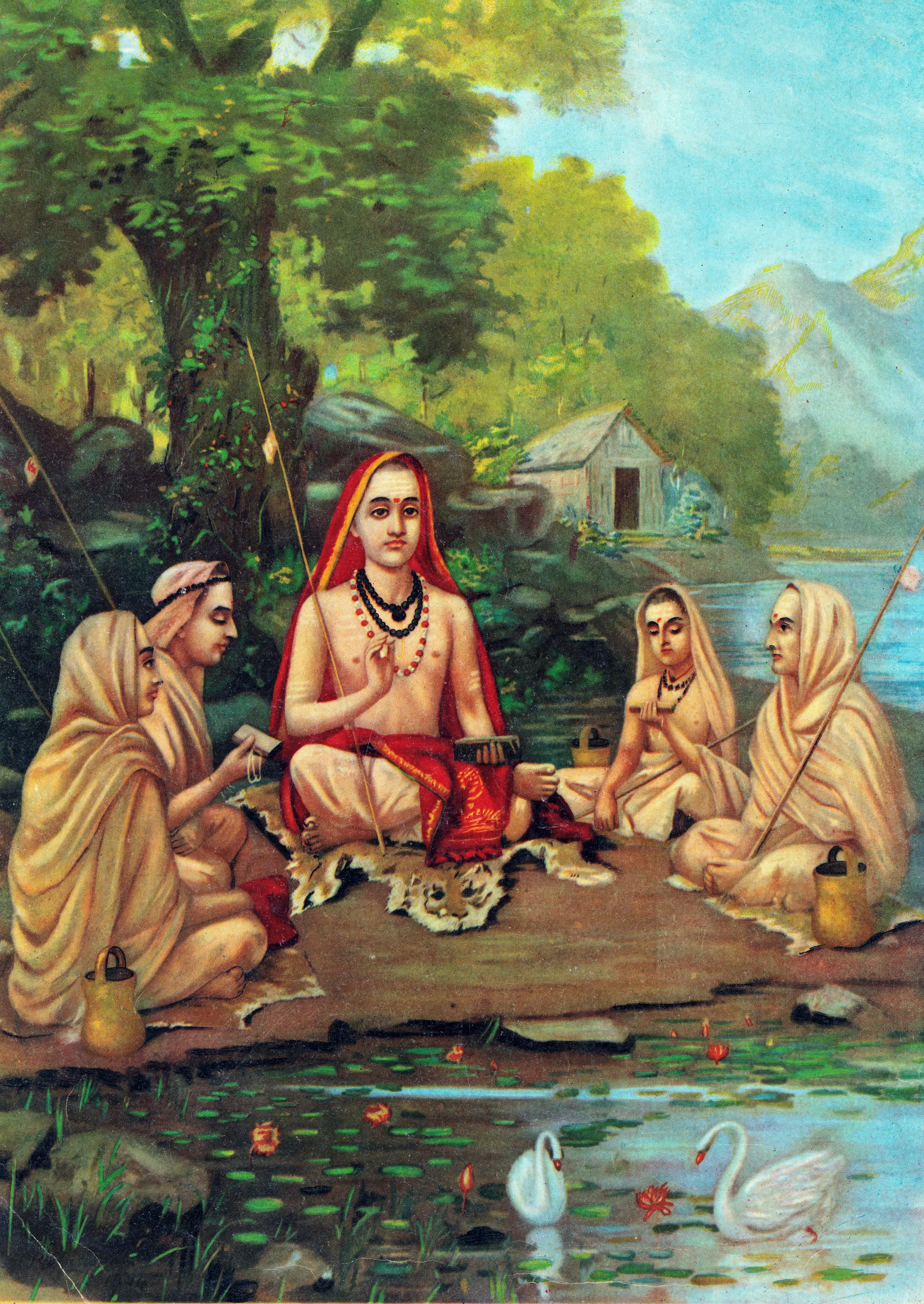
Traditionally 788 to 820 CE; many scholars place him earlier, around 700 to 750 · Born in Kaladi, Kerala; taught across India
Life
Shankara was born in Kaladi in Kerala. By tradition he became a renunciate as a boy, studied under Govinda Bhagavatpada on the Narmada, and travelled the length of India teaching and debating before dying young, at thirty-two. He wrote commentaries on the Brahma Sutras, the principal Upanishads and the Bhagavad Gita, and the tradition credits him with founding monasteries (mathas) at Sringeri, Puri, Dwarka and Badrinath. Many hymns and short works are attributed to him; scholars agree that the commentaries are his and debate the rest.
What they saw
Shankara's teaching rests on one distinction: between awareness, which is never an object, and everything that appears to it. These two are as different as light and darkness, he says. Yet we constantly mix them up. We take the Self to be the body and the mind, and we take the body and the mind to be aware. He calls this mixing up mistaking (adhyasa), and he says it is natural and has no beginning.
The world is left standing. It is dependent (mithya): real as appearance, never on its own, like the snake that was the rope, or the pot that is clay. Knowledge does not remove the world; it removes the mistake about who you are. What remains is the Self, which was never anything other than the whole.
Shankara insists this is known, not believed, and that it is known through the Upanishads, heard, reflected on and lived with, until the claim “I am this body” falls of itself.
In their words
“It is a matter not requiring any proof that the object and the subject … cannot be identified.”
Shankara, commentary on the Brahma Sutras, preamble, tr. George Thibaut (1890)
“this natural beginning- and endless superimposition”
Shankara, commentary on the Brahma Sutras, preamble, tr. George Thibaut (1890)
Where this path meets the others
Shankara argued hard with the Buddhists of his day, yet later critics called him a Buddhist in disguise, so close are some of his images. His one substance invites comparison with Spinoza, his “ground” with Meister Eckhart's, his One with Plotinus. Each comparison has limits. The Meetings set them out.
Bring the lamp. The rope was never a snake.
Works
- Commentary on the Brahma Sutras (Brahma Sutra Bhashya)c. 8th century CE
- Commentaries on the principal Upanishadsc. 8th century CE
- Commentary on the Bhagavad Gitac. 8th century CE
- Upadesa Sahasri (A Thousand Teachings)c. 8th century CE
- Vivekachudamani (Crest-Jewel of Discrimination), traditionally attributedattributed; date debated
- Atma Bodha (Self-Knowledge), traditionally attributedattributed
- Manisha Panchakam, traditionally attributedattributed
Further reading
- The Vedanta-Sutras with the Commentary by Sankaracarya, tr. George Thibaut, Sacred Books of the East vols. 34 and 38 (1890, 1896)
- Shankara's commentaries on the Isha, Kena and Katha Upanishads (many translations)
Next on your path
Sources
- The Vedanta-Sutras with the Commentary by Sankaracarya, Part I, tr. George Thibaut, Sacred Books of the East vol. 34 (Oxford, 1890), preamble to 1.1.1. Public domain.
- Traditional dates 788 to 820 CE; for the earlier scholarly dating see e.g. Hajime Nakamura's studies of early Vedanta. Dates are uncertain.
- The four mathas: traditional attribution.