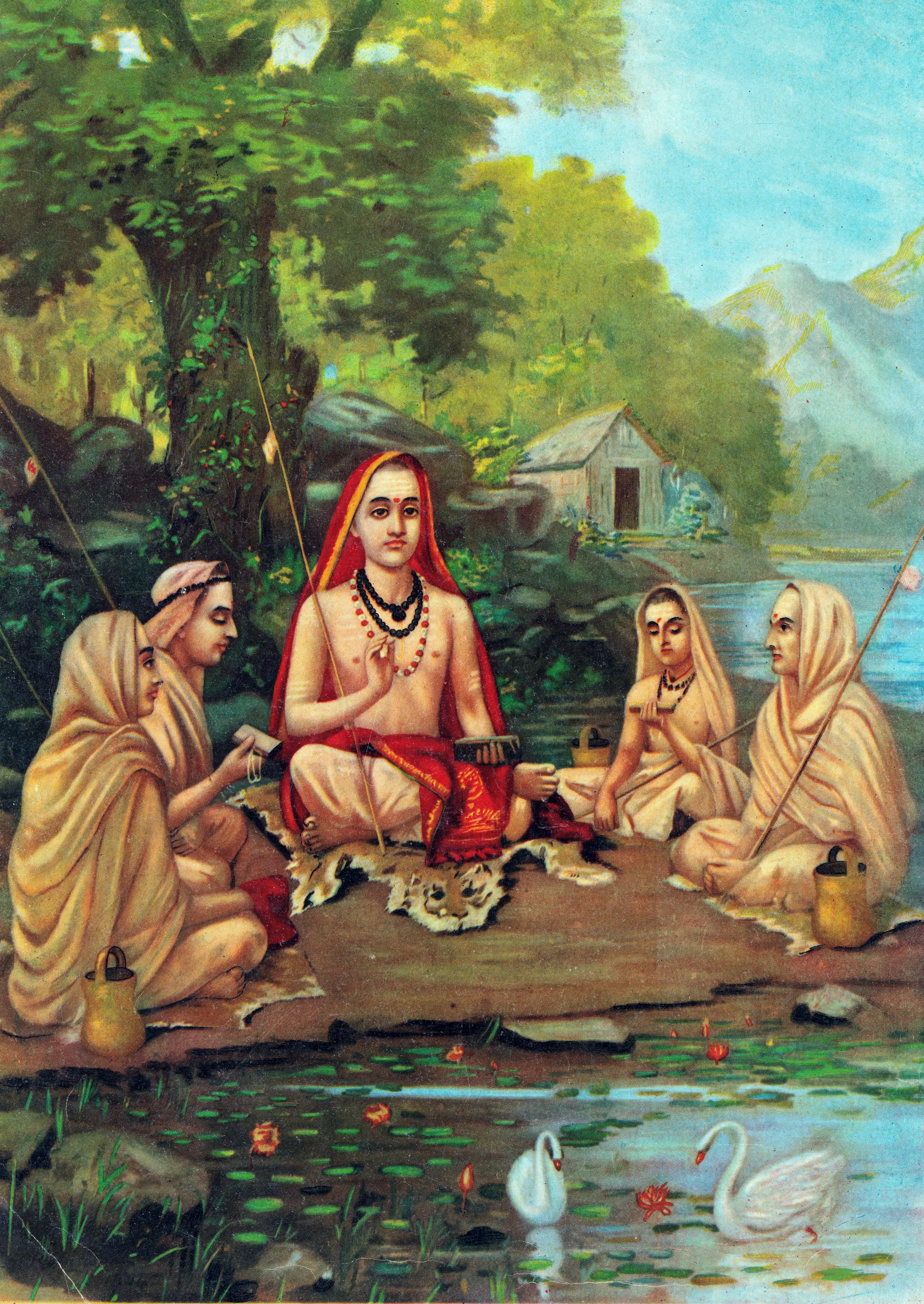
The Vivekachudamani, 'crest-jewel of discernment', is a 580-verse Sanskrit poem traditionally ascribed to Shankara, though many scholars place it later. A student burning with the round of births comes to a teacher, who teaches a way across step by step: tell the Self from what is not the Self; set aside the five layers, food, life, mind, knowing and joy; see that the witness of them all, even of their absence, is what you are; and know that this is Brahman. The student wakes and sings of it, and the teacher describes one free while living.
Far from class, custom, family and lineage,
free of name, form, merit and fault,
beyond place, time and objects:
that Brahman you are; dwell on this within yourself.
The refrain of ten verses: that Brahman you are; dwell on it within.
What most readings miss
The Vivekachudamani is usually read as world-denying: Brahman is real, the world is false, so flee it. Its own images are more exact. A pot is clay through and through; only its separateness is a name (228-230). When the rope is seen, the snake 'becomes the rope' (387); the world was never in Brahman as a second thing (404). Maya is neither real nor unreal (109): dependent, not nothing. So the student's cry 'Where has this world gone?' (483) ends a separate world, not appearing; the free one still moves among experiences, unmoved (551). The verses on samadhi and the wearing away of tendencies (267, 364) ask not to stop the world but to stop claiming it; even bondage and freedom are pictures in the intellect (571-574). And the fear that inquiry ends in a blank is met directly: whatever knows the absence is not absent (212-214).
1 / 4
The renderings on this page are shared under CC BY-NC 4.0, in the words of Pranav Ashar.