Brahmavidya Upanishad
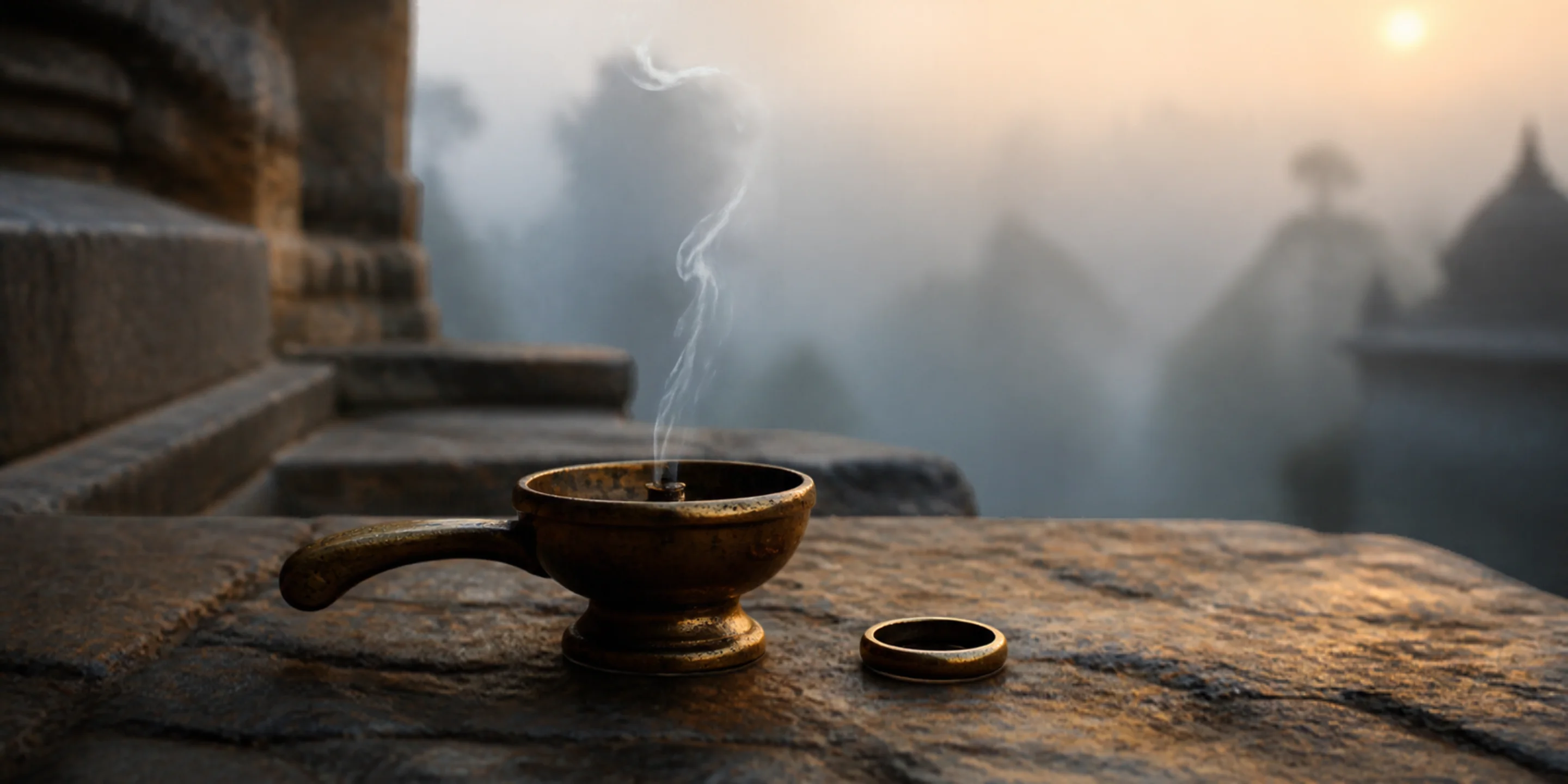
In the words of Pranav Ashar
How we renderThe heart of the Brahmavidya
In brief
Om is the one-syllabled Brahman. As the sound of a bronze bell fades into peace, so Om is to be joined to silence; where the sound dissolves, that is the highest Brahman. In the body the Self has parts; beyond the body it has none. It is in the body as oil in sesame and scent in a flower. As one lays down a torch after finding what one was looking for, so, having known what is to be known, one lets go even of knowing. The means has parts; the goal has none.
- Om fading into silence
- With parts and without parts
- Oil in sesame, scent in the flower
- Putting down the torch
- The means and the goal
Contents
अथ ब्रह्मविद्योपनिषदुच्यते । प्रसादाद्ब्रह्मणस्तस्य विष्णोरद्भुतकर्मणः । रहस्यं ब्रह्मविद्याया ध्रुवाग्निं सम्प्रचक्षते ॥ १॥
atha brahmavidyopaniṣaducyate | prasādādbrahmaṇastasya viṣṇoradbhutakarmaṇaḥ | rahasyaṃ brahmavidyāyā dhruvāgniṃ sampracakṣate || 1||
Now the Brahmavidya Upanishad is told. By the grace of Brahma, and of Vishnu, whose deeds are wonderful, they declare the secret of the knowledge of Brahman: the steady fire.
Note //
'The steady fire' (dhruvāgni) is Om, as the following verses explain. Editions agree.
ओमित्येकाक्षरं ब्रह्म यदुक्तं ब्रह्मवादिभिः । शरीरं तस्य वक्ष्यामि स्थानं कालत्रयं तथा ॥ २॥
omityekākṣaraṃ brahma yaduktaṃ brahmavādibhiḥ | śarīraṃ tasya vakṣyāmi sthānaṃ kālatrayaṃ tathā || 2||
'Om', the one syllable, is Brahman, as those who speak of Brahman say. I will tell its body, its place, and its three times.
Note //
Editions agree.
तत्र देवास्त्रयः प्रोक्ता लोका वेदास्त्रयोऽग्नयः । तिस्रो मात्रार्धमात्रा च त्र्यक्षरस्य शिवस्य तु ॥ ३॥
tatra devāstrayaḥ proktā lokā vedāstrayo'gnayaḥ | tisro mātrārdhamātrā ca tryakṣarasya śivasya tu || 3||
In it three gods are named, three worlds, three Vedas, three fires; three measures and a half-measure belong to that auspicious three-lettered one.
Note //
Editions agree.
ऋग्वेदो गार्हपत्यं च पृथिवी ब्रह्म एव च । अकारस्य शरीरं तु व्याख्यातं ब्रह्मवादिभिः ॥ ४॥
ṛgvedo gārhapatyaṃ ca pṛthivī brahma eva ca | akārasya śarīraṃ tu vyākhyātaṃ brahmavādibhiḥ || 4||
The Rig Veda, the householder's fire, the earth and Brahma: this is the body of the sound A, as those who speak of Brahman explain it.
Note //
Editions agree.
यजुर्वेदोऽन्तरिक्षं च दक्षिणाग्निस्तथैव च । विष्णुश्च भगवान्देव उकारः परिकीर्तितः ॥ ५॥
yajurvedo'ntarikṣaṃ ca dakṣiṇāgnistathaiva ca | viṣṇuśca bhagavāndeva ukāraḥ parikīrtitaḥ || 5||
The Yajur Veda, the space between, the southern fire, and Vishnu, the blessed god: this is called the sound U.
Note //
Editions agree.
सामवेदस्तथा द्यौश्चाहवनीयस्तथैव च । ईश्वरः परमो देवो मकारः परिकीर्तितः ॥ ६॥
sāmavedastathā dyauścāhavanīyastathaiva ca | īśvaraḥ paramo devo makāraḥ parikīrtitaḥ || 6||
The Sama Veda, heaven, the fire of offering, and the Lord, the highest god: this is called the sound M.
Note //
Editions agree.
सूर्यमण्डलमध्येऽथ ह्यकारः शङ्खमध्यगः । उकारश्चन्द्रसंकाशस्तस्य मध्ये व्यवस्थितः ॥ ७॥
sūryamaṇḍalamadhye'tha hyakāraḥ śaṅkhamadhyagaḥ | ukāraścandrasaṃkāśastasya madhye vyavasthitaḥ || 7||
The sound A is in the middle of the sun's disc, in the middle of the conch; the sound U, bright as the moon, stands within it.
Note //
'The conch' may mean the forehead, the place of meditation; uncertain. Editions agree.
मकारस्त्वग्निसंकाशो विधूमो विद्युतोपमः । तिस्रो मात्रास्तथा ज्ञेयाः सोमसूर्याग्निरूपिणः ॥ ८॥
makārastvagnisaṃkāśo vidhūmo vidyutopamaḥ | tisro mātrāstathā jñeyāḥ somasūryāgnirūpiṇaḥ || 8||
The sound M is like fire, smokeless, like lightning. So the three measures are to be known as having the forms of moon, sun and fire.
Note //
Editions: 'jñeyāḥ' (Adyar) over 'jñeyā' (sanskritdocuments.org).
शिखा तु दीपसंकाशा तस्मिन्नुपरि वर्तते । अर्धमात्रा तथा ज्ञेया प्रणवस्योपरि स्थिता ॥ ९॥
śikhā tu dīpasaṃkāśā tasminnupari vartate | ardhamātrā tathā jñeyā praṇavasyopari sthitā || 9||
Above it is a flame, like the flame of a lamp: so is the half-measure to be known, standing above Om.
Note //
Editions: 'ardhamātrā' (Adyar) over 'ardhamātra' (sanskritdocuments.org).
पद्मसूत्रनिभा सूक्ष्मा शिखा सा दृश्यते परा । सा नाडी सूर्यसंकाशा सूर्यं भित्त्वा तथापरा ॥ १०॥
padmasūtranibhā sūkṣmā śikhā sā dṛśyate parā | sā nāḍī sūryasaṃkāśā sūryaṃ bhittvā tathāparā || 10||
That highest flame is seen, fine as the fibre of a lotus stalk. That channel shines like the sun; piercing the sun, it goes beyond,
Note //
The sentence runs into verse 11. Editions agree.
द्विसप्ततिसहस्राणि नाडीं भित्त्वा च मूर्धनि । वरदः सर्वभूतानां सर्वं व्याप्यावतिष्ठति ॥ ११॥
dvisaptatisahasrāṇi nāḍīṃ bhittvā ca mūrdhani | varadaḥ sarvabhūtānāṃ sarvaṃ vyāpyāvatiṣṭhati || 11||
piercing the seventy-two thousand channels, to the crown of the head. The giver of boons to all beings stands pervading everything.
Note //
Editions agree.
कांस्यघण्टानिनादस्तु यथा लीयति शान्तये । ओङ्कारस्तु तथा योज्यः शान्तये सर्वमिच्छता ॥ १२॥
kāṃsyaghaṇṭāninādastu yathā līyati śāntaye | oṅkārastu tathā yojyaḥ śāntaye sarvamicchatā || 12||
As the ringing of a bronze bell fades away into peace, so whoever wants everything should join Om to peace.
Note //
The sound of Om is to be followed as it fades, like the ringing of a bell, into silence. 'Whoever wants everything' (sarvam icchatā) is read as 'whoever seeks the whole', the full. The same image is in the Dhyanabindu and the Nadabindu. Editions agree.
यस्मिन्विलीयते शब्दस्तत्परं ब्रह्म गीयते । धियं हि लीयते ब्रह्म सोऽमृतत्वाय कल्पते ॥ १३॥
yasminvilīyate śabdastatparaṃ brahma gīyate | dhiyaṃ hi līyate brahma so'mṛtatvāya kalpate || 13||
That in which the sound dissolves is called the highest Brahman. Brahman, in which the mind too dissolves: one who knows it is fit for deathlessness.
वायुः प्राणस्तथाकाशस्त्रिविधो जीवसंज्ञकः । स जीवः प्राण इत्युक्तो वालाग्रशतकल्पितः ॥ १४॥
vāyuḥ prāṇastathākāśastrividho jīvasaṃjñakaḥ | sa jīvaḥ prāṇa ityukto vālāgraśatakalpitaḥ || 14||
Air, breath and space: what is called the individual is threefold. That individual is called breath; it is pictured as a hundredth of a hair's tip.
Note //
The fineness of the individual, after Shvetashvatara 5.9. Editions agree.
नाभिस्थाने स्थितं विश्वं शुद्धतत्त्वं सुनिर्मलम् । आदित्यमिव दीप्यन्तं रश्मिभिश्चाखिलं शिवम् ॥ १५॥
nābhisthāne sthitaṃ viśvaṃ śuddhatattvaṃ sunirmalam | ādityamiva dīpyantaṃ raśmibhiścākhilaṃ śivam || 15||
In the place of the navel stands the all, the pure reality, spotless, blazing like the sun with its rays, the whole, the auspicious.
Note //
Editions agree.
सकारं च हकारं च जीवो जपति सर्वदा । नाभिरन्ध्राद्विनिष्क्रान्तं विषयव्याप्तिवर्जितम् ॥ १६॥
sakāraṃ ca hakāraṃ ca jīvo japati sarvadā | nābhirandhrādviniṣkrāntaṃ viṣayavyāptivarjitam || 16||
The individual always repeats the sounds 'sa' and 'ha', coming out from the opening of the navel, free of any spreading into objects.
Note //
The breath, going out and coming in, makes the sounds 'ham' and 'sa' without effort: the 'unrepeated repetition' (ajapā) of verse 78. Editions agree.
तेनेदं निष्कलं विद्यात्क्षीरात्सर्पिर्यथा तथा । कारणेनात्मना युक्तः प्राणायामैश्च पञ्चभिः ॥ १७॥
tenedaṃ niṣkalaṃ vidyātkṣīrātsarpiryathā tathā | kāraṇenātmanā yuktaḥ prāṇāyāmaiśca pañcabhiḥ || 17||
By that, let one know this, without parts, as ghee is drawn from milk. Joined with the Self, the cause, and with the five breath-controls,
Note //
As ghee is in milk and is drawn out by churning, the Self without parts is in the body and is found by this practice. The sentence runs into verse 18. Editions agree.
चतुष्कला समायुक्तो भ्राम्यते च हृदिस्थितः । गोलकस्तु यदा देहे क्षीरदण्डेन वा हतः ॥ १८॥
catuṣkalā samāyukto bhrāmyate ca hṛdisthitaḥ | golakastu yadā dehe kṣīradaṇḍena vā hataḥ || 18||
joined with the four parts, it is made to turn, set in the heart. When the ball in the body is struck, as with a stick in milk,
Note //
The images are obscure: the breath in the heart spun like a ball, or churned like milk with a stick. Rendered literally. Pending review. Editions agree.
एतस्मिन्वसते शीघ्रमविश्रान्तं महाखगः । यावन्निश्वसितो जीवस्तावन्निष्कलतां गतः ॥ १९॥
etasminvasate śīghramaviśrāntaṃ mahākhagaḥ | yāvanniśvasito jīvastāvanniṣkalatāṃ gataḥ || 19||
in it the great bird lives, swift, never resting. As long as the individual breathes, so long has it gone into the state without parts.
Note //
'The great bird' is the hamsa, the swan of the breath. The second line is uncertain. Pending review. Editions agree.
नभस्थं निष्कलं ध्यात्वा मुच्यते भवबन्धनात् । अनाहतध्वनियुतं हंसं यो वेद हृद्गतम् ॥ २०॥
nabhasthaṃ niṣkalaṃ dhyātvā mucyate bhavabandhanāt | anāhatadhvaniyutaṃ haṃsaṃ yo veda hṛdgatam || 20||
Meditating on the one without parts, who is in space, one is freed from the bonds of becoming. The one who knows the swan in the heart, joined with the sound that is not struck,
Note //
'The sound that is not struck' (anāhata): the inner sound heard in meditation, and the name of the heart centre. The sentence runs into verse 21. Editions: 'nabhaḥsthaṃ' (Adyar) over 'nabhasthaṃ'.
स्वप्रकाशचिदानन्दं स हंस इति गीयते । रेचकं पूरकं मुक्त्वा कुम्भकेन स्थितः सुधीः ॥ २१॥
svaprakāśacidānandaṃ sa haṃsa iti gīyate | recakaṃ pūrakaṃ muktvā kumbhakena sthitaḥ sudhīḥ || 21||
self-luminous, light and bliss: he is sung as the swan. Leaving out breathing out and breathing in, the wise one, steady in holding the breath,
Note //
The second half runs into verse 22. Editions agree.
नाभिकन्दे समौ कृत्वा प्राणापानौ समाहितः । मस्तकस्थामृतास्वादं पीत्वा ध्यानेन सादरम् ॥ २२॥
nābhikande samau kṛtvā prāṇāpānau samāhitaḥ | mastakasthāmṛtāsvādaṃ pītvā dhyānena sādaram || 22||
collected, making the outgoing and incoming breaths even at the root of the navel, drinking with care, by meditation, the taste of the nectar in the head,
Note //
The sentence runs into verse 23. Editions agree.
दीपाकारं महादेवं ज्वलन्तं नाभिमध्यमे । अभिषिच्यामृतेनैव हंस हंसेति यो जपेत् ॥ २३॥
dīpākāraṃ mahādevaṃ jvalantaṃ nābhimadhyame | abhiṣicyāmṛtenaiva haṃsa haṃseti yo japet || 23||
bathing with that nectar the great god, shaped like a lamp, blazing in the middle of the navel, whoever repeats 'hamsa, hamsa':
Note //
Editions agree.
जरामरणरोगादि न तस्य भुवि विद्यते । एवं दिने दिने कुर्यादणिमादिविभूतये ॥ २४॥
jarāmaraṇarogādi na tasya bhuvi vidyate | evaṃ dine dine kuryādaṇimādivibhūtaye || 24||
for him there is on earth no old age, death or sickness. Let one do this day after day, for the powers of becoming small and the rest.
Note //
Editions agree.
ईश्वरत्वमवाप्नोति सदाभ्यासरतः पुमान् । बहवो नैकमार्गेण प्राप्ता नित्यत्वमागताः ॥ २५॥
īśvaratvamavāpnoti sadābhyāsarataḥ pumān | bahavo naikamārgeṇa prāptā nityatvamāgatāḥ || 25||
The one who delights in constant practice reaches lordship. Many, by more than one path, have reached the eternal.
Note //
Editions agree.
हंसविद्यामृते लोके नास्ति नित्यत्वसाधनम् । यो ददाति महाविद्यां हंसाख्यां पारमेश्वरीम् ॥ २६॥
haṃsavidyāmṛte loke nāsti nityatvasādhanam | yo dadāti mahāvidyāṃ haṃsākhyāṃ pārameśvarīm || 26||
In the world there is no means to the eternal apart from the knowledge of the swan. The one who gives this great knowledge, called the swan, the knowledge of the highest Lord,
Note //
The sentence runs into verse 27. Editions agree.
तस्य दास्यं सदा कुर्यात्प्रज्ञया परया सह । शुभं वाशुभमन्यद्वा यदुक्तं गुरुणा भुवि ॥ २७॥
tasya dāsyaṃ sadā kuryātprajñayā parayā saha | śubhaṃ vāśubhamanyadvā yaduktaṃ guruṇā bhuvi || 27||
let one serve always, with the highest understanding. Whatever the teacher says on earth, pleasant or unpleasant or anything else,
Note //
Editions agree.
तत्कुर्यादविचारेण शिष्यः सन्तोषसंयुतः । हंसविद्यामिमां लब्ध्वा गुरुशुश्रूषया नरः ॥ २८॥
tatkuryādavicāreṇa śiṣyaḥ santoṣasaṃyutaḥ | haṃsavidyāmimāṃ labdhvā guruśuśrūṣayā naraḥ || 28||
let the student do it without question, content. Having gained this knowledge of the swan by serving the teacher,
Note //
Editions agree.
आत्मानमात्मना साक्षाद्ब्रह्म बुद्ध्वा सुनिश्चलम् । देहजात्यादिसम्बन्धान्वर्णाश्रमसमन्वितान् ॥ २९॥
ātmānamātmanā sākṣādbrahma buddhvā suniścalam | dehajātyādisambandhānvarṇāśramasamanvitān || 29||
knowing the Self, by the Self, directly, as Brahman, wholly unmoving, the ties of body, birth and the rest, with caste and stage of life,
Note //
The sentence runs into verse 30. Editions agree.
वेदशास्त्राणि चान्यानि पदपांसुमिव त्यजेत् । गुरुभक्तिं सदा कुर्याच्छ्रेयसे भूयसे नरः ॥ ३०॥
vedaśāstrāṇi cānyāni padapāṃsumiva tyajet | gurubhaktiṃ sadā kuryācchreyase bhūyase naraḥ || 30||
the Vedas and other scriptures, let one throw away like the dust on one's feet. Let a person always be devoted to the teacher, for the greatest good.
Note //
Once the Self is known as Brahman, the marks of body, caste and even scripture are dropped like dust: they were means, not the goal. Editions agree.
गुरुरेव हरिः साक्षान्नान्य इत्यब्रवीच्छ्रुतिः ॥ ३१॥
gurureva hariḥ sākṣānnānya ityabravīcchrutiḥ || 31||
'The teacher is Hari himself, no other': so the scripture says.
Note //
A half verse in both editions. Editions: 'abravīc chrutiḥ' (Adyar) over 'abravīc chṛtiḥ' (sanskritdocuments.org).
श्रुत्या यदुक्तं परमार्थमेव तत्संशयो नात्र ततः समस्तम् । श्रुत्या विरोधे न भवेत्प्रमाणं भवेदनर्थाय विना प्रमाणम् ॥ ३२॥
śrutyā yaduktaṃ paramārthameva tatsaṃśayo nātra tataḥ samastam | śrutyā virodhe na bhavetpramāṇaṃ bhavedanarthāya vinā pramāṇam || 32||
What scripture says is the highest truth; there is no doubt about it, then, in anything. What contradicts scripture cannot be valid; without valid knowledge, there would be harm.
Note //
Scripture (śruti) as the means of knowing what the senses cannot show, as in Shankara. Editions agree.
देहस्थः सकलो ज्ञेयो निष्कलो देहवर्जितः । आप्तोपदेशगम्योऽसौ सर्वतः समवस्थितः ॥ ३३॥
dehasthaḥ sakalo jñeyo niṣkalo dehavarjitaḥ | āptopadeśagamyo'sau sarvataḥ samavasthitaḥ || 33||
In the body, know it as having parts; free of the body, it has none. It is reached through the teaching of one who has found it, and it stands everywhere.
Note //
'With parts' (sakala) and 'without parts' (niṣkala) are the text's key terms: the one Self as it appears in a body, and as it is. 'One who has found it' renders āpta, a trustworthy teacher who knows from experience. Editions agree.
हंसहंसेति यो ब्रूयाद्धंसो ब्रह्मा हरिः शिवः । गुरुवक्त्रात्तु लभ्येत प्रत्यक्षं सर्वतोमुखम् ॥ ३४॥
haṃsahaṃseti yo brūyāddhaṃso brahmā hariḥ śivaḥ | guruvaktrāttu labhyeta pratyakṣaṃ sarvatomukham || 34||
Whoever says 'hamsa, hamsa': the swan is Brahma, Hari and Shiva. From the teacher's mouth it is gained, directly present, facing every way.
Note //
Editions agree.
तिलेषु च यथा तैलं पुष्पे गन्ध इवाश्रितः । पुरुषस्य शरीरेऽस्मिन्स बाह्याभ्यन्तरे तथा ॥ ३५॥
tileṣu ca yathā tailaṃ puṣpe gandha ivāśritaḥ | puruṣasya śarīre'sminsa bāhyābhyantare tathā || 35||
As oil is in sesame seeds, as scent lives in a flower, so it is in this body of a person, outside and inside.
Note //
Oil in sesame is also the image of Shvetashvatara 1.15. The partless is not elsewhere: it is in what has parts as its essence, 'outside and inside'. Editions agree.
उल्काहस्तो यथालोके द्रव्यमालोक्य तां त्यजेत् । ज्ञानेन ज्ञेयमालोक्य पश्चाज्ज्ञानं परित्यजेत् ॥ ३६॥
ulkāhasto yathāloke dravyamālokya tāṃ tyajet | jñānena jñeyamālokya paścājjñānaṃ parityajet || 36||
As one who holds a torch, having found the thing he was looking for, puts the torch down, so, having seen by knowledge what is to be known, one then lets go even of knowledge.
Note //
In the Advaita reading, 'knowledge' here is the act of knowing in the mind (a vṛtti), which removes not-knowing and then subsides itself, as the clearing-nut settles the mud and sinks with it; what remains is the Self, which needs no further act of knowing. Editions agree ('yathāloke' may be read 'yathā loke', 'as in the world', or 'yathā āloke', 'as in the light').
पुष्पवत्सकलं विद्याद्गन्धस्तस्य तु निष्कलः । वृक्षस्तु सकलं विद्याच्छाया तस्य तु निष्कला ॥ ३७॥
puṣpavatsakalaṃ vidyādgandhastasya tu niṣkalaḥ | vṛkṣastu sakalaṃ vidyācchāyā tasya tu niṣkalā || 37||
Know what has parts as the flower; its scent is what has none. Know what has parts as the tree; its shade is what has none.
Note //
The flower and the tree can be handled; their scent and shade cannot, yet they are where the flower and the tree are. Editions agree.
निष्कलः सकलो भावः सर्वत्रैव व्यवस्थितः । उपायः सकलस्तद्वदुपेयश्चैव निष्कलः ॥ ३८॥
niṣkalaḥ sakalo bhāvaḥ sarvatraiva vyavasthitaḥ | upāyaḥ sakalastadvadupeyaścaiva niṣkalaḥ || 38||
With parts and without parts, it is everywhere. So too the means has parts, and the goal has none.
Note //
The verse gives the place of all the practices in the text: they are means, with parts, and the goal is partless. A practice can lead to the goal but cannot contain it. Editions agree.
सकले सकलो भावो निष्कले निष्कलस्तथा । एकमात्रो द्विमात्रश्च त्रिमात्रश्चैव भेदतः ॥ ३९॥
sakale sakalo bhāvo niṣkale niṣkalastathā | ekamātro dvimātraśca trimātraścaiva bhedataḥ || 39||
In what has parts, it is with parts; in what has no parts, it is without parts. By difference it has one measure, two measures, three measures,
Note //
The sentence runs into verse 40. Editions agree.
अर्धमात्रा परा ज्ञेया तत ऊर्ध्वं परात्परम् । पञ्चधा पञ्चदैवत्यं सकलं परिपठ्यते ॥ ४०॥
ardhamātrā parā jñeyā tata ūrdhvaṃ parātparam | pañcadhā pañcadaivatyaṃ sakalaṃ paripaṭhyate || 40||
and the half-measure is to be known as the highest; above that is what is higher than the highest. What has parts is recited as fivefold, with five gods.
Note //
Editions: 'ardhamātrā' (Adyar) over 'ardhamātra' (sanskritdocuments.org).
ब्रह्मणो हृदयस्थानं कण्ठे विष्णुः समाश्रितः । तालुमध्ये स्थितो रुद्रो ललाटस्थो महेश्वरः ॥ ४१॥
brahmaṇo hṛdayasthānaṃ kaṇṭhe viṣṇuḥ samāśritaḥ | tālumadhye sthito rudro lalāṭastho maheśvaraḥ || 41||
Brahma's place is the heart; Vishnu rests in the throat; Rudra stands in the middle of the palate; the Great Lord is in the forehead.
Note //
Editions agree.
नासाग्रे अच्युतं विद्यात्तस्यान्ते तु परं पदम् । परत्वात्तु परं नास्तीत्येवं शास्त्रस्य निर्णयः ॥ ४२॥
nāsāgre acyutaṃ vidyāttasyānte tu paraṃ padam | paratvāttu paraṃ nāstītyevaṃ śāstrasya nirṇayaḥ || 42||
At the tip of the nose, let one know Achyuta; at its end, the highest state. Since it is the highest, there is nothing higher: this is the conclusion of the teaching.
Note //
Editions agree.
देहातीतं तु तं विद्यान्नासाग्रे द्वादशाङ्गुलम् । तदन्तं तं विजानीयात्तत्रस्थो व्यापयेत्प्रभुः ॥ ४३॥
dehātītaṃ tu taṃ vidyānnāsāgre dvādaśāṅgulam | tadantaṃ taṃ vijānīyāttatrastho vyāpayetprabhuḥ || 43||
Let one know him as beyond the body, twelve finger-breadths beyond the tip of the nose; let one know him as that end: staying there, the Lord pervades.
Note //
The 'twelve finger-breadths' (dvādaśānta) is the point outside the body where the breath is said to end. Editions agree.
मनोऽप्यन्यत्र निक्षिप्तं चक्षुरन्यत्र पातितम् । तथापि योगिनां योगो ह्यविच्छिन्नः प्रवर्तते ॥ ४४॥
mano'pyanyatra nikṣiptaṃ cakṣuranyatra pātitam | tathāpi yogināṃ yogo hyavicchinnaḥ pravartate || 44||
Even when the mind is set on something else, and the eyes have turned elsewhere, the yoga of the yogis goes on unbroken.
Note //
'Yoga' is read in its root sense, 'being joined': for one who knows, the joining is not a state the mind must keep, so it is not broken when the mind turns to other things. Editions agree.
एतत्तु परमं गुह्यमेतत्तु परमं शुभम् । नातः परतरं किंचिन्नातः परतरं शुभम् ॥ ४५॥
etattu paramaṃ guhyametattu paramaṃ śubham | nātaḥ parataraṃ kiṃcinnātaḥ parataraṃ śubham || 45||
This is the highest secret; this is the highest good. There is nothing higher than this, no good higher than this.
Note //
Editions agree.
शुद्धज्ञानामृतं प्राप्य परमाक्षरनिर्णयम् । गुह्याद्गुह्यतमं गोप्यं ग्रहणीयं प्रयत्नतः ॥ ४६॥
śuddhajñānāmṛtaṃ prāpya paramākṣaranirṇayam | guhyādguhyatamaṃ gopyaṃ grahaṇīyaṃ prayatnataḥ || 46||
Gaining the nectar of pure knowledge, the certainty about the highest imperishable, more secret than the secret, it is to be guarded and taken up with care.
Note //
Editions agree.
नापुत्राय प्रदातव्यं नाशिष्याय कदाचन । गुरुदेवाय भक्ताय नित्यं भक्तिपराय च ॥ ४७॥
nāputrāya pradātavyaṃ nāśiṣyāya kadācana | gurudevāya bhaktāya nityaṃ bhaktiparāya ca || 47||
It is never to be given to one who is not a son, or not a student. To one devoted to the teacher as god, always given to devotion,
Note //
The sentence runs into verse 48. Editions agree.
प्रदातव्यमिदं शास्त्रं नेतरेभ्यः प्रदापयेत् । दातास्य नरकं याति सिद्ध्यते न कदाचन ॥ ४८॥
pradātavyamidaṃ śāstraṃ netarebhyaḥ pradāpayet | dātāsya narakaṃ yāti siddhyate na kadācana || 48||
this teaching is to be given; let it not be given to others. One who gives it so goes to hell, and never succeeds.
Note //
'One who gives it so': to the unfit. Editions agree.
गृहस्थो ब्रह्मचारी च वानप्रस्थश्च भिक्षुकः । यत्र तत्र स्थितो ज्ञानी परमाक्षरवित्सदा ॥ ४९॥
gṛhastho brahmacārī ca vānaprasthaśca bhikṣukaḥ | yatra tatra sthito jñānī paramākṣaravitsadā || 49||
Householder, student, forest-dweller or mendicant, wherever he stands, the knower always knows the highest imperishable.
Note //
Editions agree.
विषयी विषयासक्तो याति देहान्तरे शुभम् । ज्ञानादेवास्य शास्त्रस्य सर्वावस्थोऽपि मानवः ॥ ५०॥
viṣayī viṣayāsakto yāti dehāntare śubham | jñānādevāsya śāstrasya sarvāvastho'pi mānavaḥ || 50||
Even one given to the senses, attached to their objects, goes to good after death. By the knowledge of this teaching alone, a person in any state
Note //
The sentence runs into verse 51. Editions agree.
ब्रह्महत्याश्वमेधाद्यैः पुण्यपापैर्न लिप्यते । चोदको बोधकश्चैव मोक्षदश्च परः स्मृतः ॥ ५१॥
brahmahatyāśvamedhādyaiḥ puṇyapāpairna lipyate | codako bodhakaścaiva mokṣadaśca paraḥ smṛtaḥ || 51||
is not stained by merit or sin, by killing a brahmin or a horse sacrifice. The one who urges, the one who awakens, and the highest, the one who gives freedom:
Note //
The knower is untouched by both merit and sin, as in Brihadaranyaka 4.4.22. The second line begins the three kinds of teacher. Editions agree.
इत्येवं त्रिविधो ज्ञेय आचार्यस्तु महीतले । चोदको दर्शयेन्मार्गं बोधकः स्थानमाचरेत् ॥ ५२॥
ityevaṃ trividho jñeya ācāryastu mahītale | codako darśayenmārgaṃ bodhakaḥ sthānamācaret || 52||
so the teacher on earth is to be known as threefold. The one who urges shows the way; the one who awakens leads to the place;
Note //
Editions: 'ity evaṃ' is read for 'ity eṣaṃ' (sanskritdocuments.org) and 'ity eṣā' (Adyar).
मोक्षदस्तु परं तत्त्वं यज्ज्ञात्वा परमश्नुते । प्रत्यक्षयजनं देहे संक्षेपाच्छृणु गौतम ॥ ५३॥
mokṣadastu paraṃ tattvaṃ yajjñātvā paramaśnute | pratyakṣayajanaṃ dehe saṃkṣepācchṛṇu gautama || 53||
the one who gives freedom gives the highest truth, knowing which one reaches the highest. Gautama, hear in brief the direct worship in the body.
Note //
Editions agree.
तेनेष्ट्वा स नरो याति शाश्वतं पदमव्ययम् । स्वयमेव तु सम्पश्येद्देहे बिन्दुं च निष्कलम् ॥ ५४॥
teneṣṭvā sa naro yāti śāśvataṃ padamavyayam | svayameva tu sampaśyeddehe binduṃ ca niṣkalam || 54||
Worshipping by it, a person goes to the eternal, unchanging state. Let one see for oneself, in the body, the point, the one without parts.
Note //
Editions agree.
अयने द्वे च विषुवे सदा पश्यति मार्गवित् । कृत्वायामं पुरा वत्स रेचपूरककुम्भकान् ॥ ५५॥
ayane dve ca viṣuve sadā paśyati mārgavit | kṛtvāyāmaṃ purā vatsa recapūrakakumbhakān || 55||
The one who knows the way always sees the two solstices and the equinox. First, child, doing breath-control, breathing out, breathing in and holding,
Note //
The 'solstices' and 'equinox' are inner: the two side channels and the central one. Interpretive. The sentence runs into verse 56. Editions agree.
पूर्वं चोभयमुच्चार्य अर्चयेत्तु यथाक्रमम् । नमस्कारेण योगेन मुद्रयारभ्य चार्चयेत् ॥ ५६॥
pūrvaṃ cobhayamuccārya arcayettu yathākramam | namaskāreṇa yogena mudrayārabhya cārcayet || 56||
and first sounding both, let one worship in due order: with bowing, with yoga, beginning with the seal, let one worship.
Note //
Editions agree.
सूर्यस्य ग्रहणं वत्स प्रत्यक्षयजनं स्मृतम् । ज्ञानात्सायुज्यमेवोक्तं तोये तोयं यथा तथा ॥ ५७॥
sūryasya grahaṇaṃ vatsa pratyakṣayajanaṃ smṛtam | jñānātsāyujyamevoktaṃ toye toyaṃ yathā tathā || 57||
The eclipse of the sun, child, is known as the direct worship. From knowledge comes union, it is said, as water in water.
Note //
'The eclipse of the sun': the inner sun swallowed, the breath stilled. Interpretive. 'Union' (sāyujya), like water poured into water, leaves no second. Editions agree.
एते गुणाः प्रवर्तन्ते योगाभ्यासकृतश्रमैः । तस्माद्योगं समादाय सर्वदुःखबहिष्कृतः ॥ ५८॥
ete guṇāḥ pravartante yogābhyāsakṛtaśramaiḥ | tasmādyogaṃ samādāya sarvaduḥkhabahiṣkṛtaḥ || 58||
These good things come about for those who have worked at the practice of yoga. So, taking up yoga, put out of reach of every sorrow,
Note //
The sentence runs into verse 59. Editions agree.
योगध्यानं सदा कृत्वा ज्ञानं तन्मयतां व्रजेत् । ज्ञानात्स्वरूपं परमं हंसमन्त्रं समुच्चरेत् ॥ ५९॥
yogadhyānaṃ sadā kṛtvā jñānaṃ tanmayatāṃ vrajet | jñānātsvarūpaṃ paramaṃ haṃsamantraṃ samuccaret || 59||
always meditating in yoga, knowledge becomes one with That. From knowledge, one's own highest nature: let one sound the swan mantra.
Note //
Editions agree.
प्राणिनां देहमध्ये तु स्थितो हंसः सदाच्युतः । हंस एव परं सत्यं हंस एव तु शक्तिकम् ॥ ६०॥
prāṇināṃ dehamadhye tu sthito haṃsaḥ sadācyutaḥ | haṃsa eva paraṃ satyaṃ haṃsa eva tu śaktikam || 60||
In the middle of the bodies of living beings stands the swan, never falling away. The swan alone is the highest truth; the swan alone is power.
Note //
Editions agree.
हंस एव परं वाक्यं हंस एव तु वादिकम् । हंस एव परो रुद्रो हंस एव परात्परम् ॥ ६१॥
haṃsa eva paraṃ vākyaṃ haṃsa eva tu vādikam | haṃsa eva paro rudro haṃsa eva parātparam || 61||
The swan alone is the highest word; the swan alone is the speaker. The swan alone is the highest Rudra; the swan alone is higher than the highest.
Note //
Editions agree.
सर्वदेवस्य मध्यस्थो हंस एव महेश्वरः । पृथिव्यादिशिवान्तं तु अकाराद्याश्च वर्णकाः ॥ ६२॥
sarvadevasya madhyastho haṃsa eva maheśvaraḥ | pṛthivyādiśivāntaṃ tu akārādyāśca varṇakāḥ || 62||
In the middle of every god is the swan, the Great Lord. From earth to Shiva, and the letters from A on,
Note //
The sentence runs into verse 63. Editions agree.
कूटान्ता हंस एव स्यान्मातृकेति व्यवस्थिताः । मातृकारहितं मन्त्रमादिशन्ते न कुत्रचित् ॥ ६३॥
kūṭāntā haṃsa eva syānmātṛketi vyavasthitāḥ | mātṛkārahitaṃ mantramādiśante na kutracit || 63||
to the last cluster: the swan alone is what stands as the alphabet. Nowhere do they teach a mantra without the letters of the alphabet.
Note //
Every principle from earth to Shiva and every letter of the alphabet is the swan; so every mantra is made of it. Editions agree.
हंसज्योतिरनौपम्यं मध्ये देवं व्यवस्थितम् । दक्षिणामुखमाश्रित्य ज्ञानमुद्रां प्रकल्पयेत् ॥ ६४॥
haṃsajyotiranaupamyaṃ madhye devaṃ vyavasthitam | dakṣiṇāmukhamāśritya jñānamudrāṃ prakalpayet || 64||
The light of the swan, beyond comparison, the god set in the middle: facing south, let one form the seal of knowledge.
Note //
'Facing south' (dakṣiṇāmukha) may also point to Dakshinamurti, the teacher who teaches by silence and the seal of knowledge. Editions: 'anaupamyaṃ' is read for 'anūpamyaṃ' (both editions).
सदा समाधिं कुर्वीत हंसमन्त्रमनुस्मरन् । निर्मलस्फटिकाकारं दिव्यरूपमनुत्तमम् ॥ ६५॥
sadā samādhiṃ kurvīta haṃsamantramanusmaran | nirmalasphaṭikākāraṃ divyarūpamanuttamam || 65||
Let one always be absorbed, remembering the swan mantra: like spotless crystal, divine in form, unsurpassed,
Note //
The sentence runs into verse 66. Editions agree.
मध्यदेशे परं हंसं ज्ञानमुद्रात्मरूपकम् । प्राणोऽपानः समानश्चोदानव्यानौ च वायवः ॥ ६६॥
madhyadeśe paraṃ haṃsaṃ jñānamudrātmarūpakam | prāṇo'pānaḥ samānaścodānavyānau ca vāyavaḥ || 66||
the highest swan in the middle place, its form the seal of knowledge. The breaths, outgoing, incoming, balancing, rising and pervading,
Note //
The five breaths, which run into verse 67. Editions agree.
पञ्चकर्मेन्द्रियैर्युक्ताः क्रियाशक्तिबलोद्यताः । नागः कूर्मश्च कृकरो देवदत्तो धनञ्जयः ॥ ६७॥
pañcakarmendriyairyuktāḥ kriyāśaktibalodyatāḥ | nāgaḥ kūrmaśca kṛkaro devadatto dhanañjayaḥ || 67||
are joined with the five organs of action, moving with the power of action. Naga, Kurma, Krikara, Devadatta and Dhananjaya,
Note //
The five minor breaths. Editions: 'yuktāḥ' (Adyar) over 'uktāḥ' (sanskritdocuments.org).
पञ्चज्ञानेन्द्रियैर्युक्ता ज्ञानशक्तिबलोद्यताः । पावकः शक्तिमध्ये तु नाभिचक्रे रविः स्थितः ॥ ६८॥
pañcajñānendriyairyuktā jñānaśaktibalodyatāḥ | pāvakaḥ śaktimadhye tu nābhicakre raviḥ sthitaḥ || 68||
are joined with the five organs of knowing, moving with the power of knowing. Fire is in the middle of power; in the wheel of the navel stands the sun.
Note //
Editions agree.
बन्धमुद्रा कृता येन नासाग्रे तु स्वलोचने । अकारे वह्निरित्याहुरुकारे हृदि संस्थितः ॥ ६९॥
bandhamudrā kṛtā yena nāsāgre tu svalocane | akāre vahnirityāhurukāre hṛdi saṃsthitaḥ || 69||
The one who has made the lock and the seal, his eyes on the tip of the nose: in the sound A, they say, is fire; in the sound U, it rests in the heart;
Note //
The sentence runs into verse 70. Editions agree.
मकारे च भ्रुवोर्मध्ये प्राणशक्त्या प्रबोधयेत् । ब्रह्मग्रन्थिरकारे च विष्णुग्रन्थिर्हृदि स्थितः ॥ ७०॥
makāre ca bhruvormadhye prāṇaśaktyā prabodhayet | brahmagranthirakāre ca viṣṇugranthirhṛdi sthitaḥ || 70||
in the sound M, between the brows: let one awaken it with the power of breath. The knot of Brahma is in the sound A; the knot of Vishnu stands in the heart;
Note //
Editions agree.
रुद्रग्रन्थिर्भ्रुवोर्मध्ये भिद्यतेऽक्षरवायुना । अकारे संस्थितो ब्रह्मा उकारे विष्णुरास्थितः ॥ ७१॥
rudragranthirbhruvormadhye bhidyate'kṣaravāyunā | akāre saṃsthito brahmā ukāre viṣṇurāsthitaḥ || 71||
the knot of Rudra between the brows is pierced by the breath of the imperishable syllable. In the sound A stands Brahma; in the sound U, Vishnu;
Note //
The three knots (granthi) of yoga. Editions agree.
मकारे संस्थितो रुद्रस्ततोऽस्यान्तः परात्परः । कण्ठं संकुच्य नाड्यादौ स्तम्भिते येन शक्तितः ॥ ७२॥
makāre saṃsthito rudrastato'syāntaḥ parātparaḥ | kaṇṭhaṃ saṃkucya nāḍyādau stambhite yena śaktitaḥ || 72||
in the sound M, Rudra; and beyond its end, the higher than the highest. When, contracting the throat, the channels and the rest are held still by power,
Note //
The sentence runs into verse 73. Editions agree.
रसना पीड्यमानेयं षोडशी चोर्ध्वगामिनी । त्रिकूटं त्रिविधा चैव गोलाखं निखरं तथा ॥ ७३॥
rasanā pīḍyamāneyaṃ ṣoḍaśī cordhvagāminī | trikūṭaṃ trividhā caiva golākhaṃ nikharaṃ tathā || 73||
the tongue, pressed, the sixteenth, goes upward; the triple peak, the threefold, the 'golākha' and the 'nikhara',
Note //
Technical terms of Hatha yoga, obscure in both editions; rendered literally. Editions: 'ṣoḍaśī cordhvagāminī' is read for 'ṣoḍaśī vordhvagāmini' (sanskritdocuments.org). Pending review.
त्रिशङ्खवज्रमोङ्कारमूर्ध्वनालं भ्रुवोर्मुखम् । कुण्डलीं चालयन्प्राणान्भेदयञ्शशिमण्डलम् ॥ ७४॥
triśaṅkhavajramoṅkāramūrdhvanālaṃ bhruvormukham | kuṇḍalīṃ cālayanprāṇānbhedayañśaśimaṇḍalam || 74||
the three conches, the thunderbolt, Om, the upward stalk, the mouth between the brows: stirring Kundalini and the breaths, piercing the disc of the moon,
Note //
Obscure; rendered literally. Editions: 'bhedayañ śaśi-' over 'bhedayan śaśi-' (sanskritdocuments.org). Pending review.
साधयन्वज्रकुम्भानि नवद्वाराणि बन्धयेत् । सुमनःपवनारूढः सरागो निर्गुणस्तथा ॥ ७५॥
sādhayanvajrakumbhāni navadvārāṇi bandhayet | sumanaḥpavanārūḍhaḥ sarāgo nirguṇastathā || 75||
achieving the diamond holds, let one close the nine doors. Mounted on the breath of a calm mind, with feeling, and yet beyond qualities,
Note //
Obscure; rendered literally. Pending review. Editions agree.
ब्रह्मस्थाने तु नादः स्याच्छाकिन्यामृतवर्षिणी । षट्चक्रमण्डलोद्धारं ज्ञानदीपं प्रकाशयेत् ॥ ७६॥
brahmasthāne tu nādaḥ syācchākinyāmṛtavarṣiṇī | ṣaṭcakramaṇḍaloddhāraṃ jñānadīpaṃ prakāśayet || 76||
in the place of Brahman there is sound, and the Shakini pours down nectar. Rising through the circle of the six wheels, let one light the lamp of knowledge.
Note //
Editions agree.
सर्वभूतस्थितं देवं सर्वेशं नित्यमर्चयेत् । आत्मरूपं तमालोक्य ज्ञानरूपं निरामयम् ॥ ७७॥
sarvabhūtasthitaṃ devaṃ sarveśaṃ nityamarcayet | ātmarūpaṃ tamālokya jñānarūpaṃ nirāmayam || 77||
Let one always worship the god who dwells in all beings, the Lord of all. Seeing him as one's own Self, whose form is knowledge, untouched by harm,
Note //
The sentence runs into verse 78. Editions agree.
दृश्यन्तं दिव्यरूपेण सर्वव्यापी निरञ्जनः । हंस हंस वदेद्वाक्यं प्राणिनां देहमाश्रितः । स प्राणापानयोर्ग्रन्थिरजपेत्यभिधीयते ॥ ७८॥
dṛśyantaṃ divyarūpeṇa sarvavyāpī nirañjanaḥ | haṃsa haṃsa vadedvākyaṃ prāṇināṃ dehamāśritaḥ | sa prāṇāpānayorgranthirajapetyabhidhīyate || 78||
seen in a divine form, the all-pervading, the stainless, dwelling in the bodies of living beings, says the word 'hamsa, hamsa'. That knot of the outgoing and incoming breath is called .
Note //
'The unrepeated repetition' (ajapā): the mantra 'hamsa' that the breath says by itself, without effort. Editions: 'sa prāṇāpānayor granthir' read for 'saprāṇāpānayor granthir' (sanskritdocuments.org).
सहस्रमेकं द्व्ययुतं षट्शतं चैव सर्वदा । उच्चरन्पठितो हंसः सोऽहमित्यभिधीयते ॥ ७९॥
sahasramekaṃ dvyayutaṃ ṣaṭśataṃ caiva sarvadā | uccaranpaṭhito haṃsaḥ so'hamityabhidhīyate || 79||
Twenty-one thousand six hundred times, always, the swan is spoken, recited: it is called 'so 'ham', 'I am He'.
Note //
The count of breaths in a day and night, 21,600. Reversed, 'hamsa' is 'so 'ham', 'I am He': the breath itself says the great identity. Editions: 'dvyayutaṃ' (Adyar) over 'dvayutaṃ' (sanskritdocuments.org).
पूर्वभागे ह्यधोलिङ्गं शिखिन्यां चैव पश्चिमम् । ज्योतिर्लिङ्गं भ्रुवोर्मध्ये नित्यं ध्यायेत्सदा यतिः ॥ ८०॥
pūrvabhāge hyadholiṅgaṃ śikhinyāṃ caiva paścimam | jyotirliṅgaṃ bhruvormadhye nityaṃ dhyāyetsadā yatiḥ || 80||
In the front, the lower mark; in the flame, the back one; between the brows, the mark of light: let the renunciant always meditate on it.
Note //
The three marks (liṅga) of the body in Tantric yoga; obscure. Pending review. Editions agree.
अच्युतोऽहमचिन्त्योऽहमतर्क्योऽहमजोऽस्म्यहम् । अप्राणोऽहमकायोऽहमनङ्गोऽस्म्यभयोऽस्म्यहम् ॥ ८१॥
acyuto'hamacintyo'hamatarkyo'hamajo'smyaham | aprāṇo'hamakāyo'hamanaṅgo'smyabhayo'smyaham || 81||
I am unfallen, unthinkable, beyond argument; I am unborn. I am without breath, without body, without limbs; I am without fear.
Note //
Verses 81-110 are a litany of the Self in the first person, the knower speaking as what he knows. Most of the names deny a limit ('un-', 'without'); the last ones affirm what remains. Editions agree.
अशब्दोऽहमरूपोऽहमस्पर्शोऽस्म्यहमद्वयः । अरसोऽहमगन्धोऽहमनादिरमृतोऽस्म्यहम् ॥ ८२॥
aśabdo'hamarūpo'hamasparśo'smyahamadvayaḥ | araso'hamagandho'hamanādiramṛto'smyaham || 82||
I am without sound, without form, without touch; I am without a second. I am without taste, without smell, without beginning; I am deathless.
Note //
After Katha 1.3.15. Editions agree.
अक्षयोऽहमलिङ्गोऽहमजरोऽस्म्यकलोऽस्म्यहम् । अप्राणोऽहममूकोऽहमचिन्त्योऽस्म्यकृतोऽस्म्यहम् ॥ ८३॥
akṣayo'hamaliṅgo'hamajaro'smyakalo'smyaham | aprāṇo'hamamūko'hamacintyo'smyakṛto'smyaham || 83||
I am undecaying, without a mark, ageless, without parts. I am without breath, not dumb, unthinkable, unmade.
Note //
Editions agree.
अन्तर्याम्यहमग्राह्योऽनिर्देश्योऽहमलक्षणः । अगोत्रोऽहमगात्रोऽहमचक्षुष्कोऽस्म्यवागहम् ॥ ८४॥
antaryāmyahamagrāhyo'nirdeśyo'hamalakṣaṇaḥ | agotro'hamagātro'hamacakṣuṣko'smyavāgaham || 84||
I am the inner ruler, ungraspable, not to be pointed to, without a mark. I am without lineage, without limbs, without eyes, without speech.
Note //
After Mundaka 1.1.6. Editions agree.
अदृश्योऽहमवर्णोऽहमखण्डोऽस्म्यहमद्भुतः । अश्रुतोऽहमदृष्टोऽहमन्वेष्टव्योऽमरोऽस्म्यहम् ॥ ८५॥
adṛśyo'hamavarṇo'hamakhaṇḍo'smyahamadbhutaḥ | aśruto'hamadṛṣṭo'hamanveṣṭavyo'maro'smyaham || 85||
I am unseen, without colour, unbroken, wonderful. I am unheard, unseen; I am the one to be sought, the deathless.
Note //
Editions agree.
अवायुरप्यनाकाशोऽतेजस्कोऽव्यभिचार्यहम् । अमतोऽहमजातोऽहमतिसूक्ष्मोऽविकार्यहम् ॥ ८६॥
avāyurapyanākāśo'tejasko'vyabhicāryaham | amato'hamajāto'hamatisūkṣmo'vikāryaham || 86||
I am without air, without space, without fire; I never stray. I am unthought, unborn, very subtle, unchanging.
Note //
Editions agree.
अरजस्कोऽतमस्कोऽहमसत्त्वोऽस्म्यगुणोऽस्म्यहम् । अमायोऽनुभवात्माहमनन्योऽविषयोऽस्म्यहम् ॥ ८७॥
arajasko'tamasko'hamasattvo'smyaguṇo'smyaham | amāyo'nubhavātmāhamananyo'viṣayo'smyaham || 87||
I am without passion, without dullness, without clarity; I am without qualities. I am without maya; my nature is experience. I am no other; I am no object.
Note //
Even clarity (sattva), the best of the three qualities, is denied: the Self is not a quality of the mind. Editions agree.
अद्वैतोऽहमपूर्णोऽहमबाह्योऽहमनन्तरः । अश्रोत्रोऽहमदीर्घोऽहमव्यक्तोऽहमनामयः ॥ ८८॥
advaito'hamapūrṇo'hamabāhyo'hamanantaraḥ | aśrotro'hamadīrgho'hamavyakto'hamanāmayaḥ || 88||
I am non-dual; I am not-full; without outside, without inside. I am without ears, not long, unmanifest, untouched by harm.
Note //
'Not-full' (apūrṇa) is surprising after 'full' elsewhere; read as 'not filled by anything', neither full nor empty of objects. Uncertain. After Brihadaranyaka 2.5.19 ('without inside, without outside') and 3.8.8 ('not long'). Editions: 'aśrotro' is read for 'aśroto' (sanskritdocuments.org). Pending review.
अद्वयानन्दविज्ञानघनोऽस्म्यहमविक्रियः । अनिच्छोऽहमलेपोऽहमकर्तास्म्यहमद्वयः ॥ ८९॥
advayānandavijñānaghano'smyahamavikriyaḥ | aniccho'hamalepo'hamakartāsmyahamadvayaḥ || 89||
I am the mass of non-dual bliss and knowing; I do not change. I am without wanting, without stain; I am not the doer; I am without a second.
Note //
Editions agree.
अविद्याकार्यहीनोऽहमवाग्रसनगोचरः । अनल्पोऽहमशोकोऽहमविकल्पोऽस्म्यविज्वलन् ॥ ९०॥
avidyākāryahīno'hamavāgrasanagocaraḥ | analpo'hamaśoko'hamavikalpo'smyavijvalan || 90||
I am free of what ignorance makes; beyond the reach of speech and taste. I am not small; I am without grief, without imagining, without burning.
Note //
Editions agree.
आदिमध्यान्तहीनोऽहमाकाशसदृशोऽस्म्यहम् । आत्मचैतन्यरूपोऽहमहमानन्दचिद्घनः ॥ ९१॥
ādimadhyāntahīno'hamākāśasadṛśo'smyaham | ātmacaitanyarūpo'hamahamānandacidghanaḥ || 91||
I am without beginning, middle or end; I am like space. My nature is the light of the Self; I am bliss, the light without break.
Note //
Editions agree.
आनन्दामृतरूपोऽहमात्मसंस्थोऽहमन्तरः । आत्मकामोऽहमाकाशात्परमात्मेश्वरोऽस्म्यहम् ॥ ९२॥
ānandāmṛtarūpo'hamātmasaṃstho'hamantaraḥ | ātmakāmo'hamākāśātparamātmeśvaro'smyaham || 92||
My nature is the nectar of bliss; I rest in the Self; I am within. I desire only the Self; beyond space, I am the highest Self, the Lord.
Note //
Editions agree.
ईशानोऽस्म्यहमीड्योऽहमहमुत्तमपूरुषः । उत्कृष्टोऽहमुपद्रष्टा अहमुत्तरतोऽस्म्यहम् ॥ ९३॥
īśāno'smyahamīḍyo'hamahamuttamapūruṣaḥ | utkṛṣṭo'hamupadraṣṭā ahamuttarato'smyaham || 93||
I am the ruler, the one to be praised; I am the highest Person. I am the highest, the witness; I am above all.
Note //
'The witness' (upadraṣṭṛ): Bhagavad Gita 13.22. Editions agree.
केवलोऽहं कविः कर्माध्यक्षोऽहं करणाधिपः । गुहाशयोऽहं गोप्ताहं चक्षुषश्चक्षुरस्म्यहम् ॥ ९४॥
kevalo'haṃ kaviḥ karmādhyakṣo'haṃ karaṇādhipaḥ | guhāśayo'haṃ goptāhaṃ cakṣuṣaścakṣurasmyaham || 94||
I am alone; I am the seer, the overseer of action, the lord of the senses. I lie in the cave of the heart; I am the guardian; I am the eye of the eye.
Note //
'The eye of the eye': Kena 1.2. Editions agree.
चिदानन्दोऽस्म्यहं चेता चिद्घनश्चिन्मयोऽस्म्यहम् । ज्योतिर्मयोऽस्म्यहं ज्यायाञ्ज्योतिषां ज्योतिरस्म्यहम् ॥ ९५॥
cidānando'smyahaṃ cetā cidghanaścinmayo'smyaham | jyotirmayo'smyahaṃ jyāyāñjyotiṣāṃ jyotirasmyaham || 95||
I am light and bliss, the knower, the light without break, made of light. I am made of radiance, the greatest; I am the light of lights.
Note //
'The light of lights': Brihadaranyaka 4.4.16, Mundaka 2.2.9. Editions agree.
तमसः साक्ष्यहं तुर्यतुर्योऽहं तमसः परः । दिव्यो देवोऽस्मि दुर्दर्शो दृष्टाध्यायो ध्रुवोऽस्म्यहम् ॥ ९६॥
tamasaḥ sākṣyahaṃ turyaturyo'haṃ tamasaḥ paraḥ | divyo devo'smi durdarśo dṛṣṭādhyāyo dhruvo'smyaham || 96||
I am the witness of darkness, the fourth of the fourth, beyond darkness. I am divine, the god, hard to see, the one whose teaching has been seen; I am constant.
Note //
'The fourth of the fourth' (turya-turya): beyond even the fourth state, the 'beyond the fourth' (turīyātīta). 'The one whose teaching has been seen' renders 'dṛṣṭādhyāyaḥ', which is uncertain. Pending review. Editions agree.
नित्योऽहं निरवद्योऽहं निष्क्रियोऽस्मि निरञ्जनः । निर्मलो निर्विकल्पोऽहं निराख्यातोऽस्मि निश्चलः ॥ ९७॥
nityo'haṃ niravadyo'haṃ niṣkriyo'smi nirañjanaḥ | nirmalo nirvikalpo'haṃ nirākhyāto'smi niścalaḥ || 97||
I am eternal, without fault, without action, without stain, spotless, without imagining, without a name, unmoving.
Note //
Editions agree.
निर्विकारो नित्यपूतो निर्गुणो निःस्पृहोऽस्म्यहम् । निरिन्द्रियो नियन्ताहं निरपेक्षोऽस्मि निष्कलः ॥ ९८॥
nirvikāro nityapūto nirguṇo niḥspṛho'smyaham | nirindriyo niyantāhaṃ nirapekṣo'smi niṣkalaḥ || 98||
I am unchanging, always pure, without qualities, without longing. I am without senses, the ruler, needing nothing, without parts.
Note //
Editions agree.
पुरुषः परमात्माहं पुराणः परमोऽस्म्यहम् । परावरोऽस्म्यहं प्राज्ञः प्रपञ्चोपशमोऽस्म्यहम् ॥ ९९॥
puruṣaḥ paramātmāhaṃ purāṇaḥ paramo'smyaham | parāvaro'smyahaṃ prājñaḥ prapañcopaśamo'smyaham || 99||
I am the Person, the highest Self, the ancient, the highest. I am the high and the low, the wise; I am where the world comes to rest.
Note //
'Where the world comes to rest' (prapañcopaśama): Mandukya 7. Editions agree.
परामृतोऽस्म्यहं पूर्णः प्रभुरस्मि पुरातनः । पूर्णानन्दैकबोधोऽहं प्रत्यगेकरसोऽस्म्यहम् ॥ १००॥
parāmṛto'smyahaṃ pūrṇaḥ prabhurasmi purātanaḥ | pūrṇānandaikabodho'haṃ pratyagekaraso'smyaham || 100||
I am the highest nectar, full, the Lord, the ancient. I am one awareness of full bliss; I am the inmost, of one taste.
Note //
Editions agree.
प्रज्ञातोऽहं प्रशान्तोऽहं प्रकाशः परमेश्वरः । एकधा चिन्त्यमानोऽहं द्वैताद्वैतविलक्षणः ॥ १०१॥
prajñāto'haṃ praśānto'haṃ prakāśaḥ parameśvaraḥ | ekadhā cintyamāno'haṃ dvaitādvaitavilakṣaṇaḥ || 101||
I am known, I am at peace, the light, the highest Lord. Thought of as one, I am other than both dual and non-dual.
Note //
'Other than both dual and non-dual': even 'non-dual' is a thought about it. Editions: 'ekadhā' (Adyar) over 'ekadā' (sanskritdocuments.org).
बुद्धोऽहं भूतपालोऽहं भारूपो भगवानहम् । महाज्ञेयो महानस्मि महाज्ञेयो महेश्वरः ॥ १०२॥
buddho'haṃ bhūtapālo'haṃ bhārūpo bhagavānaham | mahājñeyo mahānasmi mahājñeyo maheśvaraḥ || 102||
I am awake, the protector of beings; my form is light; I am the blessed one. I am the great one to be known; I am great; the great one to be known, the Great Lord.
Note //
Both editions repeat 'mahājñeyo'; 'mahādevo', 'the great god', may have been meant the first time. Editions agree.
विमुक्तोऽहं विभुरहं वरेण्यो व्यापकोऽस्म्यहम् । वैश्वानरो वासुदेवो विश्वतश्चक्षुरस्म्यहम् ॥ १०३॥
vimukto'haṃ vibhurahaṃ vareṇyo vyāpako'smyaham | vaiśvānaro vāsudevo viśvataścakṣurasmyaham || 103||
I am free, all-pervading, most to be chosen; I pervade. I am Vaishvanara, Vasudeva; I am the eye on every side.
Note //
Editions agree.
विश्वाधिकोऽहं विशदो विष्णुर्विश्वकृदस्म्यहम् । शुद्धोऽस्मि शुक्रः शान्तोऽस्मि शाश्वतोऽस्मि शिवोऽस्म्यहम् ॥ १०४॥
viśvādhiko'haṃ viśado viṣṇurviśvakṛdasmyaham | śuddho'smi śukraḥ śānto'smi śāśvato'smi śivo'smyaham || 104||
I am greater than the universe, clear; I am Vishnu, the maker of the universe. I am pure, bright, at peace, everlasting; I am Shiva.
Note //
Editions agree.
सर्वभूतान्तरात्माहमहमस्मि सनातनः । अहं सकृद्विभातोऽस्मि स्वे महिम्नि सदा स्थितः ॥ १०५॥
sarvabhūtāntarātmāhamahamasmi sanātanaḥ | ahaṃ sakṛdvibhāto'smi sve mahimni sadā sthitaḥ || 105||
I am the inner Self of all beings; I am eternal. I am the one that shines once and for all, always standing in my own greatness.
Note //
'Shines once and for all' (sakṛd-vibhāta): Chandogya 8.4.2; it does not rise and set. 'In my own greatness': Chandogya 7.24.1. Editions: 'sarvabhūtāntarātmāham' over the misprint of sanskritdocuments.org.
सर्वान्तरः स्वयंज्योतिः सर्वाधिपतिरस्म्यहम् । सर्वभूताधिवासोऽहं सर्वव्यापी स्वराडहम् ॥ १०६॥
sarvāntaraḥ svayaṃjyotiḥ sarvādhipatirasmyaham | sarvabhūtādhivāso'haṃ sarvavyāpī svarāḍaham || 106||
I am within all, self-luminous, the ruler of all. I am the dwelling of all beings, all-pervading; I rule myself.
Note //
Editions agree.
समस्तसाक्षी सर्वात्मा सर्वभूतगुहाशयः । सर्वेन्द्रियगुणाभासः सर्वेन्द्रियविवर्जितः ॥ १०७॥
samastasākṣī sarvātmā sarvabhūtaguhāśayaḥ | sarvendriyaguṇābhāsaḥ sarvendriyavivarjitaḥ || 107||
The witness of all, the Self of all, lying in the cave of every being's heart; shining in the qualities of all the senses, yet free of all the senses.
Note //
The second line is Shvetashvatara 3.17. Editions agree.
स्थानत्रयव्यतीतोऽहं सर्वानुग्राहकोऽस्म्यहम् । सच्चिदानन्दपूर्णात्मा सर्वप्रेमास्पदोऽस्म्यहम् ॥ १०८॥
sthānatrayavyatīto'haṃ sarvānugrāhako'smyaham | saccidānandapūrṇātmā sarvapremāspado'smyaham || 108||
I am beyond the three states; I am gracious to all. I am the full Self, being, the light and bliss; I am what all love rests on.
Note //
'What all love rests on' (sarva-premāspada): everything is loved for the sake of the Self (Brihadaranyaka 2.4.5). Editions agree.
सच्चिदानन्दमात्रोऽहं स्वप्रकाशोऽस्मि चिद्घनः । सत्त्वस्वरूपसन्मात्रसिद्धसर्वात्मकोऽस्म्यहम् ॥ १०९॥
saccidānandamātro'haṃ svaprakāśo'smi cidghanaḥ | sattvasvarūpasanmātrasiddhasarvātmako'smyaham || 109||
I am being, the light and bliss alone; self-luminous, the light without break. My nature is being, being alone; established, I am the Self of all.
Note //
Editions agree.
सर्वाधिष्ठानसन्मात्रः स्वात्मबन्धहरोऽस्म्यहम् । सर्वग्रासोऽस्म्यहं सर्वद्रष्टा सर्वानुभूरहम् । एवं यो वेद तत्त्वेन स वै पुरुष उच्यत इत्युपनिषत् ॥ ११०॥
sarvādhiṣṭhānasanmātraḥ svātmabandhaharo'smyaham | sarvagrāso'smyahaṃ sarvadraṣṭā sarvānubhūraham | evaṃ yo veda tattvena sa vai puruṣa ucyata ityupaniṣat || 110||
I am being alone, ; I take away the bondage of my own Self. I swallow all; I am the seer of all; I am the experience of all. Whoever knows this as it truly is is truly called the Person. This is the Upanishad.
Note //
'The ground of all' (adhiṣṭhāna): that on which the world is superimposed. 'I take away the bondage of my own Self': the Self frees itself; there is no second to do it. Editions: the last line is unnumbered in sanskritdocuments.org.
No public-domain English translation exists for this text; the Sanskrit is shown.
The renderings on this page are shared under CC BY-NC 4.0, in the words of Pranav Ashar.