Gaudapada
c. 6th to 7th century CE (uncertain) · India (exact place unknown)
Life
Almost nothing is known of Gaudapada's life. Tradition calls him the teacher of Govinda, who taught Shankara, which would place him a generation or two before Shankara. His one surviving work is a set of verses on the Mandukya Upanishad, the Mandukya Karika (also called the Agama Shastra), in four chapters. Shankara wrote a commentary on it and treated its author with great respect.
What they saw
The Mandukya Upanishad looks at three states, waking, dream and deep sleep, and points to “the fourth” (turiya): awareness present through all three and not a state among them. Gaudapada takes this one step further. If waking and dream are both appearances in the same awareness, then the world of waking, too, has no birth of its own.
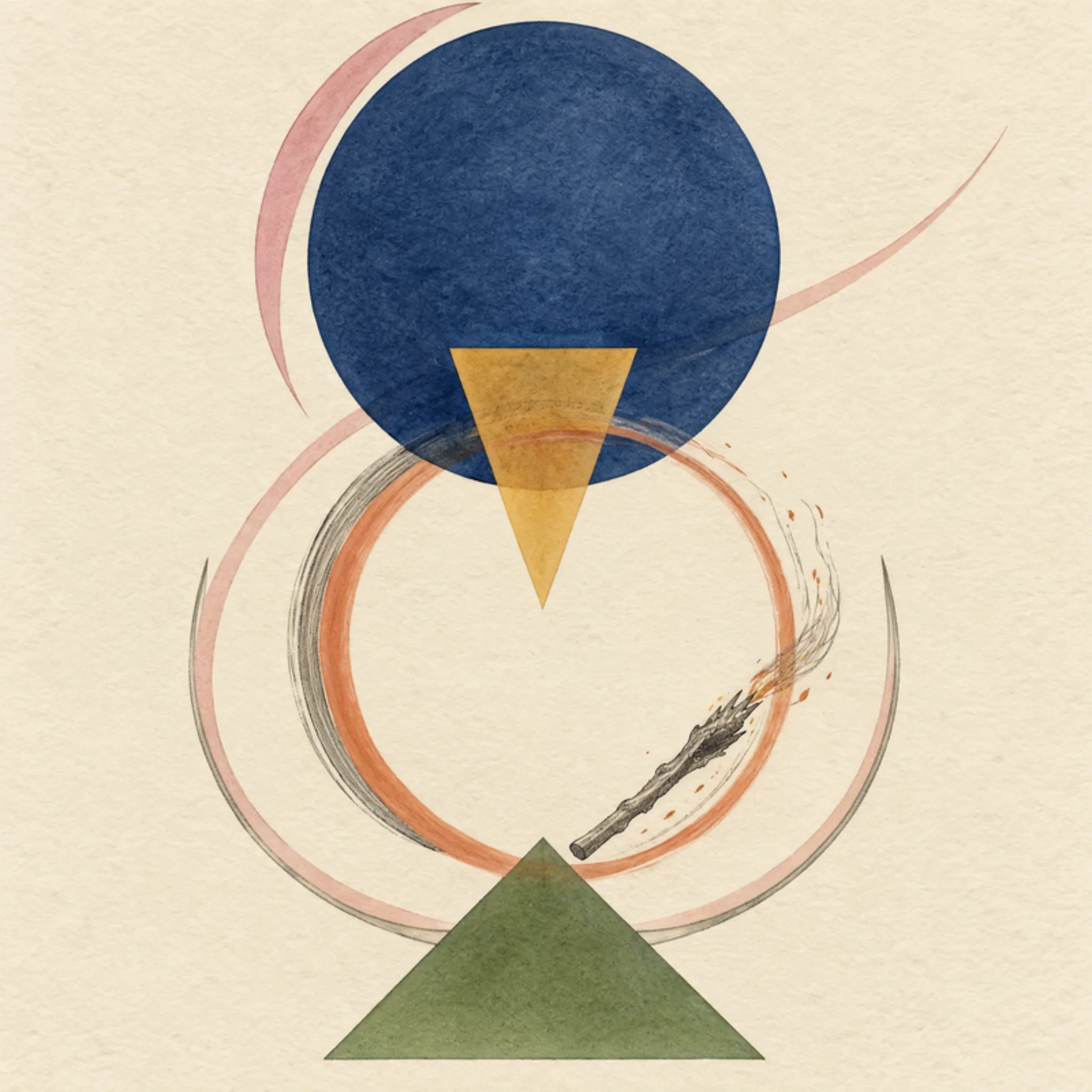
His teaching is called non-origination (ajativada): in the strict sense, nothing has ever come into being. Things appear, like the patterns a burning stick makes when you whirl it in the dark, but the fire never became the circle. The world is left standing. What is in question is what it rests on.
So bondage and freedom are appearances too. No one was ever actually bound, so no one needs to be freed. What is needed is only to stop taking oneself for what appears.
In their words
na nirodho na cotpattir na baddho na ca sādhakaḥ / na mumukṣur na vai mukta ity eṣā paramārthatā. Plain rendering: There is no ending and no beginning, no one bound and no one striving, no one wanting freedom and no one freed. This is the highest truth.
Mandukya Karika 2.32; Sanskrit with a plain rendering made for notdual.org (draft)
Where this path meets the others
Gaudapada's whirling firebrand and his dream comparison sound close to Buddhist teachers of his time, and scholars have long noticed this; he may have borrowed their images while keeping the Upanishadic Self. Zhuangzi's butterfly dream asks the same question from China. See the Meeting on Zen and Advaita.
Nothing was born, so nothing needs saving. Only the mistake ends.
Works
- Mandukya Karika (Gaudapada Karika)c. 6th to 7th century CE
Further reading
- The Mandukya Upanishad with Gaudapada's Karika and Shankara's commentary (any translation; older public-domain ones exist, such as Manilal N. Dvivedi, 1894)
Next on your path
Sources
- Mandukya Karika (Gaudapadiya Karika), especially chapters 2 to 4; verse 2.32 rendered from the Sanskrit for this site.
- The firebrand image (alatachakra) is from Mandukya Karika chapter 4.
- The traditional line Gaudapada, Govinda, Shankara is given in Shankara's tradition; historical dates are uncertain.