Nirvana Upanishad
In the words of Pranav Ashar
How we renderThe heart of the Nirvana
In brief
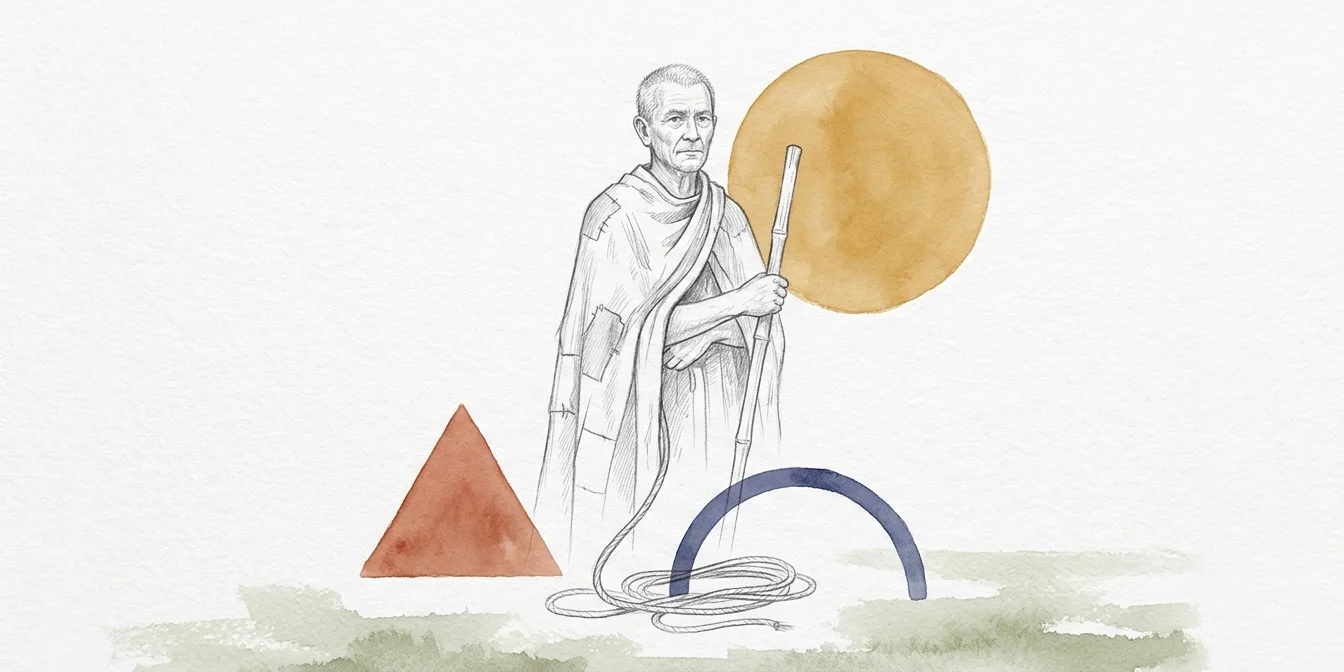
'The Paramahamsa: he is I.' The text then lists, one phrase at a time, the life of the one who has gone beyond: his patched cloak is steadiness, his loincloth detachment, his staff inquiry, his band of yoga the vision of Brahman. The world that is born is passing, like a dream-world or an elephant in the clouds; the body is imagined like a snake on a rope. His freedom is his own nature. In the end there is only Brahman, undivided, and every doubt is gone. That is the vision of nirvana.
- He is I
- The inner meaning of every mark
- The world as a dream
- The snake on the rope
- Freedom as one's own nature
अथ निर्वाणोपनिषदं व्याख्यास्यामः । परमहंसः सोऽहम् । परिव्राजकाः पश्चिमलिङ्गाः ।
atha nirvāṇopaniṣadaṃ vyākhyāsyāmaḥ | paramahaṃsaḥ so'ham | parivrājakāḥ paścimaliṅgāḥ |
Now we shall explain the Upanishad of nirvana. The Paramahamsa: . The wanderers bear the mark of the last stage.
Note //
The opening. 'He is I' (so 'ham) is also the hamsa mantra read backwards: the breath's 'ham-sa' heard as 'sa-'ham', 'he am I'. 'The mark of the last stage' (paścima-liṅga) is read as the sign of the final order of life, renunciation; the phrase is obscure. Pending review. Editions agree.
मन्मथक्षेत्रपालाः । गगनसिद्धान्तः । अमृतकल्लोलनदी । अक्षयं निरञ्जनम् ।
manmathakṣetrapālāḥ | gaganasiddhāntaḥ | amṛtakallolanadī | akṣayaṃ nirañjanam |
They guard the field of the body against the god of desire. Their settled view is space. Their stream is a river with waves of the deathless. What they hold to is imperishable, without stain.
Note //
The phrases describe the wanderers of 1. 'They guard the field against the god of desire' renders 'manmatha-kṣetra-pālāḥ' as most read it; it could also mean that desire has become no more than a keeper at the gate. 'Their settled view is space' (gagana-siddhānta): the conclusion that the Self, like space, holds everything and is touched by nothing. Interpretive; pending review. Editions agree ('akṣayan' in the Adyar collection is the same word joined to what follows).
निःसंशय ऋषिः । निर्वाणो देवता । निष्कुलप्रवृत्तिः । निष्केवलज्ञानम् । ऊर्ध्वाम्नायः । निरालम्बपीठः ।
niḥsaṃśaya ṛṣiḥ | nirvāṇo devatā | niṣkulapravṛttiḥ | niṣkevalajñānam | ūrdhvāmnāyaḥ | nirālambapīṭhaḥ |
Freedom from doubt is the seer. Nirvana is the deity. His going about belongs to no clan. His knowledge is the one alone. His tradition is the one that points upward. His seat rests on nothing.
Note //
The text gives its teaching the frame of a mantra, which always names a seer (ṛṣi) and a deity (devatā): here the seer is the absence of doubt and the deity is nirvana, the going-out of the fire of becoming. 'Belongs to no clan' (niṣkula-pravṛtti) may also echo the Tantric 'kula', the field of Shakti: his activity is beyond it. 'The tradition that points upward' (ūrdhvāmnāya) is a Tantric name for the highest line of teaching. Interpretive; pending review. Editions agree.
संयोगदीक्षा । वियोगोपदेशः । दीक्षासन्तोषपानं च । द्वादशादित्यावलोकनम् । विवेकरक्षा ।
saṃyogadīkṣā | viyogopadeśaḥ | dīkṣāsantoṣapānaṃ ca | dvādaśādityāvalokanam | vivekarakṣā |
His initiation is union. His teaching is separation. Contentment is the drink of his initiation. He sees the light of the twelve suns. Discernment is his protection.
Note //
Initiation joins him to Brahman; the teaching separates the Self from what is not the Self. 'The twelve suns' (dvādaśāditya) are the twelve Adityas, the sun of each month; seeing them all at once is read as the vision of the light that lights everything. Interpretive; pending review. Editions: 'dvādaśāditya' (Adyar collection) corrects 'dvādaśāvaditya' in sanskritdocuments.org; 'viveka-rakṣā' (sanskritdocuments.org) is followed over 'niveka' in the Adyar collection.
करुणैव केलिः । आनन्दमाला । एकान्तगुहायां मुक्तासनसुखगोष्ठी । अकल्पितभिक्षाशी । हंसाचारः । सर्वभूतान्तर्वर्ती हंस इति प्रतिपादनम् । धैर्यकन्था । उदासीनकौपीनम् । विचारदण्डः । ब्रह्मावलोकयोगपट्टः ।
karuṇaiva keliḥ | ānandamālā | ekāntaguhāyāṃ muktāsanasukhagoṣṭhī | akalpitabhikṣāśī | haṃsācāraḥ | sarvabhūtāntarvartī haṃsa iti pratipādanam | dhairyakanthā | udāsīnakaupīnam | vicāradaṇḍaḥ | brahmāvalokayogapaṭṭaḥ |
Compassion alone is his play. Bliss is his garland. In the cave of solitude, the joy of sitting free is his company. He eats what alms come unplanned. He lives as the swan; his teaching is that the swan dwells in all beings. Steadiness is his patched cloak. Detachment is his loincloth. is his staff. The vision of Brahman is the band that holds his posture.
Note //
Each item of a renunciant's life is given its inner meaning. 'The swan' (haṃsa) is the Self in all beings. 'Inquiry' (vicāra) as the staff: what supports him is the discerning of the Self from what is not the Self. The yoga-band (yogapaṭṭa) is a cloth tied round the knees to hold a seated posture. 'goṣṭhī', 'company' (Adyar collection; sanskritdocuments.org misprints 'goṣṭī'). Otherwise the editions agree.
श्रियां पादुका । परेच्छाचरणम् । कुण्डलिनीबन्धः । परापवादमुक्तो जीवन्मुक्तः । शिवयोगनिद्रा च । खेचरीमुद्रा च । परमानन्दी ।
śriyāṃ pādukā | parecchācaraṇam | kuṇḍalinībandhaḥ | parāpavādamukto jīvanmuktaḥ | śivayoganidrā ca | khecarīmudrā ca | paramānandī |
Fortune is his pair of sandals. He moves as another wills. The coiled power is held. Free of speaking ill of others, he is free while living. His sleep is the yoga-sleep of Shiva. His seal is the one that moves in space. He is full of the highest bliss.
Note //
'Fortune is his sandals': what the world counts as good fortune is under his feet. 'He moves as another wills' (parecchā-caraṇa): he plans nothing for himself and goes where he is led, by others or by the highest; set against 'living by one's own will' in 5, which is the same freedom seen from the side of the Self. Kundalini, the yoga-sleep and the khechari seal are terms of yoga, here said of one who has nothing left to gain from them. Interpretive. Editions agree.
निर्गतगुणत्रयम् । विवेकलभ्यं मनोवागगोचरम् ।
nirgataguṇatrayam | vivekalabhyaṃ manovāgagocaram |
That which has gone beyond the three qualities, which is reached by discernment, which mind and speech do not reach.
Note //
The subject changes from the renunciant to what he knows: Brahman, beyond the three qualities of nature (guṇa), reached only by discerning the Self from what is not the Self, and never an object of mind or speech. Editions agree.
अनित्यं जगद्यज्जनितं स्वप्नजगदभ्रगजादितुल्यम् । तथा देहादिसङ्घातं मोहगुणजालकलितं तद्रज्जुसर्पवत्कल्पितम् ।
anityaṃ jagadyajjanitaṃ svapnajagadabhragajāditulyam | tathā dehādisaṅghātaṃ mohaguṇajālakalitaṃ tadrajjusarpavatkalpitam |
The world that is born is passing, like a world in a dream, like an elephant seen in the clouds. So too the cluster of the body and the rest, woven of the net of delusion's qualities: it is imagined, like a snake seen on a rope.
Note //
The two classic images of Advaita: the dream, and the rope taken for a snake. The world is not called nothing; it is 'passing' and 'imagined', seen as something it is not, as the rope is seen as a snake. When the rope is seen, the snake was never there to be removed. Editions agree.
विष्णुविध्यादिशताभिधानलक्ष्यम् । अङ्कुशो मार्गः । शून्यं न सङ्केतः । परमेश्वरसत्ता । सत्यसिद्धयोगो मठः । अमरपदं तत्स्वरूपम् । आदिब्रह्मस्वसंवित् । अजपा गायत्री । विकारदण्डो ध्येयः । मनोनिरोधिनी कन्था ।
viṣṇuvidhyādiśatābhidhānalakṣyam | aṅkuśo mārgaḥ | śūnyaṃ na saṅketaḥ | parameśvarasattā | satyasiddhayogo maṭhaḥ | amarapadaṃ tatsvarūpam | ādibrahmasvasaṃvit | ajapā gāyatrī | vikāradaṇḍo dhyeyaḥ | manonirodhinī kanthā |
What Vishnu, Brahma and a hundred names point to: that is the goal. The goad is the way. It is not emptiness, not a sign agreed on: it is the being of the highest Lord. Yoga made real in truth is his monastery. The deathless state is his own nature. The first Brahman is his own awareness. His Gayatri is the one not spoken. The staff that tames the mind's changes is what he dwells on. The stilling of the mind is his patched cloak.
Note //
'The goad is the way': as the goad keeps the elephant on the road, restraint keeps the mind on the way. 'It is not emptiness, not a sign agreed on' renders 'śūnyaṃ na saṅketaḥ' as a denial that the goal is a void or a mere name; the division and sense are uncertain. Pending review. 'The Gayatri not spoken' (ajapā): the breath's own 'so 'ham', which repeats itself without effort (see 1). Editions: 'vidhi' (Brahma, Adyar collection) is followed over 'vidyā' (sanskritdocuments.org). Otherwise the editions agree.
योगेन सदानन्दस्वरूपदर्शनम् । आनन्दभिक्षाशी । महाश्मशानेऽप्यानन्दवने वासः । एकान्तस्थानम् । आनन्दमठम् । उन्मन्यवस्था । शारदा चेष्टा । उन्मनी गतिः । निर्मलगात्रम् । निरालम्बपीठम् । अमृतकल्लोलानन्दक्रिया । पाण्डरगगनम् । महासिद्धान्तः ।
yogena sadānandasvarūpadarśanam | ānandabhikṣāśī | mahāśmaśāne'pyānandavane vāsaḥ | ekāntasthānam | ānandamaṭham | unmanyavasthā | śāradā ceṣṭā | unmanī gatiḥ | nirmalagātram | nirālambapīṭham | amṛtakallolānandakriyā | pāṇḍaragaganam | mahāsiddhāntaḥ |
By yoga, he sees his own nature, bliss without end. He lives on the alms of bliss. Even in the great cremation ground he lives as in a grove of bliss. His place is solitude. His monastery is bliss. His state is beyond the mind. His movements are clear as autumn. His going is beyond the mind. His body is spotless. His seat rests on nothing. His action is bliss, in waves of the deathless. His sky is clear and white. That is the great settled view.
Note //
'The great cremation ground' is the world, where everything dies; he lives in it as in a grove of bliss. 'Beyond the mind' (unmanī) is the state in which the mind has stopped making itself the centre. 'Clear as autumn' renders 'śāradā ceṣṭā'; it may also mean 'his movements are Sharada', the goddess of speech and learning. Interpretive; pending review. Editions agree.
शमदमादिदिव्यशक्त्याचरणे क्षेत्रपात्रपटुता । परावरसंयोगः । तारकोपदेशः । अद्वैतसदानन्दो देवता । नियमः स्वान्तरिन्द्रियनिग्रहः । भयमोहशोकक्रोधत्यागस्त्यागः । परावरैक्यरसास्वादनम् । अनियामकत्वनिर्मलशक्तिः ।
śamadamādidivyaśaktyācaraṇe kṣetrapātrapaṭutā | parāvarasaṃyogaḥ | tārakopadeśaḥ | advaitasadānando devatā | niyamaḥ svāntarindriyanigrahaḥ | bhayamohaśokakrodhatyāgastyāgaḥ | parāvaraikyarasāsvādanam | aniyāmakatvanirmalaśaktiḥ |
In living by the divine powers of calm, restraint and the rest, he is skilled in knowing the right place and the right person. His union is of the higher and the lower. His teaching is the one that carries across. His deity is the non-dual, always bliss. His rule is mastering the senses within. His letting go is letting go of fear, delusion, grief and anger. He tastes the oneness of the higher and the lower. His power is spotless: .
Note //
'The teaching that carries across' (tāraka) is Om, which ferries the knower over becoming. 'Union of the higher and the lower' (parāvara-saṃyoga) is the oneness of the highest Self and the individual self. 'It rules over nothing' (aniyāmakatva): his power is pure because it does not set itself up as a controller; the I-claim, which wants to rule, is gone. Editions: 'svāntar-indriya' (Adyar collection) corrects 'svātar-' in sanskritdocuments.org; 'parāvaraikyarasāsvādanam' is in the Adyar collection only and is kept; 'tārakopadeśaḥ' (Adyar) and 'tārakopadeśāḥ' (sanskritdocuments.org) mean the same.
स्वप्रकाशब्रह्मतत्त्वे शिवशक्तिसम्पुटितप्रपञ्चच्छेदनम् । तथा पत्राक्षाक्षिकमण्डलुः । भावाभावदहनम् । बिभ्रत्याकाशाधारम् ।
svaprakāśabrahmatattve śivaśaktisampuṭitaprapañcacchedanam | tathā patrākṣākṣikamaṇḍaluḥ | bhāvābhāvadahanam | bibhratyākāśādhāram |
In the truth of Brahman, which shines by its own light, he cuts through the world that is folded between Shiva and Shakti. So too his water-pot is the eye that sees. He burns up being and not-being. He carries what rests on space.
Note //
The world appears folded between Shiva and Shakti, consciousness and its power; in the light of Brahman this whole pair-made world is cut through, seen as real as appearance, not on its own. 'Being and not-being' (bhāva-abhāva): every 'it is' and 'it is not' the mind can frame. 'The eye that sees' is a tentative reading of the obscure 'patrākṣākṣikamaṇḍalu' (perhaps 'leaf, bead and eye-water-pot'), and 'he carries what rests on space' of 'bibhraty ākāśādhāram'. Pending review. Editions: 'prapañcacchedanam' (sanskritdocuments.org) is followed over the misprint 'prapañcacchredanam' in the Adyar collection; 'bhāvābhāva' (Adyar) over 'bhavābhāva' (sanskritdocuments.org).
शिवं तुरीयं यज्ञोपवीतम् । तन्मया शिखा । चिन्मयं चोत्सृष्टिदण्डम् ।
śivaṃ turīyaṃ yajñopavītam | tanmayā śikhā | cinmayaṃ cotsṛṣṭidaṇḍam |
The auspicious fourth is his sacred thread. His tuft is made of that. His staff, which he has laid down, is made of awareness.
Note //
The sacred thread and tuft, which the renunciant gives up, are found again as turiya, the fourth, the Self beyond waking, dream and sleep. 'His staff, which he has laid down' renders 'utsṛṣṭi-daṇḍa', the staff of renunciation, said to be 'made of awareness'; the sense is uncertain. Pending review. Editions agree.
सन्तताक्षिकमण्डलुम् । कर्मनिर्मूलनं कन्था । मायाममताहङ्कारदहनम् । श्मशाने अनाहताङ्गी । निस्त्रैगुण्यस्वरूपानुसन्धानं समयम् । भ्रान्तिहरणम् । कामादिवृत्तिदहनम् । काठिन्यदृढकौपीनम् । चीराजिनवासः । अनाहतमन्त्रः । अक्रिययैव जुष्टम् ।
santatākṣikamaṇḍalum | karmanirmūlanaṃ kanthā | māyāmamatāhaṅkāradahanam | śmaśāne anāhatāṅgī | nistraiguṇyasvarūpānusandhānaṃ samayam | bhrāntiharaṇam | kāmādivṛttidahanam | kāṭhinyadṛḍhakaupīnam | cīrājinavāsaḥ | anāhatamantraḥ | akriyayaiva juṣṭam |
His water-pot is the eye that never closes. The uprooting of action is his patched cloak. He burns up maya, 'mine' and the I-claim. In the cremation ground his body is unharmed. His vow is to dwell on his own nature, beyond the three qualities. He takes away error. He burns up desire and every movement of the mind. His loincloth is firmness, strong and close. He is clothed in bark and deerskin. His mantra is the sound that is not struck. All this is served by not doing, alone.
Note //
'The eye that never closes' is a tentative reading of 'santatākṣikamaṇḍalu' (see 3e). 'The sound that is not struck' (anāhata) is the inner sound heard without any striking; here it is his only mantra. 'Served by not doing alone' (akriyayaiva juṣṭam): none of this is done; it is what is left when the doer is gone. 'In the cremation ground his body is unharmed' renders 'śmaśāne anāhatāṅgī' tentatively. Pending review. Editions: 'śmaśāne' and 'nistraiguṇya' are each misprinted in one copy (sanskritdocuments.org 'spraśāne', Adyar collection 'nistraigṇya'); the standard forms are given.
स्वेच्छाचारस्वस्वभावो मोक्षः परं ब्रह्म । प्लववदाचरणम् । ब्रह्मचर्यशान्तिसङ्ग्रहणम् । ब्रह्मचर्याश्रमेऽधीत्य वानप्रस्थाश्रमेऽधीत्य ससर्वसंविन्न्यासं सन्न्यासम् । अन्ते ब्रह्माखण्डाकारम् । नित्यं सर्वसन्देहनाशनम् । एतन्निर्वाणदर्शनम् ।
svecchācārasvasvabhāvo mokṣaḥ paraṃ brahma | plavavadācaraṇam | brahmacaryaśāntisaṅgrahaṇam | brahmacaryāśrame'dhītya vānaprasthāśrame'dhītya sasarvasaṃvinnyāsaṃ sannyāsam | ante brahmākhaṇḍākāram | nityaṃ sarvasandehanāśanam | etannirvāṇadarśanam |
Freedom is living by one's own will, in one's own nature: the highest Brahman. He moves as if floating. He holds to celibacy and peace. Having studied as a student, having studied as a forest-dweller, he renounces, letting go of every notion. In the end: Brahman, undivided. Always: the end of every doubt. This is the vision of nirvana.
Note //
'Living by one's own will' (svecchācāra) is not licence: the 'will' is that of one whose nature is the Self, and the phrase is joined to 'one's own nature' (svasvabhāva). 'Floating' (plavavat): moving through the world without sinking in it, like something carried on water. 'Letting go of every notion' (sarvasaṃvin-nyāsa) is the inner meaning of renunciation. 'Brahman, undivided' (akhaṇḍākāra): the knowledge in which there is no division. Editions: 'vānaprasthāśrame 'dhītya' is in the Adyar collection only; it is kept. The closing line follows in 6.
शिष्यं पुत्रं विना न देयमित्युपनिषत् ॥
śiṣyaṃ putraṃ vinā na deyamityupaniṣat ||
It is not to be given except to a disciple or a son. This is the Upanishad.
Note //
The usual closing restriction: the teaching is for one who has come to learn it, not for display. The Adyar collection joins this to the last sentence of 5. Editions agree.
No public-domain English translation exists for this text; the Sanskrit is shown.
The renderings on this page are shared under CC BY-NC 4.0, in the words of Pranav Ashar.