Amritabindu Upanishad
In the words of Pranav Ashar
How we renderThe heart of the Amritabindu
In brief
The mind is the cause of both bondage and freedom: bound when it runs after objects, free when it rests without them. But the text quickly goes past mind-control. Brahman is neither something to think about nor something beyond thought; from the highest standpoint there is no one bound and no one freed. The Self is one in waking, dream and sleep, untouched like the space in a pot. Learn the scriptures, then drop them like straw once the grain is in hand, and know: 'I am that Brahman.'
- The mind as bondage and freedom
- Beyond thinkable and unthinkable
- No one bound, no one freed
- Space in the pot
- Scripture as straw
- I am that Brahman
मनो हि द्विविधं प्रोक्तं शुद्धं चाशुद्धमेव च । अशुद्धं कामसंकल्पं शुद्धं कामविवर्जितम् ॥ १॥
mano hi dvividhaṃ proktaṃ śuddhaṃ cāśuddhameva ca | aśuddhaṃ kāmasaṃkalpaṃ śuddhaṃ kāmavivarjitam || 1||
The mind is said to be of two kinds, pure and impure. Impure, when it is shaped by desire; pure, when it is free of desire.
Note //
मन एव मनुष्याणां कारणं बन्धमोक्षयोः । बन्धाय विषयासक्तं मुक्त्यै निर्विषयं स्मृतम् ॥ २॥
mana eva manuṣyāṇāṃ kāraṇaṃ bandhamokṣayoḥ | bandhāya viṣayāsaktaṃ muktyai nirviṣayaṃ smṛtam || 2||
The mind alone, for human beings, is the cause of bondage and of freedom. Clinging to objects, it binds; free of objects, it frees.
Note //
The mind is the cause, not the Self: bondage and freedom are both states of the mind. The Self is neither bound nor freed (10).
यतो निर्विषयस्यास्य मनसो मुक्तिरिष्यते । अतो निर्विषयं नित्यं मनः कार्यं मुमुक्षुणा ॥ ३॥
yato nirviṣayasyāsya manaso muktiriṣyate | ato nirviṣayaṃ nityaṃ manaḥ kāryaṃ mumukṣuṇā || 3||
Since freedom belongs to the mind that is free of objects, whoever wants freedom should keep the mind free of objects, always.
Note //
निरस्तविषयासङ्गं संनिरुद्धं मनो हृदि । यदाऽऽयात्यात्मनो भावं तदा तत्परमं पदम् ॥ ४॥
nirastaviṣayāsaṅgaṃ saṃniruddhaṃ mano hṛdi | yadā''yātyātmano bhāvaṃ tadā tatparamaṃ padam || 4||
When the mind has let go of its hold on objects, is gathered into the heart, and comes to be the Self, that is the highest state.
Note //
'Comes to be the Self' (atmano bhavam ayati): the mind does not reach a new place; it stops standing apart from what it always was.
तावदेव निरोद्धव्यं यावद्धृदि गतं क्षयम् । एतज्ज्ञानं च ध्यानं च शेषो न्यायश्च विस्तरः ॥ ५॥
tāvadeva niroddhavyaṃ yāvaddhṛdi gataṃ kṣayam | etajjñānaṃ ca dhyānaṃ ca śeṣo nyāyaśca vistaraḥ || 5||
Hold the mind in, until it has dissolved in the heart. This is knowledge, this is meditation; the rest is argument and elaboration.
Note //
'The rest is argument and elaboration' (shesho nyayash cha vistarah): Aiyar has 'other ways are but long or tedious'.
नैव चिन्त्यं न चाचिन्त्यं न चिन्त्यं चिन्त्यमेव च । पक्षपातविनिर्मुक्तं ब्रह्म सम्पद्यते तदा ॥ ६॥
naiva cintyaṃ na cācintyaṃ na cintyaṃ cintyameva ca | pakṣapātavinirmuktaṃ brahma sampadyate tadā || 6||
It is not something to be thought, nor something beyond thought; it cannot be thought, and yet it is what is thought on. Free of taking either side, one then becomes Brahman.
Note //
The verse refuses both positions: Brahman is not an object of thought, and it is not an 'unthinkable' that thought could set apart as its opposite. Since it is the light in which every thought appears, it is 'what is thought on' in every thought. 'Free of taking either side' (pakshapata-vinirmukta) can also be read as 'free of partiality'; Aiyar: 'Brahman that is devoid of partiality'. The rendering takes it with the one who sees.
स्वरेण संधयेद्योगमस्वरं भावयेत्परम् । अस्वरेण हि भावेन भावो नाभाव इष्यते ॥ ७॥
svareṇa saṃdhayedyogamasvaraṃ bhāvayetparam | asvareṇa hi bhāvena bhāvo nābhāva iṣyate || 7||
Join yourself in yoga through the sounded syllable; contemplate the highest as soundless. Through soundless contemplation what is is .
Note //
The sounded syllable is Om chanted aloud; the soundless is what remains when the sound has ended. The last line guards against taking the silence after Om as a blank: what is left is being itself. Aiyar: 'that which is cannot become non-existent'.
तदेव निष्कलं ब्रह्म निर्विकल्पं निरञ्जनम् । तद्ब्रह्माहमिति ज्ञात्वा ब्रह्म सम्पद्यते ध्रुवम् ॥ ८॥
tadeva niṣkalaṃ brahma nirvikalpaṃ nirañjanam | tadbrahmāhamiti jñātvā brahma sampadyate dhruvam || 8||
That alone is Brahman, without parts, beyond all thought-constructs, without stain. Knowing 'I am that Brahman', one surely becomes Brahman.
Note //
निर्विकल्पमनन्तं च हेतुदृष्टान्तवर्जितम् । अप्रमेयमनादिं च यज्ज्ञात्वा मुच्यते बुधः ॥ ९॥
nirvikalpamanantaṃ ca hetudṛṣṭāntavarjitam | aprameyamanādiṃ ca yajjñātvā mucyate budhaḥ || 9||
Beyond all constructs, without end, beyond reasons and examples, beyond measure, without beginning: knowing that, the wise are free.
Note //
'Beyond reasons and examples' (hetu-drishtanta-varjita): it cannot be proved by inference, which needs a reason and an example, because it is what every proof appears to.
न निरोधो न चोत्पत्तिर्न बद्धो न च साधकः । न मुमुक्षुर्न वै मुक्त इत्येषा परमार्थता ॥ १०॥
na nirodho na cotpattirna baddho na ca sādhakaḥ | na mumukṣurna vai mukta ityeṣā paramārthatā || 10||
No dissolution, no creation, no one bound, , no one seeking freedom, and no one freed: this is .
Note //
The same verse is Gaudapada's Mandukya Karika 2.32. It speaks from the standpoint of the highest truth (paramarthata): from there, bondage was never real, so freedom is not an event. The practice of verses 1-5 belongs to the standpoint of the one who still takes himself to be bound.
एक एवात्मा मन्तव्यो जाग्रत्स्वप्नसुषुप्तिषु । स्थानत्रयव्यतीतस्य पुनर्जन्म न विद्यते ॥ ११॥
eka evātmā mantavyo jāgratsvapnasuṣuptiṣu | sthānatrayavyatītasya punarjanma na vidyate || 11||
Know the Self as one in waking, dream and deep sleep. For the one who has gone beyond these three states there is no birth again.
Note //
एक एव हि भूतात्मा भूते भूते व्यवस्थितः । एकधा बहुधा चैव दृश्यते जलचन्द्रवत् ॥ १२॥
eka eva hi bhūtātmā bhūte bhūte vyavasthitaḥ | ekadhā bahudhā caiva dṛśyate jalacandravat || 12||
There is one Self of all beings, present in each being. It is seen as one and as many, like the moon in many waters.
Note //
One moon, many reflections: the many are real as appearance, not on their own.
घटसंवृतमाकाशं नीयमानो घटे यथा । घटो नीयेत नाकाशः तद्वज्जीवो नभोपमः ॥ १३॥
ghaṭasaṃvṛtamākāśaṃ nīyamāno ghaṭe yathā | ghaṭo nīyeta nākāśaḥ tadvajjīvo nabhopamaḥ || 13||
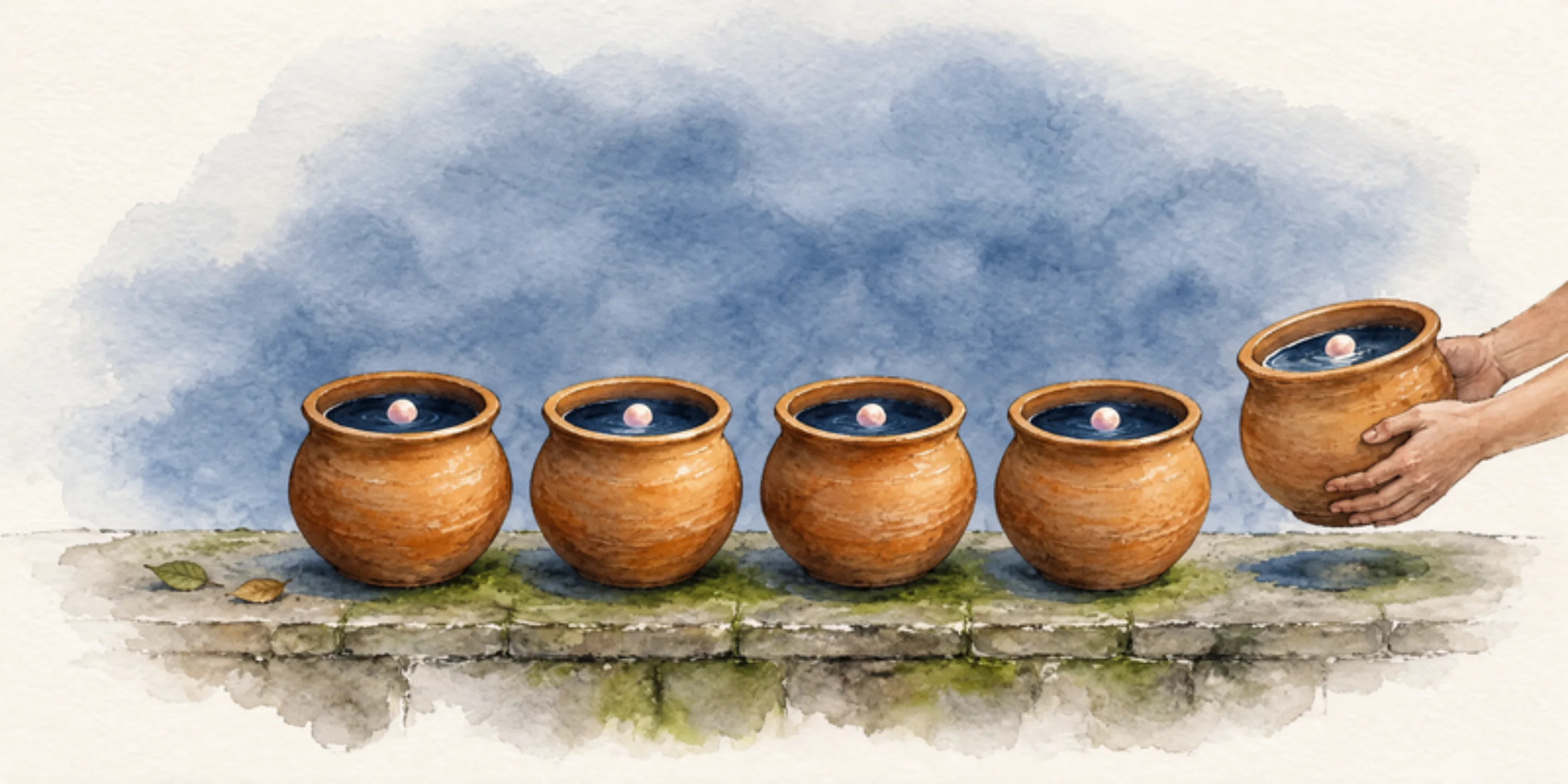
When a pot is carried, the space enclosed in it is not carried; the pot is. The living self is like that space.
Note //
The simile Gaudapada uses (Mandukya Karika 3.3-9): the body moves, is born and dies; the space-like Self in it does not go anywhere.
घटवद्विविधाकारं भिद्यमानं पुनः पुनः । तद्भग्नं न च जानाति स जानाति च नित्यशः ॥ १४॥
ghaṭavadvividhākāraṃ bhidyamānaṃ punaḥ punaḥ | tadbhagnaṃ na ca jānāti sa jānāti ca nityaśaḥ || 14||
Like pots, bodies take many forms and break again and again. The body does not know its breaking; he knows it, always.
Note //
'He' is the Self, the knower, which sees each body end and is not ended with it. The edition reads तद्भेदे and records तद्भग्नं as a variant; the variant is adopted (see uncertain notes).
शब्दमायावृतो नैव तमसा याति पुष्करे । भिन्ने तमसि चैकत्वमेक एवानुपश्यति ॥ १५॥
śabdamāyāvṛto naiva tamasā yāti puṣkare | bhinne tamasi caikatvameka evānupaśyati || 15||
Covered by the appearance of words, held by darkness, one does not reach the open sky. When the darkness is broken, one sees the oneness, alone.
Note //
Pushkara is read as the open sky of the Self (or the lotus of the heart); Aiyar: 'the sun (of Parabrahman)'. 'The appearance of words' renders shabda-maya: name and form, which seem to be things on their own. The line is compressed and its reading uncertain; pending review.
शब्दाक्षरं परं ब्रह्म तस्मिन्क्षीणे यदक्षरम् । तद्विद्वानक्षरं ध्यायेद्यदीच्छेच्छान्तिमात्मनः ॥ १६॥
śabdākṣaraṃ paraṃ brahma tasminkṣīṇe yadakṣaram | tadvidvānakṣaraṃ dhyāyedyadīcchecchāntimātmanaḥ || 16||
The sounded syllable is the highest Brahman. When it has died away, what does not die away: that the wise should contemplate, if they want peace for themselves.
Note //
A play on akshara, which means both 'syllable' and 'imperishable'. Om sounded is Brahman as sound; what remains when the sound has ended is the imperishable itself.
द्वे विद्ये वेदितव्ये तु शब्दब्रह्म परं च यत् । शब्दब्रह्मणि निष्णातः परं ब्रह्माधिगच्छति ॥ १७॥
dve vidye veditavye tu śabdabrahma paraṃ ca yat | śabdabrahmaṇi niṣṇātaḥ paraṃ brahmādhigacchati || 17||
Two things are to be known: Brahman as word, and the highest. Whoever is steeped in Brahman as word comes to the highest Brahman.
ग्रन्थमभ्यस्य मेधावी ज्ञानविज्ञानतत्परः । पलालमिव धान्यार्थी त्यजेद्ग्रन्थमशेषतः ॥ १८॥
granthamabhyasya medhāvī jñānavijñānatatparaḥ | palālamiva dhānyārthī tyajedgranthamaśeṣataḥ || 18||
Having studied the books, intent on knowing and on living what is known, the wise should let the books go entirely, as someone after grain throws away the straw.
Note //
The order matters: the books are let go after they have been studied and the grain is in hand, not instead of studying them.
गवामनेकवर्णानां क्षीरस्याप्येकवर्णता । क्षीरवत्पश्यते ज्ञानं लिङ्गिनस्तु गवां यथा ॥ १९॥
gavāmanekavarṇānāṃ kṣīrasyāpyekavarṇatā | kṣīravatpaśyate jñānaṃ liṅginastu gavāṃ yathā || 19||
Cows are of many colours, but their milk is one colour. The wise see knowing as the milk, and its many forms as the cows.
Note //
घृतमिव पयसि निगूढं भूते भूते च वसति विज्ञानम् । सततं मनसि मन्थयितव्यं मनो मन्थानभूतेन ॥ २०॥
ghṛtamiva payasi nigūḍhaṃ bhūte bhūte ca vasati vijñānam | satataṃ manasi manthayitavyaṃ mano manthānabhūtena || 20||
Like butter hidden in milk, knowing dwells in every being. It is to be churned out constantly, with the mind as the churning-stick.
Note //
ज्ञाननेत्रं समाधाय चोद्धरेद्वह्निवत्परम् । निष्कलं निश्चलं शान्तं तद्ब्रह्माहमिति स्मृतम् ॥ २१॥
jñānanetraṃ samādhāya coddharedvahnivatparam | niṣkalaṃ niścalaṃ śāntaṃ tadbrahmāhamiti smṛtam || 21||
Setting up the eye of knowledge as the churning-rod, draw out the highest, like fire from wood: without parts, unmoving, at peace. 'I am that Brahman': this is what is taught.
Note //
The image is the fire-drill of the Vedic rite, where fire is churned from wood (as in Shvetashvatara 1.14). The fire was in the wood all along.
सर्वभूताधिवासं यद्भूतेषु च वसत्यपि । सर्वानुग्राहकत्वेन तदस्म्यहं वासुदेवः ॥ २२॥
sarvabhūtādhivāsaṃ yadbhūteṣu ca vasatyapi | sarvānugrāhakatvena tadasmyahaṃ vāsudevaḥ || 22||
That in which all beings dwell, which also dwells in all beings, which blesses all: that am I, Vasudeva.
The renderings on this page are shared under CC BY-NC 4.0, in the words of Pranav Ashar.