Brahma Sutras with Shankara's commentary: the first four sutras
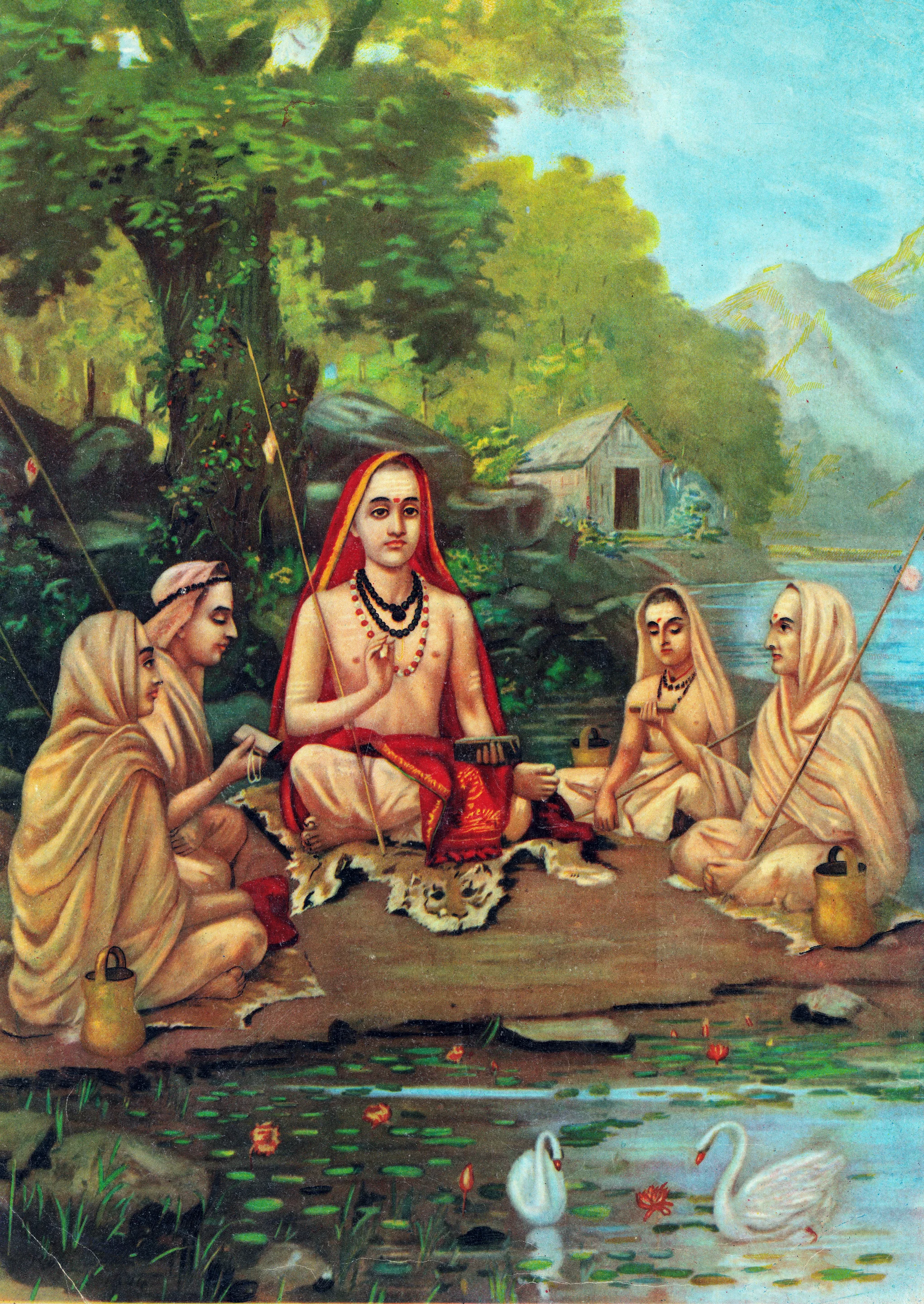
In the words of Pranav Ashar
How we renderChapter 1: Introduction: the laying-on (adhyasa-bhashya)
Two that cannot be one
Reverence to . The subject and the object are as opposed as light and darkness. The object belongs to the notion 'you', the subject to the notion 'I'. That the two cannot be one needs no proof, and still less can the features of one become the features of the other. So it is wrong to lay the object and its features onto the subject, whose very self is awareness and whose ground is the notion 'I'; and wrong, the other way round, to lay the subject and its features onto the object. Even so, people do it, and do it naturally. Rooted in a wrong knowing, they fail to tell the two apart, although they are wholly distinct, and lay the nature and features of each onto the other. Joining the real and the unreal, they say 'I am this' and 'this is mine'.
Note //
The famous opening, in which Shankara names the problem the whole commentary answers. 'You' (yushmat) is chosen rather than 'this' to mark a complete opposition: 'I' and 'you' can never be one person in grammar. The site's position 5 is this paragraph: mistaking runs both ways, and it is natural.
What laying-on is
What, then, is this laying-on? It is the appearance, in the manner of memory, of something seen before, in another place. Some say it is laying the features of one thing on another. Others say it is a mistake that rests on not grasping the difference between what is laid on and what it is laid on. Others say it is imagining in a thing features contrary to its nature. All of them agree on this much: one thing appears with the features of another. Ordinary speech agrees too: 'the mother-of-pearl shows like silver', 'the one moon looks like two'. But how can objects and their features be laid onto the inner Self, which is not an object? People lay an object only on another object in front of them, and you have said the inner Self, untouched by the notion 'you', is never an object. It is not wholly a non-object, we reply. It is the content of the notion 'I', and the inner Self is well known because it is immediately present. Nor is it a fixed rule that something can be laid only on an object in front of the senses: people who do not look closely lay a dark blue colour on the sky, which the senses do not reach. So there is nothing unreasonable in the not-Self being laid on the inner Self.
Note //
Adhyasa, 'laying-on', is the technical heart of Advaita; the site's word is mistaking. Shankara's examples (shell taken for silver, one moon seen as two, the blue of the sky) are the ones every later Advaita text uses. 'Immediately present' renders aparoksha: the Self is never at a distance from the one who looks for it.
Not-knowing, and everything that rests on it
The wise call this laying-on (avidya), and they call knowing (vidya) the finding of what is really so by telling apart what was laid on. Once that is known, neither the Self nor the not-Self is touched in the least by any fault or merit that came from laying one on the other. This mutual laying-on of Self and not-Self, called , is what all our dealings rest on, in daily life and in the Veda alike: the means of knowing, what is known, the knower, and every scripture, whether it commands, forbids, or speaks of freedom. How can perception, inference and scripture rest on ? Because none of them works without a knower, and there is a knower only when the body, the senses and the rest are wrongly taken as oneself or as one's own. Without the senses there is no perceiving; the senses need a body to work from; and no one acts through a body that has not been taken as oneself. Without all this, the Self, which by its nature touches nothing, could not become a knower; and without a knower the means of knowing do not work. So perception and the rest, and the Veda too, have their place within . Animals show the same. When a sound or a sight reaches them they move toward it or away from it, as the impression is pleasant or threatening. A cow sees a man coming with a raised stick and moves off, thinking he will beat her; she walks up to a man holding fresh grass. People do the same, for all their higher intelligence: they run from fierce men coming at them shouting with swords drawn, and go up to people who look and act the other way. So humans and animals deal with knowing and the known in the same way; and since animals act without telling Self and not-Self apart, so do people, however clever, as long as the laying-on lasts.
Note //
The boldest claim in the introduction: knowing and being known, even scripture, operate inside not-knowing. Shankara does not say they are useless; he says they need a knower, and a knower is already a Self taken as a body. The site reads this as positions 5 and 7: the dealings go on, the confinement is what falls.
The laying-on in daily life
With Vedic action (sacrifices and the like) it is true that the thoughtful person qualified for it does not act without knowing that the Self goes on to another world. But that qualification does not need the knowledge, taught in the Upanishads, of the Self as it is: without wants, beyond the distinctions of priest and warrior and the rest, outside the round of birth and death. That knowledge is of no use to it and even contradicts it. Before that knowledge dawns, Vedic texts work within : 'a Brahmin is to sacrifice' works only when caste, stage of life, age, circumstances and so on are laid on the Self. We have said what laying-on is: the notion of one thing in another. Here is how it shows. Someone thinks himself whole or broken as his wife and children are well or not: features of others are laid on the Self. He thinks 'I am fat, thin, fair, I am standing, walking, jumping': features of the body. 'I am mute, deaf, one-eyed, blind': features of the senses. 'I want, I intend, I doubt, I decide': features of the mind. In the same way the maker of the notion 'I' is laid on the inner Self, which is the witness of all the mind's changes; and the other way round, the inner Self, the witness of everything, is laid on the mind, the senses and the rest. So this laying-on runs naturally, without beginning and without end, in the form of wrong notions. It makes the individual seem an agent and an enjoyer, and everyone sees it.
Note //
The examples run from the outside in: family, body, senses, mind, and finally the I-maker (ahamkara) itself. The last sentence names mistaking as natural, beginningless and, without knowledge, endless: the site's position 5, and its position 6 for the I-claim laid on the witness.
Why this teaching is begun
To uproot this wrong notion, the cause of all harm, and to gain the knowledge that the Self is one, the study of the Upanishads is begun. That this is what all of them mean, we shall show in this inquiry into the embodied Self. Of this inquiry into the Upanishads, which we are about to explain, the first sutra is this.
Note //
The 'embodied Self' (sharira) is the title Shankara gives his commentary: Sharirakamimamsa. One sentence states the whole purpose: not a new state to reach, but a wrong notion to remove.
The renderings on this page are shared under CC BY-NC 4.0, in the words of Pranav Ashar.