Jalal al-Din Rumi
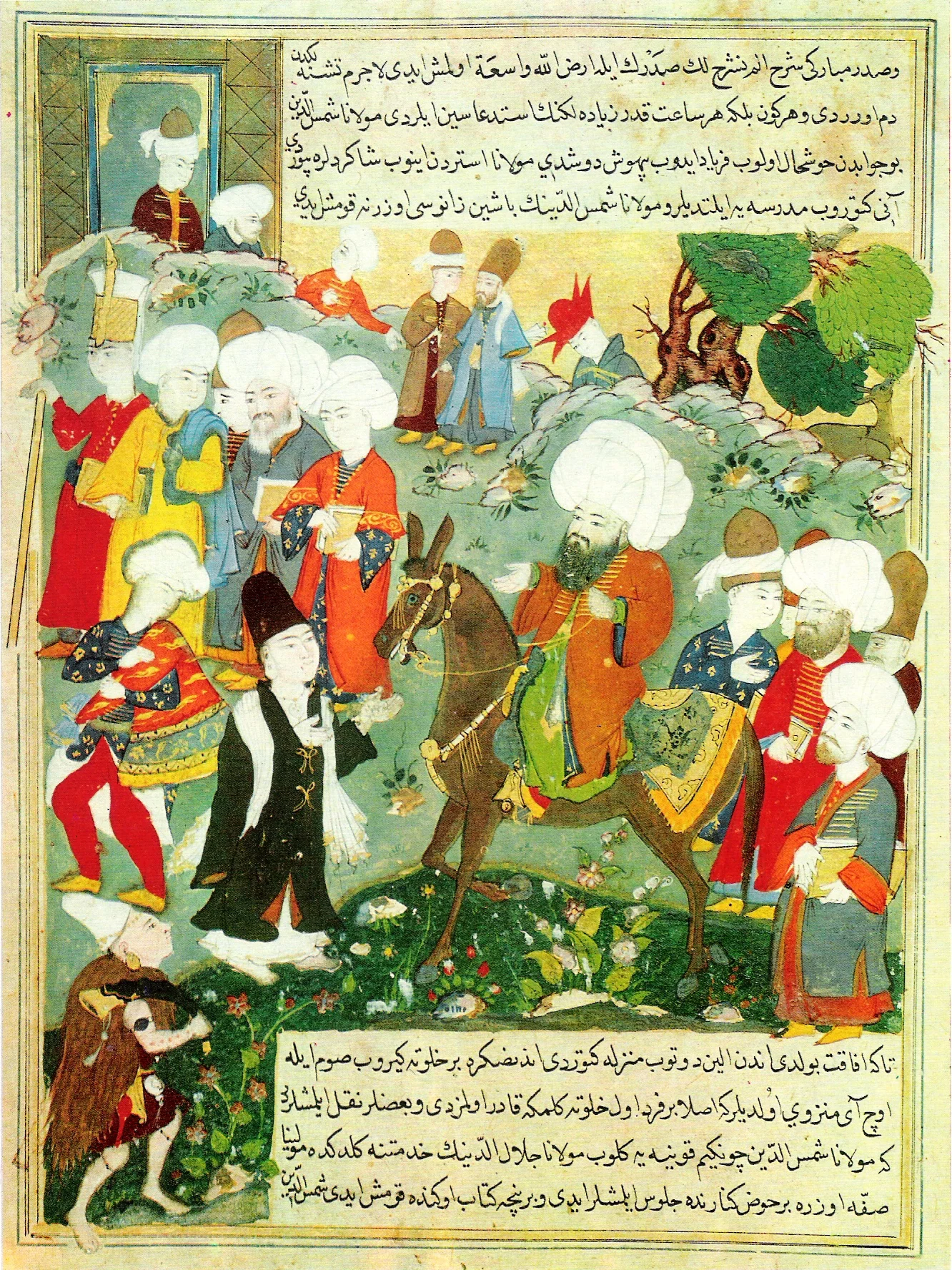
1207 to 1273 · Born in the region of Balkh (probably at Wakhsh, in present-day Tajikistan); lived in Konya, Anatolia
Life
Rumi's family left Central Asia when he was a child, ahead of the Mongol invasions, and settled in Konya. Like his father, he became a respected teacher of Islamic law and theology. In 1244 he met a wandering dervish, Shams of Tabriz, and his life turned over: the scholar became a poet of love. Shams disappeared a few years later. Rumi's grief poured into thousands of lyric poems and, later, into the Masnavi, a long teaching poem in six books, dictated to his student Husam al-Din. After his death his son Sultan Walad shaped his followers into the Mevlevi order, known in the West for its turning dervishes.
What they saw
For Rumi, the soul's whole life is the reed's song: a lament for separation from its source. The cure is not argument but love, which burns away the separate self (fana) until only the Beloved remains, and the lover lives on in him (baqa).
He speaks always as a Muslim. God, the Prophet and the Quran are never far. But his images go to the edge: the lover is only a veil; the drop and the ocean; the self that must die before you die. He is also a great teacher in stories, like the elephant in the dark, where each person mistakes a part for the whole.
In their words
“Hearken to the reed-flute, how it complains, / Lamenting its banishment from its home”
Rumi, Masnavi, Book I, Prologue, tr. E. H. Whinfield (1887)
“The Beloved is all in all, the lover only veils Him”
Rumi, Masnavi, Book I, Prologue, tr. E. H. Whinfield (1898)
Where this path meets the others
Rumi's end of separation stands beside the Upanishads' end of sorrow in the vision of oneness, and his love beside Madhusudana Sarasvati's devotion. See Rumi and the Upanishads, and the story The elephant in the dark.
The flute's sadness is the sound of home.
Works
- Masnavic. 1258 to 1273
- Divan-e Shams-e Tabrizi13th century
- Fihi Ma Fihi (Discourses)13th century
Further reading
- Masnavi i Ma'navi, abridged and tr. E. H. Whinfield (1898)
- The Mathnawi of Jalalu'ddin Rumi, tr. R. A. Nicholson (1925 to 1940; check copyright in your country)
Next on your path
Sources
- Masnavi i Ma'navi, abridged and tr. E. H. Whinfield (London: Kegan Paul, Trench, Trübner, 1898), Book I; the reed-flute lines are quoted from the first edition (London: Trübner, 1887). Public domain.
- Biography: standard accounts (e.g. Franklin Lewis, Rumi: Past and Present, East and West, 2000). Meeting with Shams: 1244. Birthplace: Wakhsh is the view of recent scholarship; tradition says Balkh.