Ibn Arabi
1165 to 1240 · Born in Murcia, al-Andalus (Spain); died in Damascus
Life
Muhyi al-Din Ibn Arabi was born in Murcia in 1165 and grew up in Seville. As a young man he had visionary experiences that changed his life, and he spent years among the Sufis of Andalusia and North Africa. Around 1200 he left the West for good, travelling to Mecca, where he began his vast work al-Futuhat al-Makkiyya (The Meccan Openings), and on through Anatolia and Iraq, finally settling in Damascus, where he died in 1240. His shorter Fusus al-Hikam (The Bezels of Wisdom) became one of the most studied, and argued over, books in Islamic thought. His title: al-Shaykh al-Akbar, the greatest master.
What they saw
Only God has real being, Ibn Arabi taught. Everything else exists by borrowing that being, as reflections exist by the light that falls on mirrors. Each thing shows God in its own way, and none shows God completely. Later followers summed up his view in the phrase “the oneness of being” (wahdat al-wujud), though he did not use it as a slogan himself.
It follows that the heart that genuinely knows can receive every form in which God appears, without locking God into any one of them: which is why he could say that his heart had become capable of every form.
In their words
“My heart has become capable of every form: it is a pasture for gazelles and a convent for Christian monks”
Ibn Arabi, Tarjuman al-Ashwaq, poem 11, verse 13, tr. R. A. Nicholson (1911)
“I follow the religion of Love: whatever way Love's camels take, that is my religion and my faith.”
Ibn Arabi, Tarjuman al-Ashwaq, poem 11, verse 15, tr. R. A. Nicholson (1911)
Where this path meets the others
His one Being lent to all things is close to Advaita's dependent world, real as appearance and never on its own, and to Spinoza's one substance. He speaks of God and creation, which Advaita does not. See Spinoza and Shankara.
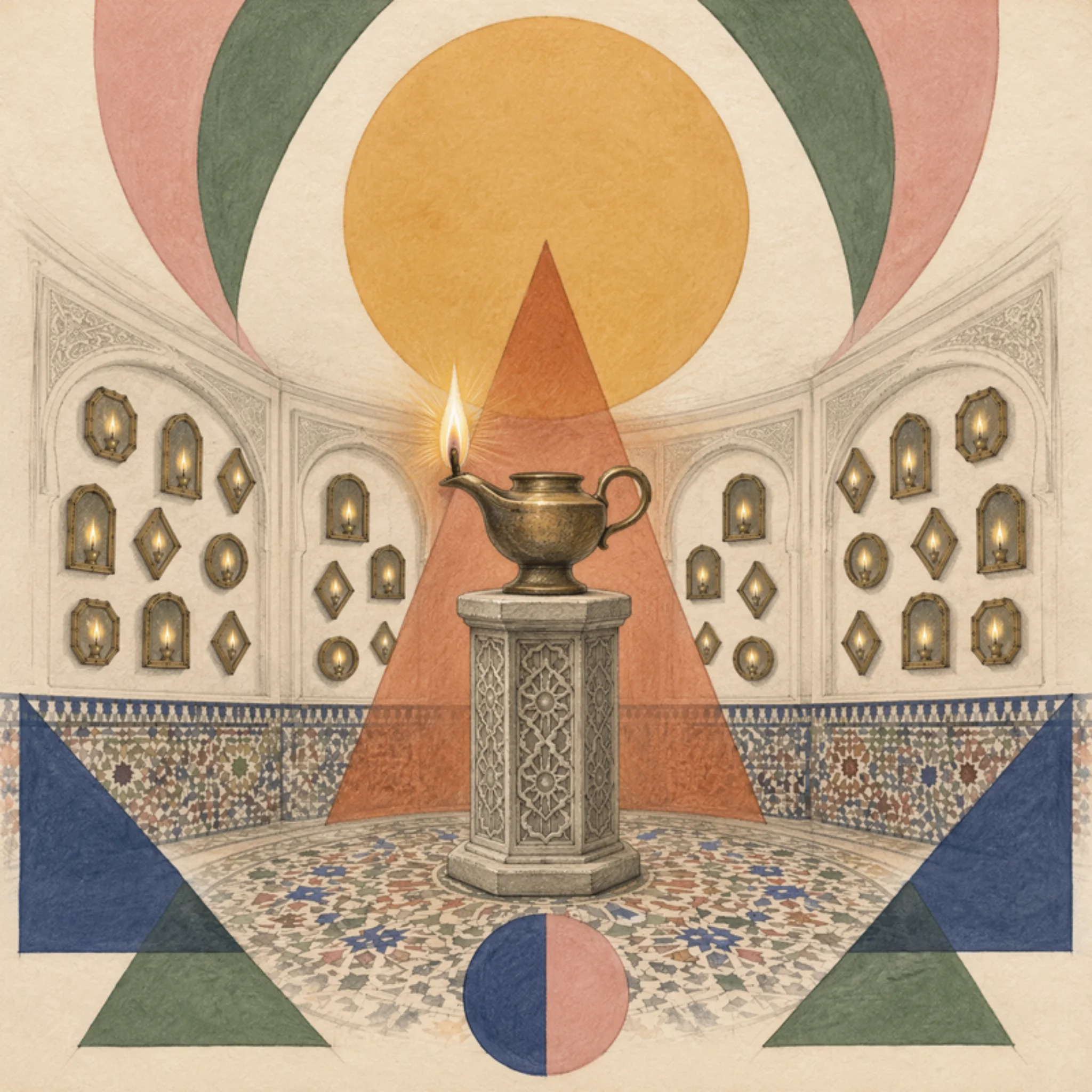
One lamp, many mirrors: each shows it, none contains it.
Works
- Fusus al-Hikam (The Bezels of Wisdom)c. 1229
- al-Futuhat al-Makkiyya (The Meccan Openings)1203 to 1238
- Tarjuman al-Ashwaq (The Interpreter of Desires)c. 1215
Further reading
- The Tarjuman al-Ashwaq, tr. R. A. Nicholson (1911)
- William C. Chittick, The Sufi Path of Knowledge (1989; in copyright)
Next on your path
Sources
- The Tarjuman al-Ashwaq: A Collection of Mystical Odes by Muhyiddin Ibn al-Arabi, tr. Reynold A. Nicholson (London: Royal Asiatic Society, 1911), poem XI. Public domain.
- Biography and works: standard accounts (e.g. Claude Addas, Quest for the Red Sulphur, 1993).
- The phrase wahdat al-wujud: associated with his school after him; he did not use it as a fixed term.