Ramana Maharshi
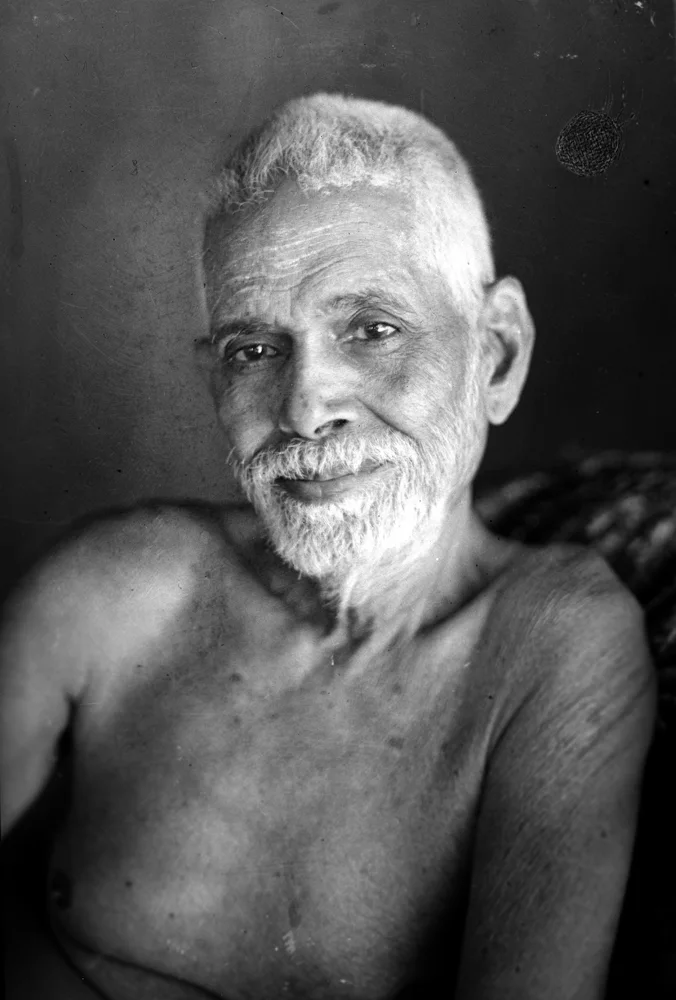
30 December 1879 to 14 April 1950 · Born in Tiruchuzhi, Tamil Nadu; lived at Arunachala, Tiruvannamalai
Life
Venkataraman Iyer was born in Tiruchuzhi in 1879. In 1896, at sixteen, alone in an upstairs room in Madurai, he was seized by a sudden fear of death. He lay down, held his breath and asked what it was that died. He found that the body would die but that he, the one aware of it, was untouched. Weeks later he left home for the hill of Arunachala at Tiruvannamalai, and never left it. People came to sit with him. An ashram grew around him. He taught mostly in silence and in short answers, and died there in 1950.
What they saw
Ramana's teaching is a single question turned back on itself: who am I? Not as a riddle to solve with thought, but as a way of tracing the sense “I” back to where it rises. Every thought is someone's thought. Ask whose, and the thinker is not found as a thing; what remains is awareness, which he called the Self.
He called this self-inquiry (vichara). He also allowed surrender: give yourself wholly to the whole, and the I-claim drops just the same. Both ways end in the same place, he said, because both remove the one who thinks he is separate.
He did not ask anyone to leave their work or family. The inquiry, he said, can go on in the middle of ordinary life.
In their words
In paraphrase: ask, of every thought, “to whom does this arise?” The answer is “to me”. Then ask “who am I?”, and the mind turns back to its source.
After Ramana Maharshi, Nan Yar? (Who Am I?), written answers from about 1902; paraphrase, not a quotation
Where this path meets the others
Ramana taught classical Advaita without its scholarship: Hastamalaka's question, twelve centuries later. Nisargadatta's “I am” is a close neighbour, and Krishnamurti, who also refused all authority, asked a similar question in different words. See the Meetings with Nisargadatta and Krishnamurti.
Ask whose thought this is, and keep asking.
Works
- Nan Yar? (Who Am I?)written answers from about 1902; published later
- Upadesa Saram (The Essence of Instruction)1927
- Ulladu Narpadu (Forty Verses on Reality)1928
Further reading
- Who Am I? (Nan Yar?), many editions
- Talks with Sri Ramana Maharshi (in copyright)
- Arthur Osborne, Ramana Maharshi and the Path of Self-Knowledge (1954; in copyright)
Next on your path
Sources
- The 1896 death experience is told in Ramana's own later account, as recorded in B. V. Narasimha Swami, Self-Realisation (1931), and Arthur Osborne (1954).
- Nan Yar? (Who Am I?): answers given to Sivaprakasam Pillai around 1902, later published; paraphrased here.
- Ramana's recorded talks are in copyright and are paraphrased only.