Kali-Santarana Upanishad
In the words of Pranav Ashar
How we renderThe heart of the Kali-Santarana
In brief
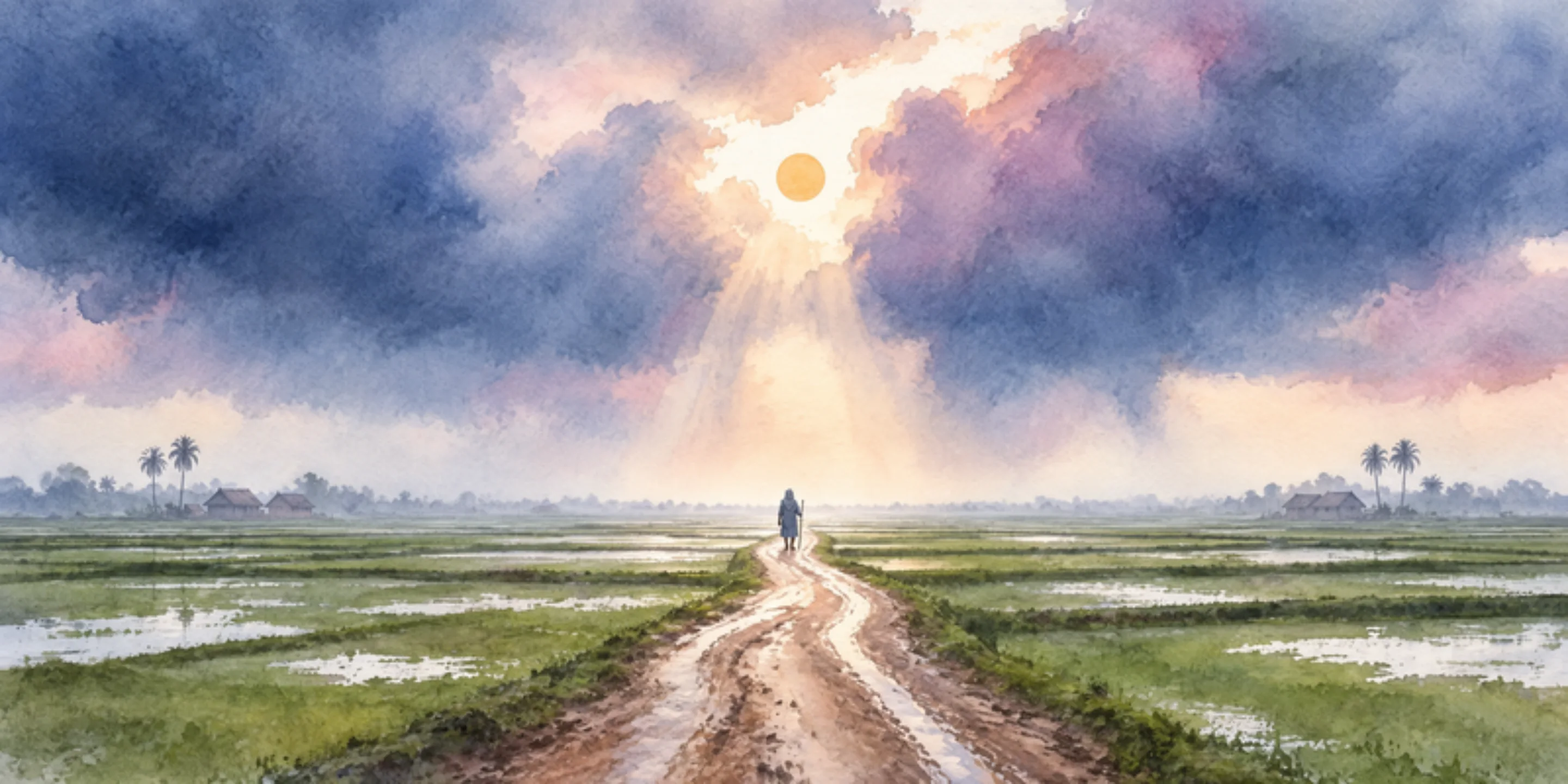
Narada asks how, wandering the earth, he can cross the age of Kali, the age of strife. Brahma answers with the secret of all the Vedas: the mere saying of the Lord's name. The name is the sixteen words of the mantra Hare Rama, Hare Krishna, which remove the covering of the sixteen parts around the individual self, so that the highest Brahman shines, as the sun's disc shines when the clouds part. There is no rule for it: pure or impure, whoever says it is freed at once.
- Crossing the age of Kali
- The name of the Lord
- The sixteen-word mantra
- The covering of the sixteen parts
- No rule, no condition
हरिः ॐ । द्वापरान्ते नारदो ब्रह्माणं जगाम कथं भगवन् गां पर्यटन् कलिं सन्तरेयमिति । स होवाच ब्रह्मा साधु पृष्टोऽस्मि सर्वश्रुतिरहस्यं गोप्यं तच्छृणु येन कलिसंसारं तरिष्यसि । भगवत आदिपुरुषस्य नारायणस्य नामोच्चारणमात्रेण निर्धूतकलिर्भवतीति ॥ १॥
hariḥ oṃ | dvāparānte nārado brahmāṇaṃ jagāma kathaṃ bhagavan gāṃ paryaṭan kaliṃ santareyamiti | sa hovāca brahmā sādhu pṛṣṭo'smi sarvaśrutirahasyaṃ gopyaṃ tacchṛṇu yena kalisaṃsāraṃ tariṣyasi | bhagavata ādipuruṣasya nārāyaṇasya nāmoccāraṇamātreṇa nirdhūtakalirbhavatīti || 1||
Hari Om. At the end of the third age Narada went to Brahma and said: 'Lord, as I wander the earth, how can I cross the age of Kali?' Brahma said: 'You have asked well. Listen to the secret of all the Vedas, which is to be guarded, by which you will cross the round of becoming in the age of Kali. By the mere saying of the name of the Lord Narayana, the first Person, one shakes off Kali.'
Note //
Kali is the last and darkest of the four ages, the age of strife. 'Crossing Kali' is crossing the round of becoming as it is lived in such an age.
नारदः पुनः पप्रच्छ तन्नाम किमिति । स होवाच हिरण्यगर्भः । हरे राम हरे राम राम राम हरे हरे । हरे कृष्ण हरे कृष्ण कृष्ण कृष्ण हरे हरे ॥ इति षोडशकं नाम्नां कलिकल्मषनाशनम् । नातः परतरोपायः सर्ववेदेषु दृश्यते ॥ षोडशकलावृतस्य जीवस्यावरणविनाशनम् । ततः प्रकाशते परं ब्रह्म मेघापाये रविरश्मिमण्डलीवेति ॥ २॥
nāradaḥ punaḥ papraccha tannāma kimiti | sa hovāca hiraṇyagarbhaḥ | hare rāma hare rāma rāma rāma hare hare | hare kṛṣṇa hare kṛṣṇa kṛṣṇa kṛṣṇa hare hare || iti ṣoḍaśakaṃ nāmnāṃ kalikalmaṣanāśanam | nātaḥ parataropāyaḥ sarvavedeṣu dṛśyate || ṣoḍaśakalāvṛtasya jīvasyāvaraṇavināśanam | tataḥ prakāśate paraṃ brahma meghāpāye raviraśmimaṇḍalīveti || 2||
Narada asked again: 'What is that name?' Hiranyagarbha said: 'Hare Rama, Hare Rama, Rama Rama, Hare Hare; Hare Krishna, Hare Krishna, Krishna Krishna, Hare Hare. These sixteen names destroy the stain of Kali. No better means than this is seen in all the Vedas. They destroy the of the individual self, wrapped in the sixteen parts. Then the highest Brahman shines, as the circle of the sun's rays shines when the clouds have gone.'
Note //
Hiranyagarbha is Brahma. 'Hare' is the vocative of Hari or of Hara (Radha, the Lord's power); Rama and Krishna are names of Vishnu. 'The sixteen parts' (kalas) are the components of the person in the Prashna Upanishad (6.4): breath, faith, space, air, fire, water, earth, the senses, mind, food, strength, austerity, mantras, action, the worlds and name. Some editions put the 'Hare Krishna' line first; the edition and Aiyar have this order.
पुनर्नारदः पप्रच्छ भगवन् कोऽस्य विधिरिति । तं होवाच नास्य विधिरिति । सर्वदा शुचिरशुचिर्वा पठन् ब्राह्मणः सलोकतां समीपतां सरूपतां सायुज्यमेति । यदास्य षोडशकस्य सार्धत्रिकोटीर्जपति तदा ब्रह्महत्यां तरति । तरति वीरहत्याम् । स्वर्णस्तेयात् पूतो भवति । वृषलीगमनात् पूतो भवति । पितृदेवमनुष्याणामपकारात् पूतो भवति । सर्वधर्मपरित्यागपापात् सद्यः शुचितामाप्नुयात् । सद्यो मुच्यते सद्यो मुच्यते इत्युपनिषत् ॥ ३॥
punarnāradaḥ papraccha bhagavan ko'sya vidhiriti | taṃ hovāca nāsya vidhiriti | sarvadā śuciraśucirvā paṭhan brāhmaṇaḥ salokatāṃ samīpatāṃ sarūpatāṃ sāyujyameti | yadāsya ṣoḍaśakasya sārdhatrikoṭīrjapati tadā brahmahatyāṃ tarati | tarati vīrahatyām | svarṇasteyāt pūto bhavati | vṛṣalīgamanāt pūto bhavati | pitṛdevamanuṣyāṇāmapakārāt pūto bhavati | sarvadharmaparityāgapāpāt sadyaḥ śucitāmāpnuyāt | sadyo mucyate sadyo mucyate ityupaniṣat || 3||
Narada asked again: 'Lord, what is its rule?' He said: '. Whoever says it always, pure or impure, reaches the Lord's world, his nearness, his likeness, and union with him. When one repeats these sixteen thirty-five million times, one crosses the killing of a Brahmin, crosses the killing of a hero, is cleansed of stealing gold, cleansed of going to a woman outside one's caste, cleansed of wrongs done to ancestors, gods and men. From the wrong of abandoning every duty one becomes pure at once. One is freed at once, freed at once.' Such is the Upanishad.
Note //
Salokya, samipya, sarupya, sayujya: the four kinds of freedom in the devotional schools, living in the Lord's world, near him, in his form, and one with him. In Advaita the last, union, is no reaching but the recognition that there was never a second. The list of great wrongs is the traditional list; the point is that nothing is beyond the reach of what uncovers.
The renderings on this page are shared under CC BY-NC 4.0, in the words of Pranav Ashar.