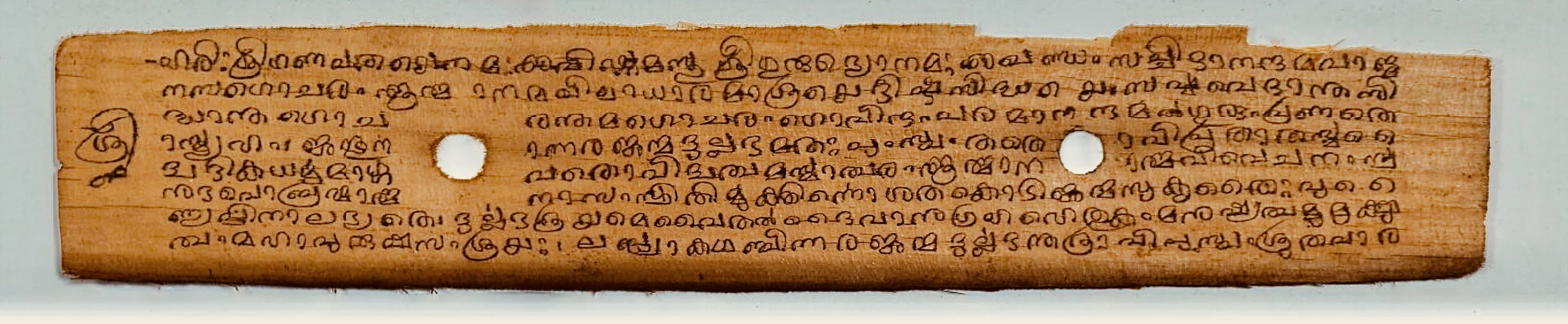
The Upadesha Sahasri, 'a thousand teachings', is the one independent work scholars agree is Shankara's own: three prose chapters and nineteen in verse. The first prose chapter is a teacher's manual. It says whom to teach and how, then stages the teaching: 'Who are you, dear one?' The student answers with his caste and stage of life, and the teacher shows him he has described his body. Then the harder objections: I feel pain; the Veda itself speaks of means and ends. Prose chapter 1 is given here complete; no English translation is in the public domain.
When the student has grasped the marks of the highest Self from the Veda and tradition in this way,
and wants to cross the sea of the round,
he should ask him:
'Who are you, dear one?'
When the student has grasped the marks of the highest Self and wants to cross, the teacher asks: 'Who are you, dear one?'
he should say to him: 'What you said, that when the body is burnt or cut pain is plainly felt as yours, is not so.
Why? Because the pain of burning and cutting is felt in the body, the object, which is being burnt or cut,
as in a tree that is being burnt or cut, by the one who feels it;
so the pain has the same seat as the burning.
Where the burning or cutting is done, there people place the pain of it,
not in the one who feels the burning.
How? Asked "where is your pain?", one says "in my head", "in my chest", "in my belly":
one places it where the burning is, not in the feeler.
If the pain were in the feeler, or the burning and cutting that occasion it,
one would point to the feeler as the seat of the pain, as one points to the seat of the burning.'
Asked 'where is your pain?', one says 'in my head', never 'in the one who feels it': pain has the same seat as the burning.
What most readings miss
The chapter is read for its conclusion, that ritual and caste are to be given up, and the arguments about Shankara and renunciation start there. Read it for its method. The teacher never tells the student what he is. He asks, lets him answer, and shows him that each answer named something else: a lineage, a stage of life, a body that birds will eat. When the student says he feels pain, the teacher does not deny it; he asks where it is, and the student points to his head. Pain has the same seat as the burning. The feeler is never pointed to. That is the site's witness, found by a question anyone can answer; position 9 follows: pain may stay, suffering ends. What is given up at the end, for the site's readers, is the claim, not the life.