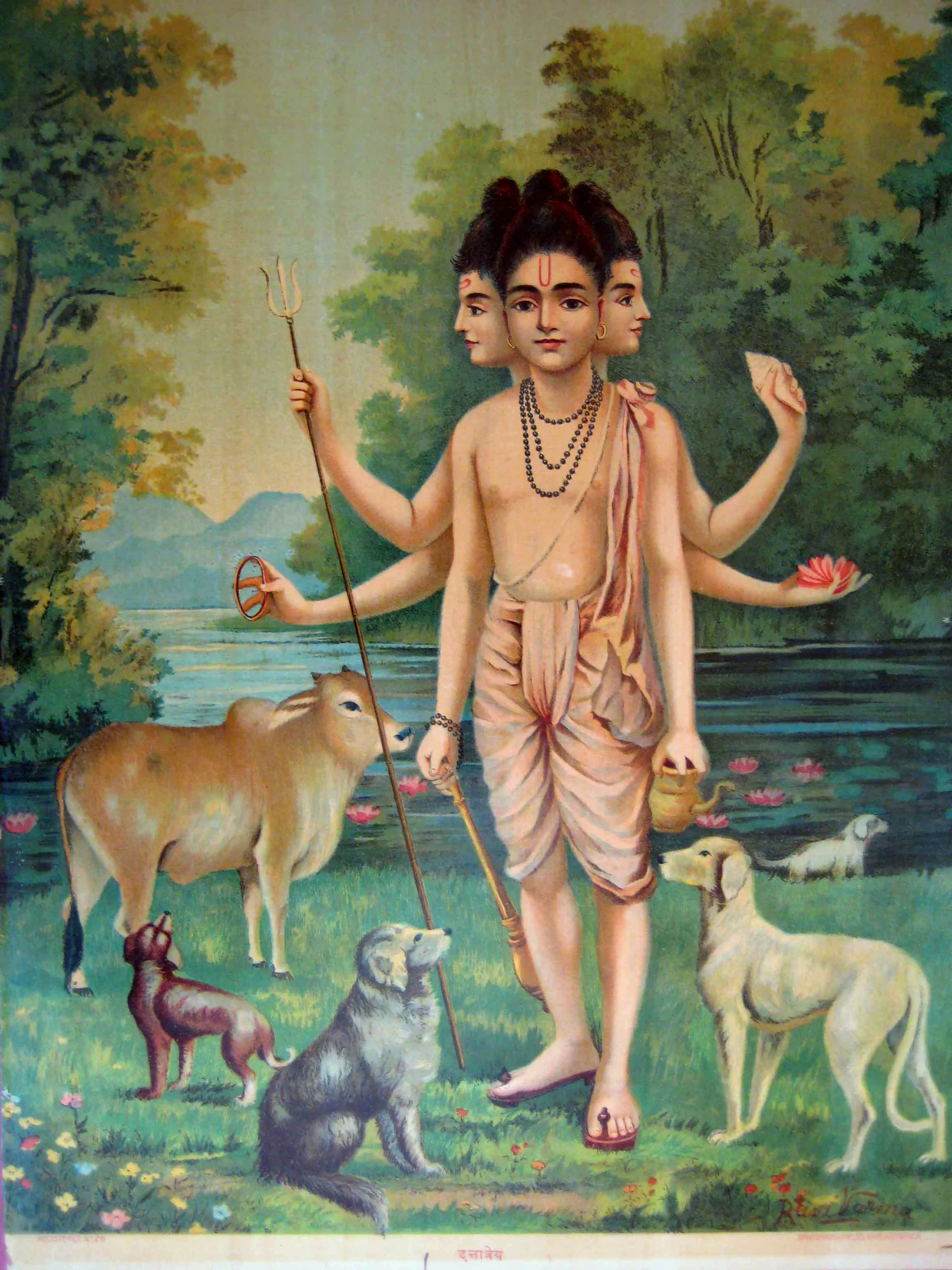
The Avadhuta Gita, the song of the one who has shaken everything off, is a Sanskrit poem of about 290 verses in eight chapters, put in the mouth of Dattatreya, the wandering sage of the Puranas. It has no story and no argument. Verse after verse says the same thing from a new side: you are the Self, the same everywhere, never bound, and every practice, teacher, scripture and state is set aside once this is seen. Chapter 1, its best-known part, is given here complete. No public-domain English translation exists, so the Sanskrit and the rendering stand alone.
Not by the six-limbed yoga is it made pure;
not by the ending of the mind is it made pure;
not by a teacher's instruction is it made pure.
is itself, and awake by itself.
Nothing makes the Self pure, not yoga, not the mind's ending, not a teacher: it is awake by itself.
What most readings miss
The Avadhuta Gita is often read as the Advaita text that goes furthest: no practice, no teacher, no scripture, no fourth state, and so a text that leaves a reader with nothing to do. It does something else. It talks to the mind, in the second person, over and over: why do you cry, child; why do you run like a ghost; friend mind, what is the use of so much talk. The one who has nothing to do is the Self; the one being spoken to is the mind, which still runs, and the speaker keeps it company to the end. That is the whole of it: knowledge ends the mind's claim, not the mind. The denials are a clearing, not a programme. The last verses, with the avadhuta alone in an empty house calling his own words babble, give the tone: nothing left to defend.