Vasishtha
Legendary; the Yoga Vasishtha was composed between about the 6th and 14th centuries CE (scholars disagree) · Ancient India, in legend the court of Ayodhya
Life
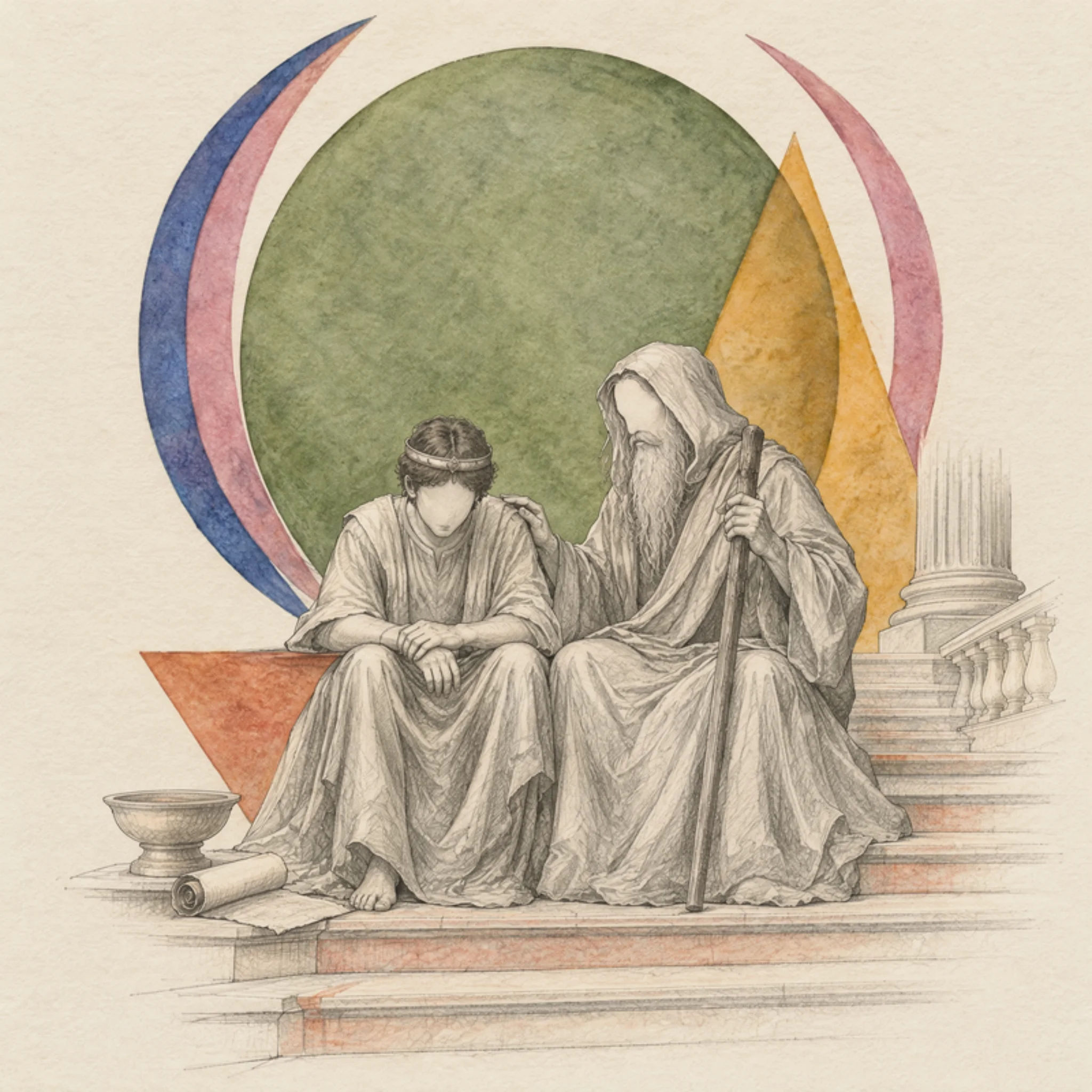
Vasishtha is one of the seven great seers of the Rig Veda, and many hymns of its seventh book are credited to his family. In the epics he is the teacher of the royal house of Ayodhya. The long Sanskrit work called the Yoga Vasishtha puts him in conversation with the prince Rama, who has fallen into that despair. Its date and author are unknown; tradition gives it to Valmiki, while scholars place it anywhere from about the 6th to the 14th century. A shorter Laghu Yoga Vasishtha also circulated.
What they saw
Vasishtha does not tell Rama his despair is wrong. He tells him it is a beginning: turning away from what passes is the first step toward asking what does not.
His answer runs through dozens of stories, worlds inside worlds, dreams inside dreams. A queen named Lila finds whole lifetimes inside the space of a room. The point is always the same. The world appears in awareness the way a dream appears in a sleeper, real as experience, never standing on its own.
Oddly, Vasishtha praises effort. He says a person's own effort shapes what happens, and he wants Rama back on his throne, ruling well. The text's ideal is the one free while living, who governs, eats and talks like anyone else.
In their words
In paraphrase: as the waves are water and the bracelet gold, so the world is awareness appearing. Know this and act; there is nothing to run from.
After the Yoga Vasishtha (Nirvana Prakarana); paraphrase. A public-domain English version is Vihari-Lala Mitra, The Yoga-Vasishtha Maharamayana (1891 to 1899).
Where this path meets the others
Vasishtha's dream-worlds sit close to Gaudapada's, and his statesman free while living looks forward to the Gita's action without attachment. Zhuangzi's butterfly asks the same question from China. See Chop wood, carry water.
Rama went back to his throne.
Works
- Yoga Vasishtha (attributed)c. 6th to 14th century CE (debated)
Further reading
- Vihari-Lala Mitra, The Yoga-Vasishtha Maharamayana, 4 vols. (1891 to 1899)
- Swami Venkatesananda, The Concise Yoga Vasistha (1984; in copyright)
Next on your path
Sources
- Rig Veda, book 7, traditionally the Vasishtha family's book.
- Yoga Vasishtha: date range from the scholarly literature summarised in the general reference works; Mitra's translation (1891 to 1899) for the content, paraphrased.