Vachaspati Mishra
9th or 10th century CE (scholars debate between about 840 and 980) · Mithila, in present-day Bihar
Life
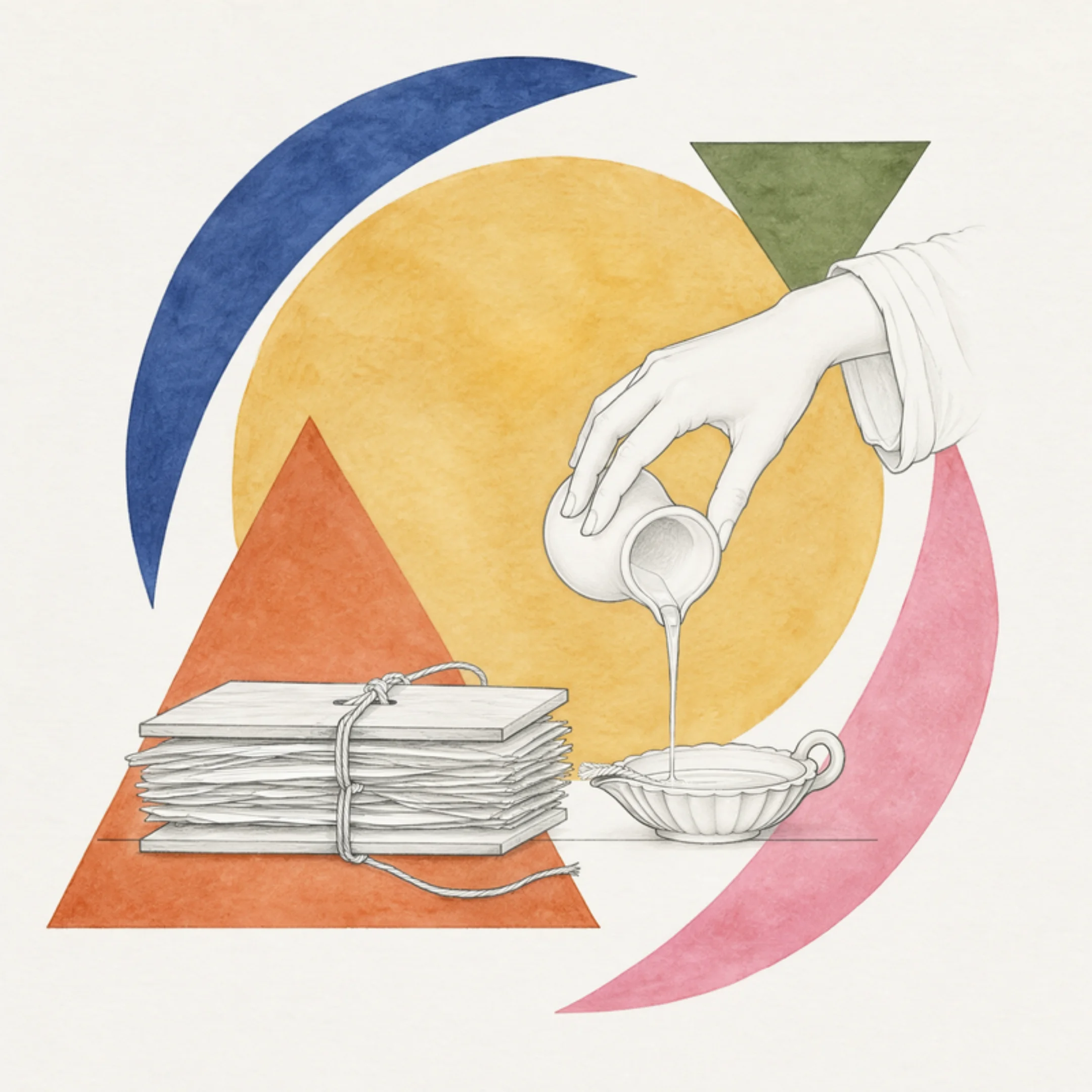
Vachaspati Mishra lived in Mithila and wrote major commentaries on nearly every school of Indian philosophy: Nyaya, Samkhya, Yoga, Mimamsa and Vedanta. His commentary on Shankara's Brahma Sutra commentary is called the Bhamati. A well-known story says he was so absorbed in writing it that he forgot his wife, Bhamati, for years, and when he finished he named the book after her so that her name would last. The story is loved. It cannot be checked.
What they saw
Vachaspati's Advaita is careful about where not-knowing lives. For him it rests in the individual person (jiva), not in the whole; each person has their own not-knowing, which is why one person can be free while another is not. The whole is untouched.
This gave rise to the Bhamati school, one of the two great lines of later Advaita, alongside the Vivarana school that grew from Padmapada. The difference is technical, but the question behind it is simple: if the whole is all there is, where does the mistake happen? In the person, he answered. Never in the whole.
In their words
“For when there is as it were duality, then one sees the other”
Brihadaranyaka Upanishad 4.5.15, tr. Max Müller (1884)
Where this path meets the others
His fairness to every school is the model this site tries to follow: each tradition first in its own terms. His question about where the mistake lives returns in the Meeting with Nisargadatta, who starts from the person's plain sense “I am”.
The mistake lives in the person. The whole is never touched.
Works
- Bhamati (on Shankara's Brahma Sutra commentary)9th or 10th century CE
- Tattva Vaisharadi (on the Yoga Sutras)9th or 10th century CE
- Samkhya Tattva Kaumudi9th or 10th century CE
Further reading
- The Bhamati of Vacaspati on Sankara's Brahmasutrabhasya (Catussutri), tr. S. S. Suryanarayana Sastri and C. Kunhan Raja (1933; in copyright, for further study)
Next on your path
Sources
- Dates: Vachaspati dates his Nyayasucinibandha to a year read either as 841 or 976 CE, depending on the era used; scholars disagree.
- The Bhamati story is traditional.
- Brihadaranyaka Upanishad 4.5.15, in The Upanishads, Part II, tr. F. Max Müller, Sacred Books of the East vol. 15 (Oxford, 1884). Public domain.