Baruch Spinoza
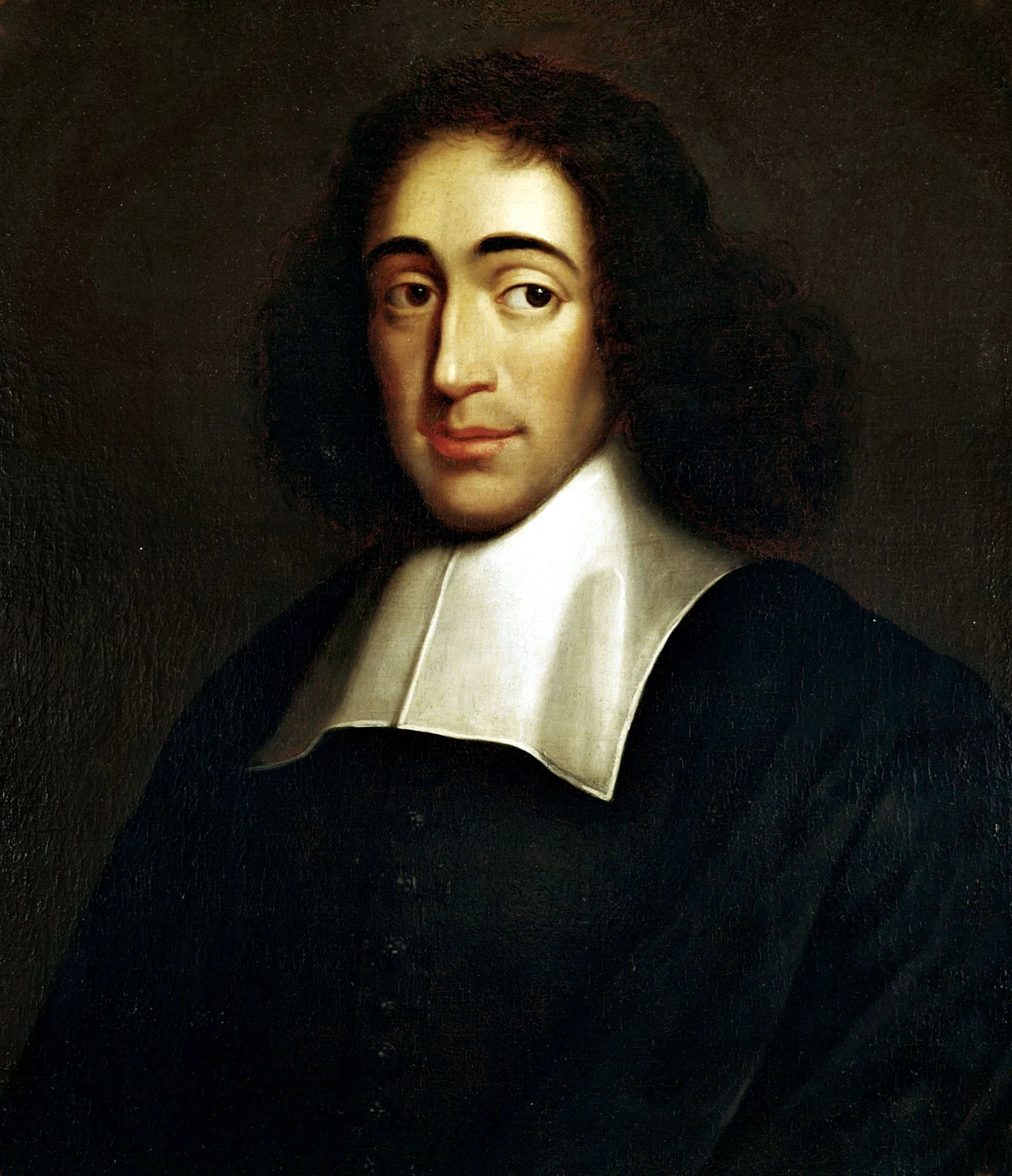
24 November 1632 to 21 February 1677 · Born in Amsterdam; died in The Hague
Life
Spinoza was born in Amsterdam's Portuguese-Jewish community. In 1656, at twenty-three, he was expelled from it for his views, and he never joined another religious community. He lived plainly, grinding lenses for microscopes and telescopes, corresponding with the leading scientists of his day and refusing a professorship at Heidelberg to keep his freedom of thought. He died at forty-four, probably of a lung disease made worse by glass dust. His Ethics, written in the form of geometric proofs, was published after his death in 1677.
What they saw
There can be only one substance: what exists in itself and is conceived through itself. Spinoza calls it God or Nature. It has infinite attributes, of which we know two, thought and extension. Every body and every idea is a mode: a way that one substance is.
This changes what freedom means. We suffer when we are driven by passions that come from confused ideas. As we understand things as they are, following from the nature of the one substance, the passions lose their grip. The highest good is the intellectual love of God: the mind's joy in seeing all things in the one.
In their words
“Whatsoever is, is in God, and without God nothing can be, or be conceived.”
Spinoza, Ethics, Part I, Proposition 15, tr. R. H. M. Elwes (1883)
“By substance, I mean that which is in itself, and is conceived through itself”
Spinoza, Ethics, Part I, Definition 3, tr. R. H. M. Elwes (1883)
Where this path meets the others
His one substance and its modes are close to Advaita's clay and pots, and his freedom through understanding close to freedom through knowledge. He gives extension the same standing as thought, where Advaita gives awareness first place. See Spinoza and Shankara.
Understand the wave, and you are already in the sea.
Works
- Ethicspublished 1677
- Theological-Political Treatise1670
Further reading
- The Chief Works of Benedict de Spinoza, tr. R. H. M. Elwes, 2 vols. (1883 to 1884)
- Steven Nadler, Spinoza: A Life (1999; in copyright)
Next on your path
Sources
- Spinoza, Ethics, tr. R. H. M. Elwes, in The Chief Works of Benedict de Spinoza, vol. 2 (London: George Bell, 1883), Part I, Def. 3 and Prop. 15; checked against Project Gutenberg ebook 3800. Public domain.
- Biography: Steven Nadler, Spinoza: A Life (1999). Heidelberg offer: 1673. Cause of death uncertain.