Arthur Schopenhauer
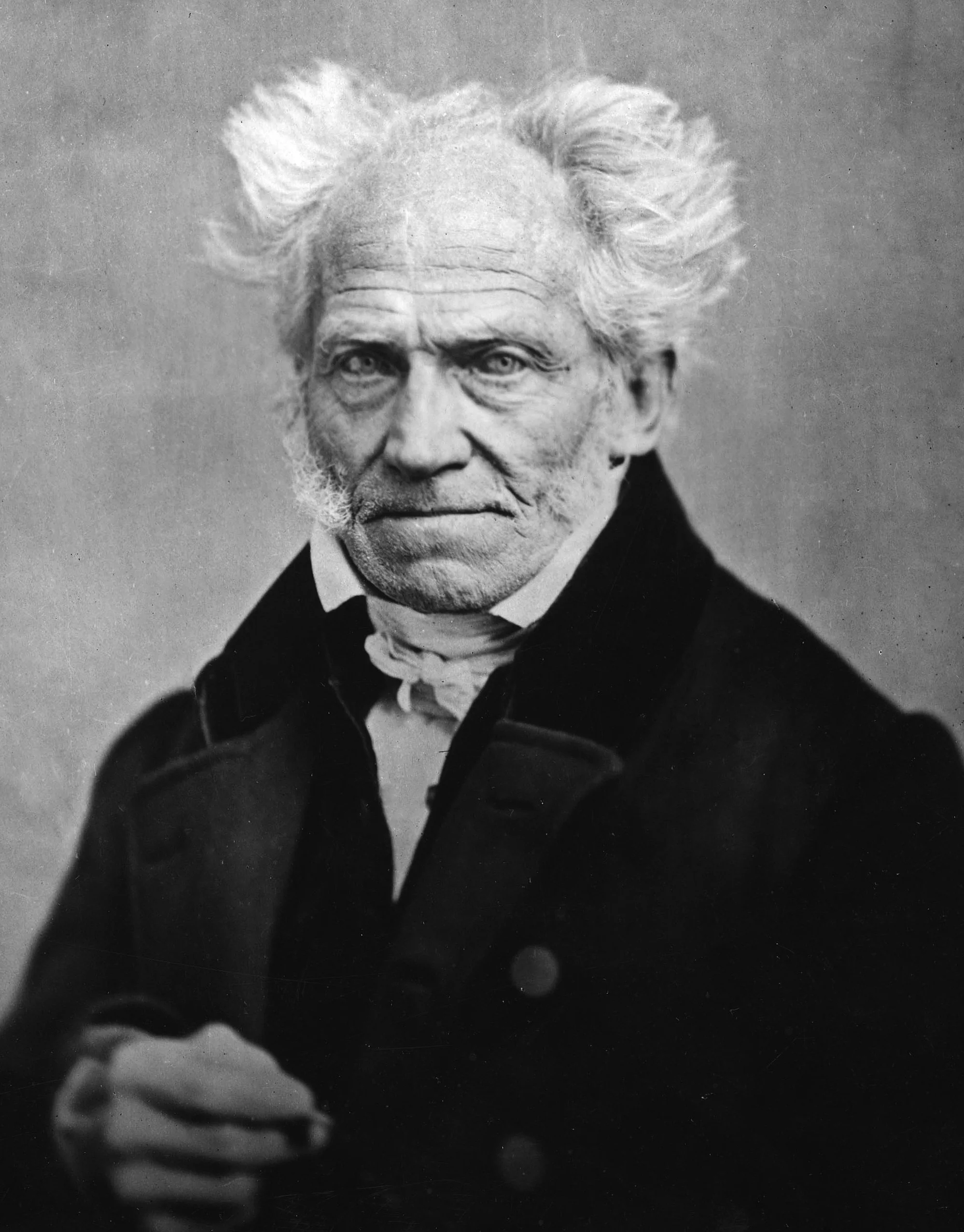
22 February 1788 to 21 September 1860 · Born in Danzig (Gdańsk); lived mostly in Frankfurt
Life
Schopenhauer was the son of a wealthy Danzig merchant and a novelist mother. As a young man in Weimar, around 1813 to 1814, he was introduced to Indian thought and read the Oupnek'hat, a Latin translation by Anquetil-Duperron of a Persian version of fifty Upanishads made for the Mughal prince Dara Shikoh. It stayed on his desk for life. His main work, The World as Will and Idea, appeared at the end of 1818 and was ignored for decades. He lived quietly in Frankfurt and became famous only in his last years.
What they saw
The world, he said, is first of all my idea: everything I know is known as an object for a subject. But behind the idea there is something else, which we know from inside ourselves: will, a blind, endless striving. The same will is in every being. The many are its appearances, divided by space and time.
Since willing is endless, life is suffering. The way out is to see through the division: in compassion, where another's pain is felt as one's own, and finally in the quieting of the will, which he compared to the saints of India and Europe.
In their words
“‘The world is my idea:’—this is a truth which holds good for everything that lives and knows”
Schopenhauer, The World as Will and Idea, vol. 1, §1, tr. R. B. Haldane and J. Kemp (1883)
access to the Vedas through the Upanishads is “the greatest advantage which this still young century enjoys over previous ones.”
Schopenhauer, The World as Will and Idea, Preface to the first edition, tr. R. B. Haldane and J. Kemp (1883)
Where this path meets the others
His world as idea is close to Advaita's world as appearance, and his compassion close to seeing the Self in all. But his inner reality is will, not awareness, and his last word is the stilling of will, not the recognition of a fullness. See Schopenhauer and the Upanishads.
The same will strives in every being; compassion is seeing that.
Works
- The World as Will and Representation (The World as Will and Idea)1818; enlarged 1844
- Parerga and Paralipomena1851
Further reading
- The World as Will and Idea, tr. R. B. Haldane and J. Kemp, 3 vols. (1883 to 1886)
Next on your path
Sources
- The World as Will and Idea, vol. 1, tr. R. B. Haldane and J. Kemp (London: Trübner, 1883), Preface to the first edition and §1; checked against Project Gutenberg ebook 38427. Public domain.
- Oupnek'hat, tr. A. H. Anquetil-Duperron (Strasbourg, 1801 to 1802), from Dara Shikoh's Persian Sirr-i Akbar (1657). Schopenhauer's first reading of it is usually dated to 1814.
- First edition dated 1819 on the title page; published December 1818.