Socrates
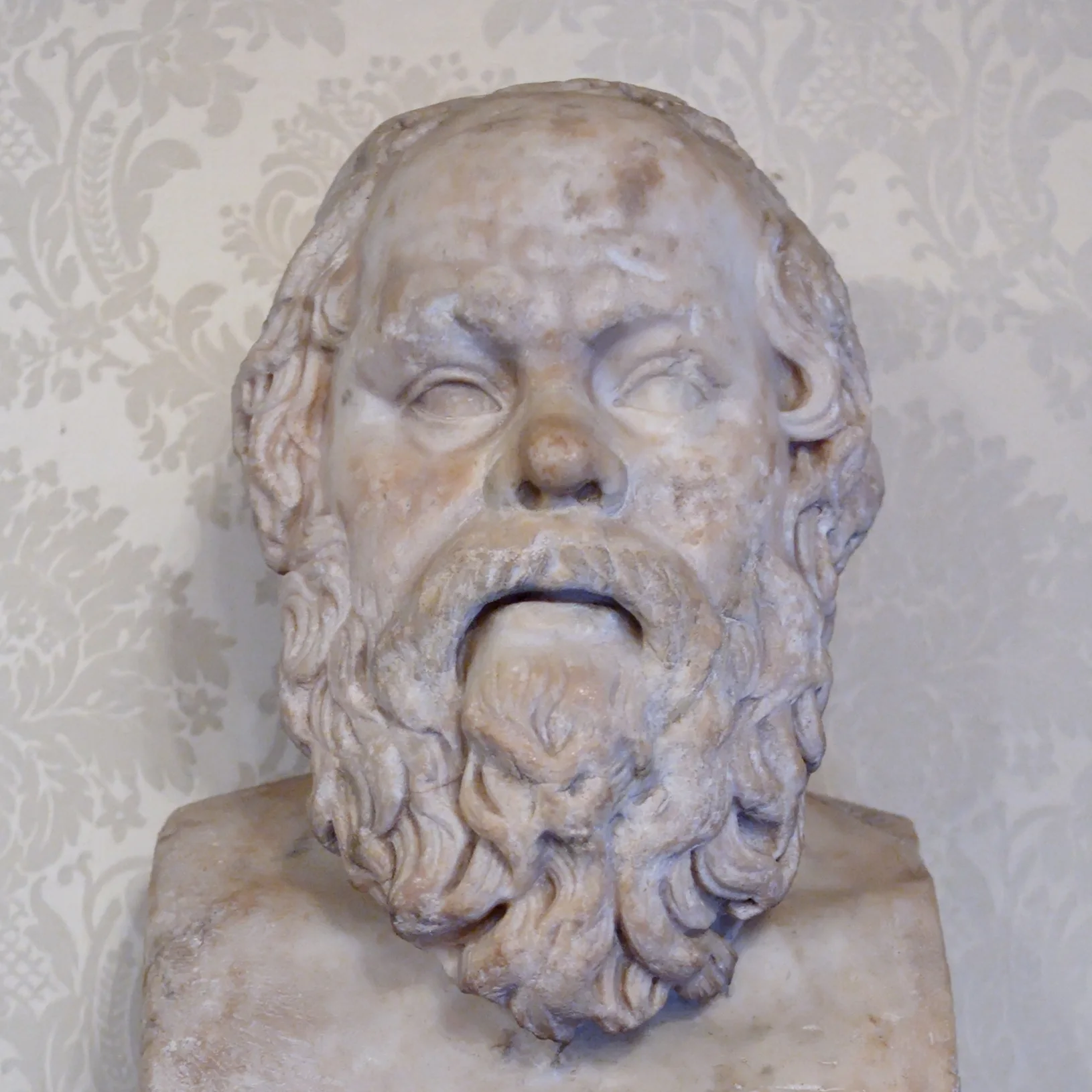
About 470 to 399 BCE · Athens
Life
Socrates wrote nothing. We know him from his students, mostly Plato and Xenophon, and from the comic playwright Aristophanes, who mocked him. He served as a soldier, married Xanthippe and had three sons. His days went to conversation. The oracle at Delphi said no one was wiser; he decided this meant he alone knew he knew nothing. In 399 BCE Athens tried him for impiety and corrupting the young. He was condemned and drank hemlock in prison, talking philosophy to the end.
What they saw
Socrates' method was the question. Ask someone what justice or courage is; examine the answer; find where it fails; ask again. People came away annoyed, or changed.
At his trial he said that he would not stop asking, even to save his life, because a life without such examination is not worth living for a human being. He had an inner voice, his daimonion, which only ever told him what not to do.
His “know thyself”, the old Delphic motto he made his own, is not yet the Upanishads' Self. But the turning of every question back on the one asking is the same movement as inquiry, two centuries before Shankara.
In their words
“…the life which is unexamined is not worth living.”
Plato, Apology 38a, tr. Jowett (1871; 2nd ed. 1875)
Where this path meets the others
Socrates and the Upanishads sets his questioning beside Yajnavalkya's. See Inquiry and Plato.
Ask again.
Further reading
- Plato, Apology, Crito and Phaedo, tr. Jowett (1871)
- Xenophon, Memorabilia
Next on your path
Sources
- Plato, Apology 38a, tr. Jowett (1871; 2nd ed. 1875).
- Benjamin Jowett, The Dialogues of Plato (Oxford, 1871; 3rd ed. 1892). Public domain.
- The oracle and the daimonion: Apology 21a and 31d, paraphrased.