Plato
About 428 to 348 BCE · Athens; the Academy
Life
Plato was born into a leading Athenian family. He followed Socrates as a young man and, after Socrates' execution in 399 BCE, left Athens for some years. He travelled in Italy and Sicily, where he tried and failed to guide the rulers of Syracuse. Around 387 BCE he founded the Academy outside Athens, where Aristotle studied for twenty years. He wrote some thirty dialogues, nearly all with Socrates as the main speaker. He died in Athens about 348 BCE.
What they saw
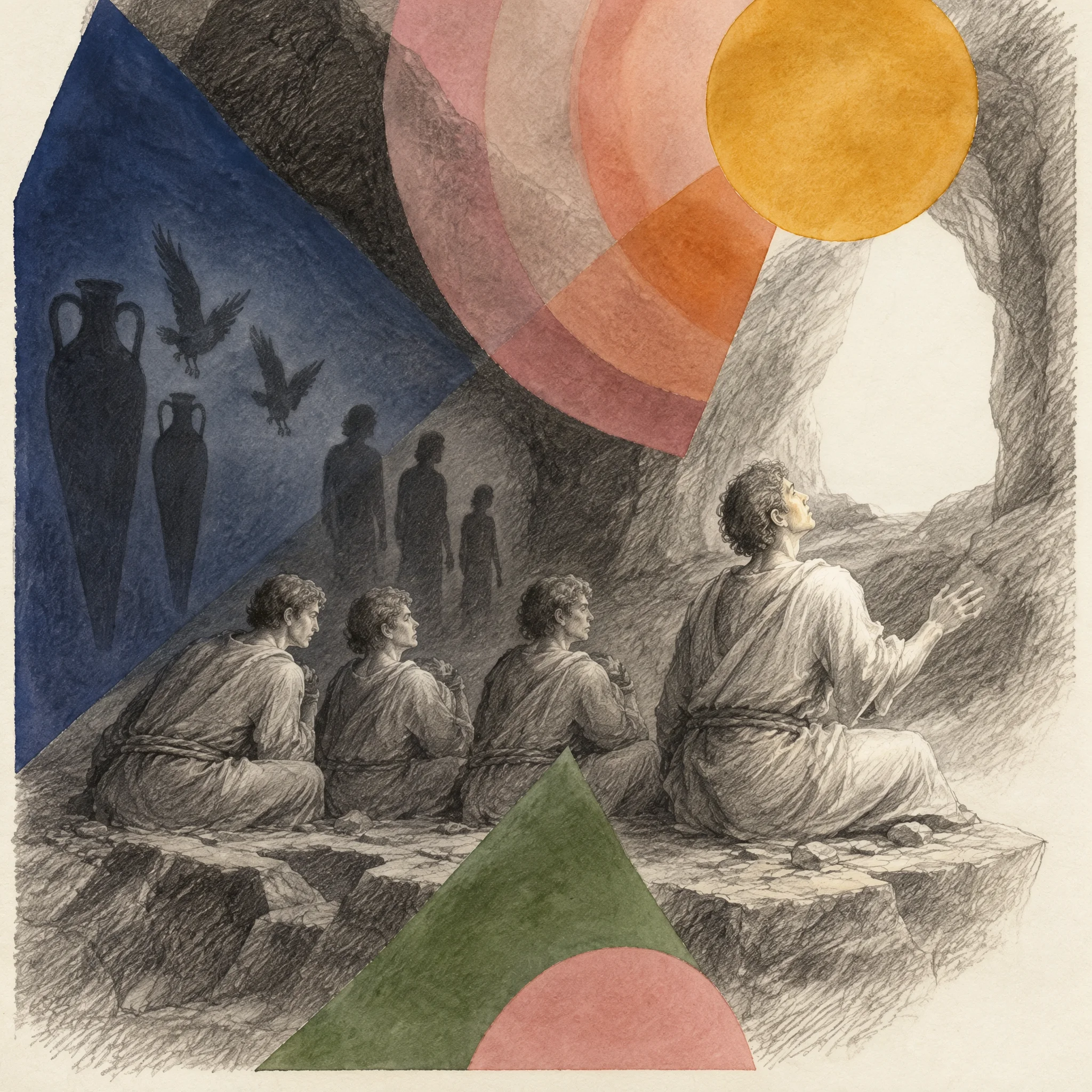
The cave, in Book VII of the Republic, is Plato's picture of learning. Most people take the shadows as real. The freed prisoner sees the fire and the objects, then, painfully, the world outside, and last the sun, which makes everything visible and alive. Back in the cave, his eyes no longer used to the dark, he is laughed at.
The things we see change and pass; the forms they share (beauty itself, justice itself) do not. The highest of all, the Good, is like the sun: the source of being and of knowing.
We read the cave beside Advaita's appearance. The shadows are actually seen and are never on their own. Plato keeps a ladder of levels; Advaita says the sun was in the cave too.
In their words
“…let me show in a figure how far our nature is enlightened or unenlightened.”
Plato, Republic VII, 514a, tr. Jowett
Where this path meets the others
The cave is set beside appearance in Plato's cave and appearance. Plotinus took Plato's Good further, toward the One. See Plotinus and What is real?
Turn round. Then walk out.
Works
- Republicc. 375 BCE
- Symposiumc. 385 to 370 BCE
- Phaedoc. 380s BCE
- Apologyc. 399 to 390 BCE
Further reading
- Plato, Republic, tr. Jowett (1871)
- Plato, Symposium and Phaedrus, tr. Jowett
Next on your path
Sources
- Plato, Republic 514a to 520a, tr. Jowett; the quoted words are 514a.
- Benjamin Jowett, The Dialogues of Plato (Oxford, 1871; 3rd ed. 1892). Public domain.
- Life: Diogenes Laertius, Lives of the Eminent Philosophers, book 3, and the Seventh Letter (authenticity debated), paraphrased.