Erwin Schrödinger
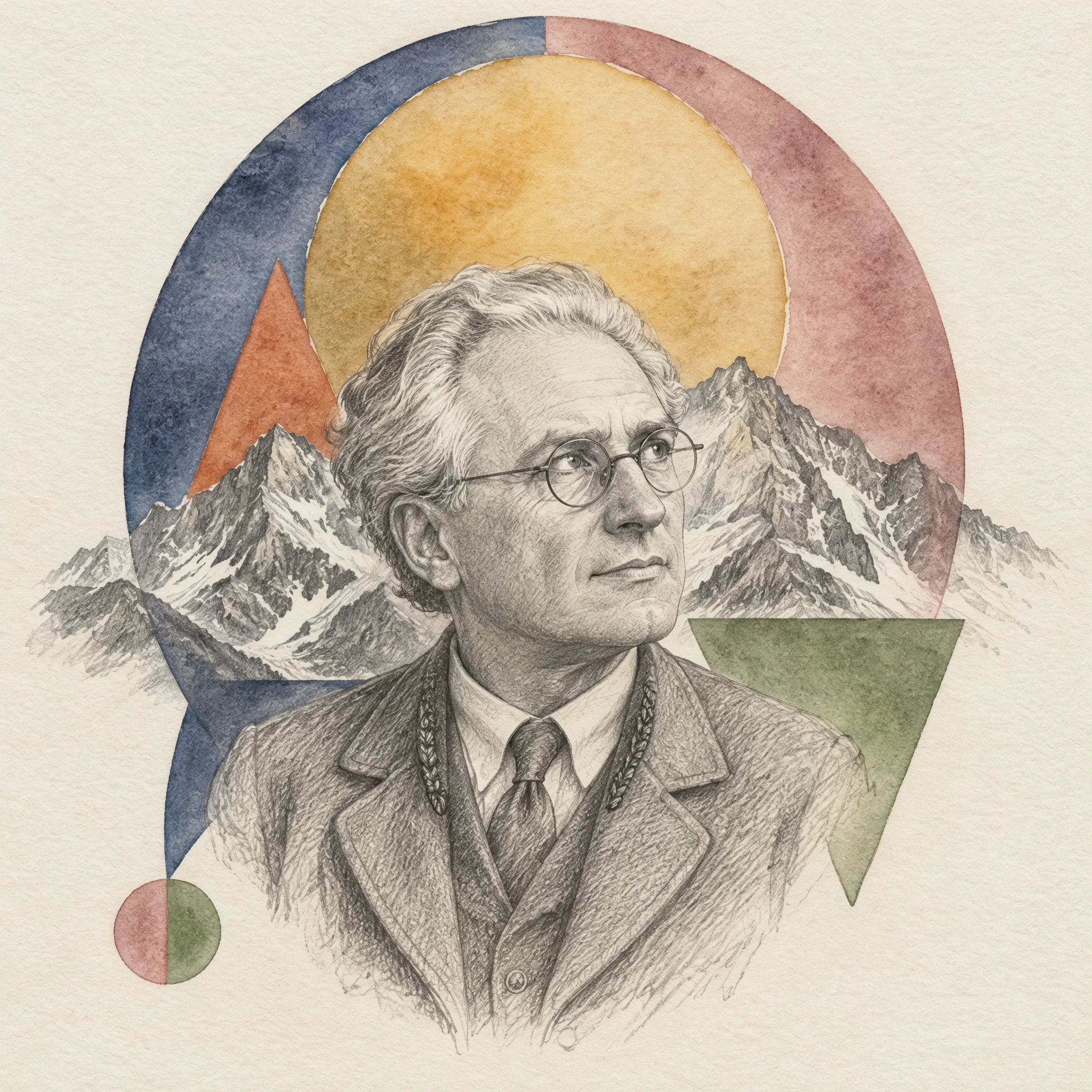
12 August 1887 to 4 January 1961 · Born in Vienna; worked in Zurich, Berlin, Dublin and Vienna
Life
Schrödinger was an Austrian physicist. In 1926 he wrote the wave equation at the heart of quantum mechanics, and he shared the Nobel Prize in Physics in 1933. He left Germany after the Nazis came to power and spent the war years at the Dublin Institute for Advanced Studies, where in 1943 he gave the lectures published as What Is Life? (1944), which influenced the discovery of DNA's structure. He read Vedanta from about 1918 and returned to it in his later writings, especially Mind and Matter (1958) and My View of the World (written 1925 and 1960).
What they saw
Physics, Schrödinger noticed, works by leaving the knower out of the picture it builds. That is its strength and its blind spot: the mind that makes the picture never appears in it.
He concluded, explicitly from the Upanishads, that the mind that knows is not many but one. Each of us feels like a separate mind. The plurality is only apparent. In the epilogue of What Is Life? he summed up the Upanishads' teaching in a single equation of two words: Atman equals Brahman.
In their words
In paraphrase: the plurality of minds is only apparent; in truth there is only one mind. That is the teaching of the Upanishads.
After Erwin Schrödinger, What Is Life? (1944), epilogue, and Mind and Matter (1958); paraphrase, not a quotation (in copyright)
Where this path meets the others
No scientist here comes closer to Advaita. He speaks of “consciousness” and “mind” where we would say awareness, and he reached the view by reading as much as by physics. See The Science of Being and Who am I?
Many people say “I”. There may be only one saying it.
Works
- What Is Life?1944
- Mind and Matter1958
- My View of the WorldGerman 1961; English 1964
Further reading
- Erwin Schrödinger, What Is Life? (1944; in copyright)
- Erwin Schrödinger, Mind and Matter (1958; in copyright)
- Erwin Schrödinger, My View of the World (1961; in copyright)
Next on your path
Sources
- Erwin Schrödinger, What Is Life? (Cambridge University Press, 1944), epilogue “On Determinism and Free Will” (the phrase ATMAN = BRAHMAN); Mind and Matter (1958), chapter 4. In copyright; paraphrased.
- Nobel Prize in Physics 1933, shared with Paul Dirac.