David Bohm
20 December 1917 to 27 October 1992 · Born in Wilkes-Barre, Pennsylvania; worked in the United States, Brazil, Israel and London
Life
David Bohm studied with J. Robert Oppenheimer at Berkeley, became a leading quantum physicist, and in 1949 refused to testify against colleagues before the House Un-American Activities Committee. He lost his post at Princeton and left the United States, eventually settling at Birkbeck College, London. In 1952 he reinterpreted quantum mechanics. From 1961 he met and talked with J. Krishnamurti for a quarter of a century; their dialogues were published as The Ending of Time (1985). His main book on his own view is Wholeness and the Implicate Order (1980).
What they saw
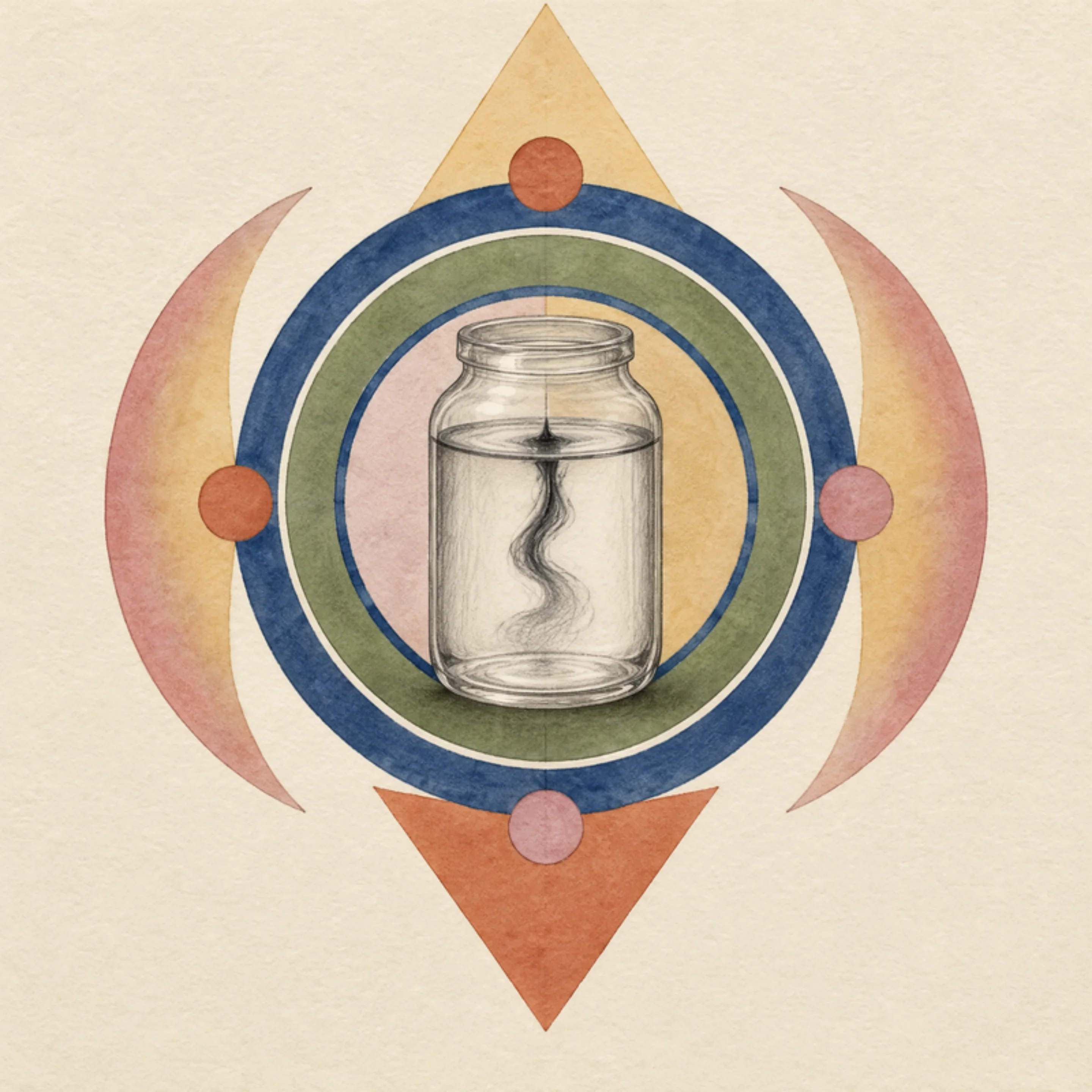
Bohm thought physics had taken the world apart into separate pieces and forgotten that the separation was its own method. Underneath, he proposed, is an unbroken wholeness. He called it the implicate order: everything enfolded in everything else. The separate things we see are unfolded from it, like the ink drop reappearing as the jar turns back.
He thought thought itself works the same way: it divides, and then forgets that it did the dividing. On that point he met Krishnamurti.
In their words
In paraphrase: wholeness comes first; separate things are relatively stable forms unfolded from an undivided whole.
After David Bohm, Wholeness and the Implicate Order (1980); paraphrase, not a quotation (in copyright)
Where this path meets the others
His undivided whole is close to Advaita's whole, and his account of thought dividing the world close to the I-claim. He speaks as a physicist of order and movement, not of awareness as what one is. See Advaita and Krishnamurti.
Thought divides, then forgets it did the dividing.
Works
- Wholeness and the Implicate Order1980
Further reading
- David Bohm, Wholeness and the Implicate Order (1980; in copyright)
- J. Krishnamurti and David Bohm, The Ending of Time (1985; in copyright)
Next on your path
Sources
- David Bohm, Wholeness and the Implicate Order (London: Routledge, 1980), including the ink-in-glycerine example; paraphrased.
- Biography: F. David Peat, Infinite Potential: The Life and Times of David Bohm (1997). HUAC appearance 1949; Birkbeck from 1961.