J. Krishnamurti
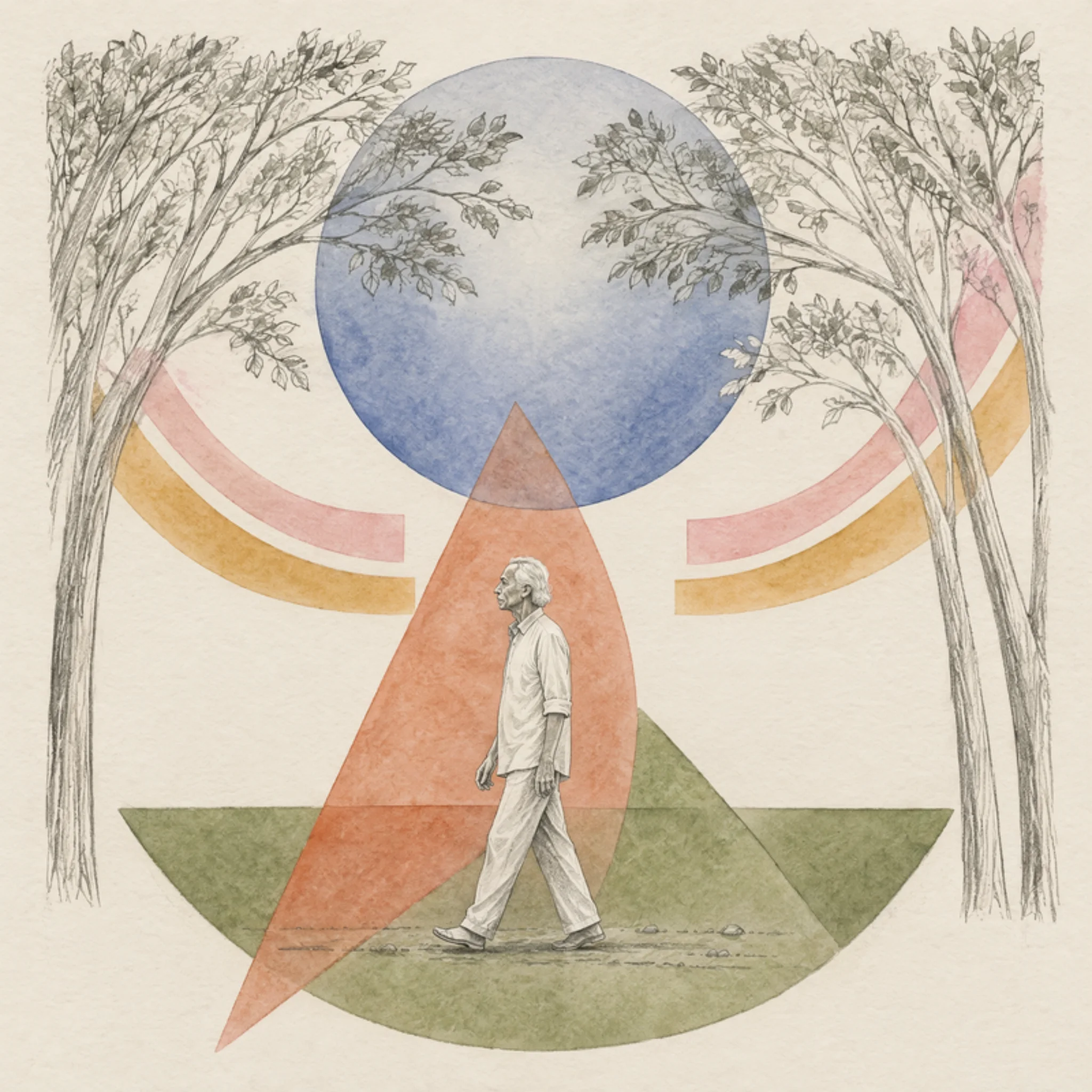
11 May 1895 to 17 February 1986 · Born in Madanapalle, Andhra Pradesh; lived in India, England and Ojai, California
Life
Jiddu Krishnamurti was born in Madanapalle in 1895. As a boy he was taken up by the Theosophical Society, which raised him in England to be a coming world teacher and built an organisation, the Order of the Star in the East, around him. In 1929 he dissolved it, saying that truth cannot be organised. For nearly sixty years after that he spoke and held dialogues around the world, founded schools in India, England and the United States, and talked at length with the physicist David Bohm. He died in Ojai, California, in 1986.
What they saw
Krishnamurti said that the mind is its contents: memory, fear, desire, the known. What we call “me” is made of these, and so is the one who tries to change them. When I watch my anger, the watcher is just more thought, splitting itself in two. His phrase: “the observer is the observed”.
Freedom, for him, does not come through a method, a teacher or time. It comes in seeing what is, now. The observer does no choosing. Such seeing is a kind of total attention, and in it the conflict between “me” and “my anger” ends.
In their words
In paraphrase: truth cannot be reached by any path, religion or organisation, and no one can lead another to it.
After J. Krishnamurti, talk dissolving the Order of the Star, Ommen, 3 August 1929; paraphrase, not a quotation
Where this path meets the others
Advaita agrees with him completely about the observer: it is the I-claim posing as a watcher. Advaita keeps something he does not name: the witness: no watcher at all, only the presence in which all states, the observer included, are known. See the Meeting Advaita and Krishnamurti.
The watcher you try to improve yourself with is more of the same.
Works
- The First and Last Freedom1954
- Freedom from the Known1969
- Krishnamurti's Notebook1976
- The Ending of Time (with David Bohm)1985
Further reading
- Freedom from the Known (1969; in copyright)
- The First and Last Freedom (1954; in copyright)
- J. Krishnamurti and David Bohm, The Ending of Time (1985; in copyright)
Next on your path
Sources
- Biography: Mary Lutyens, Krishnamurti: The Years of Awakening (1975) and later volumes.
- Dissolution talk, Ommen, 3 August 1929 (in copyright): paraphrased.
- “The observer is the observed” (the one short phrase quoted on this page) is found throughout his talks, e.g. Freedom from the Known (1969). His works are in copyright and are otherwise paraphrased.