F. W. J. Schelling
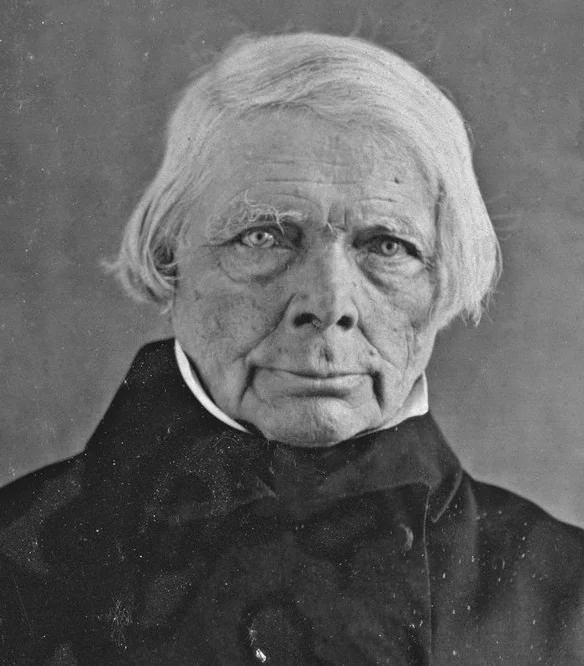
27 January 1775 to 20 August 1854 · Born at Leonberg, Württemberg; taught at Jena, Würzburg, Munich and Berlin; died at Bad Ragaz, Switzerland
Life
Friedrich Wilhelm Joseph Schelling entered the Tübingen seminary at fifteen, where he shared rooms with Hegel and the poet Hölderlin. By twenty-three he was a professor at Jena, at the centre of German Romanticism. His philosophy of nature and his System of Transcendental Idealism (1800) were widely read. He later fell out with Hegel, who criticised him in print, and spent decades working on a late philosophy he rarely published. He was called to Berlin in 1841 to answer Hegel's influence. He died in Switzerland in 1854.
What they saw
Schelling refused to split mind from nature. Nature, he said, is spirit that has not yet become aware of itself; mind is nature that has. One reality appears both ways. In his philosophy of identity he called this the Absolute, in which subject and object are one.
Hegel mocked this Absolute as the night in which all cows are black, a sameness that explains nothing. Schelling's later work took the challenge seriously and asked why there is anything at all.
His identity of subject and object comes within a step of not two. His generation was the first in Germany to read the Upanishads, in Anquetil-Duperron's Latin version (1801 to 1802).
In their words
Die Natur soll der sichtbare Geist, der Geist die unsichtbare Natur sein. Plain rendering: Nature should be mind made visible, and mind invisible nature.
F. W. J. Schelling, Ideas for a Philosophy of Nature (1797), introduction; German original with a rendering made for notdual.org (draft)
Where this path meets the others
Schelling's identity of mind and nature is the German Romantic face of not two; Hegel's answer is on the next page. See Hegel and Schopenhauer and the Upanishads.
Nature is mind you can see.
Works
- Ideas for a Philosophy of Nature1797
- System of Transcendental Idealism1800
Further reading
- Schelling, Ideas for a Philosophy of Nature, tr. Errol E. Harris and Peter Heath (1988; in copyright)
- Andrew Bowie, Schelling and Modern European Philosophy (1993; in copyright)
Next on your path
Sources
- Bowie (1993), for the life and ideas, paraphrased.
- Schelling, Ideen zu einer Philosophie der Natur (1797), introduction; the German sentence is widely cited (check against the original edition).
- Hegel's “night in which all cows are black”: Phenomenology of Spirit (1807), preface, paraphrased.