G. W. F. Hegel
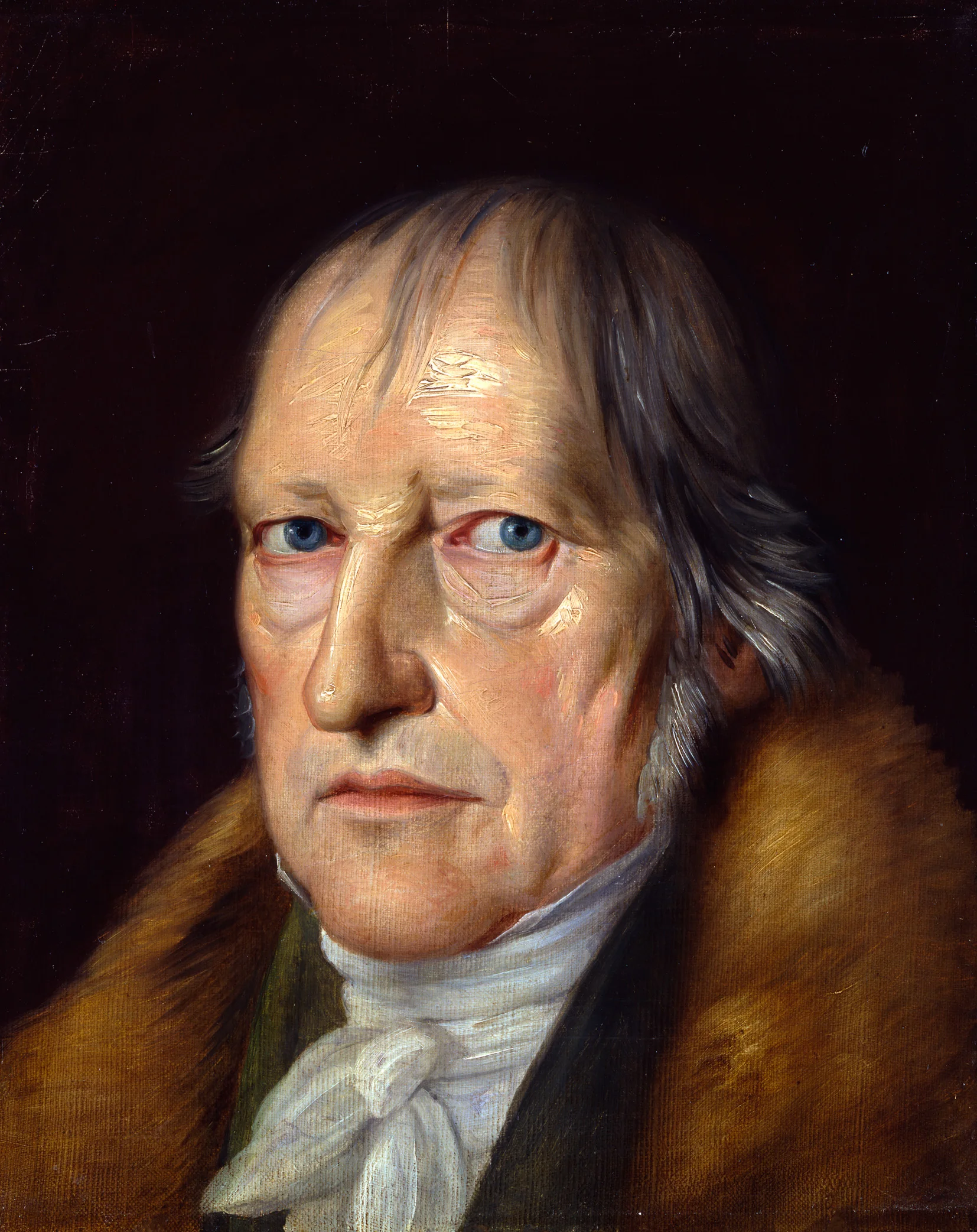
27 August 1770 to 14 November 1831 · Born in Stuttgart; taught at Jena, Heidelberg and Berlin; died in Berlin
Life
Georg Wilhelm Friedrich Hegel studied theology at Tübingen with Schelling and Hölderlin, worked as a private tutor, and lectured at Jena, where he finished The Phenomenology of Spirit in 1806 (published 1807). He then edited a newspaper, ran a school in Nuremberg, and became professor at Heidelberg and, from 1818, at Berlin, where he was the most influential philosopher in Germany. He died in 1831. Cholera was blamed.
What they saw
Hegel's whole aim was to understand reality as one living whole, which he called spirit (Geist). The whole is not given at once. It comes to know itself by going through every stage: sense, perception, self-consciousness, society, art, religion, philosophy. Each stage contradicts itself and is taken up into a fuller one.
His quarrel with Schelling turned on this. An Absolute in which all differences merely vanish, he said, is empty. The truth is the whole, and the whole includes its own long becoming.
He knew Indian thought only from early and partial sources and judged it harshly. Yet his whole, which contains every part and has nothing outside it, is close to Brahman; the question is whether the becoming is real at the highest level, which Advaita denies.
In their words
Das Wahre ist das Ganze. Plain rendering: The true is the whole.
G. W. F. Hegel, The Phenomenology of Spirit (1807), preface, §20; German original with a rendering made for notdual.org (draft). Compare J. B. Baillie's translation (1910).
Where this path meets the others
Hegel's whole that becomes is the West's sharpest alternative to Advaita's whole that does not change. See Schelling and Bradley and Shankara.
The true is the whole.
Works
- The Phenomenology of Spirit1807
- Science of Logic1812 to 1816
- Encyclopaedia of the Philosophical Sciences1817; revised 1827 and 1830
Further reading
- Hegel, The Phenomenology of Mind, tr. J. B. Baillie (1910)
- Terry Pinkard, Hegel: A Biography (2000; in copyright)
Next on your path
Sources
- Pinkard (2000), for the life and the Napoleon letter (to Niethammer, 13 October 1806), paraphrased.
- Phenomenology, preface, §20 and §16 (the cows), paraphrased; Baillie's translation (1910) is public domain.
- Hegel on India: Lectures on the Philosophy of History, paraphrased.