Isaac Newton
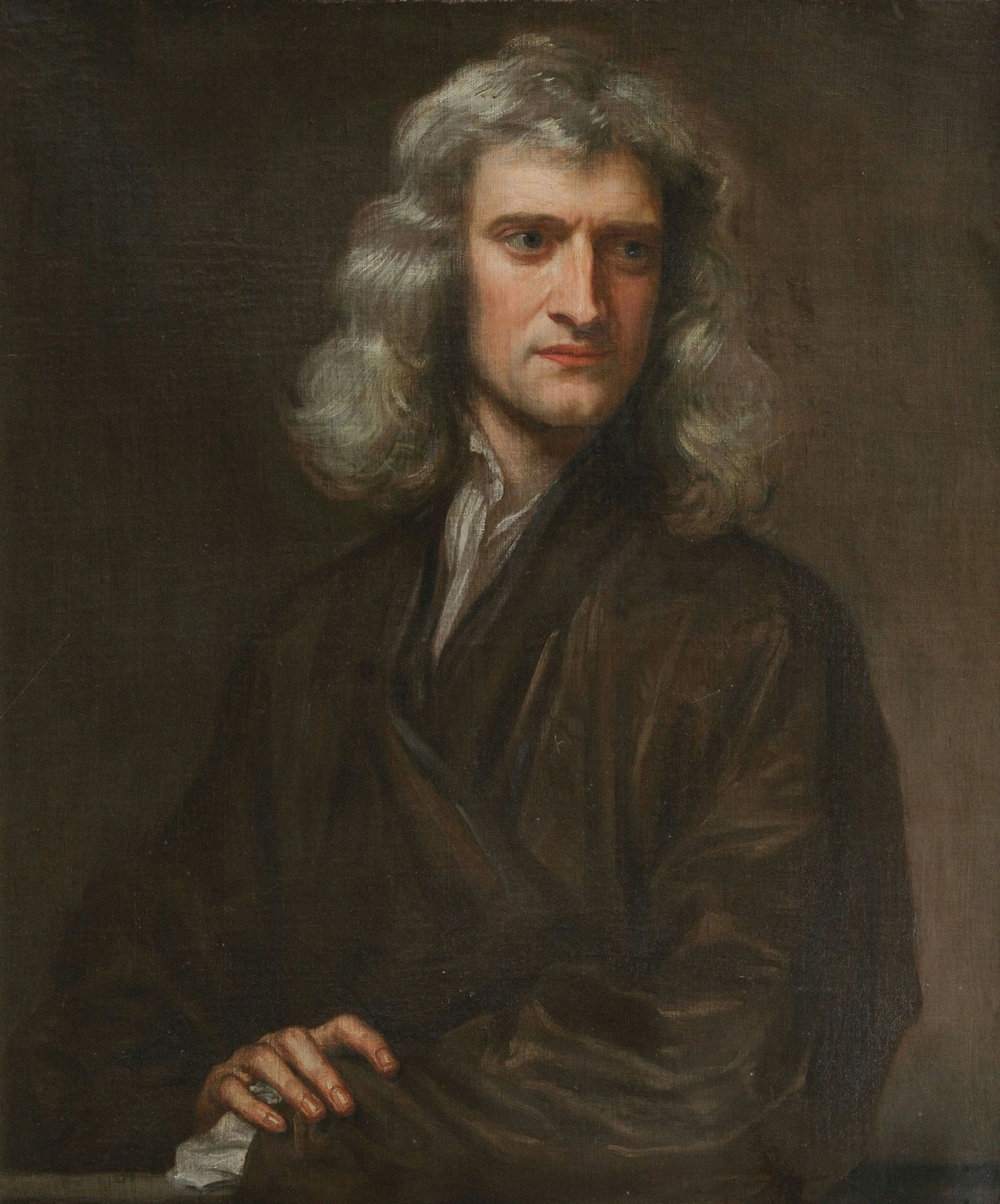
25 December 1642 to 20 March 1727 (Old Style dates; 4 January 1643 to 31 March 1727 New Style) · Born at Woolsthorpe, Lincolnshire; worked in Cambridge and London
Life
Newton was born in rural Lincolnshire and studied at Trinity College, Cambridge, where he later held the Lucasian chair of mathematics. In 1687 came the Principia (Mathematical Principles of Natural Philosophy). It set out the laws of motion and universal gravitation. He also did foundational work on light and colour, and invented calculus at the same time as Leibniz. Later he ran the Royal Mint. He also presided over the Royal Society. He wrote at least as much on theology and alchemy as on physics.
What they saw
Newton's great discovery was unity of law: the same few principles govern the fall of a stone, the tides and the orbits of the planets. The universe is one ordered system.
He himself drew a theological conclusion. In the General Scholium added to the Principia in 1713, he wrote that so beautiful a system could only come from an intelligent and mighty being, who is not space and time but is present everywhere and always. For Newton this was the God of the Bible, the Lord of creation.
In their words
“He is not Eternity and Infinity, but Eternal and Infinite; he is not Duration and Space, but he endures and is present.”
Newton, Principia, General Scholium (1713), tr. Andrew Motte (1729)
Where this path meets the others
As our reading: Newton's one lawful system is close to what Advaita calls the order (Ishvara), the intelligence of the whole. Newton, however, sees a Creator distinct from creation, where Advaita sees the order as the whole itself, appearing as law. See The Science of Being.
One law for the apple and the moon: the order is one.
Works
- Philosophiae Naturalis Principia Mathematica1687
- Opticks1704
Further reading
- Newton, The Mathematical Principles of Natural Philosophy, tr. Andrew Motte (1729)
- Richard S. Westfall, Never at Rest (1980; in copyright)
Next on your path
Sources
- Newton, Principia, General Scholium (added to the 2nd edition, 1713), tr. Andrew Motte (London, 1729); checked against the Newton Project text at isaac-newton.org. Public domain.
- Biography: Richard S. Westfall, Never at Rest (1980).