Gottfried Wilhelm Leibniz
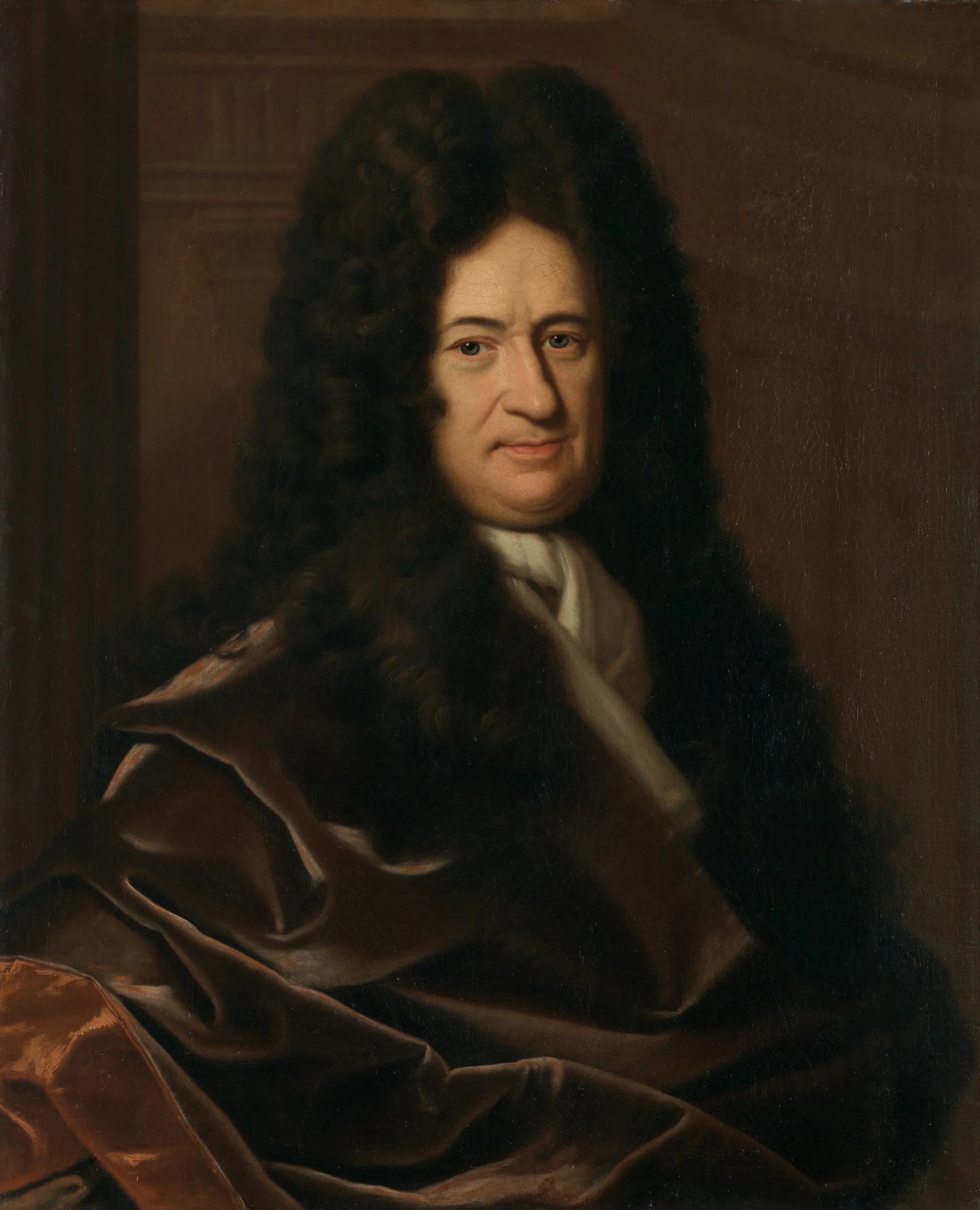
1 July 1646 to 14 November 1716 · Born in Leipzig; worked mostly in Hanover
Life
Leibniz was a philosopher, mathematician, diplomat, lawyer and librarian, serving the court of Hanover for most of his life. He invented calculus independently of Newton (his notation is the one we still use), designed a calculating machine, worked out binary arithmetic, and wrote on everything from law to Chinese philosophy. The short Monadology (1714) sums it up. He died in Hanover, largely neglected by the court he served.
What they saw
The world, Leibniz said, is made of simple, indivisible units he called monads. They are centres of perception, not bits of matter. Each sees the whole universe from its own point of view, more or less clearly. A stone's monads perceive dimly. A human mind perceives clearly enough to reflect on itself.
So each monad is a living mirror of the universe. The many are not cut off from each other; each contains the whole, from its own angle.
In their words
“each simple substance has relations which express all the others, and, consequently, that it is a perpetual living mirror of the universe.”
Leibniz, Monadology §56, tr. Robert Latta (1898)
Where this path meets the others
His scale of clearer and dimmer perception is close to the site's “degrees of reflection”: the stone lit but not reflecting, the human mind reflecting enough to ask who it is. But Leibniz keeps many real substances, where Advaita has one being appearing through many frames.
Each being mirrors the whole, from where it stands.
Works
- Monadology1714
Further reading
- Leibniz, The Monadology and Other Philosophical Writings, tr. Robert Latta (Oxford, 1898)
Next on your path
Sources
- Leibniz, The Monadology and Other Philosophical Writings, tr. Robert Latta (Oxford: Clarendon Press, 1898), §56; checked against the Harvard (Knill) copy of Latta's translation. Public domain.
- Degrees of reflection: position 9 of the site's settled positions.