Johann Wolfgang von Goethe
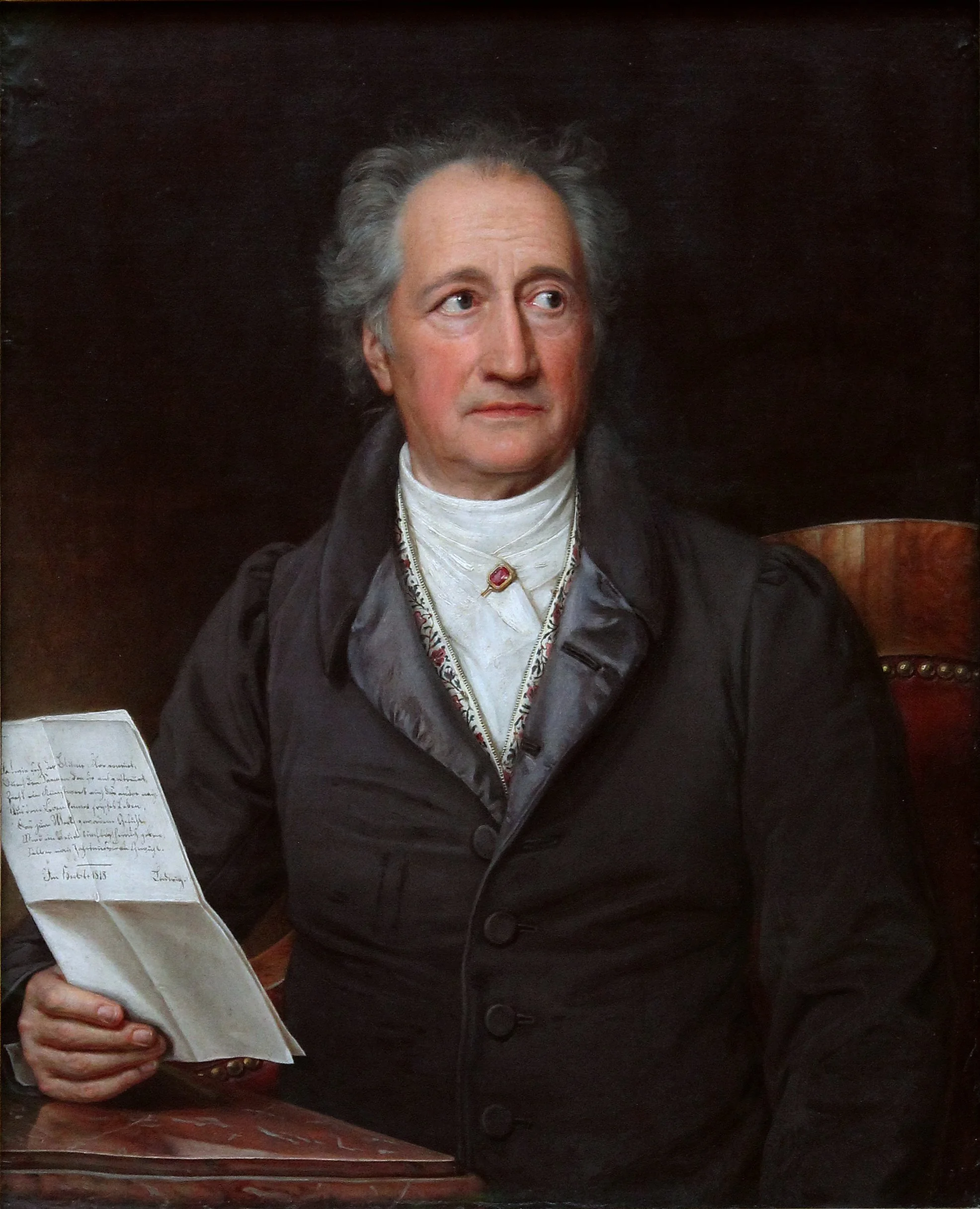
28 August 1749 to 22 March 1832 · Born in Frankfurt; lived in Weimar
Life
Goethe wrote Faust. He is known as Germany's greatest poet. He was also a minister at the court of Weimar and a serious naturalist for fifty years. He studied the metamorphosis of plants (1790), showed that humans, like other mammals, have the intermaxillary bone in the upper jaw (1784), and wrote a long Theory of Colours (1810), which challenged Newton's account of light and gave close attention to how colours are actually seen.
What they saw
Goethe distrusted a science without the looker. He wanted to train perception itself, looking so patiently at a plant or a colour that its own pattern became visible. Colour, for him, is a meeting of light, darkness and the seeing eye; leave out the eye and you have not explained colour.
He took from Plotinus the thought that the eye could not see the sun unless it were sunlike: the knower must be akin to what it knows.
In their words
„Wär nicht das Auge sonnenhaft, / Die Sonne könnt es nie erblicken;“ Plain rendering: If the eye were not like the sun, it could never see the sun.
Goethe, Zahme Xenien III (1827), after Plotinus, Enneads 1.6.9; German original with a rendering made for notdual.org
Where this path meets the others
His sunlike eye is close to the Upanishads' “by his light all this is lighted”: what knows light is light. Goethe does not go on to say the seer is the whole, but he will not let science forget the seer. See The Science of Being.
Only light can see light.
Works
- Theory of Colours1810
- The Metamorphosis of Plants1790
- FaustPart One 1808; Part Two 1832
Further reading
- Goethe's Theory of Colours, tr. Charles Lock Eastlake (London, 1840)
Next on your path
Sources
- Goethe, Zahme Xenien, Book 3 (1827); the same lines appear in the introduction to Zur Farbenlehre (1810). Public domain. Rendering made for the site.
- Plotinus, Enneads 1.6.9 (no eye ever saw the sun without becoming sunlike), the source Goethe names.
- Goethe's Theory of Colours, tr. Charles Lock Eastlake (1840). Public domain.