Max Planck
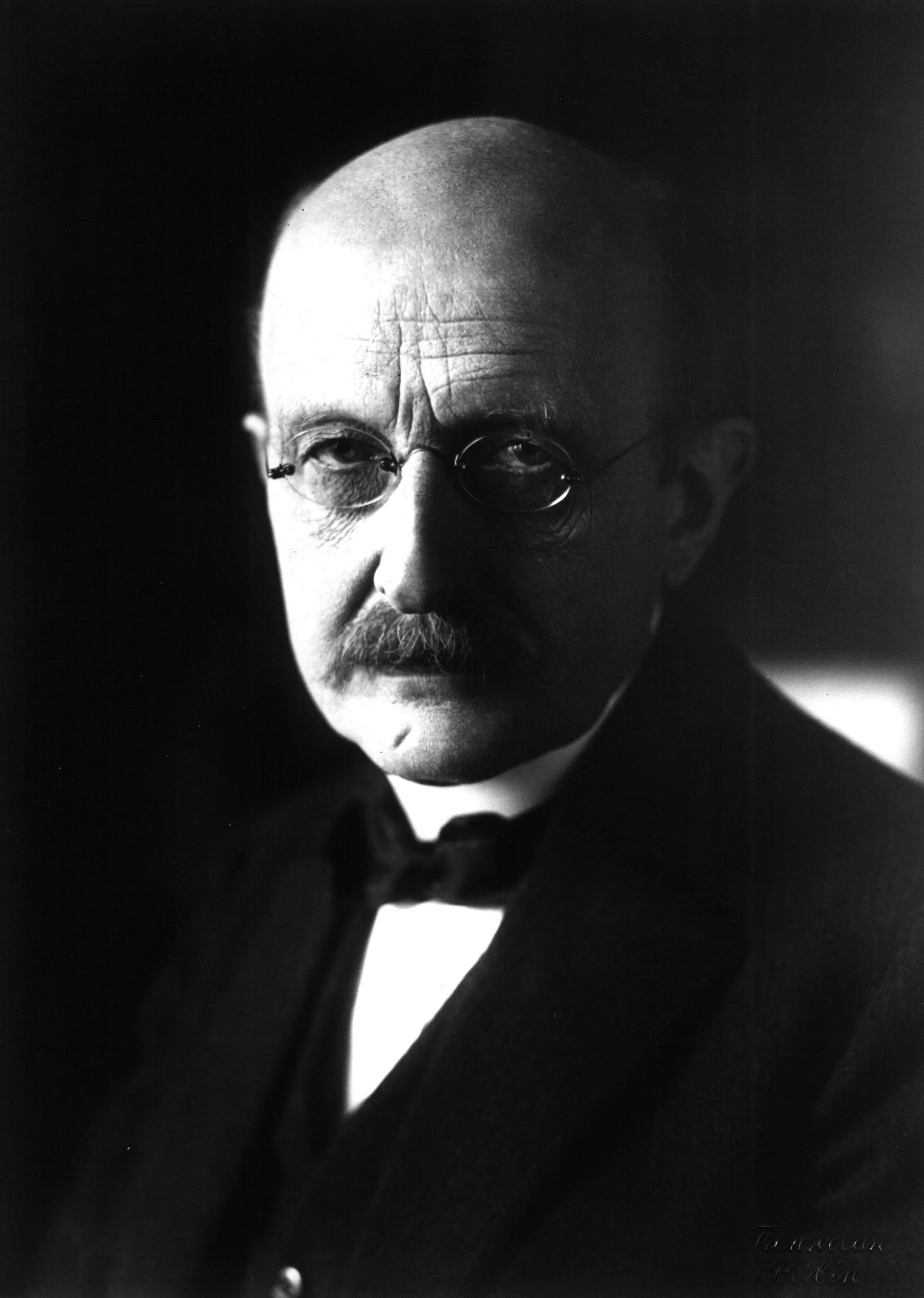
23 April 1858 to 4 October 1947 · Born in Kiel; professor in Berlin; died in Göttingen
Life
Max Karl Ernst Ludwig Planck was born in Kiel in 1858 and taught theoretical physics in Berlin from 1889. In 1900, trying to explain the radiation from hot bodies, he proposed that radiation is emitted in discrete amounts, quanta. He received the Nobel Prize in Physics in 1918. He was a leader of German science through two world wars; his son Erwin was executed in 1945 for his part in the plot against Hitler. He died in Göttingen in 1947. The Max Planck Society is named after him.
What they saw
Planck was a conservative physicist who disliked the strangeness his own discovery led to. Yet he thought hard about what physics can and cannot reach.
In a 1931 interview he said he regarded consciousness as fundamental and matter as derived from it; we cannot get behind consciousness, because everything we talk about presupposes it. Science, he thought, can describe the world ever more exactly, but always from inside experience.
The site's reading is that this is the Upanishads' starting point said by a physicist. Planck spoke as a scientist reflecting, not as a mystic, and his remark should not be made to carry more than it says.
In their words
“I regard consciousness as fundamental. I regard matter as derivative from consciousness.”
Max Planck, interview with J. W. N. Sullivan, The Observer, 25 January 1931
Where this path meets the others
Planck's remark opens the door that Schrödinger walked through. See Schrödinger and the Upanishads and The science of being.
We cannot get behind awareness.
Works
- On the Law of Distribution of Energy in the Normal Spectrum1900 (published 1901)
- Where Is Science Going?1932
Further reading
- Max Planck, Where Is Science Going? (1932; in copyright)
- J. L. Heilbron, The Dilemmas of an Upright Man (1986; in copyright)
Next on your path
Sources
- Heilbron (1986), for the life, paraphrased.
- The Observer, 25 January 1931, interview by J. W. N. Sullivan; the quoted two sentences are widely cited from it (check against the newspaper).