Kabir
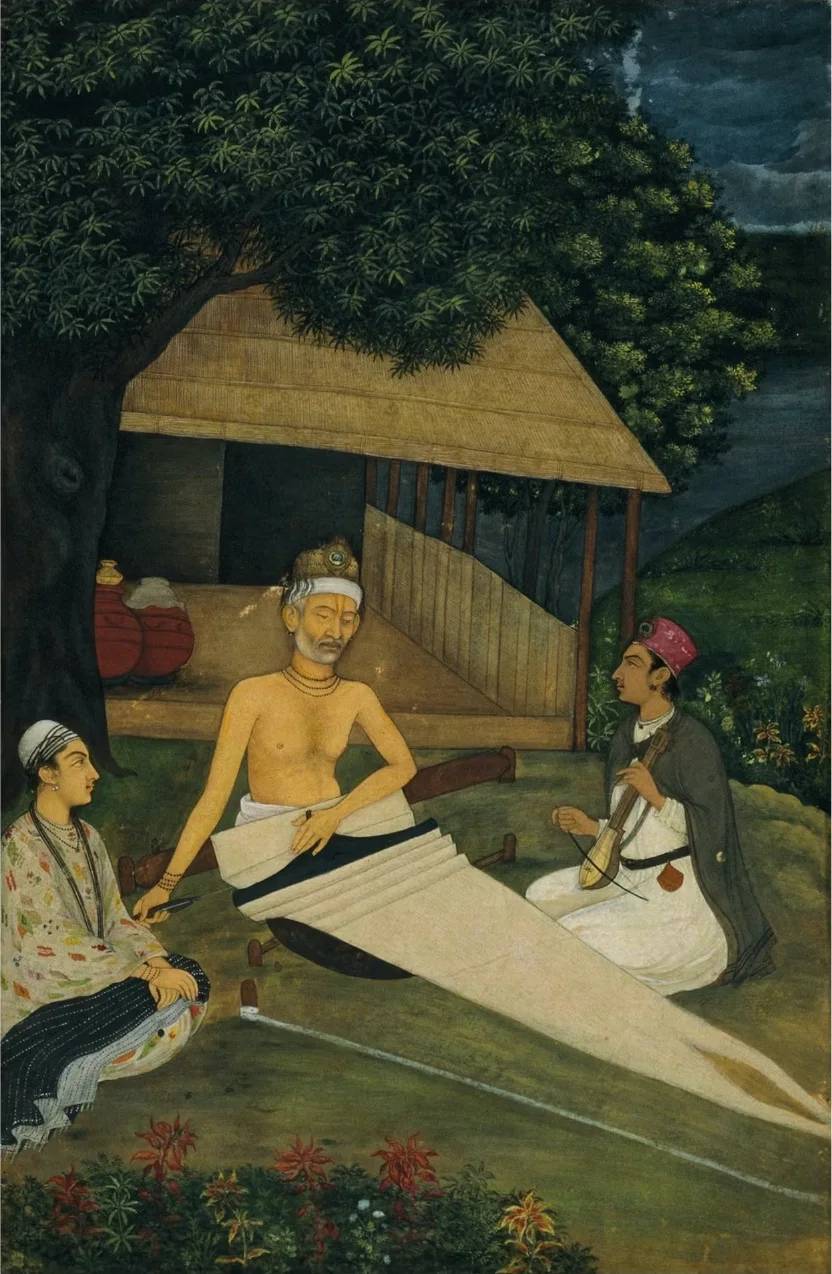
15th century; traditional dates range from 1398 to 1518, and many scholars place him about 1440 to 1518 · Varanasi (Kashi); died, by tradition, at Maghar
Life
Kabir was a weaver, raised in a Muslim family of weavers in Varanasi. He probably could not read, and his poems were sung before they were written down. They survive in three main collections: the Bijak of the Kabir Panth, the Rajasthani collections, and the verses in the Sikh scripture, the Guru Granth Sahib, compiled in 1604. By tradition he died at Maghar, a town said to bring a bad rebirth, to prove that place does not matter.
What they saw
Kabir mocked the priest and the mullah alike: the one bathing for purity, the other calling from the minaret as if God were deaf. Rituals, pilgrimages and scriptures, he said, keep you busy outside while the one you want sits inside.
He called that one Ram, Hari, the Name, the formless. He used love-songs and riddles, and the plain language of the market and the loom. His poems are full of weaving. The body is cloth, life is thread, the weaver unseen.
He was no philosopher of not two in Shankara's sense, and he never used the word. But again and again his poems arrive where the Upanishads arrive: the one sought is the one seeking.
In their words
“O servant, where dost thou seek Me? Lo! I am beside thee. I am neither in temple nor in mosque: I am neither in Kaaba nor in Kailash.”
Songs of Kabir, tr. Rabindranath Tagore (1915), poem I
Where this path meets the others
Kabir stands between the Sufis and the Vedanta, and his verses sit in the Sikh scripture beside Guru Nanak's. Bulleh Shah and Lalon sing in the same key. See Devotion.
Stop looking over there.
Works
- Bijak15th to 16th century (compiled later)
- Songs of Kabir, tr. Tagoretranslation 1915
Further reading
- Songs of Kabir, tr. Rabindranath Tagore (1915)
- Linda Hess and Shukdev Singh, The Bijak of Kabir (1983; in copyright)
Next on your path
Sources
- Songs of Kabir, tr. Rabindranath Tagore with Evelyn Underhill (New York: Macmillan, 1915), poem I. Public domain. Tagore worked from Kshitimohan Sen's collection, and scholars doubt that all its poems are Kabir's.
- Kabir's dates: Charlotte Vaudeville, A Weaver Named Kabir (1993), and general reference works; the range is wide and contested.
- The Ramananda story is legend.