Guru Nanak
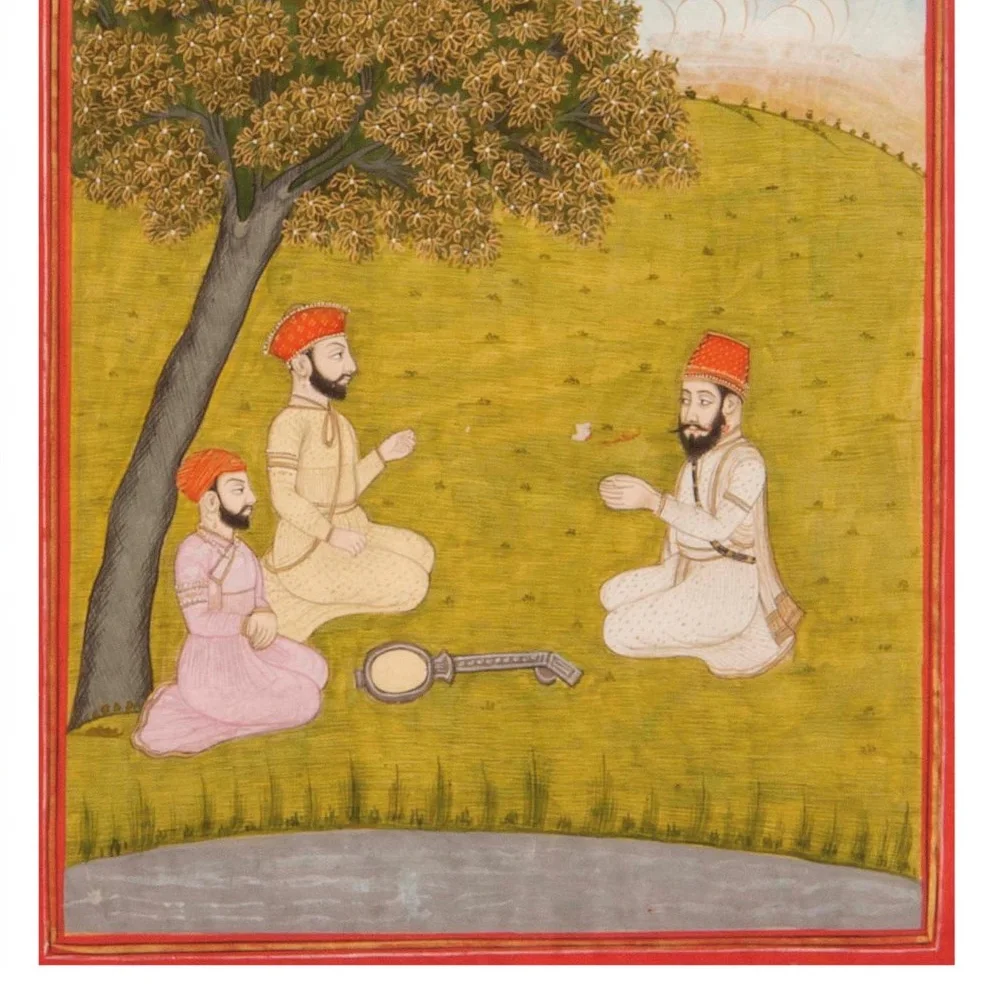
15 April 1469 to 22 September 1539 (the birth date is the traditional one; Sikhs celebrate it in the autumn month of Kartik) · Born at Talwandi (today Nankana Sahib, Pakistan); died at Kartarpur
Life
Nanak was born in 1469 into a Hindu family of the Khatri caste in the Punjab. As a young man he kept the stores of a Muslim governor at Sultanpur Lodhi. After the episode at the river, around 1499, he travelled for many years, by tradition as far as Sri Lanka, Tibet, Baghdad and Mecca, with the Muslim musician Mardana. He settled at Kartarpur, where he farmed and taught, and where the community kitchen (langar) and shared hymn-singing began. Before he died in 1539 he named Angad as the second Guru. His hymns open the Guru Granth Sahib.
What they saw
Nanak's teaching begins and ends with the One. The first words of his morning prayer, the Japji, say it is one, its name is truth, it is without fear or enmity, beyond time, unborn, self-existent. Everything else follows from that line.
He rejected caste, idol worship and the idea that renunciation is the only way. The free person, for him, lives in the world as a householder, works honestly, shares what he earns and remembers the Name. The obstacle is haumai, I-am-ness. He calls it a long sickness with its own cure inside it.
Sikhism keeps the One and the person who remembers it distinct in devotion. Its haumai is close to Advaita's I-claim, and its One without a second is close to Advaita's whole; readers can see where the paths stand side by side.
In their words
Ik oankār sati nāmu karatā purakhu nirabhau niravairu akāl mūrati ajūnī saibhaṅ gur prasādi. Plain rendering: One being. Its name is truth. Maker, present in all. Without fear, without enmity. Its form beyond time. Unborn, self-existent. Known by the Guru's grace.
The Mul Mantar, opening of the Japji and of the Guru Granth Sahib; transliterated Gurmukhi with a rendering made for notdual.org (draft). Compare Macauliffe, The Sikh Religion (1909).
Where this path meets the others
Nanak's haumai and the Gita's I-claim describe the same knot. Kabir's verses sit beside his in the Granth. See Sikhism, The I-claim and Kabir.
One being. Its name is truth.
Works
- Japji Sahibearly 16th century
Further reading
- Max Arthur Macauliffe, The Sikh Religion, 6 vols. (Oxford, 1909)
- W. H. McLeod, Guru Nanak and the Sikh Religion (1968; in copyright)
Next on your path
Sources
- Macauliffe, The Sikh Religion (1909), vol. 1, for the life and the Japji. Public domain.
- McLeod (1968) for what is historical and what is from the later janamsakhi stories (the travels are largely traditional).
- Haumai as a long sickness with its cure inside it: Guru Granth Sahib, Asa di Var (a hymn of Guru Angad in the Var, paraphrased).