Hafiz
About 1315 to 1390 · Shiraz, Iran
Life
Shams al-Din Muhammad of Shiraz took the pen name Hafiz, one who knows the Quran by heart. He lived almost all his life in Shiraz, under several rulers, some of whom favoured him and some of whom did not. He wrote ghazals, short lyric poems of love and wine, collected after his death in his Divan of about 500 poems. Goethe read him in German. His West-östlicher Divan (1819) was the answer.
What they saw
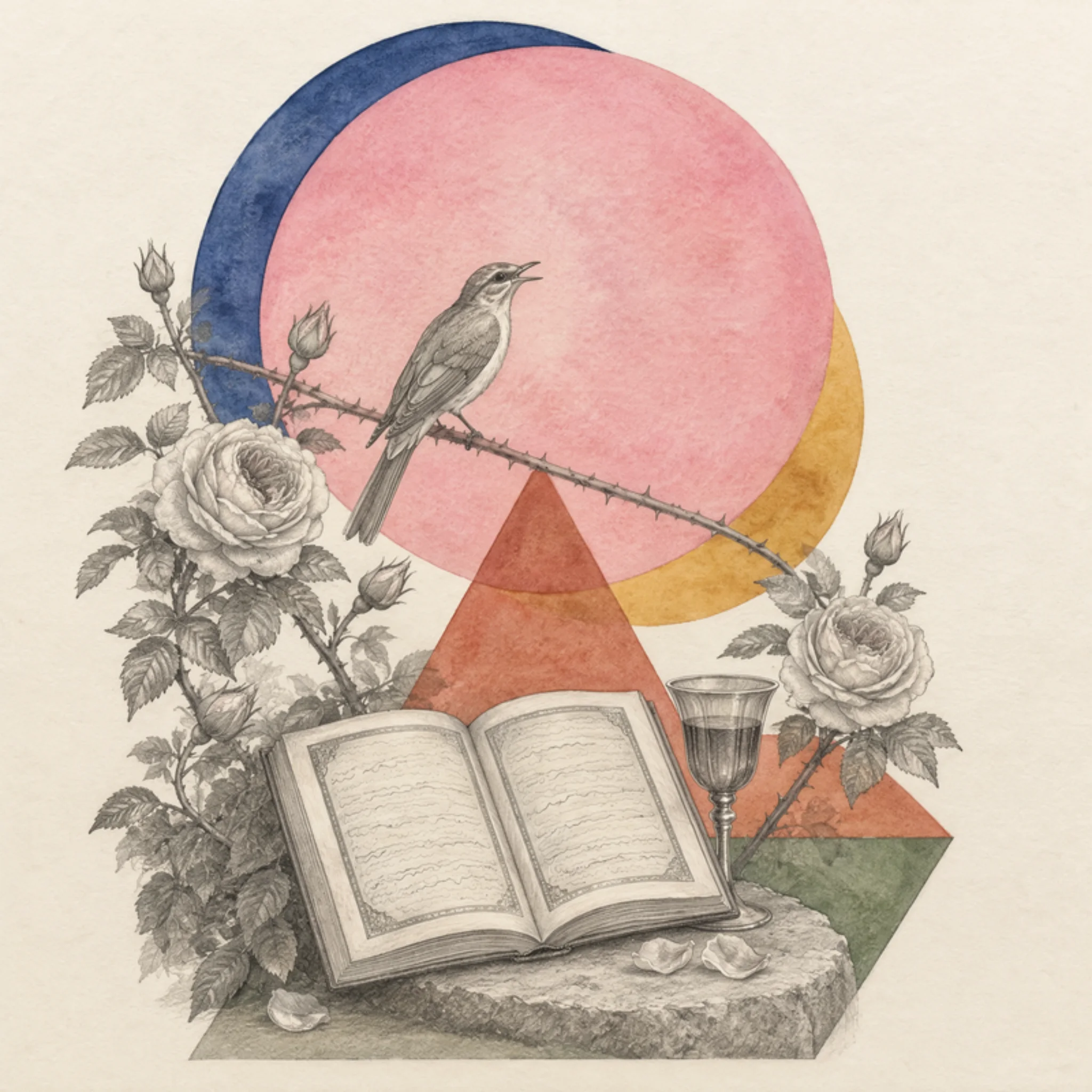
Hafiz writes of the beloved, the tavern, the cupbearer and the rose, and mocks hypocrites in turbans. Readers have argued for centuries whether the wine and the beloved are literal or the Sufi language of love for God. Hafiz seems to enjoy keeping both.
What stays is a joy without pretence, and a sharp eye for anyone who makes religion a show. The lover in his poems is always ready to lose his reputation for the sake of love.
Many popular English books under his name are free modern poems inspired by him, not translations. The older public-domain versions of Gertrude Bell (1897) and H. Wilberforce Clarke (1891) are closer to the Persian.
In their words
In paraphrase: the preacher in the pulpit puts on a show; in private he does other things. Lose your name for love, and you have lost nothing.
After the Divan of Hafiz; paraphrase, not a quotation. Compare Gertrude Bell, Poems from the Divan of Hafiz (1897).
Where this path meets the others
Hafiz is the lover's road to not two, beside Rumi and Rabia. Goethe's answer to him links him to the West. See Love and Goethe.
Open the book anywhere.
Works
- Divan14th century; collected after 1390
Further reading
- Gertrude Lowthian Bell, Poems from the Divan of Hafiz (1897)
- H. Wilberforce Clarke, The Divan-i-Hafiz (1891)
Next on your path
Sources
- Bell (1897), introduction, for the life, paraphrased.
- The custom of fal-e Hafez (divination with the Divan), especially on Yalda night, is widely documented.
- Goethe, West-östlicher Divan (1819).