Gargi and Maitreyi
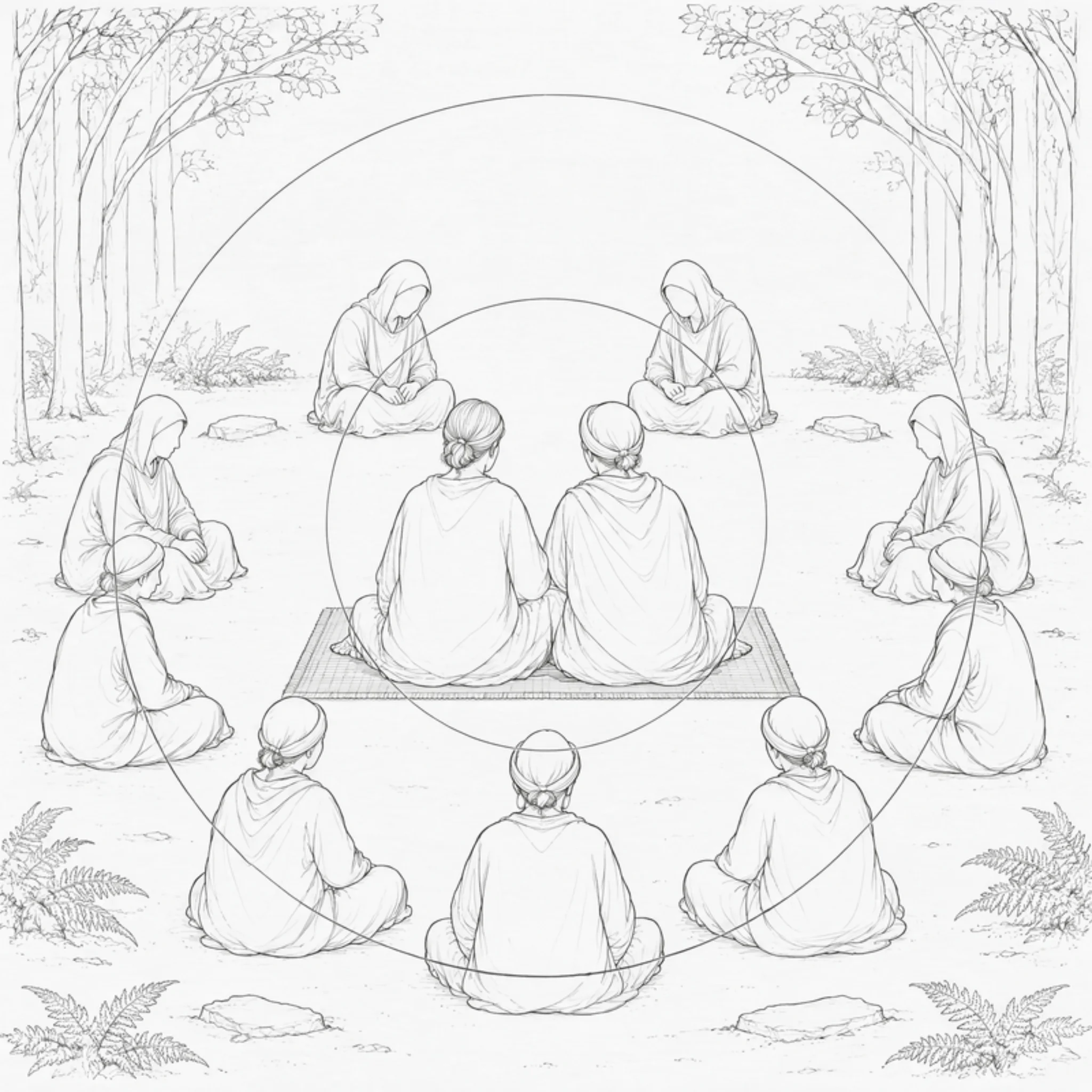
Dates unknown; both appear in the Brihadaranyaka Upanishad, usually dated to about the 7th to 6th century BCE · Videha, in the eastern Gangetic plain (today north Bihar and the Nepal Terai), at the court of King Janaka
Life
The Brihadaranyaka Upanishad records two women in conversation with the sage Yajnavalkya. Gargi Vachaknavi is a debater at King Janaka's court. Maitreyi is Yajnavalkya's wife, who, when he prepares to leave home and divide his property, asks what wealth is for. Nothing else is known of their lives. They are among the earliest women philosophers on record anywhere, and the text treats both as equals in argument.
What they saw
Gargi asks Yajnavalkya what the world is woven on, warp and woof. Water, he says. And water? Air. She keeps going, layer by layer, until he tells her to stop asking too far (3.6). Later she comes back, saying she has two questions like two arrows (3.8). Her questions bring out the teaching of the unchanging one, by whose command sun and moon stand apart, and which sees without being seen. When he finishes, she tells the court that no one will beat him.
Maitreyi's question is simpler and cuts closer to the root. Offered half her husband's wealth, she asks whether the whole earth full of it would make her immortal. No, he says. Then what would I do with it? (2.4, 4.5). His answer is the teaching on the Self: everything is dear for the sake of the Self, and the knower cannot be known as an object.
Without their questions, two of the Upanishads' greatest passages would not exist.
In their words
“What should I do with that by which I do not become immortal?”
Maitreyi, Brihadaranyaka Upanishad 2.4.3, tr. Müller (SBE 15, 1884)
Where this path meets the others
Maitreyi's refusal of wealth sits beside Nachiketa's refusal of Death's gifts. The unchanging one that Gargi's questions draw out is Maitreyi's Self. See Yajnavalkya and Maitreyi and Hearing, reflecting, abiding.
Ask until someone tells you to stop. Then ask again.
Further reading
- The Brihadaranyaka Upanishad, tr. Hume (1921) or Müller (1884): chapters 2.4, 3.6, 3.8 and 4.5
Next on your path
Sources
- Brihadaranyaka Upanishad 2.4, 3.6, 3.8, 4.5; Müller, SBE 15 (1884).
- F. Max Müller, The Upanishads, Sacred Books of the East vols. 1 (1879) and 15 (1884). Public domain.
- Robert Ernest Hume, The Thirteen Principal Upanishads (Oxford, 1921). Public domain.