Carl Jung
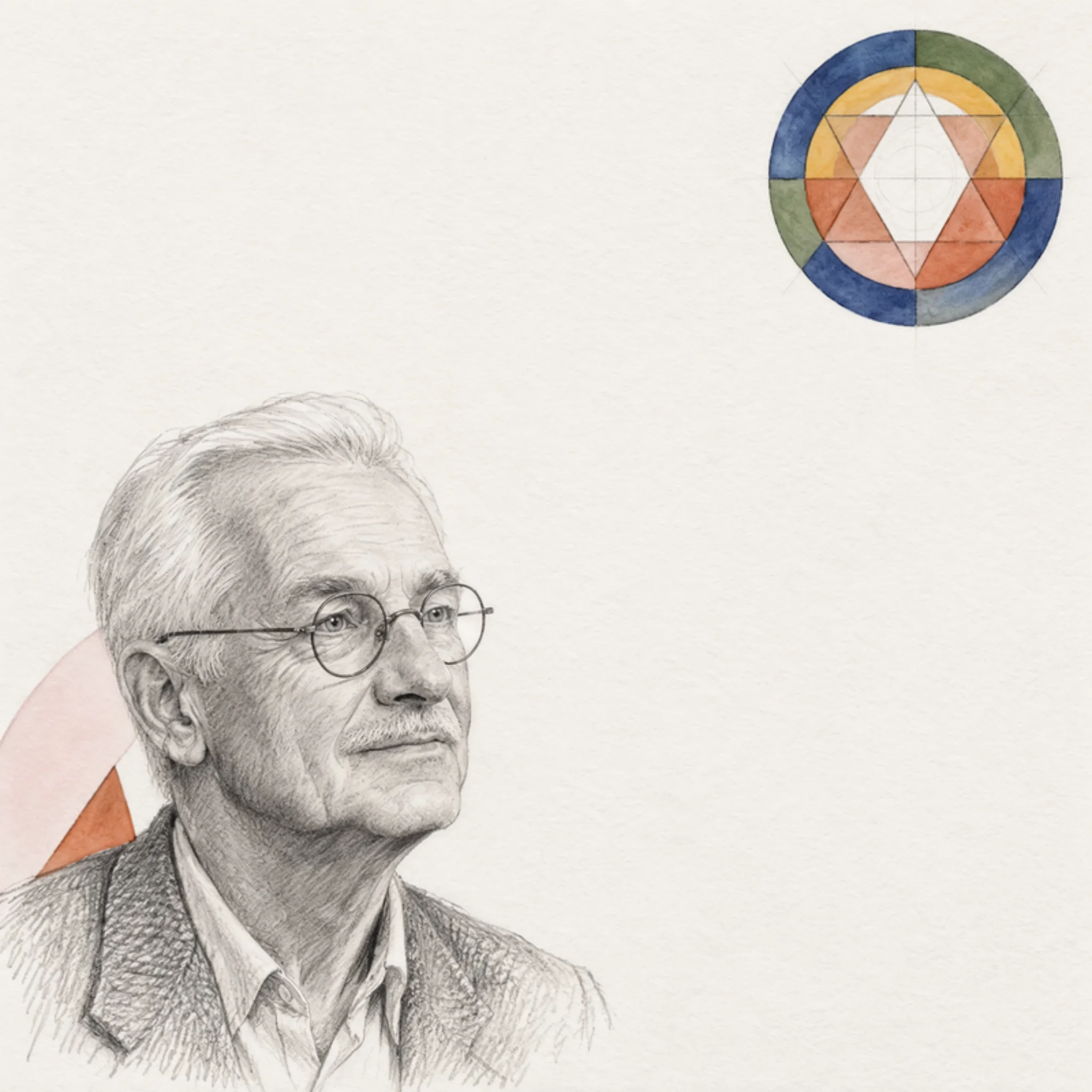
26 July 1875 to 6 June 1961 · Born at Kesswil, Switzerland; lived and died at Küsnacht, near Zurich
Life
Carl Gustav Jung trained in medicine in Basel and worked at the Burghölzli psychiatric hospital in Zurich. He was close to Freud from 1907 and broke with him in 1913. Through a long personal crisis he developed his own analytical psychology: the collective unconscious, the archetypes, introversion and extraversion, and the process of becoming whole, which he called individuation. He read widely in Eastern texts, wrote commentaries on Chinese and Tibetan works, and visited India in 1937 and 1938. He died at Küsnacht in 1961.
What they saw
The ego, for Jung, centres consciousness only. The Self (Selbst) is the whole psyche, conscious and unconscious together, and its centre too. Individuation is the ego coming into right relation with the Self, through dreams, symbols and life's crises.
He borrowed the word from the Upanishads and knew it. In his foreword to Heinrich Zimmer's book on Ramana Maharshi (1944) he wrote of Ramana's Self with respect, and said he had not gone to see him because he doubted his uniqueness: Ramana was of a type, he wrote, that he had seen all over India.
Jung's Self is a psychological reality: the whole of a person's psyche. Advaita's Self is awareness. It is no part of any psyche. The same word points to two different things, and the site keeps them apart.
In their words
In paraphrase: the Self is not only the centre but the whole circumference that holds conscious and unconscious together.
After C. G. Jung, Psychology and Alchemy (1944; in copyright); paraphrase.
Where this path meets the others
Jung's Self and Advaita's Self share a word and part on what it names. See The Self and Ramana Maharshi.
The same word, two things.
Works
- Psychological Types1921
- Psychology and Alchemy1944
- Memories, Dreams, Reflections1962
Further reading
- C. G. Jung, Memories, Dreams, Reflections (1962; in copyright)
- C. G. Jung, foreword to Heinrich Zimmer, Der Weg zum Selbst (1944; in copyright)
Next on your path
Sources
- Memories, Dreams, Reflections (1962), for the life and the India visit, paraphrased.
- Foreword to Zimmer's Der Weg zum Selbst (1944), paraphrased.