Matsuo Basho
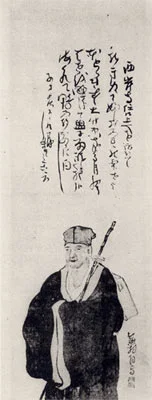
1644 to 28 November 1694 · Born at Ueno, Iga province; lived in Edo (Tokyo); died at Osaka
Life
Matsuo Kinsaku was born in 1644 into a family of low-ranking samurai in Iga. As a young man he served a lord's son who wrote poetry, and after the son's death went to Edo and made a name as a poet. In 1680 he moved to a simple hut by the Sumida river, planted with a banana tree (basho), which gave him his name. He studied Zen with the priest Butcho. In his last ten years he walked thousands of miles through Japan and wrote travel diaries, of which The Narrow Road to the Deep North (1689 travels, published 1702) is the most famous. He died in Osaka in 1694.
What they saw
Basho made the short opening verse of linked poetry into a form of its own, which later became the haiku. His aim, he said, was to learn of the pine from the pine. The poet gets out of the way. The thing speaks.
The frog poem of 1686 shows how. There is no comment in it, and no feeling is named. An old pond, a jump, a sound. The stillness is heard because of the splash. Readers have found Zen in it for three centuries, and Basho, typically, never said.
His travel diaries mix prose and verse. They are full of loss, weather and old poets' graves, and are funny about his own frailty.
In their words
古池や蛙飛び込む水の音。Plain rendering: The old pond. A frog jumps in: the sound of water.
Matsuo Basho, 1686; Japanese original with a rendering made for notdual.org (draft)
Where this path meets the others
Basho learning the pine from the pine is attention without the I-claim. See Attention and Ryokan.
Learn the pine from the pine.
Works
- The Narrow Road to the Deep North (Oku no hosomichi)travels 1689; published 1702
Further reading
- Matsuo Basho, The Narrow Road to the Deep North and Other Travel Sketches, tr. Nobuyuki Yuasa (1966; in copyright)
- R. H. Blyth, Haiku, 4 vols. (1949 to 1952; in copyright)
Next on your path
Sources
- Yuasa (1966), introduction, for the life, paraphrased.
- “Learn of the pine from the pine”: recorded by his student Doho in Sanzoshi, paraphrased.