Arthur Eddington
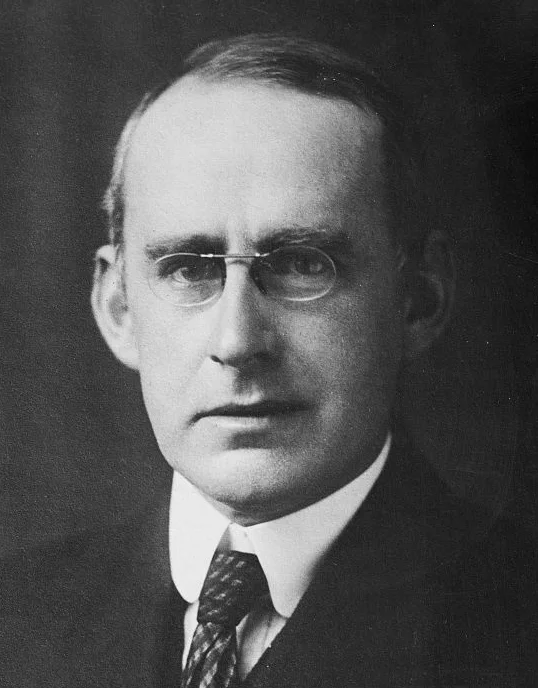
28 December 1882 to 22 November 1944 · Born at Kendal, Westmorland; Cambridge Observatory; died in Cambridge
Life
Arthur Stanley Eddington was born in 1882 to a Quaker family in Kendal. He became director of the Cambridge Observatory in 1914. A pacifist, he was excused from war service. In 1919 he led the expedition to the island of Príncipe whose eclipse photographs confirmed Einstein's prediction that gravity bends light, and made Einstein famous. He explained relativity and astrophysics in clear popular books, including The Nature of the Physical World (1928), from his Gifford Lectures. He died in 1944.
What they saw
Eddington's two tables make a simple point. Physics gives us a world of pointer readings and equations: structure, measured. It tells us nothing about what the structure is of. The only place we know the inside of anything is in our own experience.
So, he concluded, the stuff of the world is mind-stuff. He meant something general, not a particular person's mind, and he was careful to say it was a hypothesis.
The site would put it this way: the world is real as appearance, and what it appears in is awareness. Eddington, a Quaker, arrived there from the observatory, by way of what physics leaves out.
In their words
“The stuff of the world is mind-stuff.”
Arthur Eddington, The Nature of the Physical World (1928), chapter 13
Where this path meets the others
Eddington's two tables are the rope and the snake for physicists. See The science of being and Dependent reality.
Two tables. One is mind-stuff.
Works
- The Nature of the Physical World1928
- Space, Time and Gravitation1920
Further reading
- A. S. Eddington, The Nature of the Physical World (1928)
- Matthew Stanley, Practical Mystic (2007; in copyright)
Next on your path
Sources
- A. S. Eddington, The Nature of the Physical World (Cambridge, 1928), introduction (the two tables) and chapter 13. Public domain worldwide: Eddington died in 1944, and the 1928 book entered the US public domain in 2024 (Project Gutenberg 72963).
- Stanley (2007), for the life and the Quaker background, paraphrased.