Albert Einstein
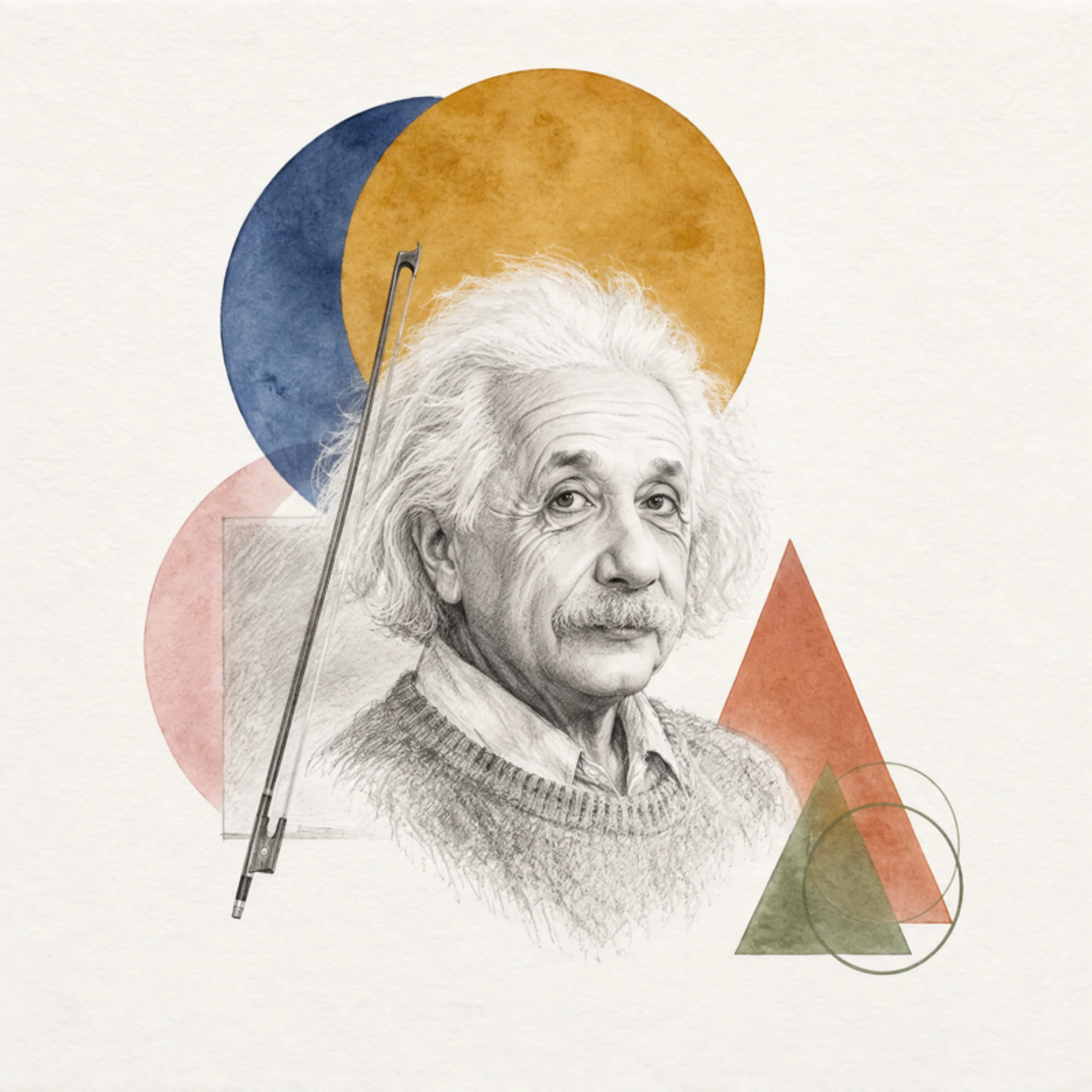
14 March 1879 to 18 April 1955 · Born in Ulm, Germany; Bern, Zurich, Berlin; died in Princeton, New Jersey
Life
Albert Einstein was born in Ulm in 1879 and grew up in Munich. While working as a clerk in the patent office in Bern he published, in 1905, papers on light quanta, Brownian motion and special relativity. His general theory of relativity followed in 1915, and the 1919 eclipse confirmed it. His Nobel Prize was for 1921. A Jew and a pacifist, he left Germany in 1933 and settled at Princeton, where he died in 1955.
What they saw
Einstein spoke of a cosmic religious feeling: awe at the order of nature, without a personal God who rewards and punishes. He admired Spinoza for this.
In a letter of 1950 to a grieving father he wrote that a human being is part of the whole we call the universe, limited in time and space, and that we experience ourselves as separate from the rest, a kind of trick of sight in our awareness; our task is to free ourselves from that prison by widening our circle of compassion. The letter's wording varies between published versions.
He did not mean what Advaita means by the whole. But his letter names the same mistake, and the same way out, through the I-claim's widening.
In their words
In paraphrase: we experience ourselves as separate from the rest, a kind of trick of sight in our awareness; our task is to free ourselves by widening our compassion to all living things and the whole of nature.
After Albert Einstein, letter to Robert S. Marcus, 12 February 1950; paraphrase. The letter is quoted in several different versions.
Where this path meets the others
Einstein's “cosmic religious feeling” comes from Spinoza. See Spinoza and Shankara and Arthur Eddington.
Part of the whole, and forgetting it.
Works
- The 1905 papers (light quanta, Brownian motion, special relativity)1905
- The general theory of relativity1915
- Ideas and Opinions1954
Further reading
- Albert Einstein, Ideas and Opinions (1954; in copyright)
- Walter Isaacson, Einstein: His Life and Universe (2007; in copyright)
Next on your path
Sources
- Isaacson (2007), for the life, paraphrased.
- Letter to Robert S. Marcus, 12 February 1950 (Einstein Archives); the widely quoted version differs from the original; paraphrased here.
- “Cosmic religious feeling”: Einstein, “Religion and Science”, New York Times Magazine, 9 November 1930.