Spinoza: the Ethics, Parts 1 and 5
In the words of Pranav Ashar
How we renderThe heart of the Spinoza: the Ethics, Parts 1 and 5
In brief
Baruch, or Benedict, de Spinoza (1632 to 1677) ground lenses in Holland and wrote the Ethics in the form of geometry: definitions, axioms, propositions, proofs. It was printed after his death, in 1677. Twelve units from Part 1, on God, and Part 5, on freedom, are given here in plain words in his own sense, with Elwes's translation of 1883 beside each.
The definitions
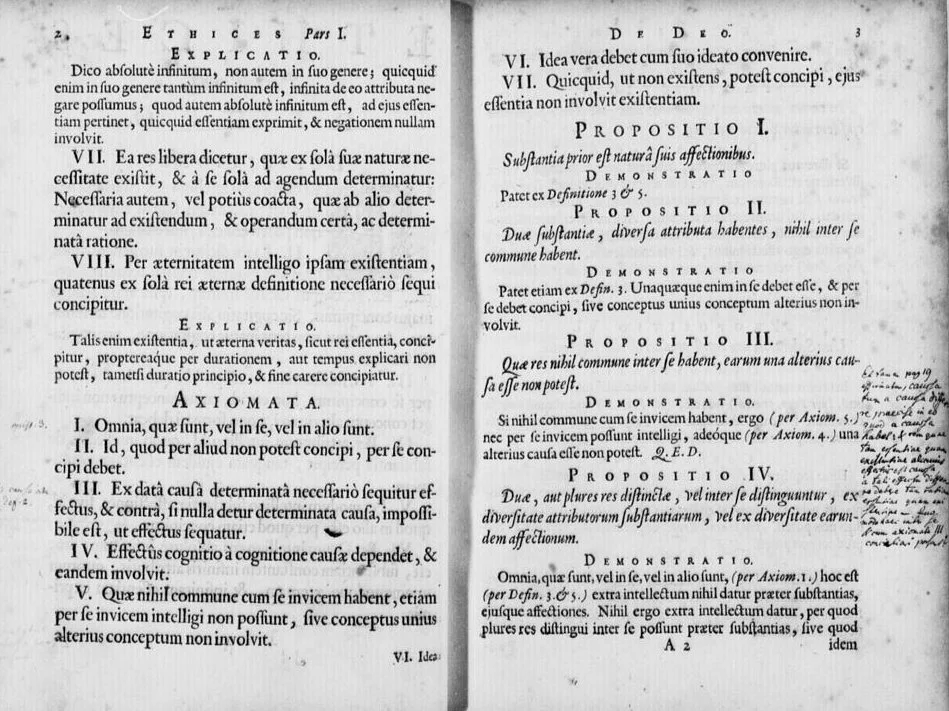
I. Per causam sui intelligo id, cujus essentia involvit existentiam; sive id, cujus natura non potest concipi nisi existens. II. Ea res dicitur in suo genere finita, quæ aliâ ejusdem naturæ terminari potest. Ex. gr. corpus dicitur finitum, quia aliud semper majus concipimus. Sic cogitatio aliâ cogitatione terminatur. At corpus non terminatur cogitatione; nec cogitatio corpore. III. Per substantiam intelligo id, quod in se est, et per se concipitur, hoc est id, cujus conceptus non indiget conceptu alterius rei, a quo formari debeat. IV. Per attributum intelligo id, quod intellectus de substantia percipit tanquam ejusdem essentiam constituens. V. Per modum intelligo substantiæ affectiones, sive id, quod in alio est, per quod etiam concipitur. VI. Per Deum intelligo ens absolute infinitum, hoc est, substantiam constantem infinitis attributis, quorum unumquodque æternam et infinitam essentiam exprimit. EXPLICATIO Dico absolute infinitum, non autem in suo genere; quicquid enim in suo genere tantum infinitum est, infinita de eo attributa negare possumus; quod autem absolute infinitum est, ad ejus essentiam pertinet quicquid essentiam exprimit et negationem nullam involvit. VII. Ea res libera dicetur, quae ex sola suae naturæ necessitate existit, et a se sola ad agendum determinatur: Necessaria autem vel potius coacta, quæ ab alio determinatur ad existendum et operandum certa ac determinata ratione. VIII. Per æternitatem intelligo ipsam existentiam, quatenus ex sola rei æternæ definitione necessario sequi concipitur. EXPLICATIO Talis enim existentia ut æterna veritas, sicut rei essentia, concipitur, proptereaque per durationem aut tempus explicari non potest, tametsi duratio principio et fine carere concipiatur.
1. By cause of itself I mean that whose essence involves existence: that whose nature cannot be conceived except as existing. 2. A thing is called finite in its kind when it can be limited by another of the same nature. A body, for example, is called finite because we always conceive another, larger one. So a thought is limited by another thought. But a body is not limited by a thought, nor a thought by a body. 3. By substance I mean what is in itself and is conceived through itself: that whose concept does not need the concept of another thing to be formed from. 4. By attribute I mean what the intellect perceives of substance as making up its essence. 5. By mode I mean the states of substance: what is in another, and is conceived through that other. 6. By I mean a being absolutely infinite: a substance made up of infinite attributes, each of which expresses an eternal and infinite essence. Explanation: I say absolutely infinite, not infinite in its kind. Of what is infinite only in its kind, we can deny infinite attributes; but to the essence of what is absolutely infinite belongs whatever expresses essence and involves no negation. 7. That thing is called free which exists from the necessity of its own nature alone and is determined to act by itself alone. That thing is called necessary, or rather compelled, which is determined by another to exist and to act in a fixed and settled way. 8. By eternity I mean existence itself, insofar as it is conceived to follow necessarily from the definition alone of an eternal thing. Explanation: such existence is conceived as an eternal truth, like the essence of a thing, and so cannot be explained by duration or time, even if duration is conceived to have no beginning and no end.
Note //
Everything in Part 1 is built from these eight lines; 3, 5 and 6 carry the weight. In Spinoza's sense 'God' names the one infinite substance, not a person who plans. The site reads definition 3 as its 'the whole' (what is in itself) and definition 5 as dependent reality: a mode is real, but only in another (positions 1 and 2).
Besides God no substance
Præter Deum nulla dari neque concipi potest substantia. DEMONSTRATIO Cum Deus sit ens absolute infinitum, de quo nullum attributum, quod essentiam substantiæ exprimit, negari potest (per Defin. 6), isque necessario existat (per Prop. 11); si aliqua substantia præter Deum daretur, ea explicari deberet per aliquod attributum Dei, sicque duæ substantiæ ejusdem attributi existerent, quod (per Prop. 5) est absurdum; adeoque, nulla substantia extra Deum dari potest, et consequenter non etiam concipi. Nam si posset concipi, deberet necessario concipi ut existens; atqui hoc (per primam partem hujus Demonst.) est absurdum. Ergo extra Deum nulla dari neque concipi potest substantia. Q. E. D. COROLLARIUM I Hinc clarissime sequitur: I° Deum esse unicum, hoc est (per Defin. 6) in rerum natura non nisi unam substantiam dari, eamque absolute infinitam esse, ut in Scholio Prop. 10 jam innuimus. COROLLARIUM II Sequitur: II° rem extensam et rem cogitantem vel Dei attributa esse, vel (per Axiom. 1) affectiones attributorum Dei.
Besides no substance can be, or be conceived. Proof: is a being absolutely infinite, of whom no attribute that expresses the essence of substance can be denied (definition 6), and he exists necessarily (proposition 11). If there were any substance besides , it would have to be explained through some attribute of , and so two substances with the same attribute would exist, which is absurd (proposition 5). So no substance outside can be, and so none can be conceived either. For if it could be conceived, it would have to be conceived as existing, and that, by the first part of this proof, is absurd. So outside no substance can be, or be conceived. Which was to be shown. Corollary 1: It follows most clearly, first, that is unique: in the nature of things there is only one substance, and it is absolutely infinite, as we hinted in the note to proposition 10. Corollary 2: It follows, second, that the extended thing and the thinking thing are either attributes of or states of the attributes of .
Note //
Spinoza's monism in one line: there are not many substances, there is one. The site reads 'besides God no substance' beside the Upanishadic 'one without a second', with the difference that Spinoza's one substance is known through infinitely many attributes, thought and extension among them, where the site's whole is awareness and being (position 1).
Whatever is, is in God
Quicquid est, in Deo est, et nihil sine Deo esse neque concipi potest. DEMONSTRATIO Præter Deum nulla datur neque concipi potest substantia (per Prop. 14), hoc est (per Defin. 3) res, quæ in se est et per se concipitur. Modi autem (per Defin. 5) sine substantia nec esse nec concipi possunt; quare hi in sola divina natura esse, et per ipsam solam concipi possunt. Atqui præter substantias et modos nil datur (per Axioma 1). Ergo nihil sine Deo esse neque concipi potest. Q. E. D.
Whatever is, is in , and nothing can be, or , without . Proof: besides no is, or can (proposition 14), that is, nothing that is in itself and is conceived through itself (definition 3). But cannot be, or , without (definition 5); so they can be only in 's nature, and can only through it. But besides s and there is nothing (axiom 1). So nothing can be, or , without . Which was to be shown.
Note //
The long note that follows in the Ethics, on whether God can be extended, is left out here. Spinoza's 'in' is the 'in' of definition 5: a mode is in substance as a wave's shape is in the water, not as a coin is in a box. The site reads this as its pot and clay: real as a pot, never apart from the clay (position 2).
The cause that stays within
Deus est omnium rerum causa immanens, non vero transiens. DEMONSTRATIO Omnia quæ sunt, in Deo sunt et per Deum concipi debent (per Prop. 15); adeoque (per Coroll. 1 Prop. 16 hujus) Deus rerum, quæ in ipso sunt, est causa; quod est primum. Deinde extra Deum nulla potest dari substantia (per Prop. 14), hoc est (per Defin. 3) res, quæ extra Deum in se sit; quod erat secundum. Deus ergo est omnium rerum causa immanens, non vero transiens. Q. E. D.
is the cause of all things that stays within them, not one that passes over to them. Proof: all things that are, are in and must be conceived through (proposition 15); so is the cause of the things that are in him (proposition 16, corollary 1). That is the first point. Next, outside there can be no substance (proposition 14), that is, no thing that is in itself outside . That was the second. So is the cause of all things that stays within them, not one that passes over to them. Which was to be shown.
Note //
'Immanent, not transient' is the scholastic pair: a transient cause acts on something outside itself, an immanent one stays in what it produces. Spinoza's God makes nothing outside itself. The site reads this as the order (Ishvara) as the whole's own intelligence in everything, with no maker standing apart (position 3).
Nothing is contingent
In rerum natura nullum datur contingens; sed omnia ex necessitate divinæ naturæ determinata sunt ad certo modo existendum et operandum. DEMONSTRATIO Quicquid est, in Deo est (per Prop. 15): Deus autem non potest dici res contingens: Nam (per Prop. 11) necessario, non vero contingenter existit. Modi deinde divinæ naturæ ex eadem etiam necessario, non vero contingenter secuti sunt (per Prop. 16), idque vel quatenus divina natura absolute (per Prop. 21), vel quatenus certo modo ad agendum determinata consideratur (per Prop. 27). Porro horum modorum Deus non tantum est causa, quatenus simpliciter existunt (per Coroll. Prop. 24), sed etiam (per Prop. 26) quatenus ad aliquid operandum determinati considerantur. Quod si a Deo (per eand. Prop.) determinati non sint, impossibile, non vero contingens est, ut se ipsos determinent; et contra (per Prop. 27) si a Deo determinati sint, impossibile, non vero contingens est, ut se ipsos indeterminatos reddant. Quare omnia ex necessitate divinæ naturæ determinata sunt, non tantum ad existendum, sed etiam ad certo modo existendum et operandum, nullumque datur contingens. Q. E. D. SCHOLIUM Antequam ulterius pergam, hic, quid nobis per Naturam Naturantem, et quid per Naturam Naturatam intelligendum sit, explicare volo, vel potius monere. Nam ex antecedentibus jam constare existimo, nempe, quod per Naturam Naturantem nobis intelligendum est id, quod in se est et per se concipitur, sive talia substantiae attributa, quæ æternam et infinitam essentiam exprimunt, hoc est (per Coroll. 1 Prop. 14 et Coroll. 2 Prop. 17), Deus quatenus ut causa libera consideratur. Per Naturam Naturatam autem intelligo id omne, quod ex necessitate Dei naturæ, sive uniuscujusque Dei attributorum sequitur, hoc est omnes Dei attributorum modos, quatenus considerantur ut res, quæ in Deo sunt, et quæ sine Deo nec esse nec concipi possunt.
In nature there is nothing contingent: all things have been determined from the necessity of 's nature to exist and to act in a certain way. Proof: whatever is, is in (proposition 15). But cannot be called a contingent thing, for he exists necessarily, not contingently (proposition 11). Next, the modes of 's nature have also followed from it necessarily, not contingently (proposition 16), whether 's nature is considered absolutely (proposition 21) or as determined to act in a certain way (proposition 27). Further, is the cause of these modes not only insofar as they simply exist (proposition 24, corollary), but also insofar as they are considered as determined to do something (proposition 26). If they have not been determined by , it is impossible, not contingent, that they should determine themselves; and if they have been determined by , it is impossible, not contingent, that they should make themselves undetermined (proposition 27). So all things have been determined from the necessity of 's nature, not only to exist, but to exist and act in a certain way, and there is nothing contingent. Which was to be shown. Note: Before I go further I want to explain here, or rather point out, what we must understand by nature naturing and what by nature natured. From what has gone before I think it is already clear that by nature naturing we must understand what is in itself and is conceived through itself, or the attributes of substance that express eternal and infinite essence, that is, insofar as he is considered as a free cause. By nature natured I understand everything that follows from the necessity of 's nature, or of each of 's attributes: all the modes of 's attributes, insofar as they are considered as things that are in and can neither be nor be conceived without .
Note //
'Nature naturing' (natura naturans) and 'nature natured' (natura naturata) are one nature seen as producing and as produced; Spinoza borrowed the pair from the scholastics and changed its sense. The site reads them as the whole and its appearance, never two (positions 1 and 2), and reads 'nothing contingent' as the order, with the difference that Spinoza allows no not-knowing at the root, only inadequate ideas in finite minds.
A passion stops being a passion
Affectus, qui passio est, desinit esse passio, simulatque ejus claram et distinctam formamus ideam. DEMONSTRATIO Affectus, qui passio est, idea est confusa (per gener. Affect. Defin.). Si itaque ipsius affectus claram et distinctam formemus ideam, hæc idea ab ipso affectu, quatenus ad solam Mentem refertur, non nisi ratione distinguetur (per Prop. 21 p. II cum ejusdem Schol.); adeoque (per Prop. 3 p. III) affectus desinet esse passio. Q. E. D. COROLLARIUM Affectus igitur eo magis in nostra potestate est, et Mens ab eo minus patitur, quo nobis est notior.
A that is a passion stops being a passion as soon as we form a clear and distinct idea of it. Proof: a that is a passion is a confused idea (general definition of the feelings). So if we form a clear and distinct idea of the itself, this idea will differ from the , insofar as the is referred to the mind alone, only in the way we think of it (Part 2, proposition 21 with its note); and so the will stop being a passion (Part 3, proposition 3). Which was to be shown. Corollary: So the better we know a , the more it is in our power, and the less the mind is acted on by it.
Note //
A 'passion' for Spinoza is any feeling in which the mind is acted on, its cause lying partly outside it; understanding the feeling makes the mind active. The site reads this beside position 9: the pain may stay, the suffering, which is being driven, ends when the thing is seen clearly.
Whoever understands himself loves God
Qui se suosque affectus clare et distincte intelligit, Deum amat, et eo magis, quo se suosque affectus magis intelligit. DEMONSTRATIO Qui se suosque affectus clare et distincte intelligit, lætatur (per Prop. 53 p. III), idque concomitante idea Dei (per Prop. præced.); atque adeo (per 6 Affect. Defin.) Deum amat, et (per eandem rationem) eo magis, quo se suosque affectus magis intelligit. Q. E. D.
Whoever understands himself and his feelings clearly and distinctly loves , and the more so, the more he understands himself and his feelings. Proof: whoever understands himself and his feelings clearly and distinctly is glad (Part 3, proposition 53), and his gladness comes with the idea of (the previous proposition); so he loves (definition 6 of the feelings), and, for the same reason, the more so, the more he understands himself and his feelings. Which was to be shown.
Note //
In Spinoza's definitions love is gladness accompanied by the idea of its cause; since every clear idea of oneself involves the idea of God, understanding oneself becomes loving God. The site reads this as inquiry and devotion meeting: to know what one is, is already to turn toward the whole.
We feel and know that we are eternal
Mens humana non potest cum Corpore absolute destrui, sed ejus aliquid remanet, quod æternum est. DEMONSTRATIO In Deo datur necessario conceptus seu idea, quæ Corporis humani essentiam exprimit (per Prop. præced.), quæ propterea aliquid necessario est, quod ad essentiam Mentis humanæ pertinet (per Prop. 13 p. II). Sed Menti humanæ nullam durationem, quæ tempore definiri potest, tribuimus, nisi quatenus Corporis actualem existentiam, quæ per durationem explicatur et tempore definiri potest, exprimit; hoc est (per Coroll. Prop. 8 p. II), ipsi durationem non tribuimus, nisi durante Corpore. Cum tamen aliquid nihilominus sit id, quod æterna quadam necessitate per ipsam Dei essentiam concipitur (per Prop. præced.), erit necessario hoc aliquid, quod ad Mentis essentiam pertinet, æternum. Q. E. D. SCHOLIUM Est, uti diximus, hæc idea quæ Corporis essentiam sub specie æternitatis exprimit, certus cogitandi modus, qui ad Mentis essentiam pertinet, quique necessario æternus est. Nec tamen fieri potest, ut recordemur nos ante Corpus exstitisse, quandoquidem nec in Corpore ulla ejus vestigia dari possunt, nec æternitas tempore definiri, nec ullam ad tempus relationem habere potest. At nihilominus sentimus experimurque, nos æternos esse. Nam Mens non minus res illas sentit, quas intelligendo concipit, quam quas in memoria habet. Mentis enim oculi, quibus res videt observatque, sunt ipsæ demonstrationes. Quamvis itaque non recordemur, nos ante Corpus exstitisse, sentimus tamen, Mentem nostram, quatenus Corporis essentiam sub æternitatis specie involvit, æternam esse, et hanc ejus existentiam tempore definiri, sive per durationem explicari, non posse. Mens igitur nostra eatenus tantum potest dici durare, ejusque existentia certo tempore definiri potest, quatenus actualem Corporis existentiam involvit; et eatenus tantum potentiam habet rerum existentiam tempore determinandi, easque sub duratione concipiendi.
The human mind cannot be destroyed altogether with the body: something of it remains that is eternal. Proof: in there is necessarily a concept or idea that expresses the essence of the human body (the previous proposition), and it is therefore necessarily something that belongs to the essence of the human mind (Part 2, proposition 13). But we give the human mind no duration that can be marked by time, except insofar as it expresses the actual existence of the body, which is explained by duration and can be marked by time; that is, we give it duration only while the body lasts (Part 2, proposition 8, corollary). Yet since there is something, all the same, that is conceived with a certain eternal necessity through 's very essence (the previous proposition), this something, which belongs to the essence of the mind, will necessarily be eternal. Which was to be shown. Note: This idea, which expresses the essence of the body under a form of eternity, is, as we have said, a certain way of thinking, which belongs to the essence of the mind and is necessarily eternal. Still, it cannot happen that we remember existing before the body, since there can be no trace of it in the body, and eternity cannot be marked by time or have any relation to time. But all the same that we are eternal. For the mind feels the things it conceives by understanding no less than the things it has in memory. The eyes of the mind, by which it sees and observes things, are the proofs themselves. So although we do not remember existing before the body, we feel that our mind, insofar as it involves the essence of the body under a form of eternity, is eternal, and that this existence of it cannot be marked by time or explained by duration. Our mind, then, can be said to last, and its existence can be marked by a set time, only insofar as it involves the actual existence of the body; and only so far does it have the power to fix the existence of things by time and to conceive them under duration.
Note //
'We feel and know by experience that we are eternal' (sentimus experimurque nos aeternos esse) is the most quoted sentence in Part 5. Spinoza's eternity is not endless time but existence outside time, and what is eternal is not the remembered person. The site reads this as position 3's changeless beside the stream, and agrees that no memory carries it.
The more we understand particular things
Quo magis res singulares intelligimus, eo magis Deum intelligimus. DEMONSTRATIO Patet ex Coroll. Prop. 25 p. I.
The more we understand particular things, the more we understand . Proof: this is clear from Part 1, proposition 25, corollary.
Note //
The corollary cited says particular things are nothing but states of God's attributes, ways in which they are expressed in a certain and settled manner. So knowing a leaf or a feeling well is knowing God, not turning away from him. The site agrees: the whole is not found by leaving things but by seeing what they are (position 2).
The third kind of knowledge
Summus Mentis conatus summaque virtus est, res intelligere tertio cognitionis genere. DEMONSTRATIO Tertium cognitionis genus procedit ab adæquata idea quorundam Dei attributorum ad adæquatam cognitionem essentiæ rerum (vide hujus defin. in 2 Schol. Prop. 40 p. II); et quo magis hoc modo res intelligimus, eo magis (per Prop. præced.) Deum intelligimus; ac proinde (per Prop. 28 p. IV) summa Mentis virtus, hoc est (per Defin. 8 p. IV) Mentis potentia seu natura, sive (per Prop. 7 p. III) summus conatus, est, res intelligere tertio cognitionis genere. Q. E. D.
The highest striving of the mind, and its highest virtue, is to understand things by the third kind of knowledge. Proof: the third kind of knowledge goes from an adequate idea of certain attributes of to adequate knowledge of the essence of things (see its definition in Part 2, proposition 40, note 2); and the more we understand things in this way, the more we understand (the previous proposition). So the highest virtue of the mind (Part 4, proposition 28), that is, the mind's power or nature (Part 4, definition 8), or its highest striving (Part 3, proposition 7), is to understand things by the third kind of knowledge. Which was to be shown.
Note //
Spinoza's three kinds are imagination (from the senses and hearsay), reason (from common notions) and intuitive knowledge (scientia intuitiva), which sees a particular thing at once in God. The site reads the third kind beside knowledge arising in understanding (position 6), with the caution that Spinoza's intuition is still an idea, where the site's knowing ends in recognising the knower.
The mind’s love is God’s love of himself
Mentis Amor intellectualis erga Deum est ipse Dei Amor, quo Deus se ipsum amat, non quatenus infinitus est, sed quatenus per essentiam humanæ Mentis, sub specie æternitatis consideratam, explicari potest; hoc est, Mentis erga Deum Amor intellectualis pars est infiniti amoris, quo Deus se ipsum amat. DEMONSTRATIO Hic Mentis Amor ad Mentis actiones referri debet (per Coroll. Prop. 32 hujus, et per Prop. 3 p. III); qui proinde actio est, qua Mens se ipsam contemplatur, concomitante idea Dei tanquam causa (per Prop. 32 hujus et ejus Coroll.), hoc est (per Coroll. Prop. 25 p. I et Coroll. Prop. 11 p. II) actio, qua Deus, quatenus per Mentem humanam explicari potest, seipsum contemplatur, concomitante idea sui; atque adeo (per Prop. præced.) hic Mentis Amor pars est infiniti amoris, quo Deus seipsum amat. Q. E. D. COROLLARIUM Hinc sequitur, quod Deus, quatenus seipsum amat, homines amat, et consequenter, quod Amor Dei erga homines, et Mentis erga Deum Amor intellectualis, unum et idem sit. SCHOLIUM Ex his clare intelligimus, qua in re nostra salus, seu Beatitudo, seu Libertas consistit; nempe in constanti et æterno erga Deum Amore, sive in Amore Dei erga homines. Atque hic Amor seu Beatitudo in Sacris codicibus Gloria appellatur, nec immerito. Nam sive hic Amor ad Deum referatur, sive ad Mentem, recte animi Acquiescentia quæ revera a Gloria (per 25 et 30 Affect. Defin.) non distinguitur, appellari potest. Nam quatenus ad Deum refertur, est (per Prop. 35 hujus) Lætitia, liceat hoc adhuc vocabulo uti, concomitante idea sui, ut et quatenus ad Mentem refertur (per Prop. 27 hujus). Deinde quia Nostræ Mentis essentia in sola cognitione consistit, cujus principium et fundamentum Deus est (per Prop. 15 p. I et Schol. Prop. 47 p. II), hinc perspicuum nobis fit, quomodo et qua ratione Mens nostra secundum essentiam et existentiam ex natura divina sequatur, et continuo a Deo pendeat; quod hic notare operæ pretium duxi, ut hoc exemplo ostenderem, quam rerum singularium cognitio, quam intuitivam sive tertii generis appellavi (vide 2 Schol. Prop. 40 p. II), polleat, potiorque sit cognitione universali, quam secundi generis esse dixi. Nam quamvis in Prima Parte generaliter ostenderim, omnia (et consequenter Mentem etiam humanam) a Deo secundum essentiam, et existentiam pendere; illa tamen demonstratio, tametsi legitima sit et extra dubitationis aleam posita, non ita tamen Mentem nostram afficit, quam quando id ipsum ex ipsa essentia rei cujuscunque singularis quam a Deo pendere dicimus, concluditur.
The mind's intellectual love of is the very love by which loves himself, not insofar as he is infinite, but insofar as he can be expressed through the essence of the human mind, considered ; that is, the mind's intellectual love of is part of the infinite love by which loves himself. Proof: this love of the mind must be counted among the mind's actions (proposition 32 of this part, corollary, and Part 3, proposition 3); so it is an action by which the mind looks at itself, with the idea of as cause (proposition 32 of this part and its corollary); that is, an action by which , insofar as he can be expressed through the human mind, looks at himself, with the idea of himself (Part 1, proposition 25, corollary, and Part 2, proposition 11, corollary); and so this love of the mind is part of the infinite love by which loves himself (the previous proposition). Which was to be shown. Corollary: It follows that , insofar as he loves himself, loves human beings, and so the love of for human beings and the mind's intellectual love of are one and the same. Note: From this we see clearly in what our salvation, or blessedness, or freedom, consists: in a constant and eternal love of , or in 's love for human beings. This love, or blessedness, is called glory in scripture, and rightly. For whether this love is referred to or to the mind, it can rightly be called peace of mind, which is not really different from glory (definitions 25 and 30 of the feelings). For insofar as it is referred to , it is gladness, if we may still use the word, with the idea of himself (proposition 35 of this part); and so too insofar as it is referred to the mind (proposition 27 of this part). Next, since the essence of our mind consists in knowledge alone, whose source and foundation is (Part 1, proposition 15, and Part 2, proposition 47, note), it becomes plain to us how and in what way our mind, in its essence and its existence, follows from 's nature and depends on without a break. I thought this worth noting here to show by this example how strong the knowledge of particular things is, which I have called intuitive, or of the third kind (Part 2, proposition 40, note 2), and how much more it can do than the universal knowledge I called the second kind. For although in Part 1 I showed in general that all things, and so the human mind too, depend on in essence and existence, that proof, though valid and beyond the risk of doubt, does not move our mind as much as when the same thing is concluded from the very essence of some particular thing that we say depends on .
Note //
The pivot of Part 5: the love that seems to go from the mind to God is God's own love of himself, so there are not two lovers. In Spinoza's sense this love is intellectual, an act of understanding, not a feeling one works up. The site reads it as position 6's recognition said as love: the claim of a separate lover falls, and what remains is the whole knowing itself through this mind.
Blessedness is not the reward of virtue
Beatitudo non est virtutis præmium, sed ipsa virtus; nec eadem gaudemus, quia libidines coercemus, sed contra, quia eadem gaudemus, ideo libidines coercere possumus. DEMONSTRATIO Beatitudo in Amore erga Deum consistit (per Prop. 36 hujus, et ejus Schol.), qui quidem Amor ex tertio cognitionis genere oritur (per Coroll. Prop. 32 hujus); atque adeo hic Amor (per Prop. 59 et 3 p. III) ad Mentem, quatenus agit, referri debet; ac proinde (per Defin. 8 p. IV) ipsa virtus est; Quod erat primum. Deinde quo Mens hoc Amore divino seu beatitudine magis gaudet, eo plus intelligit (per Prop. 32 hujus), hoc est (per Coroll. Prop. 3 hujus), eo majorem in affectus habet potentiam, et (per Prop. 38 hujus) eo minus ab affectibus qui mali sunt, patitur; atque adeo ex eo, quod Mens hoc Amore divino seu Beatitudine gaudet, potestatem habet libidines coercendi. Et quia humana potentia ad coercendos affectus in solo intellectu consistit, ergo nemo beatitudine gaudet, quia affectus coercuit, sed contra potestas libidines coercendi ex ipsa beatitudine oritur. Q. E. D. SCHOLIUM His omnia, quæ de Mentis in affectus potentia, quæque de Mentis Libertate ostendere volueram, absolvi. Ex quibus apparet, quantum Sapiens polleat, potiorque sit ignaro, qui sola libidine agitur. Ignarus enim, præterquam quod a causis externis multis modis agitatur, nec unquam vera animi acquiescentia potitur, vivit præterea sui et Dei et rerum quasi inscius, et simulac pati desinit, simul etiam esse desinit. Cum contra sapiens, quatenus ut talis consideratur, vix animo movetur, sed sui et Dei et rerum æterna quadam necessitate conscius, nunquam esse desinit, sed semper vera animi acquiescentia potitur. Si jam via, quam ad hæc ducere ostendi, perardua videatur, inveniri tamen potest. Et sane arduum debet esse, quod adeo raro reperitur. Qui enim posset fieri, si salus in promptu esset, et sine magno labore reperiri posset, ut ab omnibus fere negligeretur? Sed omnia præclara tam difficilia quam rara sunt.
is not the reward of virtue, but virtue itself. We do not enjoy it because we hold back our cravings; we can hold back our cravings because we enjoy it. Proof: blessedness consists in love of (proposition 36 of this part and its note), and this love arises from the third kind of knowledge (proposition 32 of this part, corollary); so this love must be referred to the mind insofar as it acts (Part 3, propositions 59 and 3), and therefore it is virtue itself (Part 4, definition 8). That was the first point. Next, the more the mind enjoys this love of , or blessedness, the more it understands (proposition 32 of this part), that is, the greater power it has over its feelings (proposition 3 of this part, corollary), and the less it is acted on by feelings that are bad (proposition 38 of this part); and so, from the mind's enjoying this love of , or blessedness, it has the power to hold back its cravings. And since human power to hold back the feelings lies in the understanding alone, no one enjoys blessedness because he has held back his feelings; on the contrary, the power to hold back cravings arises from blessedness itself. Which was to be shown. Note: With this I have finished all I wanted to show about the mind's power over the feelings and about the mind's freedom. It is clear from this how much the wise person can do, and how much stronger he is than the ignorant one, who is driven by alone. For the ignorant person, besides being shaken in many ways by outside causes and never having true peace of mind, lives as if he knew neither himself nor nor things, and as soon as he stops being acted on, he also stops being. The wise person, on the other hand, insofar as he is considered as such, is hardly moved in spirit; aware of himself and of and of things by a certain eternal necessity, he never stops being, and always has true peace of mind. If the way I have shown to lead here now seems very hard, it can still be found. And it must be hard, since it is found so seldom. For how could it be, if salvation were close at hand and could be found without great labour, that nearly everyone neglects it? But all things excellent are as difficult as they are rare.
Note //
The last proposition and the last sentence of the Ethics. In Spinoza's sense freedom is the mind's acting from its own nature, which is understanding; blessedness is that activity, not a prize after it. The site reads this as free while living (position 7): nothing is earned later, and the test is whether it holds when the cravings come.
Touch an underlined word to see the Latin behind it. The lighter lines are how the tradition read the verse; the rest is the verse.
The renderings on this page are shared under CC BY-NC 4.0, in the words of Pranav Ashar.