Mulla Nasruddin: twenty tales
In the words of Pranav Ashar
How we renderThe heart of the Mulla Nasruddin: twenty tales
In brief
Nasruddin, the Hoja, is the wise fool of the Turkish, Persian and Central Asian world; the Turks place him at Akshehir in the thirteenth century, and every country between Bosnia and Xinjiang tells his tales as its own. Twenty are given here in plain words, chosen for the ones Sufi teachers use, from the only public-domain English collection, George Borrow's Turkish Jester of 1884, which stands beside each tale. The tradition's own reading comes first; the site's is marked.
Do you know what I am going to say?
One day climbed into the pulpit and said, ", do you know what I am going to say to you?" "Dear Hoja, we do not," said the congregation. "Then what can I say to you until you do?" said , and came down. The next time he climbed up and asked, "Do you know what I am going to say to you?" "We do," they said. "Some of you know already," said ; "what would I have to say to you?" And he came down and went out, leaving them asking one another, "Which of us know? Which of us do not?" The third time he asked the same question, and they had agreed their answer: "Some of us know and some of us do not." "Good," said . "Let those who know teach those who do not." And he came down.
Note //
The first tale in the Turkish collection and the one every tradition tells. In the Sufi reading the Hoja refuses to be the one who knows for others; the site adds that what is to be known is not information, so the sermon cannot be given and the congregation already has it.
Nine coins
One night dreamt that someone was giving him nine coins. "Make it ten," he said. "Make it eleven." An argument started, and he woke up, and his hand was empty. He shut his eyes again, held out his hand, and said, "All right. I will take the nine."
Note //
Trying to get back into the dream to accept the nine: the mind bargaining with what it knows is not there. The site's mistaking (position 5) in one gesture, and done knowingly, which is the joke.
What happens to the old moons?
Someone asked , "When there is a new moon, what becomes of the old one?" "They cut each one up," said , "and make forty stars out of it."
Note //
Nonsense delivered with the confidence of knowledge; the question itself is the mistake, since there is one moon. The site's not-two in a child's question.
Selling a ladder
put a ladder against a garden wall, climbed over, and pulled the ladder after him. The gardener found him. "Who are you? What do you want here?" "I have come to sell this ladder," said , without a pause. "Is this a place to sell a ladder?" "You foolish man," said . "Can't a ladder be sold anywhere?"
Note //
A thief's excuse that happens to be true: a ladder can be sold anywhere. The Sufi reading takes the ladder as the method that is carried over the wall and then has to be got rid of; the site reads it the same way.
Put me in an old tomb
made his will. "When I die," he said, "put me in an old tomb." "Why an old one?" "When the questioning angels come," said , "I can say: I am deaf. Can't you see how old I am, and my tomb too?"
Note //
The two angels who question the dead are Munkar and Nakir. The Hoja plans to be too old to be examined, which is the person (position 4) trying to outlast the account; the site notes that nothing in him was ever the age of his tomb.
My son's father is dead
put on black and went out. "Hoja Efendi, whose death are you mourning?" "My son's father is dead," said , "and I am in mourning for him."
Note //
He is mourning himself, correctly described from the outside. The site's position 6: the I-claim can be named in the third person and does not survive the naming.
Tomorrow is the Day of Judgement
had a lamb he had fattened, and his friends wanted to eat it. They came to him and said, "Hoja, tomorrow is the Day of Judgement. What good is the lamb to you? Let us eat it." He did not believe them. They came again and said the same, and at last he believed them, killed the lamb, carried it to the public walk, lit a fire and began to roast it. His friends took off their clothes, gave them to to mind, and went off to sleep. threw the clothes on the fire. When they woke up hungry and came back, their clothes were nearly coal. "Who burnt our clothes?" "My dear friends," said , "tomorrow is the Day of Resurrection. What do you need clothes for?"
Note //
Taking the other man's premise all the way is the Hoja's standard move; here it is also the Sufi's answer to the pious talk of the end of the world. The site's position 7: knowledge changes what is done with the clothes, not whether the lamb is eaten.
The cauldron that died
borrowed a cauldron from a coppersmith. When he took it back he put a small saucepan inside it. "What is this?" said the owner. "The cauldron has had a child," said , and the owner kept the saucepan. Later borrowed the cauldron again, and this time it did not come back. After five days the owner knocked at his door. "The cauldron." "Set your heart at rest," said . "The cauldron is dead." "Hoja, can a cauldron die?" "You believed it could have a child," said . "Why won't you believe it can die?"
Note //
The most quoted of all the tales. The owner's belief was bought with a saucepan; the Sufi reading is that every creed accepted for profit has its funeral built in. The site reads the cauldron as the body-mind: whoever takes it as born will have to take it as dying (position 5, mistaking runs both ways).
Duck broth
saw a crowd of ducks playing on a pond. "I'll catch you," he said, and ran at them, and they all flew off. So he sat down at the edge of the pond with a piece of bread, crumbled it into the water, and ate it. Someone came by. "What are you eating?" "Duck broth," said .
Note //
The ducks are gone and the water is still duck water; the Hoja takes what is left. The site reads it as fullness (position 1) by way of a joke: nothing is missing from the pond.
Cutting the branch he sat on
climbed a tree, sat on a branch, and began to saw it off. A man passing said, "What are you doing? When the branch goes, you go." said nothing and went on sawing, and when the branch went, down he came. He got up and ran after the man and took him by the collar. "If you knew I would fall, you knew when I would die." The man, to get free, said: "Lie down in the road on your back. At the first belch half your will leave; at the second, all of it." lay down, belched twice, said "I am dead," and did not move. The learned men came with a coffin and set off with him to his house. On the way they came to a muddy place and stopped to rest and talk. lifted his head out of the coffin. "If I were alive," he said, "I would get out of this place as quick as I could."
Note //
Two tales in one: the branch, and the man who takes the prophet's word for his own death. The site reads the second half as position 8: the one who says 'if I were alive' is not the one in the coffin, and never was.
The donkey is not at home
A man came to borrow 's donkey. "He is not at home," said . Just then the donkey brayed inside. "Hoja Efendi, you say he is not at home, and there he is braying." "What a strange fellow you are," said . "You believe the donkey and you won't believe a grey-bearded man like me."
Note //
The appeal to authority against the evidence, said out loud so that it can be heard for what it is. Hearing (shravana) over hearsay, in the site's terms.
The donkey is dead, not the master
asked his wife, "How do you know when a man is dead?" "His hands and feet go cold," she said. One day, going up the mountain for wood, felt his hands and feet go cold. "I am a dead man," he said, and lay down under a tree. Wolves came and started on his donkey. shouted at them from where he lay: "It seems the donkey is dead, and not the master."
Note //
He is dead by definition and alive by observation, and he shouts. The site's position 8 again: the one who notices is never among the things noticed.
The quilt
was in bed at midnight when a noise started in the street outside. "Get up and light a candle," he said to his wife, "I will go and see." "You had better stay in," she said. He paid no attention, put the quilt round his shoulders and went out. A man saw him, snatched the quilt and ran. came in shivering. "What was the noise about?" said his wife. "It was about our quilt," said . "As soon as they got that, it stopped."
Note //
Told in every Sufi collection: the quarrel outside was about what you took out into it. The site's position 5, the mistake is the mind's, and position 7, the noise stops when there is nothing to take.
Sandals up the tree
The boys of the town said, "Let's get up a tree and take his sandals." They stood at the foot of a tree and said, "No one can climb this one." "I can," said . "No, you can't." tucked up his robe and put his sandals inside his shirt. "Hoja Efendi, what do you want your sandals for up a tree?" "If I find a road up there," said , "I shall want my sandals."
Note //
Folly that is wiser than the trick played on it. The site reads the road up the tree as free while living (position 7): the knower keeps his sandals, since the same life goes on.
What becomes of the old moons? (the shepherd)
Travelling in the pass of Derbend met a shepherd. "Are you a faqir?" said the shepherd. "Yes." "See these seven men lying here. They were men like you, and I killed them because they could not answer my questions. So let us understand each other: if you can answer, we talk; if not, we say nothing." "What are your questions?" "The new moon is small; it grows until it is like a wheel; after the fifteenth it shrinks and does not last; and then there is a little one again, the size of a crescent, which does last. Now: what becomes of the old moons?" "How is it you don't know a thing like that?" said . "They take the old moons and make lightning out of them. Haven't you seen them when the sky thunders, flashing like so many swords?" "Bravo, faqir," said the shepherd. "You know the matter well. I had come to the same conclusion myself."
Note //
The same question as tale 3 of this selection, with seven corpses added and an examiner who already has the answer. The Sufi reading: the one who kills over doctrine is satisfied by any doctrine that matches his. The site adds nothing.
The broth pan
met some students on his way home. "Gentlemen, come to our house tonight and taste a bowl of the old man's broth." They came. He took them in, went to his wife and said, "I have brought some travellers; let us give them broth." "Master," said his wife, "is there oil in the house, or rice? Have you brought any, that you want broth?" "Bless me," said , "give me the broth pan." He snatched it up, ran back to the students and said: "Forgive me, gentlemen. If there had been oil or rice in the house, this is the pan I would have served it in."
Note //
The gesture given in place of the meal, in full view. The Sufi reading is about teachers who serve the pan; the site adds that the pan is the frame (upadhi) and the broth was never in it.
Come down; come up
was upstairs when a man knocked. "What do you want?" he called down. "Come down," said the man, who was a beggar. came down. "What do you want?" "Charity." "Come upstairs," said . The beggar came up. "God help you," said . "Master, why didn't you say that downstairs?" "When I was upstairs," said , "why did you bring me down?"
Note //
Tit for tat, and also a lesson about where answers are given: the beggar wanted the Hoja at his level and got his own treatment back. The site reads 'come up' as the direction of every teaching.
When I was alive
lay down to sleep on a river bank and decided he was dead. A man came along. "I wonder where one can cross this river." "When I was alive," said , "I crossed here. But now I can't tell you where you should cross."
Note //
The dead man answers, which is the joke and the teaching in one. The site's position 8: whatever can say 'when I was alive' is not what died.
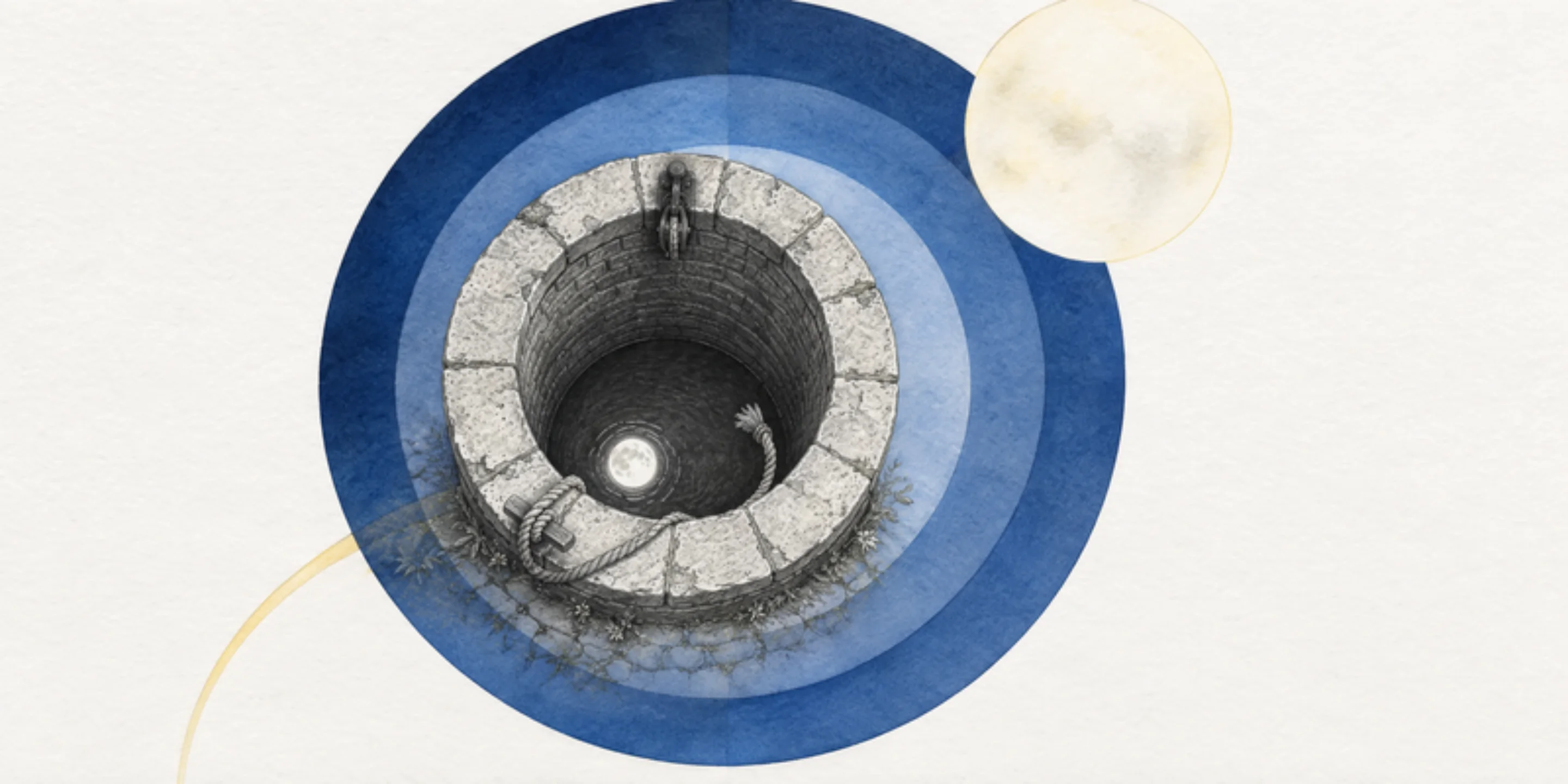
The moon in the well
went to the well for water and saw the moon in it. "The moon has fallen into the well. I must get it out." He went home for a rope and a hook, came back, and threw the hook in; it caught on a stone. He pulled once, pulled twice, and at the second pull the rope broke and he fell on his back. Looking up at the sky he saw the moon. "Thank God," he said. "I have been through a lot, but the moon is back in its place."
Note //
The reflection taken for the thing, and the thing found by falling over: the Sufi reading is the whole path in one tumble. The site's position 2 exactly, the moon in the well real as reflection and never on its own, and position 7, that what is found was never lost.
Madness or wisdom
, now with God, was master of all learning and skilled in every art. If people say, "We hoped to be taught by his sayings and have read nothing but the ravings of a madman," and ask for some other book of his, we must tell them that he said nothing beyond what is written here. Some say that while he seemed to talk madness he was in truth inspired, and that it was not madness he spoke but wisdom. The mercy of God be upon him, mercy without end.
Note //
The Turkish compiler's own closing note, kept as the last tale because it says what the tradition thinks it has been doing. The site leaves the question where he leaves it.
The renderings on this page are shared under CC BY-NC 4.0, in the words of Pranav Ashar.