Kabir: twenty songs
In the words of Pranav Ashar
How we renderThe heart of the Kabir: twenty songs
In brief
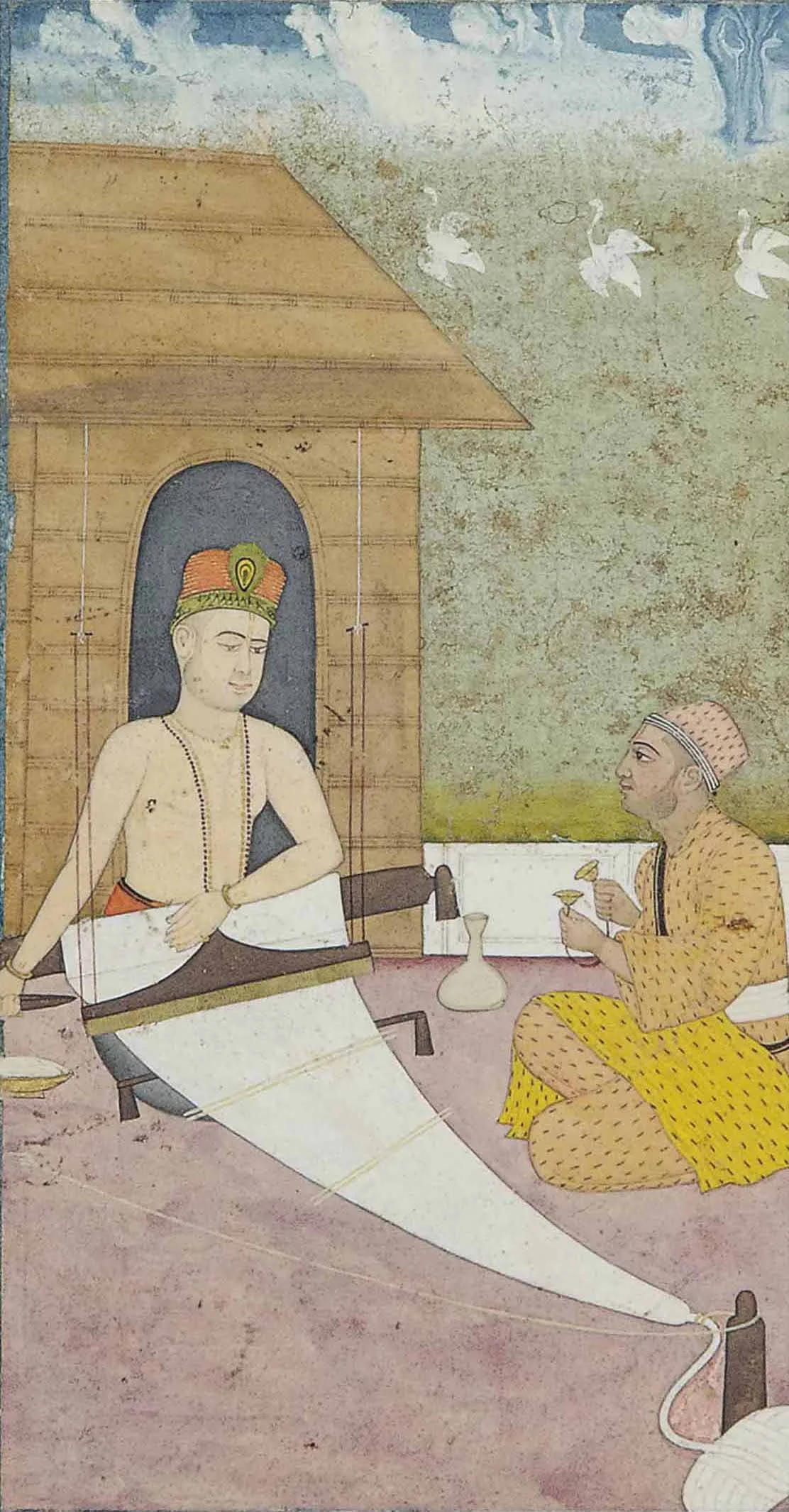
Kabir, the weaver-poet of Benares (fifteenth century), sang in Hindi for people who could not read, and his songs are still sung. He belonged to no school: raised in a Muslim family, taught, it is said, by the Vaishnava Ramananda, he refused temple and mosque alike and spoke of the Lord as the breath inside every breath. In 1915 Rabindranath Tagore turned a hundred of these songs into English from Kshitimohan Sen's collection. Twenty are given here in plain words, in Kabir's own sense first, with Tagore's version beside each.
Where do you look for me?
मोको कहाँ ढूँढ़ो बंदे
mo ko kahān dhūnro vande
Where do you look for me, ? Look, I am beside you. Not in the temple, not in the mosque, not in the Kaaba, not on Kailash; not in rites and ceremonies, not in yoga, not in giving things up. If you look for me in earnest you will see me at once; you will meet me in a moment. Kabir says: listen, sadhu, the Lord is the breath inside every breath.
Note //
The best known of Kabir's songs: the Lord speaks in the first person, and the places where people look for him are named only to be set aside. 'The breath inside every breath' is the whole poem, nearer than anywhere you could go. The site reads this 'me' as awareness, what you are, which is why there is nowhere to go.
How is appearance given up?
अवधू माया तजी न जाय
avadhū, māyā tajī na jāi
Tell me, brother, how is given up? I gave up tying ribbons; I still tied my cloth. I gave up tying the cloth; I still wrapped my body in it. I let go of wanting; anger was still there. I let go of anger; greed stayed with me. Greed went; pride and self-regard stayed. The mind let go and threw off, and still it clung to the letter. Kabir says: listen, dear sadhu, the true way is hard to find.
Note //
Maya is 'appearance', the site's word, where Tagore keeps the Sanskrit. The song is a comedy of renunciation: each layer thrown off leaves the next, down to clinging to scripture. In the site's reading what is to be let go is not any of these but the I-claim that holds them, which is why the way is hard to find: it is not one more thing to give up.
Inside this clay pot
इस घट अंतर बाग बगीचे
is ghat antar bāg bagīce
Inside this clay pot are gardens and groves, and inside it the maker; inside this pot the seven seas and the countless stars. The touchstone and the jewel-tester are inside; inside this pot the unstruck sound rings, and the spring wells up. Kabir says: listen, friend, my beloved Lord is inside.
Note //
Ghat, the clay pot, is Kabir's word for the body. The unstruck sound (anahad) is the sound no striking makes, heard inwardly in the yoga Kabir knew. The site reads the list as saying that the body does not contain awareness; the body, seas and stars appear in it.
The river and its waves
दरिया की लहर दरियाव है जी
dariyā kī lahar dariyāo hai jī
The river and its waves are one surf: where is the difference between river and wave? The wave rises, and it is water; it falls, and it is the same water again. Tell me, sir, where is the dividing line? Because it has been called a wave, is it no longer to be counted as water? In the highest whole the worlds are told like beads; look at that rosary with the eyes of knowing.
Note //
The wave and the water is the same figure as the site's pot and clay: the wave is real as a wave and never apart from the water. 'The highest whole' renders Tagore's 'Supreme Brahma'.
The swing
जहँ चेत अचेत खंभ दोऊ
jānh cet acet khambh dōū
Between the two posts, aware and unaware, the mind has hung a swing. On it hang all beings and all worlds, and the swing never stops swaying. Millions of beings are on it; the sun and the moon on their rounds are on it; millions of ages pass, and the swing goes on. Everything swings: sky and earth, air and water, and the Lord himself, taking form. Seeing this made Kabir a servant.
Note //
'Aware and unaware' render Tagore's 'conscious and unconscious' (chet, achet). The site's position that the cycle of appearing and dissolving is beginningless and goes on is this swing; even the Lord in form is on it. The one who sees it is not.
Lamps in every house
घर घर दीपक बरै
ghar ghar dīpak varai
Lamps burn in every house, blind one, and you cannot see them. One day your eyes will open all at once, and you will see, and the chains of death will fall from you. There is nothing to say and nothing to hear; there is nothing to do. It is the one who is who will never die again. Because he lives alone, the yogi says his home is far away. Your Lord is near, and you climb a palm tree to look for him. The brahmin priest goes from house to house, initiating; the spring of life is right beside you, and you have set up a stone to worship. Kabir says: I could never tell how sweet my Lord is. Yoga and telling beads, virtue and vice: these are nothing to him.
Note //
'Dead while living' (jivat mritak) is Kabir's name for the free while living: dead to the I-claim and alive to everything else.
My Lord hides himself
हरि ने अपना आप छिपाया
Hari ne apnā āp chipāyā
My Lord hides himself, and my Lord wonderfully shows himself; my Lord has hedged me in with hardness, and my Lord has thrown down what hedged me. My Lord brings me words of sorrow and words of joy, and he himself heals their quarrel. I will offer my body and mind to my Lord; I will give up my life, but I can never forget my Lord.
Note //
Covering and uncovering are both the Lord's. The site's words are the covering (avarana) and its removal; neither is done by the person.
The guru bows to the disciple
निर्गुन आगे सर्गुन नाचै
nirgun āge sargun nācai
Before the one without qualities the one with qualities dances. 'You and I are one', this trumpet proclaims. The guru comes and bows before the disciple: this is the greatest of wonders.
Note //
Nirguna and saguna, without qualities and with them, are the whole and the Lord in form; the Lord in form dances before the formless. The guru bowing to the disciple is Kabir's picture of where the teaching ends: there was never a lower one.
What need of words?
मन मस्त हुआ तब क्यों बोले
man mast huā tab kyon bole
When love has made the heart drunk, what need is there of words? I have wrapped the diamond in my cloak; why keep opening it? When the load was light, the pan of the scale went up; now it is full, where is the need to weigh? The swan has flown to the lake beyond the mountains; why go looking for pools and ditches? Your Lord lives inside you; why do your outward eyes need opening? Kabir says: listen, brother, my Lord, who takes my eyes, has joined himself to me.
The lock of mistaking
भ्रम के ताला लगा महल ये
bhram ke tālā lagā mahal ye
The lock of mistaking shuts the gate; open it with the key of love. Opening the door like that, you wake the Beloved. Kabir says: brother, do not pass by luck like this.
Note //
'Mistaking' renders bhram, the site's word for adhyasa, the rope taken for a snake. Kabir's key is love, not analysis; in the site's reading the two meet, since what love does is stop treating the Beloved as elsewhere.
This body is his lute
साधो यह तन ठाठ तँबूरे का
sādho, yah tan thāth tanvure kā
Friend, this body is his lute. He tightens its strings and draws from it the music of the whole. If the strings snap and the pegs slacken, this instrument of dust goes back to dust. Kabir says: no one but the whole can draw its music out.
The easy absorption
संतो सहज समाधि भली
santo sahaj samādh bhalī
Sadhus, is best. Since the day I met my Lord the play of our love has had no end. I do not shut my eyes, I do not stop my ears, I do not wear down my body; I look with open eyes and smile, and see his beauty everywhere. I say his name, and whatever I see reminds me of him; whatever I do becomes his worship. Rising and setting are one to me; every contradiction is settled. Wherever I go, I move around him; all I achieve is his service; when I lie down, I lie at his feet. He is the only one I adore; I have no other. My tongue has left off unclean words; it sings his praise day and night. Whether I rise or sit, I can never forget him, for the rhythm of his music beats in my ears. Kabir says: my heart is frenzied, and I tell openly what is hidden. I am sunk in the one great beyond all pleasure and pain.
Note //
Sahaj samadhi, the easy or natural absorption, is Kabir's name for what the site calls free while living: eyes open, the same life, nothing mortified. 'Fullness' is the site's word for ananda, where Tagore has 'bliss'.
Nothing but water
तीरथ में तो सब पानी है
tīrath men to sab pānī hai
At the bathing places there is nothing but water; I know they are useless, for I have bathed in them. The images are all lifeless; they cannot speak; I know, for I have cried out to them. The Purana and the Koran are only words; I lifted the curtain, and I have seen. Kabir speaks what he has found out, and he knows well that all else is untrue.
The fish in the water is thirsty
पानी बिच मीन पियासी
pānī vic mīn piyāsī
I laugh when I hear that the fish in the water is thirsty. You do not see that what is real is in your own house, and you wander from forest to forest, restless. Here is the truth: go where you will, to Benares or to Mathura; if you do not find your Self, the world is not real to you.
Note //
Tagore's 'soul' is 'your Self' here. The fish in the water is Kabir's picture of looking for awareness while being it.
The tree without roots
तरवर एक मूल बिन ठाढ़ा
tarvar ek mūl vin thādā
There is a strange tree that stands without roots and bears fruit without blossoming; it has no branches and no leaves; it is lotus all over. Two birds sing there: one is the guru, the other the disciple. The disciple picks the many fruits of life and tastes them, and the guru watches him in joy. What Kabir says is hard to understand: the bird is beyond seeking, yet plain to see. The formless is in the midst of all forms; I sing the praise of forms.
Note //
The two birds on one tree are from the Mundaka Upanishad: one eats the fruit, the other looks on. Kabir ends where the site also stands: the formless is not elsewhere than the forms, and the forms are sung, not denied.
What you see is not
जो दीसै सो तो है नाहीं
jo dīsai, so to hai nāhīn
What you see is not; and for what is, you have no words. Unless you see, you do not believe; what is told you, you cannot take in. The discerning know it by the word; the ignorant stand and gape. Some contemplate the formless, others meditate on form, but the wise know the whole is beyond both. That beauty of his is not seen by the eye; that metre of his is not heard by the ear. Kabir says: whoever has found both love and letting go never goes down to death.
Note //
'The word' (shabda) is the teaching heard and taken in; the site's hearing, reflecting, abiding begins there.
Empty the cup
पीले प्याला हो मतवाला
pīle pyālā ho matwālā
Empty the cup! Be drunk! Drink the nectar of his name. Kabir says: listen, dear sadhu, from the sole of the foot to the crown of the head this mind is full of poison.
If the Lord lives in the mosque
जो खुदाय मसजिद बसतु है
jo khodāy masjid vastu hai
If the Lord lives in the mosque, then whose is the rest of the world? If Ram is in the image you find on pilgrimage, then who knows what happens outside it? Hari is in the east, Allah in the west; look inside your heart, and there you find both Karim and Ram. All the men and women of the world are his living forms. Kabir is the child of Allah and of Ram: he is my guru, he is my pir.
Note //
Khuda, Allah, Karim, Hari, Ram: Kabir, raised in a Muslim weaver's family in Benares, uses the names from both sides and refuses the dispute. A pir is a Sufi master.
Neither pious nor ungodly
ना मैं धर्मी नहीं अधर्मी
nā main dharmī nahīn adharmī
I am not pious and not ungodly; I live neither by the law nor by the senses. I am not a speaker and not a hearer; not a servant and not a master; not bound and not free. I am not detached and not attached. I am far from no one; I am near to no one. I will go neither to hell nor to heaven. I do all my work, and I am apart from all my work. Few understand what I mean; the one who does sits unmoved. Kabir seeks neither to build up nor to pull down.
Note //
The nearest of these songs to the 'not this, not this' of the Avadhuta Gita: every pair is refused, bound and free included, and the last line refuses even building up and pulling down. The site reads 'I do all my work, and I am apart from all my work' as its own daily line: attention to the task; awareness is what I am and goes nowhere.
The Lord is in me, the Lord is in you
साहब हम में साहब तुम में
sāhab ham men sāhab tum men
The Lord is in me, the Lord is in you, as life is in every seed. Servant, put false pride away, and look for him inside you. A million suns blaze with light; the blue sea spreads in the sky; the fever of life is stilled and every stain is washed away when I sit in the middle of that world. Listen to the unstruck bells and drums! Take your delight in love! Rain pours down without water, and the rivers are streams of light. One love fills the whole world; few are those who know it fully. They are blind who hope to see it by the light of reason, the reason that is the cause of separation; the house of reason is very far away. How lucky Kabir is, that in this great joy he sings inside his own pot. It is the music of the meeting of self with self; it is the music of the forgetting of sorrows; it is the music that goes beyond all coming in and all going out.
Note //
'His own pot' is the body again (ghat), Tagore's 'vessel'; 'self with self' renders Tagore's 'soul with soul'.
Touch an underlined word to see the Hindi behind it. The lighter lines are how the tradition read the verse; the rest is the verse.
The renderings on this page are shared under CC BY-NC 4.0, in the words of Pranav Ashar.