Ludwig Wittgenstein
26 April 1889 to 29 April 1951 · Born in Vienna; Cambridge; died in Cambridge
Life
Ludwig Wittgenstein was born into one of the richest families in Vienna. He studied engineering in Manchester, then logic with Bertrand Russell at Cambridge. He wrote the Tractatus Logico-Philosophicus while serving in the Austrian army in the First World War; it was published in 1921 and in English in 1922. Believing he had solved philosophy, he gave away his fortune and became a village schoolteacher. He returned to Cambridge in 1929. He rethought everything, and taught there until 1947. His later work appeared after his death in 1951 as Philosophical Investigations (1953).
What they saw
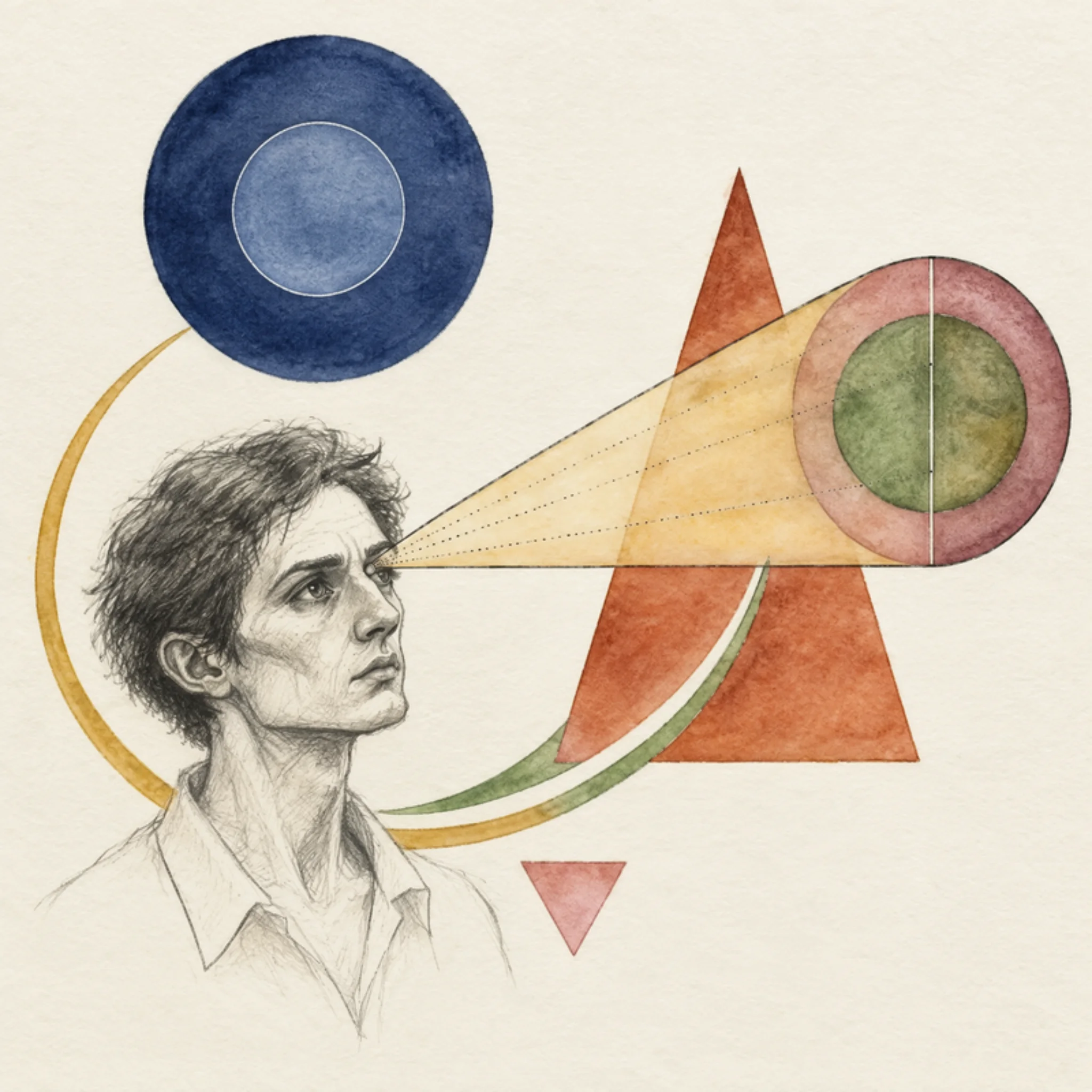
The Tractatus asks what language can say. It can picture facts. It cannot picture itself, or the one who uses it. The subject, Wittgenstein writes, does not belong to the world; it is a limit of the world, as the eye is not part of what it sees.
The things that matter most, ethics, the meaning of life, the mystical, cannot be said. They show themselves. That the world is, not how it is, he calls the mystical.
His later work turned to ordinary language and dropped much of this. But the early remark about the eye is one of the clearest statements in Western philosophy of the witness: never in the field, always what the field is for.
In their words
“The subject does not belong to the world but it is a limit of the world.”
Ludwig Wittgenstein, Tractatus Logico-Philosophicus 5.632, tr. C. K. Ogden (1922)
Where this path meets the others
Wittgenstein's subject at the limit of the world is the witness. His silence meets not this, not this. See The witness and Harding and the witness.
You do not see the eye.
Works
- Tractatus Logico-Philosophicus1921 (German); 1922 (English)
- Philosophical Investigations1953
Further reading
- Wittgenstein, Tractatus Logico-Philosophicus, tr. C. K. Ogden (1922)
- Ray Monk, Ludwig Wittgenstein: The Duty of Genius (1990; in copyright)
Next on your path
Sources
- Tractatus 5.632 and 7, tr. C. K. Ogden (London, 1922); public domain in the United States; check status elsewhere.
- Monk (1990), for the life, paraphrased.
- The eye and the field of sight: Tractatus 5.633, paraphrased.