Vasubandhu
4th to 5th century CE (dates debated) · Born at Purushapura (Peshawar), Gandhara; taught in Kashmir and Ayodhya
Life
Vasubandhu was born at Purushapura in Gandhara. He first wrote the Abhidharmakosha, a great summary of early Buddhist analysis, from the Sarvastivada and Sautrantika schools. By tradition his half-brother Asanga then won him over to the Yogacara school, and he wrote its key short texts, the Twenty Verses and the Thirty Verses. His dates are debated; most scholars place him in the 4th or 5th century.
What they saw
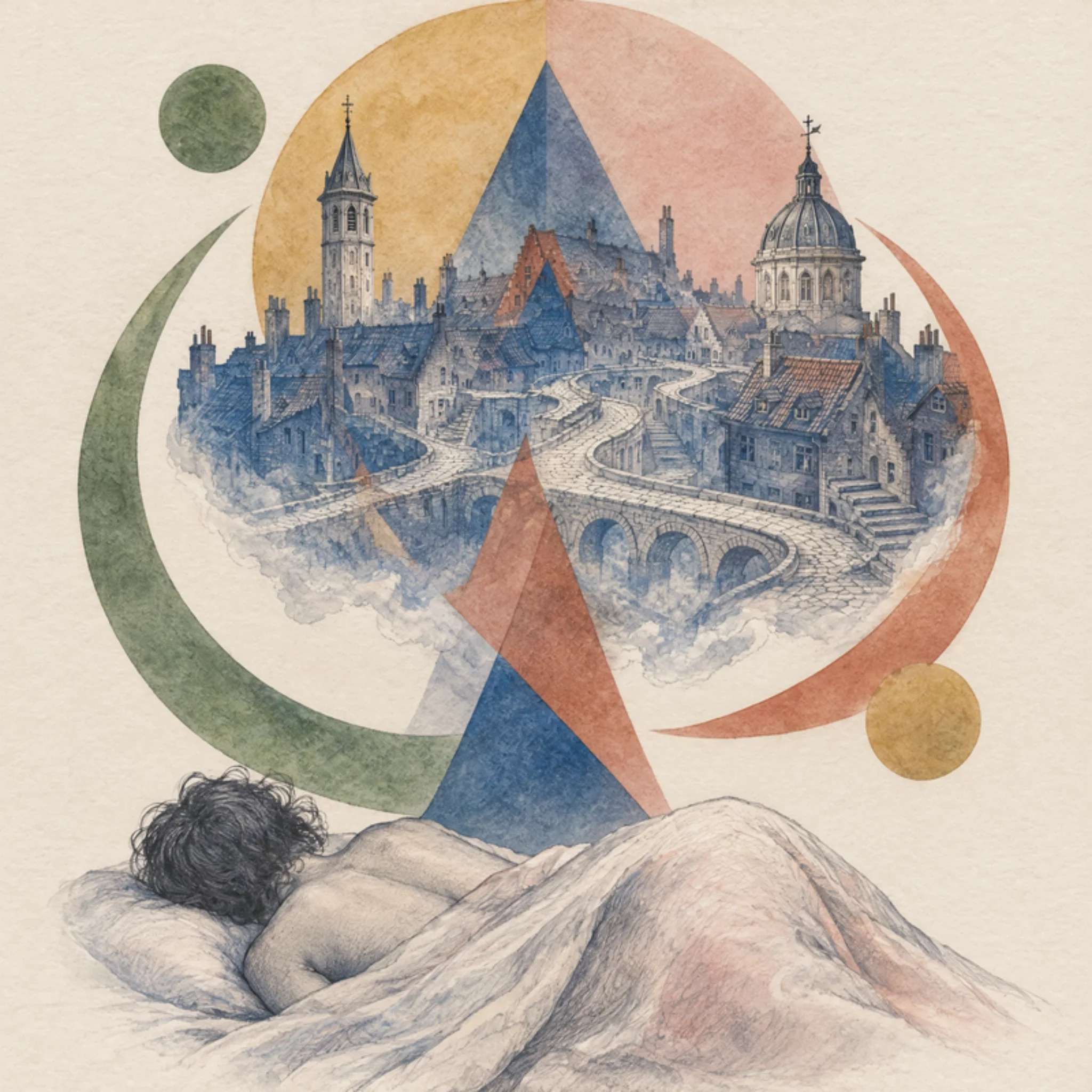
Yogacara is often called the school of mind-only. Vasubandhu argues that what we take as outer objects are appearances in experience. The dream shows how: a dream city works, has rules and can be shared in a sense, yet there is no outer city. Waking life, he argues, is like that.
He does not end with a mind that owns these appearances. When the split between a knower and a known is seen through, what remains is called suchness, beyond the subject and object split.
Advaita argued with Yogacara for centuries. Shankara rejected its denial of outer things, holding that the world is actually met. Yet both arrive near the same place: experience without a second, the line between knower and known not final.
In their words
In paraphrase: all this is only appearing-in-awareness, like a man with eye disease who sees hairs and moons that are not there.
After Vasubandhu, Vimshatika (Twenty Verses), verse 1; paraphrase, not a quotation.
Where this path meets the others
Vasubandhu's dream argument stands near Gaudapada, who used the same image, and against Shankara, who drew a line between dream and waking. See Nagarjuna and Gaudapada and Appearance.
The dream city had streets.
Works
- Abhidharmakosha4th to 5th century CE
- Vimshatika (Twenty Verses)4th to 5th century CE
- Trimshika (Thirty Verses)4th to 5th century CE
Further reading
- Vasubandhu, Twenty Verses and Thirty Verses, tr. in Stefan Anacker, Seven Works of Vasubandhu (1984; in copyright)
Next on your path
Sources
- Anacker, Seven Works of Vasubandhu (1984), for the works and dates, paraphrased.
- Shankara's criticism of Yogacara: Brahma Sutra Bhashya 2.2.28 to 32, tr. Thibaut (SBE 34, 1890).